The first thing Greg did after ending the call was stare at my hands. He seemed unable to decide whether to approach me or retreat. Around us, the family portrait had stalled completely. The photographer lowered his camera, Lauren stepped down from the staircase, and my mother remained beside the hall table with the sweater draped over one arm. I asked Greg whom he had called. Instead of answering, he wanted to know whether I remembered a particular stretch of terrain in Afghanistan, a damaged vehicle, and an officer with an injured shoulder. The details were too specific to dismiss. I felt the old memory rising before I could stop it: the gray dust, the ruined transport, the weight of a wounded man being moved inch by inch toward safety. Greg noticed the change in my expression. He whispered that he thought he had been there.
For a few seconds, I couldn't reconcile the man in front of me with the young officer I remembered. Greg was always immaculate, even when he arrived at family meals after a long day. His posture was easy, his manner considerate, and he rarely spoke about the parts of his career that happened overseas. The officer in Afghanistan had been covered with dirt and someone else's blood. His shoulder hung at an unnatural angle, yet he kept trying to shoulder more weight. I had been too concerned with moving the group to retain much about his face. Now, standing in the bright Williamsburg foyer, I noticed a faint stiffness when Greg turned his left arm. I had seen it before without thinking about it. Suddenly, it belonged to an entirely different history.
I asked whether he had been twenty-six during that deployment. He nodded. I asked whether one of the injured men had been carried on a stretcher improvised under difficult conditions. His mouth opened slightly. Lauren looked between us, no longer smiling. Greg said they had been stranded longer than anyone expected. Their communications had failed intermittently, and the man with the worst injuries was becoming dangerously weak. He remembered hearing someone approaching through the dust, then seeing a figure kneel and begin assessing the safest way out. The rescuer had spoken with the calm authority of someone who knew there was no room for panic. Greg stopped, swallowed, and admitted that for years he had thought the voice belonged to a man. I understood the mistake. Through protective equipment, exhaustion, and fear, many details become uncertain.
That memory had begun for me with a routine assessment that turned urgent in a matter of minutes. Our team was supporting an operation in a remote district where previous incidents had made nearly every approach suspect. The ground was uneven, with narrow passageways and abandoned materials that prevented easy movement. When the call came, the information was incomplete. Four personnel were stranded beyond an area believed to contain explosive hazards. One was badly wounded. A damaged vehicle blocked a route considered less dangerous, and there was little confidence that the remaining approaches were clear. I remembered studying the available information and recognizing how much we did not know. We had procedures and equipment, but neither could turn uncertain ground into certainty.
I was afraid. That remains one of the details I have never felt ashamed to admit. Fear sharpened my attention as long as I kept it from dictating my movements. I remember the sensation of dry earth shifting beneath my knees as my teammate and I began our approach. Every deliberate movement required patience. The stranded men were close enough that I could occasionally distinguish their voices, but distance meant little when the terrain itself could not be trusted. I thought about the injured man's condition, the time we had already lost, and the possibility of making everything worse by moving too quickly. The knowledge that people were waiting for us did not erase the danger. It made care more important.
When we reached them, the oldest of the four tried to give me a hurried account of what had happened. I interrupted long enough to make sure he understood that speed would not help us if it led to a mistake. One man was pale and unresponsive for several frightening moments. Another had trouble putting weight on one leg. The young officer with the shoulder injury kept reaching toward the stretcher, determined to be useful. I remember looking directly at him and telling him I needed obedience more than enthusiasm. He gave a short, exhausted laugh, then nodded. There was no time to discuss rank or embarrassment. I explained the movement plan, confirmed that the men understood their positions, and began the difficult process of taking them back.
What I remember most clearly is how ordinary the sounds became. Breathing. Fabric scraping against equipment. A boot brushing loose grit. The injured officer's attempts to suppress a groan. We moved deliberately, pausing whenever someone needed to adjust their grip or regain balance. At one point, the young officer looked toward a section of ground he believed might offer an easier route. I caught the movement and stopped him. He looked embarrassed, then frightened. I told him to keep his eyes on me. The instruction that followed was practical, not dramatic: he needed to place each foot exactly where mine had been. He repeated my surname once, as though fastening it in his memory. Then he followed.
It took one hour and forty minutes to get everyone through. I know the time because it appeared in the operational record, though during the rescue I experienced it as a series of small decisions without any clear sense of passing minutes. When we finally reached safer ground, the medical personnel moved quickly. The wounded men were transferred, equipment was collected, and the operation continued. Someone pressed a bottle of water into my hand. I remember unscrewing the cap and discovering that my fingers were trembling too badly to drink without spilling. My teammate sat nearby, staring silently at his boots. Neither of us celebrated. The relief was too large and too private for noise.
By the following morning, the men we had rescued were gone. Medical evacuation had taken priority, as it should have. I completed the required reports and answered questions about conditions on the route. Several descriptions were deliberately limited because parts of the operation were restricted. Names, units, and responsibilities became scattered across different administrative channels. I received no invitation to meet the survivors, and I didn't seek one. In my line of work, you learned to accept that gratitude often arrived indirectly, if it arrived at all. What mattered was that four people had survived and that the others on our team had returned safely. Later, after a different assignment, I found myself occasionally wondering whether the young officer's shoulder had healed. That was the extent of our connection.
Greg was still watching me when I came back to the present. His expression contained the stunned recognition of someone discovering that a familiar person had occupied an important place in his life long before they met socially. He asked whether I remembered him repeatedly trying to lift the injured man. I said yes. He laughed without amusement and rubbed his left shoulder. Apparently, his doctors had not been pleased with his behavior either. Then he repeated the instruction I had given him about following my footprints. Hearing the familiar words in his voice made the room feel strangely narrow. I could almost smell the dust again. I knew then that he was the officer from the field. There was no reasonable alternative.
Lauren took the last few steps down to us. She asked Greg why he looked as if he might faint. He turned toward her, opened his mouth, and then seemed unable to arrange his thoughts. Finally, he said that the person who had guided him out of Afghanistan was standing in front of them. Lauren looked at me. She knew I had served overseas, but I had never told her the details of that rescue. She had spent years hearing her husband speak with reverence about an unidentified specialist. I saw her trying to fit the two histories together, and then her eyes filled. She reached for Greg's hand, but he was already moving toward me.
He stopped an arm's length away. I could see that he wanted to embrace me, but he also understood that the memory was not simple. I had been responsible for men in danger; he had been one of them. Neither experience had vanished because we now shared family dinners. He thanked me quietly. I told him that his own efforts had helped save the wounded man. He shook his head. “I remember what I was like that day,” he said. “You don't have to improve the story for me.” I was surprised by how much that remark affected me. People sometimes imagine rescue work as a sequence of noble gestures. The reality is that frightened, injured people do imperfect things, and the job is to get everyone home anyway.
My mother interrupted before either of us could speak again. She asked whether the reunion could take place after the photographs. Eighteen relatives were waiting, she pointed out, and the photographer had another appointment later that afternoon. Her tone suggested that Greg and I were discussing an unfortunate scheduling problem rather than an event that had changed both our lives. Greg turned toward her slowly. I had never seen him look genuinely angry in her presence. He said the photographs could wait. She glanced at his uniform trousers and pressed her lips together. I recognized the expression. She was preparing to explain that emotional displays were best handled privately.
Instead of arguing, Greg went to the door. He said he needed to retrieve something and would return shortly. Lauren asked where he was going. He told her he had his dress uniform nearby and wanted to change. My mother seemed relieved, assuming he was finally cooperating with her expectations. I wasn't sure what he intended. A family photographer rarely required military dress, and Greg had arrived wearing clothes that matched everyone else's. Yet the precision of his movements told me he had made a decision. He walked outside before Margaret could issue another instruction.
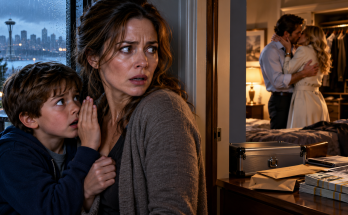
While he was gone, I stood beside the hall table with the unwanted sweater. My mother spoke to Aunt Phyllis in a low voice about how difficult it was to coordinate people who worked irregular hours. I heard my own career reduced to another inconvenience. Russ descended from the landing and approached me cautiously. He looked at my name tape, then at my face. “Are you all right?” he asked. I almost answered automatically. Instead, I said I wasn't sure. He seemed to understand. His gaze wandered toward the open doorway through which Greg had disappeared. There was a strained quality to his expression that I couldn't explain. I assumed he was worried about the family argument. Only much later would I reconsider how he had behaved during those minutes.
The photographer, a patient man who had been hired for several previous gatherings, asked whether he should adjust the lighting while we waited. I appreciated the ordinary question. It gave everyone something harmless to do. Lauren took my hand and led me toward the staircase. She asked why I had never told her about the rescue. I explained that it hadn't seemed like a story requiring an audience. People had been in danger. We had done the work. They had lived. I didn't know how to make it more dramatic than that. She squeezed my hand and said her husband had spoken about the unknown rescuer for years. He had even wondered whether he might recognize the person from the voice alone. I told her that memory could be unreliable. She looked at me seriously and said some memories never left people.
When Greg returned, he wore his Navy dress blues. He had taken time to arrange everything correctly, though his expression remained unsettled. He walked across the foyer and stopped beside me, facing the photographer. His uniform contrasted sharply with the carefully coordinated clothing on the staircase. My mother drew in a sharp breath. She asked whether he intended to ruin the color scheme as well. Greg looked at her and replied that he wanted the photograph to show him standing beside the officer who had saved his life. His voice was respectful, but it left no room for negotiation. Margaret stared at him. For once, she couldn't find an answer quickly enough to control the situation.
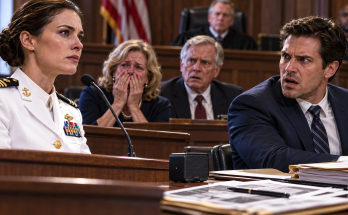
Aunt Phyllis asked whether I really held the rank Greg had mentioned. I explained that I was a lieutenant commander. Uncle Walt adjusted his glasses and studied the insignia on my uniform, visibly embarrassed that he had never understood what I did. Lauren stood beside her husband, crying quietly. My mother looked from one face to another, then down at the sweater still resting on the table. Without another word, she carried it toward the closet. I thought she might return with a different arrangement or another argument. Instead, she went upstairs and closed her bedroom door. The sound echoed through the foyer.
Greg remained beside me. He spoke to the photographer about moving the lights slightly so both uniforms would be visible. Lauren joined us, placing a hand against her husband's back. I was still trying to absorb everything when Russ stepped down from the landing. He moved to my other side without asking permission. His dark green tie was the one I had given him for Father's Day several years earlier. He adjusted it nervously, then stood upright. The photographer arranged the others around us. Aunt Phyllis complained about the height difference between two cousins. A child began whining. Someone knocked a decorative cushion onto the floor. Ordinary family disorder returned, and I found myself grateful for it.
The photographer took eight pictures. In some, Greg looked solemn. In others, Lauren was visibly struggling to keep her composure. I don't remember smiling. I was thinking about the young officer in Afghanistan and the man who now called me his sister-in-law. Somewhere between those two identities lay fifteen years of birthdays, marriages, difficult assignments, and countless evenings neither of us had known we owed partly to that rescue. The realization made me uncomfortable because I did not know what it demanded of me. Greg seemed to sense this. When the photographer lowered his camera, he said nothing about medals or recognition. He simply rested a hand briefly on my shoulder.
After the portraits, I asked why he had called someone immediately upon recognizing my name. Greg led me toward a quieter corner near the front windows. He explained that his father had spent years trying to identify the person who brought him back from Afghanistan. Captain Daniel Sandival, now retired, had once held senior positions in the Navy and knew how to pursue information through appropriate channels. Greg had told him everything he remembered. The problem was that the surviving records identified the rescuer incorrectly. Some descriptions suggested a male specialist, while others provided only the surname Voss. They had followed several leads that ended nowhere. Over time, the search had become almost a private obligation between father and son.
I asked why a retired captain would continue investigating an operation after so many years. Greg glanced toward Lauren, who was speaking with relatives near the staircase. “Because he remembers what my daughter looked like when I came home,” he answered. His voice tightened. She had been an infant in 2011, too young to understand why her father had disappeared or why her mother cried whenever the telephone rang. Daniel Sandival had watched his son's family endure weeks of uncertainty. When Greg returned, injured but alive, his father made a private promise to find the person responsible. The search was not about securing an award or correcting someone's reputation in the abstract. It was about gratitude that had remained unfinished.
Greg said he had just called Daniel, who lived within driving distance. His father wanted to meet me as soon as possible. I felt immediately uneasy. Meeting a retired Navy captain because of an event I considered part of my duty seemed unnecessarily formal. I told Greg there was no obligation to arrange anything that day. He responded that his father was already on the road. I looked toward the staircase, where my mother's carefully planned gathering was dissolving into smaller conversations. She would be furious when she discovered another unexpected guest was coming. Greg appeared to understand the problem, but he didn't apologize. He said his father would not forgive him for allowing this opportunity to pass.
We moved into the sitting room while the photographer began packing his equipment. Russ appeared at the doorway and asked whether Greg's father was coming. Greg said yes. For a moment, my stepfather's face changed. He looked genuinely alarmed, though he recovered almost immediately. He asked which Sandival we meant, and Greg repeated the captain's name. Russ nodded too quickly. I watched him walk away with an expression I had never seen on him before. He had always been uneasy when conversations turned toward my biological father. Now he seemed afraid of a man I hadn't met. The connection puzzled me, but before I could ask, Lauren called us back to help gather the younger children.
My mother remained upstairs. I considered going to her room, then decided against it. I had spent years trying to smooth over disagreements by apologizing for the parts of my life that embarrassed her. I would not apologize for wearing the uniform I had earned or for being recognized by someone whose life had crossed mine in a war zone. I felt guilty about that decision, which irritated me almost as much as her behavior. There was no reason a grown woman should have to choose between family peace and the truth of her own accomplishments. Yet old habits rarely disappear simply because we understand them.
Fifty minutes after Greg's telephone call, a silver pickup turned into the driveway. Through the window, I watched an older man climb out. He had short white hair, broad shoulders, and the economical movements of someone accustomed to carrying himself with purpose. Greg went outside to greet him. They spoke briefly beside the vehicle. The older man placed a hand on his son's shoulder, then looked toward the house. I saw something pass between them that made Greg lower his eyes. Whatever Daniel Sandival had carried for fifteen years, he appeared to be bringing more than gratitude to our doorstep.
When the front door opened, the captain stepped into the foyer and asked for Lieutenant Commander Claire Voss. I introduced myself. He studied me with an intensity that was almost painful, then reached inside his jacket. He produced a small white card sealed in worn plastic. Across it, in black marker, was my surname. VOSS. He told me he had written it down after his son's evacuation because it was the only reliable identifying detail Greg could remember. I accepted the card carefully. The plastic was cracked along one edge, as though it had spent years being carried in a pocket. Then the captain withdrew a sealed envelope and said the official history of the rescue was not merely incomplete. Someone had interfered with it deliberately.