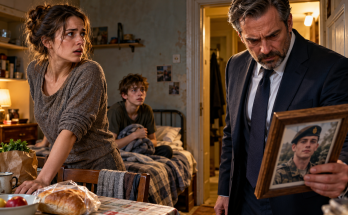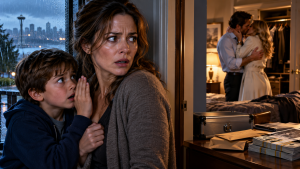
The morning my nine-year-old son begged me not to leave for Chicago, I thought he was afraid of spending three nights without his mother.
I had no idea he was trying to save my life.
And when he whispered that my husband was bringing another woman into our home and stealing money from my bedroom closet, I thought the worst thing I was about to discover was an affair.
I was wrong.
Because twenty-four hours later, I would hear my husband discussing how to make my death look like an accident.
I would discover that the man I’d loved for fifteen years had been hiding an identity I never knew existed.
And I would finally understand why my father had looked so terrified the last time I saw him alive.
But the most devastating truth of all was waiting inside a small metal case that had remained unopened for three years.
A case my father had given me shortly before his death.
A case my husband was suddenly desperate to find.
And a case that would reveal the terrifying secret behind our entire marriage.
Chapter One: The Warning
Monday morning began with the ordinary chaos of a family trying to get out the door.
It was 7:15 a.m. in Seattle, and rain tapped softly against the kitchen windows.
My suitcase stood near the front door, packed for a three-day business conference in Chicago.
I had an eight-thirty rideshare scheduled, a ten-forty flight, and a presentation that had taken me nearly six weeks to prepare.
My husband, Evan, was sitting at the kitchen island, drinking coffee and scrolling through his phone.
Our nine-year-old son, Noah, sat at the breakfast table, pushing scrambled eggs around his plate.
Everything looked normal.
Painfully normal.
“Don’t forget your charger,” Evan called without looking up.
“Already packed.”
“And the blue blazer?”
“Wearing it.”
He smiled.
“Then I guess you’ve got everything.”
I walked toward Noah to kiss the top of his head.
That’s when his fingers closed around my wrist.
“Mom?”
“What’s up, buddy?”
His eyes moved toward his father.
Then back to me.
“Can you come upstairs?”
Something about his expression made me hesitate.
Noah was usually cheerful in the mornings.
He complained about homework, broccoli, and the unfairness of bedtime, but he rarely looked genuinely frightened.
That morning, his face was pale.
“Sure, sweetheart.”
I followed him upstairs.
The moment we entered my bedroom, Noah closed the door.
Then he turned toward me.
“Mom, please don’t go.”
I crouched in front of him.
“Oh, honey.
I’ll only be gone three nights.
Remember?
We talked about this.”
He shook his head.
“No.
That’s not why.”
His lower lip trembled.
I felt the first flicker of unease.
“Then what’s wrong?”
He leaned closer, lowering his voice until I could barely hear him.
“Whenever you leave, Dad brings another woman here.
And they go into your closet and take your money.”
For a second, I thought I’d misunderstood.
“What?”
“The lady,” Noah whispered.
“She comes when you’re gone.
Dad tells me to stay in my room, but sometimes I hear them.”
I stared at him.
“Are you sure, sweetheart?”
He nodded quickly.
“One time I came downstairs for my charger.
Dad had your envelopes open.
He was putting money into his brown briefcase.”
“Did you see the woman?”
“Yes.”
“What did she look like?”
“She had long brown hair.
She wore a white coat.
She smelled like flowers.”
I could feel my heartbeat in my throat.
“And what did Daddy say?”
Noah looked down.
“He got mad.
He told me I wasn’t supposed to be downstairs.”
He paused.
Then he said something that made every protective instinct in my body flare.
“He said if I told you, you’d get divorced, and it would be my fault.”
I immediately pulled him into my arms.
“Noah, listen to me.”
He began crying against my shoulder.
“Whatever happens between your father and me is never your fault.
Do you understand?”
“But he said—”
“I know what he said.
And he was wrong.”
I held him until his breathing slowed.
Then I asked one more question.
“How long has this been happening?”
He wiped his cheeks.
“Since before Christmas.”
Christmas.
Almost ten months earlier.
I remembered several strange things from those months.
The missing cash.
The nights Evan had insisted I attend networking events while he stayed home.
The unfamiliar perfume on his shirt.
The way he’d suddenly become interested in the emergency savings I kept in our bedroom closet.
I’d noticed those things.
I’d simply found explanations that allowed me to keep trusting him.
My father, Thomas Bennett, had taught me to keep emergency cash at home.
“Never let one frozen bank account decide whether your family eats,” he’d say.
After his death three years earlier, I’d continued the habit.
We kept several cash envelopes in a locked drawer beneath my sweaters.
Over the previous six months, their contents had been shrinking.
Evan always had an explanation.
A contractor’s deposit.
An emergency plumbing repair.
A replacement appliance.
I had believed every word.
Now I wondered how much else I’d believed because I couldn’t bear the alternative.
“Stay here for a minute, buddy,” I told Noah.
He grabbed my hand again.
“Are you going to tell Dad?”
“Not yet.”
“Promise?”
I kissed his forehead.
“I promise I won’t put you in the middle of this.”
When I returned downstairs, Evan glanced up.
“Everything okay?”
His voice was warm.
His expression relaxed.
This was the man who made pancakes shaped like dinosaurs on Sunday mornings.
The man who had slept sitting upright beside Noah after his tonsil surgery.
The man who still reached across the center console to squeeze my knee during long drives.
If betrayal had a face, I never imagined it would look so much like love.
“He’s upset about the trip,” I said.
Evan chuckled.
“He’ll survive.”
I looked at him for one second longer than usual.
Then I smiled.
“Of course he will.”
I walked back upstairs, opened my closet, and unlocked the drawer.
Inside were six envelopes.
I counted the money.
Nearly twelve thousand dollars was missing.
My stomach dropped.
There was no longer room for denial.
I moved quickly.
I removed every genuine bill and replaced the contents with stage money left over from a school fundraiser Noah had participated in earlier that year.
I placed several real bills on top of each stack.
From a casual glance, the envelopes looked untouched.
Then I photographed everything.
The drawer.
The cash.
The lock.
Even the spare key tucked inside the small ceramic dish on my dresser.
I put the real money into a lockbox in my home office.
When I came downstairs, I made sure Evan could hear me.
“Oh, I almost forgot.
I was going to take some cash to Chicago, but I’ll just leave it in the closet.”
His head turned immediately.
A tiny movement.
Barely noticeable.
But I noticed.
“Probably smart,” he said.
He kissed my cheek.
“Safe flight, babe.”
And I kissed him back.
I still remember how much that cost me.
Chapter Two: The Woman in the Cream Coat
The rideshare arrived at 8:27.
Evan carried my suitcase outside.
I waved goodbye through the rear window.
He stood in the driveway until the car turned the corner.
Then I asked the driver to take me to a grocery store instead of the airport.
My older sister, Rachel, was waiting in her black SUV.
Rachel was forty-six, four years older than me, and had always been the person I called when life stopped making sense.
She’d helped raise me after our mother died.
She’d been my maid of honor.
She’d held my hand when Dad’s funeral director brought us his ashes.
And when I’d texted her that morning asking her to pick up Noah from school and keep him overnight, she’d agreed without asking questions.
But she hadn’t expected me to appear at her car carrying a suitcase.
“Claire?”
I climbed inside.
“Don’t ask me anything until we’re parked.”
Rachel studied my face.
Then she nodded and started the engine.
We stopped several blocks from my house, where the street curved behind a row of maple trees.
From there, we had a partial view of our driveway.
I explained everything.
Noah’s warning.
The missing cash.
The woman.
The envelopes.
By the time I finished, Rachel’s hands were clenched around the steering wheel.
“That son of a bitch.”
“Rachel—”
“No.
Don’t defend him.”
“I’m not.”
“Then why do you look like you’re about to apologize?”
I stared out the windshield.
“Because part of me still wants Noah to be wrong.”
Rachel’s anger softened.
“I know.”
We waited.
At 10:45, nothing had happened.
At eleven, I began wondering whether we were making a terrible mistake.
Then, at exactly 11:23, a white Lexus turned onto our street.
A woman stepped out.
She was around thirty-five, elegant, with glossy brown hair and a cream-colored coat.
She carried a designer handbag and walked toward my front door.
Before she reached the steps, Evan came outside.
He smiled.
He took her by the waist.
And he kissed her.
Not the way someone kisses a colleague.
Not the way someone greets an old friend.
He kissed her like a man welcoming his lover into a house that belonged to them both.
I felt physically sick.
Rachel reached across the console.
“Claire…”
I couldn’t speak.
I opened the security-camera app on my phone.
We’d installed the cameras after a string of neighborhood break-ins.
Evan knew about them, of course.
But the upstairs camera had been repositioned several weeks earlier after Noah complained that the hallway was too dark at night.
Apparently, Evan hadn’t noticed that its new angle showed the entrance to our bedroom.
I turned up the volume.
The woman followed Evan upstairs.
“Are you absolutely sure she’s gone?” she asked.
Evan laughed.
“Claire won’t be back until Thursday.”
“Good.”
The woman lowered her voice.
“Then today we get what Carter needs.”
Rachel frowned.
“Who’s Carter?”
“I don’t know.”
We watched them enter the bedroom.
Evan went directly to my closet.
He opened the drawer and removed the envelopes.
The woman leaned closer.
“How much?”
“Enough to cover the initial payment.”
She looked unimpressed.
“The cash is useful, Evan.
But Carter doesn’t care about a few thousand dollars.”
Evan stiffened.
“I know what he wants.”
“Then find it.”
He began pulling sweaters from the shelves.
The woman opened my jewelry box.
She lifted the velvet lining.
Then she removed something small.
A brass key.
I recognized it immediately.
My father’s key.
Three years earlier, just days before his death, Dad had given me that key along with a small metal document case.
He’d looked unusually nervous.
“Keep these somewhere safe, Claire.”
“What’s in the case?”
“Something I hope you’ll never need.”
I’d asked him what that meant.
He’d kissed my forehead.
“One day, you’ll understand.”
I had placed the case in a locked storage cabinet in my home office.
The key had remained hidden beneath the lining of my jewelry box.
Now the woman was holding it.
And she looked delighted.
“I told you she kept it here.”
Evan snatched it from her hand.
“Then where’s the case?”
“Find that, and we’re done.”
He began searching more aggressively.
Then the woman said something that changed everything.
“Your wife inherited controlling shares worth millions, Evan.
Carter can’t finalize the sale without those original documents.”
Rachel stared at me.
“Millions?”
“I don’t know what she’s talking about.”
The woman continued.
“Carter promised you five million dollars.
But if we don’t deliver before Thursday, he’ll make sure neither of us sees a penny.”
Evan slammed a drawer.
“I’ve spent fifteen years getting close enough to this family.
I’m not walking away empty-handed.”
My skin went cold.
Fifteen years?
That was how long we’d been together.
The woman laughed bitterly.
“You should’ve searched while her father was alive.”
Evan stopped moving.
Then he said, very quietly, “Her father became a problem.”
“Well, Claire’s becoming one, too.”
There was a pause.
Then Evan spoke.
“If she finds out, we’ll deal with her the same way we dealt with Thomas.”
Rachel covered her mouth.
I couldn’t breathe.
Thomas.
My father.
The man whose death certificate said he’d suffered a sudden heart attack.
The man I’d watched disappear behind the doors of a funeral home three years earlier.
The man whose last words to me had been, “Don’t ever let anyone make you doubt what you know is right.”
I suddenly understood that the affair wasn’t the worst thing happening inside my house.
Not even close.
I was watching two people search for something connected to my father’s death.
And one of those people was my husband.
Rachel grabbed her phone.
“I’m calling the police.”
I didn’t stop her.
Chapter Three: The Case My Father Left Behind
Detective Lena Ortiz arrived at Rachel’s house just after three that afternoon.
She was in her early forties, with dark hair pulled into a tight bun and the tired eyes of someone who had heard too many people lie.
Her partner, Detective Marcus Reed, carried a laptop and a small evidence kit.
Noah was downstairs watching a movie with Rachel’s husband, Daniel.
Rachel had picked him up early from school, telling the office there was a family emergency.
I’d told Noah only that he would spend a few nights with his aunt.
I wasn’t ready to explain why.
Detective Ortiz watched the security footage twice.
When Evan said, “We’ll deal with her the same way we dealt with Thomas,” she stopped the recording.
“Thomas is your father?”
I nodded.
“And he’s deceased?”
“Three years ago.”
“What was the cause of death?”
“Heart attack.”
“Was there an autopsy?”
I thought back.
“No.
Evan said Dad’s medical history made one unnecessary.”
Ortiz looked at Reed.
He wrote something down.
“Did your father have heart problems?”
“Not that I knew of.”
“Did your husband have access to his medications?”
I stared at her.
“Yes.”
She closed the laptop.
“Mrs.
Mercer, I need you to understand something.
We can’t conclude from this recording alone that your husband was involved in your father’s death.
But given the financial allegations and the threat you recorded, we are taking this extremely seriously.”
My hands began shaking.
“Are you saying he might have killed my father?”
“I’m saying we need to investigate.”
She leaned forward.
“And until we know more, you and your son should not return home.”
I nodded.
Then I remembered the case.
“I have something.”
I explained the document case, the key, and Dad’s strange warning.
“Where is it?”
“In my office at home.”
Ortiz exchanged another look with Reed.
“We’ll arrange a lawful way to retrieve it.
For now, don’t go there yourself.”
At 6:40 that evening, officers brought the case to Rachel’s house after my attorney helped coordinate its recovery.
It was smaller than I remembered.
A rectangular steel box, dark gray, with scratches across the lid and a brass lock.
My father had always been practical.
He repaired old radios, sharpened kitchen knives, and kept jars of screws organized by size.
He was the last person anyone would’ve mistaken for a millionaire.
Yet the woman in my bedroom had claimed he owned a controlling interest in a company worth millions.
Nothing made sense.
Detective Ortiz placed the key beside the case.
“Do you want to open it?”
I swallowed.
“Yes.”
The lock turned with a quiet metallic click.
Inside were several folders, a flash drive, an old photograph, and a sealed envelope.
The envelope had my name written across it.
In my father’s handwriting.
CLAIRE — OPEN THIS FIRST.
My fingers trembled as I broke the seal.
The letter inside was dated eleven days before his death.
My darling girl,
If you’re reading this because someone has frightened you, I’m sorry.
I tried to find the right moment to explain everything, but there never seemed to be a moment that wouldn’t destroy the life you’ve built.
There are things about my business that I kept from you.
I believed secrecy would protect you and Rachel.
I was wrong.
The company was never the important part.
The important part was what we discovered while building it.
Some men will spend any amount of money to keep the truth hidden.
One of those men is Miles Carter.
I stopped reading.
“Miles Carter,” I whispered.
Ortiz straightened.
“That’s the name from the recording.”
I continued.
Do not sign anything Carter puts in front of you.
Do not believe anyone who tells you these papers are only about money.
And please, Claire, if your husband ever asks you to choose between trusting him and protecting your son, protect Noah.
The room went silent.
Rachel began crying.
I read that sentence again.
And again.
My father had known.
Somehow, before he died, he’d known Evan might become dangerous.
Why hadn’t he told me?
Why had he let me continue living with a man he clearly didn’t trust?
I turned the page.
The final paragraph had been written in darker ink.
There is one thing I need you to remember about the summer of 2011.
The day you met Evan was not a coincidence.
I felt my chest tighten.
The summer of 2011.
Fifteen years earlier.
The summer I’d met my husband at a charity fundraiser near Lake Washington.
He’d been charming, funny, and a little nervous.
He’d spilled sparkling water on my dress.
We’d laughed.
He’d offered to pay for dry cleaning.
Three weeks later, we were inseparable.
I’d always called it fate.
Now my father’s handwriting was telling me something different.
I looked at Ortiz.
“What does he mean?”
“We’ll find out.”
Reed opened the first folder.
Inside were incorporation records, shareholder agreements, and several documents bearing an embossed corporate seal.
At the top of the first page were the words:
WESTHAVEN SYSTEMS, INC.
I didn’t recognize the name.
But Rachel did.
She suddenly went very still.
“Claire,” she whispered, “Dad used to work with that company.”
I looked at her.
“What?”
“When we were younger.
Before Mom died.”
“Why didn’t you tell me?”
Rachel shook her head.
“I didn’t know it still existed.”
Ortiz opened another folder.
There were patent registrations, trust documents, and a notarized agreement transferring fifty-one percent of Westhaven Systems’ voting shares into a family trust.
The named successor trustee was me.
And the protected beneficiary was Noah.
Reed gave a low whistle.
“Fifty-one percent.”
Ortiz looked at the papers.
“Your father may have left you control of a very valuable company.”
I stared at the signature.
Thomas Bennett.
My father.
The man who bought generic cereal and drove the same pickup truck for fourteen years.
The man who’d once spent an entire afternoon repairing a broken toaster because he refused to throw away something that could be fixed.
“Why would he hide this?”
Ortiz carefully turned the page.
“That’s what we need to determine.”
Then Rachel reached into the case and removed the old photograph.
It showed three men standing outside an industrial building.
One was my father.
Another was an older man in a dark suit.
The third was much younger.
Rachel squinted.
“Is that…?”
I leaned closer.
The young man’s face was partly hidden by a baseball cap.
But there was something familiar about his smile.
Something terribly familiar.
Before I could examine it, Ortiz’s phone rang.
She stepped into the hallway.
When she returned, her expression had changed.
“Mrs.
Mercer, we’ve confirmed that Miles Carter is a real person.
He’s currently chairman of Westhaven Systems.”
My mouth went dry.
“And?”
“His company has a pending acquisition valued at approximately one hundred and eighty million dollars.”
Rachel gasped.
Ortiz continued.
“The transaction is scheduled to close on Thursday.”
Thursday.
The day Evan expected me to return from Chicago.
The day the woman said Carter needed the documents.
I looked down at the case.
My father’s letter was still lying open beside it.
The cash had never been the real target.
My husband had been searching for the legal power to control a fortune.
And somewhere inside that fortune was a secret someone had already killed to protect.
Chapter Four: The Truth Beneath the Numbers
I didn’t sleep that night.
Rachel insisted I take the guest bedroom while she slept on the couch outside Noah’s room.
At two in the morning, I was sitting on the edge of the bed with my father’s letter spread across my knees.
Fifteen years.
Evan had said he’d spent fifteen years getting close to my family.
What kind of man measured his marriage that way?
I thought about our first date.
The little Italian restaurant in Kirkland.
The way he’d pretended not to know anything about red wine, then ordered exactly what I liked.
The way he’d remembered that my mother died when I was twelve.
The way he’d asked thoughtful questions about my father.
Back then, I’d thought he was genuinely interested in my family.
Now I wondered whether he’d been gathering information.
My phone vibrated.
A message from Evan.
Hey, beautiful.
How was the flight?
I stared at the screen.
Another message appeared.
Noah seems quiet tonight.
Guess he misses you.
I felt a sudden, vicious wave of anger.
He knew Noah wasn’t home.
He’d seen Rachel pick him up earlier that afternoon.
And still, he was pretending.
I typed:
Long day.
Conference starts early tomorrow.
Three dots appeared.
Then:
Love you.
Sleep well.
I dropped the phone onto the bed.
The words “I love you” had never looked so much like a threat.
At seven the next morning, Detective Ortiz called.
“We found something on the flash drive.”
I was dressed and downstairs within minutes.
She asked Rachel and me to meet her at a federal office in downtown Seattle.
Federal.
The word terrified me more than I expected.
At the office, we were introduced to Special Agent Elena Cho, a woman with a calm voice and a sharp, assessing gaze.
She explained that federal investigators had previously examined financial irregularities involving Westhaven Systems.
They’d never had enough evidence to bring the case they suspected existed.
“What kind of irregularities?”
I asked.
Cho opened a folder.
“Environmental monitoring contracts.
Municipal water systems.
Industrial contamination reporting.”
I frowned.
“My father repaired machinery.”
“Your father designed machinery,” she corrected gently.
“And one of his inventions was considerably more important than you knew.”
She placed an old magazine article in front of me.
The photograph showed Dad standing beside a metal cabinet filled with electronic sensors.
He was younger.
His hair was darker.
But the proud smile was unmistakable.
The headline described a new monitoring system capable of detecting chemical contamination in drinking-water supplies.
Westhaven had developed the system for municipal utilities and industrial sites.
Dad had co-founded the company with Miles Carter in the early 1990s.
Carter handled sales, investors, and government contracts.
Dad handled the engineering.
For years, the partnership had been successful.
Then Carter began pursuing increasingly lucrative industrial contracts.
“Your father’s technology could identify contamination early,” Cho explained.
“But Carter discovered that some clients would pay far more for reports showing clean water than for reports showing the truth.”
My stomach turned.
“You’re saying they falsified the readings?”
“That’s what your father believed.
We now have evidence supporting it.”
She showed me photographs of a river running beside a small Washington town called Alder Creek.
The water looked beautiful.
Clear.
Almost silver in the sunlight.
Then she showed me the documents.
Elevated chemical concentrations.
Altered laboratory records.
Suppressed warnings.
A factory whose environmental reports remained reassuring even as independent testing identified serious contamination.
“Your father discovered that Westhaven’s reporting software had been manipulated,” Cho said.
“The underlying instruments recorded accurate readings, but the reports submitted to clients and regulators were changed.”
“Did people get sick?”
Cho hesitated.
“There have been lawsuits alleging serious health consequences.
Some are still pending.
We need to be careful about what we claim is proven.”
I stared at the photographs.
My father had spent years telling us that clean water was something people took for granted until it disappeared.
I remembered him refusing bottled water at restaurants.
“Water shouldn’t be a luxury,” he’d say.
I’d thought it was another of his old-fashioned opinions.
Now I understood.
“Why didn’t he go to the police?”
“He did approach a federal investigator,” Cho said.
“But he believed someone inside the company learned what he was doing.
The investigator transferred out shortly afterward, and your father began receiving threats.”
Rachel covered her face.
“Oh, Dad.”
Cho continued.
“He stopped trusting his business partners.
He gradually withdrew from public involvement.
He maintained his ownership position through a family trust but kept a low profile.”
I looked at the shareholder documents.
“So Carter needs my signature?”
“Potentially.
The trust controls fifty-one percent of the voting shares.
Your father executed documents transferring trustee authority to you under specified conditions.
The company’s proposed sale appears to require approval that Carter doesn’t lawfully possess.”
“Then why doesn’t he simply ask?”
Cho looked at me.
“Because your father’s original records may also prove that Carter manipulated corporate filings to hide the ownership structure.”
She paused.
“And the flash drive contains evidence of the reporting fraud.”
For a moment, the room seemed to tilt.
My father’s case wasn’t merely a collection of valuable documents.
It was evidence capable of destroying a hundred-and-eighty-million-dollar deal.
I thought about the envelopes.
The mistress.
The stolen cash.
All the strange little things I’d been trying to explain.
They suddenly looked like distractions surrounding something much larger.
“What did you find on the drive?”
I asked.
Cho opened her laptop.
A video appeared.
My father sat at his old workbench.
Behind him were jars of screws, a soldering iron, and the battered red toolbox he’d owned since I was a child.
He looked exhausted.
His hands trembled as he adjusted the camera.
Then he spoke.
“Claire, if you’re watching this, I failed to explain things while I still had the chance.”
I covered my mouth.
Hearing his voice was unbearable.
For three years, I’d kept an old voicemail just so I could hear him say, “Hi, sweetheart.”
Now he was speaking directly to me.
“I built Westhaven because I believed people deserved to know whether their water was safe.
Carter turned that technology into something else.
When I discovered what he’d done, I tried to stop him.”
Dad looked away.
Then back at the camera.
“There’s more you need to know.
Something about a man who came into our family.”
The recording flickered.
Dad began coughing.
He reached toward a glass of water.
And then the image froze.
Agent Cho frowned.
“The file is corrupted after this point.
Our technicians are working to recover the remainder.”
I felt a desperate urge to grab the laptop.
“No.
Please.
There has to be more.”
“We believe there is.”
“Then find it.”
My voice cracked.
“Please.”
Cho’s expression softened.
“We’re doing everything we can.”
I sat there for several minutes, staring at the frozen image of my father’s face.
Then I noticed something.
On the wall behind him was an old photograph.
It showed my mother standing beside him in front of a workshop.
My mother had been a science teacher.
She died after a long illness when I was twelve.
Dad rarely spoke about the years before her death.
When he did, his voice changed in a way that made me reluctant to ask questions.
Now I wondered how many secrets had begun in that workshop.
And how many of them had followed us into our adult lives.
Chapter Five: The Husband I Never Knew
By Tuesday afternoon, Evan had called me six times.
I didn’t answer.
Instead, I forwarded every message to Detective Ortiz.
The police had already documented the missing cash, the security footage, and the threats.
Financial investigators were tracing accounts associated with Carter and Westhaven.
Meanwhile, I was instructed not to reveal where Noah and I were staying.
I wanted Evan arrested immediately.
But Cho explained that the corporate evidence, the suspicious circumstances surrounding Dad’s death, and the ongoing threat required careful coordination.
“We have several possible charges,” she said.
“But we also want to identify everyone involved before they destroy evidence or disappear.”
I hated how reasonable she sounded.
I hated even more that I had to trust strangers because the person I was supposed to trust most had become dangerous.
That afternoon, an attorney named Rebecca Hale joined us.
Rebecca specialized in family law and emergency protective orders.
She had short silver hair and a direct manner that I immediately appreciated.
“Your first priority is safety,” she told me.
“Your second is protecting your legal and financial position.
The marriage comes after those.”
I almost laughed.
“The marriage is over.”
“Emotionally, perhaps.
Legally, there are steps to take.”
She helped me secure access to my personal accounts, document the cash theft, begin emergency custody proceedings, and review our property records.
Then she asked a question.
“Do you know your husband’s family well?”
I frowned.
“Evan’s mother died before we met.
His father was never involved.”
“What was his father’s name?”
I thought for a moment.
“He never told me much.
He said his father abandoned them.”
“Did you ever meet extended relatives?”
“No.”
“Attend family reunions?”
“No.”
“See childhood photographs?”
“A few.”
Rebecca looked at me.
“Who supplied them?”
“Evan.”
A strange feeling crept over me.
For fifteen years, Evan had been part of every important moment in my life.
He’d met my coworkers.
He’d attended my family dinners.
He’d helped bury my father.
He’d watched Noah take his first steps.
But I had never met a single person who could tell me what Evan was like before the age of nineteen.
I suddenly remembered a conversation we’d had early in our relationship.
I’d asked why he never talked about his parents.
He’d smiled sadly.
“Not everyone’s childhood is worth revisiting.”
I’d felt ashamed for pressing him.
I’d never asked again.
Now that memory felt like a door I’d walked past hundreds of times without realizing it was locked.
Rebecca stepped out to take a call.
A few minutes later, Detective Reed entered carrying a folder.
He placed a photograph on the table.
It was the same old picture from my father’s case.
Three men outside an industrial building.
Dad.
Miles Carter.
And the younger man in the baseball cap.
Reed laid a second photograph beside it.
My wedding picture.
Evan, smiling at me beneath an arch of white flowers.
“Mrs.
Mercer,” Reed said quietly, “look at their faces.”
I stared.
The young man had the same straight nose.
The same jaw.
The same unusual dimple beside his mouth.
My hands began trembling.
“That’s Evan.”
Reed nodded.
“We believe so.”
“But how?
That picture was taken before we met.”
“Several years before.”
He opened the folder.
Inside was a copy of a legal name-change record.
The original name was:
EVAN JAMES CARTER.
The new name was:
EVAN JAMES MERCER.
I stared at the page.
“No.”
Reed said nothing.
I read it again.
Evan Carter.
Evan Mercer.
The husband I’d married.
The father of my child.
He had legally changed his last name before meeting me.
I looked up.
“Who is Miles Carter to him?”
Reed’s expression told me before he spoke.
“His father.”
The room seemed to disappear.
I gripped the edge of the table.
For a moment, I couldn’t hear anything.
Then my own voice emerged, small and unfamiliar.
“I’ve been married to Miles Carter’s son for fifteen years?”
“Yes.”
I stared at the wedding photograph.
Evan’s smile looked exactly as it had on our wedding day.
Confident.
Tender.
Almost boyish.
I’d believed I was marrying a man who understood what it meant to build a family after losing one.
Instead, I’d married the son of the man who threatened my father.
And Evan had known.
Every single day.
“He told me his father abandoned him,” I whispered.
Reed nodded.
“We found evidence that the two maintained financial connections throughout your marriage.”
My chest tightened.
“Financial connections?”
“Payments, transfers, and business arrangements.”
I shook my head.
“No.
Evan worked in consulting.”
“Some of his consulting clients appear to have been companies linked to Carter.”
I stared at the photographs.
The fundraiser.
The spilled drink.
The first date.
The flowers.
The proposal.
All those cherished memories began rearranging themselves into something horrifying.
My marriage had not begun with a chance encounter.
It had begun with a plan.
And suddenly I wondered whether anything Evan had ever told me had been true.
That evening, I sat beside Noah on Rachel’s couch while he built a tower from plastic blocks.
He looked up.
“Mom?”
“Yes, sweetheart?”
“Are you mad at Dad?”
I considered lying.
Then I remembered what Dad had taught me.
Children could handle difficult truths better than confusing silences.
“I’m upset about some things your father did.”
Noah placed another block on the tower.
“Because of the lady?”
“Yes.
And some other things.”
“Are you going to get divorced?”
My throat tightened.
“I think so.”
He looked down.
For a long moment, he said nothing.
Then he whispered, “Is it because I told you?”
I pulled him into my lap.
“No, Noah.
You telling me the truth helped me understand something important.”
“But Dad said—”
“Dad was wrong.”
He pressed his face against my shoulder.
“Will he still be my dad?”
That question broke me.
Because whatever Evan had done to me, Noah loved him.
I couldn’t erase nine years of bedtime stories and fishing trips with one explanation.
“He’ll always be the person who helped bring you into this world,” I said carefully.
“But being a dad means keeping your child safe.
Right now, the adults have to work out what that means.”
Noah nodded.
Then he asked something I hadn’t expected.
“Was Grandpa Thomas bad, too?”
I pulled back.
“What?”
“Dad said Grandpa Thomas wasn’t a good man.”
My skin prickled.
“When did he say that?”
“Last year.
When I asked why Grandpa died.”
I kept my voice steady.
“What exactly did Daddy tell you?”
Noah thought for a moment.
“He said Grandpa made bad choices.
He said sometimes people get what they deserve.”
I felt sick.
My husband had said that about my father.
To our son.
And I hadn’t known.
Noah touched my cheek.
“But I remember Grandpa.”
“Of course you do.”
“He taught me how to whistle.
And he made pancakes shaped like stars.”
Tears blurred my vision.
“Yes, he did.”
Noah looked serious.
“He was nice to me.”
I hugged him.
“He loved you more than anything.”
That night, after Noah fell asleep, Rachel found me in the kitchen.
She poured two mugs of tea and sat beside me.
For a while, neither of us spoke.
Then she said, “There’s something I need to tell you about Dad.”
I looked up.
She was staring into her mug.
“What?”
“About six months before he died, he asked me whether Evan ever made you feel afraid.”
My stomach dropped.
“What did you say?”
“I told him no.
Because you’d never said anything like that.”
I swallowed.
“Why didn’t you tell me?”
“Because Dad made me promise not to until he figured something out.
And then…”
Her voice broke.
“Then he died.”
I stared at her.
Rachel began crying.
“He thought Evan was using you.
He wouldn’t explain why.
I told him he was being paranoid.”
My eyes filled.
“Rachel…”
“I was wrong, Claire.”
I reached for her hand.
“We were both wrong.”
She looked at me.
“No.
Listen.
I need you to understand something.”
Her expression became fierce.
“Whatever happens next, Noah and you are not going through it alone.”
And for the first time since Monday morning, I believed I might survive what was coming.
Chapter Six: The Call
At 8:17 Wednesday morning, my phone rang.
Evan.
I stared at his name.
Detective Ortiz had asked me not to answer unexpected calls without coordinating with investigators, but this one came while I was already sitting in a secure interview room.
Ortiz glanced at the screen.
“Do you feel comfortable speaking to him?”
“No.”
She nodded.
“That’s enough reason not to.”
I swallowed.
“But maybe he’ll tell us something.”
Ortiz considered it.
Then she explained the recording arrangements and reminded me I could end the conversation whenever I wanted.
I agreed.
The phone rang again.
I answered.
“Hello?”
For a moment, there was silence.
Then Evan spoke.
“Claire.”
His voice sounded different.
No warmth.
No teasing.
“Where are you?”
“At a hotel.”
“Which hotel?”
“Why?”
“Because you haven’t answered my calls.”
“I’ve been busy.”
He exhaled sharply.
“Cut the act.”
My pulse quickened.
“What act?”
“You’re not in Chicago.”
I said nothing.
“I checked with your conference organizer.
You canceled your registration Monday morning.”
I glanced at Ortiz.
She motioned for me to remain calm.
Evan continued.
“Why would you lie to me?”
I nearly laughed.
The sheer audacity of the question stunned me.
“Do you really want to discuss lying, Evan?”
Silence.
Then his voice changed.
“Where’s Noah?”
“Safe.”
“With Rachel?”
I didn’t answer.
“Claire, listen carefully.
There are things happening that you don’t understand.”
“Then explain them.”
“I can’t.
Not over the phone.”
“Try.”
He lowered his voice.
“Your father’s business wasn’t what you think.”
“I know.”
There was a sharp intake of breath.
“What do you know?”
“Enough.”
“Claire.”
For the first time, I heard genuine fear.
“Did you open the case?”
I looked at Ortiz.
She nodded once.
“Yes.”
Evan cursed.
Then he began speaking quickly.
“You need to bring it to me.
Everything.
The documents, the drive, all of it.”
“Why?”
“Because you’re putting yourself and Noah in danger.”
I felt something harden inside me.
“You don’t get to use our son to frighten me.”
“Don’t be stupid.
You have no idea what Carter is capable of.”
“Your father?”
Silence.
Long enough that I thought he’d hung up.
Then:
“Who told you?”
I closed my eyes.
“How long were you going to keep that secret?”
“Claire—”
“Did you marry me because he told you to?”
He didn’t answer.
That silence was worse than any confession.
I felt tears running down my cheeks.
“Did you ever love me?”
For several seconds, I heard only his breathing.
Then Evan whispered, “That wasn’t supposed to happen.”
My entire body went cold.
“What?”
“I wasn’t supposed to fall in love with you.”
I covered my mouth.
He continued.
“At first, it was business.
I was supposed to get close to your father.
Find out what he’d hidden.
But then…”
His voice cracked.
“Then you became my life.”
I stared at the table.
Our wedding.
Our vacations.
The day Noah was born.
All those beautiful memories pressed against the terrible words.
“Then why did you keep stealing from me?”
“Because Carter doesn’t let people walk away.”
“You could’ve told me.”
“I tried.”
“No, Evan.
You lied.”
He began breathing harder.
“You think you know everything because you found a few papers?
You don’t know what your father did.”
“Then tell me.”
“Bring the case.
Meet me alone.”
“Where?”
“The old marina outside Bellevue.
Six o’clock.”
I glanced at Ortiz.
She wrote something on her notepad.
Evan continued.
“No Rachel.
No lawyers.
And absolutely no police.”
“What happens if I refuse?”
His voice became cold.
“Then Carter stops being patient.”
My stomach tightened.
“Is that a threat?”
“It’s a warning.”
He paused.
“And Claire?”
“What?”
“Don’t make me choose between you and Noah.”
The line went dead.
I stared at the phone.
For a moment, nobody spoke.
Then Detective Ortiz reached across the table and gently took it from my hand.
“You did well.”
I shook my head.
“No.”
“Claire—”
“He said he wasn’t supposed to fall in love with me.”
Ortiz’s expression softened.
I stared at the wall.
“Do you know what that means?”
She didn’t answer.
“It means every anniversary, every family vacation, every time he told me we were lucky to have found each other…”
My voice disappeared.
Then I whispered the truth I’d been trying not to face.
“He was sent into my life before I even knew his name.”
Ortiz let me cry.
Then she slid a tissue box across the table.
“We’re going to focus on keeping you and your son safe.”
I wiped my face.
“And finding out what happened to my father?”
“That, too.”
She stood.
“But I need you to trust us.
You are not going to that marina alone.”
I nodded.
For once, I had no desire to be brave.
I only wanted to live long enough to see Noah grow up.
Chapter Seven: The Missing Minutes
By noon, the federal technicians had recovered most of the damaged recording from my father’s flash drive.
Agent Cho brought me into a conference room.
Detective Ortiz and Rebecca were already there.
“Before we play this,” Cho said, “I want to prepare you.
Some of it may be difficult.”
I nodded.
“I need to hear it.”
She pressed play.
The familiar image of Dad’s workshop appeared.
He looked exhausted.
“I built Westhaven because I believed people deserved to know whether their water was safe,” he began.
I’d already heard that part.
The recording continued past the point where it had previously frozen.
Dad leaned forward.
“There was a time when I thought Miles Carter was my friend.
We started the company with almost nothing.
We worked eighteen-hour days and borrowed money from anyone foolish enough to lend it.”
A sad smile crossed his face.
“Your mother believed in us when nobody else did.”
I gripped the armrest.
He continued.
“When she became ill, Carter began handling more of the business.
I trusted him.
That was my mistake.”
Dad looked directly into the camera.
“He started falsifying reports for industrial clients.
When I discovered it, I demanded he stop.
He refused.
Then he threatened to destroy everything we had built.”
His voice hardened.
“I kept records.
Original sensor data, payment histories, internal communications.
I put copies in several places.”
He coughed.
Then he continued.
“About a year before I became seriously concerned for my safety, Carter came to me with an offer.
He said he’d return control of the company if I surrendered the original evidence.”
Dad shook his head.
“I knew he was lying.”
He paused.
“Then he told me something I couldn’t believe.”
My fingers tightened around the chair.
Dad looked down at a photograph lying on his workbench.
“Carter said he’d already placed someone close to my family.”
My stomach turned.
“He told me his son had married my daughter.”
I began crying silently.
Dad’s voice cracked.
“I wanted to tell you, Claire.
God knows I wanted to.
But Carter threatened Noah.
He knew where you lived.
He knew your schedules.
He knew which school Noah attended.”
Dad covered his face.
For several seconds, he couldn’t speak.
When he looked up, his eyes were red.
“I was afraid that if I confronted Evan or told you without enough protection, he’d take you and Noah somewhere I couldn’t reach you.”
I closed my eyes.
I could almost hear my father’s voice from childhood.
Be careful, sweetheart.
Being brave doesn’t mean you stop being afraid.
The recording continued.
“There’s another reason I didn’t tell you immediately.”
Dad leaned closer to the camera.
“I was gathering evidence that could put Carter away.
And I had finally found someone willing to help.”
The screen flickered.
Dad coughed again.
Then he said a name.
“Dr.
Samuel Porter.”
Agent Cho paused the recording.
“Do you recognize that name?”
I shook my head.
“No.”
“He signed your father’s death certificate.”
I stared at her.
“What?”
Cho opened a folder.
“Dr.
Porter was a physician associated with the private clinic where your father was treated.
He later left Washington.”
“Where is he now?”
“We’re trying to locate him.”
I looked back at the frozen image.
“Why did Dad mention him?”
Cho’s expression was grave.
“We think your father may have been trying to document suspicious medical treatment.”
She started the video again.
Dad’s voice sounded weaker.
“Porter knows what Carter’s people have been doing.
I don’t know whether he’ll help me or help Carter.
But if anything happens to me, someone needs to ask him about the medication.”
Then Dad glanced off camera.
A doorbell rang faintly in the background.
He looked frightened.
The last words on the recording were barely audible.
“Evan wasn’t supposed to be here today.”
The screen went black.
I sat motionless.
That was it.
Those were the last recorded words of my father’s life.
Or so I believed.
I remembered the final evening we’d spent together.
Dad had invited Evan and me to dinner.
Noah had been six.
We’d eaten roast chicken and mashed potatoes.
Dad seemed distracted.
He’d barely touched his food.
When Evan stepped outside to take a phone call, Dad had reached across the table.
“Claire, I need to talk to you about something.”
“What is it?”
He’d glanced toward the window.
“About your marriage.”
I’d laughed nervously.
“Dad, please.
Evan and I are fine.”
His expression had tightened.
“I know you love him.”
“Then what?”
He’d opened his mouth.
But Evan had returned.
And Dad had said nothing.
Three days later, he was dead.
For three years, I’d blamed myself for not noticing how sick he seemed.
Now I realized he might not have been sick at all.
He might have been terrified.
I looked at Cho.
“Did Evan hurt him?”
“We don’t know yet.”
“But you suspect it.”
“We have serious questions about the circumstances of his death.”
I gripped the edge of the table.
“Then why isn’t Evan in handcuffs?”
Cho leaned forward.
“Because we need evidence that will survive in court, Claire.
And because Carter has people who may help him if they learn how much we know.”
I thought of the marina.
The meeting Evan had demanded.
The deadline.
The documents.
For the first time, I stopped thinking only about what Evan had done to my family.
I began thinking about what Carter was still capable of doing.
“Then let’s give him a reason to talk,” I said.
Ortiz studied me.
“What do you mean?”
I looked at my father’s metal case.
“He wants the papers.”
Cho nodded.
“And?”
“Then make him believe I’m bringing them.”
Chapter Eight: The Marina
At five-forty Wednesday evening, the sky over Lake Washington had turned the color of bruised steel.
Wind pushed small waves against the docks.
The old marina outside Bellevue was nearly deserted.
A few sailboats rocked against their moorings, and somewhere beyond the parking lot, a loose metal sign rattled in the wind.
I sat behind the wheel of a car provided by federal investigators.
On the passenger seat was a black briefcase.
Inside were carefully prepared copies of my father’s documents.
The originals were secured elsewhere.
I wore a recording device beneath my blouse, and officers were positioned around the marina.
Agent Cho’s voice came through the concealed earpiece.
“Remember, Claire.
You don’t have to prove anything.
If you become uncomfortable, we’ll end it.”
I swallowed.
“Understood.”
“Your son is safe.”
That was the only thing that mattered.
Noah was with Rachel and Daniel at a protected location.
He believed I was attending an important meeting.
I hated lying to him.
But I couldn’t bear the thought of making him afraid again.
At 5:58, a dark Mercedes entered the parking lot.
Evan stepped out.
He wore the navy jacket I’d bought him for his birthday.
His hair was perfectly styled.
His face looked tired.
For a second, he seemed like the same man who had brought me coffee in bed on countless Sunday mornings.
Then a second car arrived.
A black SUV.
A tall older man stepped out.
He had silver hair, expensive shoes, and the confident posture of someone accustomed to getting what he wanted.
I recognized him immediately.
Miles Carter.
The man from my father’s photograph.
The man who had apparently controlled my marriage from the beginning.
The woman in the cream coat emerged from the passenger side.
Paige Sloan.
She looked different without her carefully composed smile.
Her face was drawn.
Her eyes moved nervously across the parking lot.
Evan approached my car.
“Claire.”
I stepped outside.
He reached for me.
I moved away.
Pain flashed across his face.
“Please.
We need to talk.”
“We’ve talked enough.”
He glanced at the briefcase.
“Did you bring everything?”
“Where’s Carter?”
The older man walked toward us.
“Mrs.
Mercer.”
His voice was smooth.
Almost pleasant.
“I’m sorry we’ve had to meet under such unfortunate circumstances.”
I stared at him.
“You knew my father.”
“Very well.”
“Then you know his name was Thomas Bennett.”
Carter smiled faintly.
“Of course.”
“You don’t get to act as though you’re sorry about anything.”
His smile disappeared.
Evan stepped closer.
“Claire, don’t make this harder.”
I turned toward him.
“Harder for whom?”
He looked away.
Carter held out his hand.
“The documents, please.”
“First, I want answers.”
He sighed.
“Your father held shares he no longer had any business controlling.
He was stubborn.
Difficult.
He refused several generous offers.”
“He also knew what you were doing to those water reports.”
Carter’s eyes narrowed.
“Your father filled your head with nonsense.”
“He left evidence.”
For the first time, I saw fear flicker across his face.
Only for a second.
But it was there.
“What evidence?”
I glanced toward the briefcase.
“Enough.”
Carter looked at Evan.
“You said she didn’t understand the business.”
Evan swallowed.
“She didn’t.”
“Apparently, she’s learned.”
I forced myself to remain calm.
“Tell me what happened to my father.”
Nobody answered.
The wind carried the distant sound of a boat engine.
Then Carter laughed softly.
“Thomas was a man who couldn’t accept reality.”
“What reality?”
“That his little invention had become bigger than him.”
My hands curled into fists.
“He invented technology to keep people safe.”
“And I turned it into a company worth hundreds of millions.”
“By falsifying reports?”
Carter’s expression hardened.
“By understanding what our clients were willing to pay for.”
I felt sick.
He said it without shame.
As if deceiving communities about contaminated water were simply another business decision.
“People trusted those reports.”
“People trust all sorts of things, Mrs.
Mercer.”
His gaze moved deliberately toward Evan.
“Don’t they?”
I felt the words like a slap.
But I refused to give him the satisfaction of seeing me break.
“What happened to my father?”
Carter’s patience vanished.
“He interfered.”
“With what?”
“Everything.”
He stepped closer.
“Thomas had ownership rights, records, and a conscience that had become inconvenient.
He threatened to ruin a transaction that would’ve made everyone wealthy.”
“So you killed him?”
Evan flinched.
Carter didn’t.
Instead, he looked at my husband.
“Tell her.”
Evan’s face went pale.
“Don’t.”
“Tell her, son.”
I felt my heartbeat thundering.
Evan looked at me.
“Claire…”
“Tell me.”
His eyes filled.
“Your father was supposed to sign the documents.
That’s all.”
“That’s not what I asked.”
Evan rubbed his face.
“He was taking medication for his heart.
Carter had someone change his prescription.”
I stopped breathing.
“He was supposed to become confused,” Evan continued.
“Weak enough that we could convince him to cooperate.”
Carter interrupted.
“Thomas was already causing problems.
We needed him out of the way.”
I stared at them.
“What happened?”
Evan’s voice became barely audible.
“He collapsed.”
The world seemed to tilt.
I remembered Dad sitting at his kitchen table, looking tired.
I remembered his unfinished dinner.
I remembered how Evan had insisted on driving him to a clinic when he complained of dizziness.
And I remembered thanking my husband afterward.
I’d thanked the man who had helped put my father in danger.
“Did you know what would happen?”
I whispered.
Evan began crying.
“I didn’t know he’d die.”
Carter scoffed.
“Stop embarrassing yourself.”
I looked at the older man.
“You made my father sick.”
“He refused to cooperate.”
“You arranged for his death.”
Carter’s face hardened.
“Your father had plenty of opportunities to make better choices.”
I heard Agent Cho’s voice in my ear.
We’ve got enough.
Hold position.
But then Carter said something that made my blood turn cold.
“Just as you’ve had opportunities, Claire.”
He nodded toward the briefcase.
“Give me the documents.
Sign the authorization, and we’ll all walk away.”
I swallowed.
“And if I don’t?”
Carter looked at Evan.
My husband closed his eyes.
“Don’t do this,” he whispered.
Carter ignored him.
“Accidents happen, Mrs.
Mercer.”
My body went rigid.
He continued.
“Your father suffered an unfortunate medical event.
You might suffer something equally unfortunate.
And your husband would be left to comfort your grieving son.”
I stared at Evan.
He couldn’t look at me.
“That was the plan?”
I asked.
Nobody answered.
“Kill me and let Evan take control of Noah’s inheritance?”
Carter tilted his head.
“You’re finally beginning to understand.”
For a moment, everything became unbearably clear.
The company.
The documents.
The marriage.
The affair.
The stolen money.
All of it had been part of a plan to control my father’s legacy.
And now they were prepared to kill me to finish it.
I looked at Evan.
“Did you agree to this?”
His eyes were wet.
“Claire, I swear I never wanted you hurt.”
“That’s not what I asked.”
He began shaking.
“Carter said you would cooperate.”
“And if I didn’t?”
He said nothing.
I felt something inside me settle.
A terrible, final certainty.
Whatever love Evan claimed to feel, he’d chosen money over my life.
I reached for the briefcase.
Carter extended his hand.
Then Paige suddenly spoke.
“Miles, stop.”
We all turned.
She was standing several feet away, staring at Carter.
“What?” he snapped.
“She brought the documents.
We don’t need to threaten her.”
Carter’s expression twisted.
“Get back in the car.”
Paige didn’t move.
“Is this what happened to Thomas?”
Carter took a step toward her.
“I said get in the car.”
Her face went white.
For the first time, I realized she was frightened of him, too.
That didn’t excuse what she’d done.
But it changed what happened next.
Paige looked directly at me.
“Claire, don’t give him anything.”
Carter lunged toward her.
Evan grabbed his arm.
“Stop!”
Everything happened at once.
Carter shoved Evan backward.
Paige screamed.
I stumbled against my car.
Then Agent Cho’s voice cut through my earpiece.
“Move in.
Now.”
Vehicles surged into the parking lot.
Doors opened.
Agents shouted commands.
“Federal agents!
Hands where we can see them!”
Carter froze.
Then he turned toward me with an expression of pure hatred.
“You set me up.”
I backed away.
“No.”
My voice shook.
“My father did.
You just didn’t know he was still protecting us.”
Carter reached inside his coat.
An agent shouted.
“Hands!
Now!”
Evan stepped between Carter and me.
A second later, officers forced Carter to the pavement.
The sound of handcuffs snapping shut seemed impossibly loud.
Paige sank to her knees.
Evan stood motionless, hands raised.
He looked at me.
“Claire…”
I couldn’t answer.
Officers approached him.
He lowered his head as they secured his wrists.
For fifteen years, he’d held those hands around mine.
He’d helped me put up Christmas decorations.
He’d lifted Noah onto his shoulders.
He’d carried my father’s casket at the funeral.
Now those same hands were cuffed behind his back.
As the officers led him toward a vehicle, he turned.
“I did love you.”
I stood beside my car, trembling.
And finally said the words I should’ve said long before.
“Then you should have protected us.”
Chapter Nine: The Dead Man’s Secret
I thought the arrests would bring relief.
Instead, I felt empty.
As investigators processed the scene, I sat inside an unmarked vehicle with a blanket around my shoulders.
Rain began falling.
Agent Cho approached just after eight.
“Claire, Carter and Evan are in custody.
Paige is being questioned.
You’re safe.”
I stared through the windshield.
“Did he really kill my father?”
Cho didn’t answer immediately.
Then she sat beside me.
“There’s something we need to discuss.”
My stomach tightened.
“What?”
She folded her hands.
“The investigation into Dr.
Samuel Porter uncovered information we didn’t initially have access to.”
“The doctor who signed Dad’s death certificate?”
“Yes.”
“Was he working for Carter?”
Cho looked at me carefully.
“Not in the way we first believed.”
I turned toward her.
“Then what happened?”
She hesitated.
“Claire, what do you remember about your father’s funeral?”
The question confused me.
“What?”
“Did you see his body?”
I stared at her.
“No.”
“Why not?”
I swallowed.
“Evan said Dad had requested cremation.
The funeral director told us the arrangements had already been made.”
“Did you speak directly with Dr.
Porter?”
“No.”
“Did you see the hospital records?”
I shook my head.
“No.
Evan handled everything.
I was…”
My voice broke.
“I was grieving.”
Cho nodded.
“Your father was admitted to a private clinic after collapsing.
His condition was initially life-threatening.”
I felt my pulse quicken.
“Initially?”
She took a slow breath.
“Dr.
Porter discovered that your father’s medication had been tampered with.
He became suspicious when someone attempted to prevent further testing.”
I gripped the blanket.
“Who?”
“An associate of Carter’s.”
“And?”
“Porter realized your father was in danger.
He helped move him to another medical facility under a different identity.”
My mind struggled to process the words.
“What are you saying?”
Cho looked directly into my eyes.
“Your father survived the medical emergency.”
For a moment, I couldn’t understand her.
The words seemed to hang in the air, meaningless.
Survived.
My father had survived.
Then the full implication hit me.
I stared at her.
“No.”
“Claire—”
“No.
That’s impossible.”
I shook my head.
“We buried him.”
“You held a memorial service.”
“We received his ashes.”
“The cremation documentation was falsified.”
I felt the world spin.
“No.”
Cho’s expression softened.
“Dr.
Porter signed a false death certificate because he believed Carter’s associates would try again if they knew your father survived.
That decision is part of the ongoing investigation.”
I pressed my hands against my mouth.
“But where…”
My voice disappeared.
I tried again.
“Where is my father?”
Cho’s eyes filled with emotion.
“He’s alive, Claire.”
I began shaking uncontrollably.
“Where?”
“He’s been living under protection.”
“All this time?”
She nodded.
I couldn’t breathe.
Three years.
Three birthdays.
Three Christmases.
Three Father’s Days when I’d stood beside a grave marker and cried.
Three years of Noah asking why Grandpa couldn’t come home.
Three years of keeping Dad’s old flannel shirt folded in my bedroom because it still smelled faintly of sawdust.
And he was alive.
I began crying so hard that I couldn’t speak.
Then another emotion rose beneath the relief.
Anger.
Raw and overwhelming.
“He let us believe he was dead?”
Cho said nothing.
“He let me bury him?”
“Claire, the first months were very difficult.
He needed extensive medical treatment, and there were serious concerns about his neurological recovery.”
I shook my head.
“But later?”
“Later, investigators learned your husband was connected to Carter.
They believed contacting your family could expose your father and put you and Noah in immediate danger.”
I stared at her.
For a moment, I hated all of them.
My father.
The doctor.
The investigators.
Everyone who had known I was grieving a living man.
Then I imagined what Carter might have done if he’d discovered Dad had survived.
I imagined Noah.
And I understood how a desperate decision could become a terrible burden that grew harder to undo with every passing day.
“Does Rachel know?”
“No.”
“Does Carter know?”
“Until tonight, he believed your father died.”
I closed my eyes.
“Can I see him?”
Cho nodded.
“He’s agreed to meet you.
We’ve been preparing for the possibility that the case would reach this point.”
My voice cracked.
“He’s really alive?”
“Yes.”
I started crying again.
I didn’t know whether I wanted to hug him or scream at him.
Maybe both.
Cho placed a hand over mine.
“There’s one more thing.”
I looked at her.
“Your father helped investigators identify the financial network Carter used to hide the environmental reporting fraud.
He also preserved original company records.
The evidence recovered from his case allowed us to move more quickly than expected.”
I wiped my cheeks.
“So he knew Evan was stealing from me?”
“Not the full extent.
He learned about the financial activity during the investigation.”
“Why didn’t anyone warn us?”
“The team was still trying to establish what Carter and Evan were planning.
The threats against your son were taken seriously.
Your father’s protection arrangements were also tightly restricted.”
I stared out at the rain.
“And Noah figured it out before everyone else.”
Cho smiled sadly.
“In a very important way, he did.”
I thought of my son’s tiny hand closing around my wrist.
Mom, please don’t go.
I had almost dismissed him.
Almost boarded the plane.
Almost trusted Evan one more time.
And suddenly, the truth became unbearably clear.
My nine-year-old son had done what an entire team of adults had struggled to accomplish.
He had recognized danger.
He had refused to stay silent.
And he had saved us.
Chapter Ten: The Man at the Door
Thursday morning arrived cold and clear.
Rachel’s house smelled of coffee and cinnamon toast.
Noah was sitting at the kitchen table drawing a picture of a rocket ship.
He had no idea that the grandfather he’d mourned for three years was alive.
I hadn’t told him yet.
I needed to see Dad first.
Needed to know he was real.
Rachel had spent the previous evening crying with me after I told her.
At first, she thought I was confused.
Then she became furious.
Then she cried again.
“I don’t know whether to hug him or slap him,” she’d said.
“I was thinking the same thing.”
At ten-thirty, a dark sedan pulled into Rachel’s driveway.
Agent Cho stepped out.
A second person emerged from the passenger side.
An older man.
Tall.
Thin.
His shoulders slightly stooped.
His hair almost completely white.
He wore a brown jacket and leaned on a wooden cane.
For a moment, I didn’t recognize him.
Three years had changed him.
The illness had changed him.
But then he lifted his face.
And I saw his eyes.
Those familiar blue eyes.
The same eyes that had watched me take my first steps.
The same eyes that had filled with tears on my wedding day.
The same eyes I’d seen in the video from his workshop.
My father was standing in Rachel’s driveway.
I ran.
I didn’t think.
Didn’t hesitate.
Didn’t care who was watching.
I ran down the steps and threw myself into his arms.
“Dad!”
He staggered slightly.
Then his arms closed around me.
“Oh, sweetheart.”
His voice.
That voice.
I buried my face against his chest and sobbed.
“You’re alive.”
He held me tighter.
“I’m here.”
“You’re alive.”
“I know.”
I pulled back and hit his shoulder weakly.
“How could you?”
He began crying.
“I know, honey.”
“How could you let us think you were dead?”
“I know.”
“I buried you!”
His face crumpled.
“I’m so sorry.”
I struck his shoulder again, then wrapped my arms around him.
He held me while I cried against his jacket.
For several minutes, neither of us could speak.
Then I heard Rachel behind me.
“Dad?”
He looked up.
Rachel stood frozen on the porch.
Her hands covered her mouth.
“Rachel,” he whispered.
She ran toward him.
And for the first time in three years, the three of us held one another.
Not beside a grave.
Not inside a funeral home.
But in the morning sunlight.
Alive.
Together.
Eventually, Dad pulled back.
“Where’s my little astronaut?”
I smiled through my tears.
“Inside.”
Dad’s face changed.
Fear.
Hope.
Love.
All at once.
“Does he remember me?”
My throat tightened.
“He talks about you all the time.”
Dad pressed his lips together.
“Can I see him?”
I nodded.
We walked inside.
Noah was still at the kitchen table.
He looked up when we entered.
His pencil stopped moving.
For several seconds, he stared.
Then he whispered, “Grandpa?”
Dad stood in the doorway.
“Hey, buddy.”
Noah blinked.
He looked at me.
Then back at Dad.
“But…”
His voice trembled.
“Grandpa died.”
Dad knelt carefully, one hand on his cane.
“I know, sweetheart.”
Noah looked confused.
“Are you a ghost?”
Dad laughed through his tears.
“No, buddy.”
He opened his arms.
“Just a very late grandpa coming home.”
Noah ran toward him.
Dad caught him.
And as my son wrapped both arms around his grandfather’s neck, I saw something I’d thought was gone forever.
My father’s smile.
Not the tired smile from his final months.
Not the frightened expression from the recording.
His real smile.
The one I’d grown up with.
Noah clung to him.
“I missed you.”
Dad closed his eyes.
“Oh, buddy.
I missed you more than you could possibly know.”
Then Noah leaned back.
“Mom said I was brave.”
Dad looked at me.
I nodded.
“He told me about Evan.”
My father’s face filled with pain.
He looked at Noah.
“Your mom’s right.
You were very brave.”
Noah smiled shyly.
Then he asked, “Can you still make star pancakes?”
Dad laughed.
“Son, I haven’t forgotten how to make pancakes.”
And just like that, my father was back in our kitchen.
Not as a ghost.
Not as a memory.
But as a man who had returned carrying terrible secrets, deep regrets, and a second chance.
Chapter Eleven: The Final Betrayal
The following weeks were not easy.
People imagine that discovering a loved one is alive after years of mourning would erase grief.
It doesn’t.
It changes its shape.
I was grateful Dad had survived.
I was furious he’d remained hidden.
I understood why he’d been afraid.
I resented that he hadn’t trusted me.
Some mornings, I called him just to hear his voice.
Other mornings, I couldn’t answer when he called.
He never complained.
He apologized when I needed him to.
He listened when I was angry.
And slowly, we began rebuilding something neither of us had expected to get back.
Meanwhile, the investigation continued.
Carter was charged in connection with the financial fraud, threats, and the attempt to harm my father.
Evan faced charges arising from the conspiracy, theft, and his role in the plot against us.
Paige agreed to cooperate with investigators.
Her testimony helped establish how Carter had planned to pressure me into signing documents transferring control of the trust.
She admitted she’d been involved with Evan for nearly two years.
She also admitted she’d known he was married.
But she claimed she hadn’t understood the full extent of Carter’s plans until the marina meeting.
Investigators would have to determine which parts of her story were true.
I had little sympathy left for her.
She’d stood inside my bedroom and searched through my belongings.
She’d helped steal from me.
She’d discussed threatening me.
Whatever fear she felt at the end did not erase what she’d done before.
My attorney filed for divorce.
Evan was denied unsupervised contact with Noah while the criminal proceedings and custody case remained pending.
That was the hardest part for my son.
He missed his father.
Some days, he was angry with him.
Other days, he asked whether Evan would come to his birthday party.
I told him the truth in ways he could understand.
His father had made serious choices that hurt people.
Adults were working out what consequences followed.
And none of those choices were Noah’s responsibility.
One evening, Noah asked, “Can somebody love you and still do bad things?”
I thought about Evan.
The Sunday pancakes.
The fishing trips.
The nights he’d held Noah when he was sick.
Then I thought about the marina.
The threats.
The documents.
The way he’d stood silently while Carter discussed my death.
“Yes,” I said.
“Sometimes people can care about someone and still make terrible choices.”
Noah considered that.
“Then how do you know who to trust?”
I pulled him close.
“You watch what people do, sweetheart.
Not just what they say.”
He leaned against me.
“Like Grandpa?”
“Yes.”
“Grandpa came back.”
I swallowed.
“He did.”
“And you came back when I told you about the lady.”
I kissed his hair.
“I’ll always do everything I can to come back to you.”
He seemed satisfied.
For a while, we sat together quietly.
Then he whispered, “Mom?”
“Yes?”
“I’m glad you didn’t get on the plane.”
I held him tighter.
“So am I.”
Three months after the arrests, Dad asked Rachel and me to meet him at his old workshop.
The building stood behind the house where we’d grown up.
For years, it had been locked.
Now the doors were open.
Sunlight fell across familiar wooden shelves.
The old red toolbox sat beneath the workbench.
Jars of screws lined the wall.
And beside the window was the photograph of my mother I’d seen in Dad’s recording.
Rachel touched it.
“Mom looks so young.”
Dad smiled sadly.
“She was.”
He sat carefully on a stool.
“I owe you girls one last explanation.”
I folded my arms.
“Dad, I don’t think my heart can handle another secret.”
He looked at me.
“This one belongs to your mother.”
My stomach tightened.
“What do you mean?”
He reached beneath the workbench and pulled out a worn blue notebook.
The cover was faded.
Inside were pages of handwritten calculations, diagrams, and notes.
I recognized the handwriting.
My mother’s.
“Your mother wasn’t just a science teacher,” Dad said.
I frowned.
“Of course she was.”
“She was a remarkable scientist who chose teaching because she loved children.
Before she became ill, she helped me develop the original water-monitoring technology.”
I looked at the notebook.
The pages were filled with formulas I barely understood.
Dad continued.
“The sensor system was my engineering work.
But the method that separated genuine chemical readings from interference…”
His voice broke.
“That was your mother’s.”
Rachel pressed a hand against her mouth.
Dad looked down.
“Carter never respected her.
He thought she was just my wife who sometimes helped in the workshop.”
He smiled sadly.
“Your mother didn’t care what he thought.”
I turned the pages.
There were sketches of circuit boards.
Tables of readings.
And notes written in the margins.
Then I found a sentence underlined three times.
THE TRUTH MUST REMAIN IN THE ORIGINAL DATA.
I looked up.
“What does that mean?”
Dad leaned forward.
“When Carter began altering reports, he believed he could control the information the system produced.”
He pointed to the notebook.
“But your mother had designed an independent verification process.
It preserved the unaltered sensor readings so they could be checked against the final reports.”
I stared at him.
“So she created a way to prove the reports were false?”
“Yes.”
“And Carter never knew?”
“He never understood how thoroughly she documented her work.”
Dad opened another folder.
Inside was an old agreement bearing my mother’s signature.
It documented her ownership of the original verification method and the licensing terms she had insisted upon.
I read the first pages.
Then looked at him.
“She retained rights to this?”
Dad nodded.
“She refused to let Carter control every part of the technology.
After she died, those rights passed through her estate.
I preserved them for you and Rachel.”
Rachel began crying.
Dad continued.
“That independent technology is what helped investigators verify that Carter’s reports had been altered.
The financial records prove the fraud.
Your mother’s work proves what the original measurements showed.”
I stared at the notebook.
For years, I’d believed Dad’s secret was a company.
Then I thought it was money.
Then murder.
Then an elaborate betrayal.
But now I understood that my mother’s forgotten work had become essential to exposing it all.
I turned another page.
In the margin, she’d written something different.
Not a formula.
Not a measurement.
Just a sentence.
For Claire and Rachel — so you girls will always know that doing the right thing matters more than being rich.
My eyes filled.
Rachel leaned against me.
Dad wiped his cheeks.
“Your mother used to say that people were always more important than profits.”
He looked at the notebook.
“She would’ve hated what Carter did.”
I closed it carefully.
Then I looked at my father.
“And what happens to Westhaven now?”
“The trust still controls its shares.
The courts and regulators will determine what happens to the company and its liabilities.
Carter’s proposed sale is no longer proceeding as planned.”
I thought about Alder Creek.
The people who’d trusted the water reports.
The families who’d feared what might be in their drinking water.
The children who deserved better.
“What if we don’t sell?”
I asked.
Dad looked at me.
“What would you want to do?”
I glanced at Rachel.
Then at the notebook.
“Make sure the technology is used the way Mom intended.”
Dad’s eyes filled.
I continued.
“Work with the lawyers to protect the evidence, help affected communities pursue restitution, and make the verified monitoring methods accessible to independent researchers and public agencies.”
Rachel nodded.
“We could establish a foundation.”
Dad smiled.
“You could.”
I looked at him.
“Not just in your name.”
His expression softened.
“In Mom’s name, too.”
For a moment, he couldn’t speak.
Then he whispered, “She would’ve loved that.”
Chapter Twelve: What He Couldn’t Take
The criminal cases took more than a year to resolve.
Investigators uncovered a complicated network of shell companies, fraudulent reports, concealed payments, and intimidation.
Former Westhaven employees testified.
Financial records showed Carter had used corporate money to maintain his influence over Evan.
The altered medical records and testimony from Dr.
Porter supported the charges connected to the attempt on Dad’s life.
Evan eventually entered a guilty plea to several offenses.
In court, he acknowledged that he had approached me in 2011 knowing Carter wanted access to my father’s family.
He admitted that our first meeting had been arranged.
He admitted helping steal money from my home.
And he admitted participating in the plan to pressure me into surrendering control of the trust.
When the prosecutor asked whether he’d understood that Carter might have me killed if I refused, Evan lowered his head.
“Yes.”
That single word hurt more than I expected.
For months, part of me had wondered whether he truly understood the danger.
Whether he’d been manipulated.
Whether he’d secretly planned to protect me at the last moment.
Now there was no room left for those comforting possibilities.
He had known I might die.
And he’d continued.
When I gave my victim impact statement, I didn’t talk about the money.
I didn’t talk about the house.
I didn’t talk about the company.
I talked about Noah.
I described a little boy who had been frightened inside his own home.
A child who had been told that telling his mother the truth could destroy his family.
A child who had carried an adult secret until the fear became unbearable.
Then I looked directly at Evan.
“You didn’t just betray me,” I said.
“You taught our son that love requires silence.”
Evan began crying.
I continued.
“But he was braver than you expected.
He told the truth anyway.”
My voice steadied.
“And because he did, I’m alive.”
I looked at the judge.
“I don’t know whether I’ll ever forgive what happened.
But I know what I want my son to learn from it.”
I paused.
“He should never have to choose between being loved and being safe.”
When I finished, the courtroom was silent.
I returned to my seat beside Rachel.
Dad reached for my hand.
For the first time in a long time, I felt as though the past no longer had complete control over me.
The sentences imposed on Evan and Carter meant they would spend years in prison.
Paige’s cooperation affected her own legal outcome, although she still faced consequences for her role.
Civil proceedings involving Westhaven continued.
Families affected by the contaminated-water reports pursued compensation.
There were difficult negotiations over company assets, insurance coverage, and responsibility.
Nothing was as simple as writing a check.
But eventually, through the trust and with appropriate legal oversight, we helped establish the Rose Bennett Clean Water Foundation, named after my mother.
Its first major commitment was funding independent water testing in communities that had been affected by unreliable monitoring reports.
Rachel helped organize community partnerships.
Dad advised on the technical work.
And I became responsible for making sure the foundation never forgot why it existed.
It wasn’t built to make us look generous.
It was built because people had been hurt.
And because my mother had once written a simple sentence in an old blue notebook:
The truth must remain in the original data.
That became the foundation’s guiding principle.
Two years after the Monday morning that changed our lives, I stood in the kitchen of a smaller house outside Seattle.
It wasn’t as impressive as the home I’d shared with Evan.
There was no grand staircase.
No enormous walk-in closet.
No expensive furniture chosen to impress guests.
But sunlight filled the breakfast nook.
Noah’s drawings covered the refrigerator.
And the back door opened onto a little garden where Dad grew tomatoes that never seemed to ripen at the same time.
I liked it better.
That Saturday, Noah was helping Grandpa make pancakes.
He was eleven now.
Taller.
More confident.
He still loved science fiction, basketball, and anything involving rockets.
Dad was teaching him how to make pancakes shaped like stars.
The first attempt looked more like a potato.
Noah laughed so hard that he nearly dropped the spatula.
“Grandpa, that’s terrible!”
Dad examined the pancake.
“It’s abstract art.”
“It’s a blob!”
“A very expensive blob.
You could sell it in a gallery.”
I stood in the doorway watching them.
For a moment, I remembered the Monday morning two years earlier.
The suitcase by the front door.
The scrambled eggs.
Evan drinking coffee at the island.
Noah reaching for my wrist.
I remembered how close I’d come to dismissing him.
How easily I could’ve boarded that plane.
How desperately I’d wanted to believe everything was fine.
I thought about all the things I’d lost.
My marriage.
My old home.
My trust in the man I’d once loved.
The version of my life I’d expected to live.
But I also thought about what I’d gained.
The truth.
My freedom.
A second chance with my father.
And a son who had learned that his voice mattered.
Noah looked up.
“Mom?”
“Yes?”
“Can I ask you something?”
“Always.”
He glanced toward Dad.
Then back at me.
“Do you think people can start over even after something really bad happens?”
I walked toward him.
“Yes, sweetheart.”
“Even if everything changes?”
I smiled.
“Especially then.”
He thought about that.
Then he grinned.
“Good.
Because Grandpa burned the first pancake, and we definitely need to start over.”
Dad laughed.
I laughed, too.
And for a moment, the kitchen felt wonderfully ordinary.
After breakfast, Dad stepped outside to check his tomatoes.
Noah ran upstairs to get his basketball.
I remained at the table, holding my coffee.
On the wall beside the kitchen window hung two framed photographs.
One showed Dad and Mom standing outside their first workshop.
The other showed Noah and me on the day the Rose Bennett Clean Water Foundation opened its first community testing center.
I studied them for a long moment.
Then I noticed something I’d somehow never seen before.
In the photograph of my parents, my mother was holding a small metal case.
The very same case Dad had given me before his supposed death.
I smiled.
He’d never told me she’d used it first.
Later that afternoon, I asked him about it.
Dad looked at the photograph and chuckled.
“That old thing?
Your mother kept her research notes in it.”
“Why did you give it to me?”
His smile faded slightly.
“Because after she died, I put everything important inside it.”
I looked at him.
“The shares?
The documents?”
He shook his head.
“No, Claire.”
He reached for my hand.
“Those were only papers.”
I frowned.
“Then what was important?”
He looked toward the backyard, where Noah was trying to shoot a basketball through a hoop attached to the garage.
Then he turned back to me.
“Your mother once told me something I’ve never forgotten.”
“What?”
He smiled.
“She said that if we ever built something worth protecting, we had to make sure it didn’t become more important than the people we loved.”
My throat tightened.
Dad continued.
“I failed at that for a while.
I let fear make decisions for me.
I stayed away too long.”
I squeezed his hand.
He looked at Noah again.
“But your boy figured out what mattered.”
I followed his gaze.
Noah missed the basket.
The ball bounced across the driveway.
He chased it, laughing.
Dad’s eyes shone.
“He chose you over fear.
And that choice saved more than one life.”
I leaned against my father’s shoulder.
For a long time, we sat there without speaking.
The breeze moved gently through the trees.
Somewhere in the neighborhood, a dog barked.
Noah called for Grandpa to come outside.
Dad stood slowly, taking his cane.
As he reached the door, he turned back.
“Claire?”
“Yeah, Dad?”
“I’m proud of you.”
My eyes filled.
“For what?”
He smiled.
“For finding your way home.”
Then he stepped into the sunlight.
I watched my son run toward him.
And at last, I understood something I’d spent years trying to learn.
The greatest betrayal of my life had begun with a lie.
But the life I rebuilt began with one small, courageous truth.
A truth spoken by a frightened nine-year-old boy who refused to stay silent.
A boy who trusted his mother.
A boy who believed she would listen.
And when I think about that Monday morning now, I no longer remember the suitcase first.
I don’t remember the expensive conference.
Or the canceled flight.
Or even the kiss my husband gave me as I pretended to leave.
I remember Noah’s small hand reaching for mine.
I remember his trembling voice.
And I remember the words that changed everything.
“Mom, please don’t go.”
He thought he was asking me to stay home.
But he was really asking me to see the truth.
And because I listened, he gave me something no amount of money could ever buy.
He gave me my life back.
THE END.