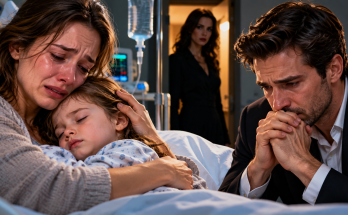
At eight-seventeen that morning, I was sitting beside Lily's hospital bed when a message from Ethan appeared on my phone. It contained no question about our daughter's condition. Instead, he had written that I needed to stop involving my father in matters I didn't understand. He said the presentation would proceed as planned and warned that any disruption could have serious consequences for our family's financial future. Beneath the message was a photograph of himself standing outside Aster Health's headquarters, wearing the dark blue suit I had bought him for our fifth wedding anniversary.
I studied the photograph longer than I intended. His tie was straight, his hair neatly arranged, and he wore the expensive silver watch Sylvia had given him after LittleLight's supposedly disappointing financial quarter. Nothing about him suggested that his infant daughter had spent the night in an emergency department. A person looking at the picture would have seen an ambitious professional arriving for an important opportunity. I saw a man who had driven his sick child to a hospital, abandoned her before receiving a diagnosis, and then demanded that her mother protect his business interests.
Dad was speaking quietly with Renée Lawson near the window. The hospital had offered us a small consultation room for discussions that could not reasonably take place beside a recovering infant. I had refused to leave Lily until Dr. Patel assured me that the staff would continue watching her closely. Her temperature had improved, and she had begun accepting small amounts of milk. Those ordinary signs mattered more to me than any corporate decision scheduled for that morning.
At eight-twenty-five, Nurse Leah came to record another set of observations. Lily stirred when Leah touched her forehead, then turned her head toward my voice. Her fingers closed around the edge of the blanket. I asked whether she was recovering as expected. Leah explained that the treatment appeared to be helping, although the medical team still needed to review the pending culture results and monitor her feeding. She didn't promise that Lily would be discharged that day. I appreciated her refusal to offer reassurance she couldn't yet justify.
When Leah left, I checked Ethan's message again. I considered replying with a photograph of Lily lying beneath the hospital lights, but I knew it would accomplish nothing. He had seen her condition himself. The problem was not a lack of information. It was what he had decided mattered more.
I wrote only that Lily remained under medical observation and that I would communicate about her care through an appropriate arrangement while the other matters were investigated. Then I put the phone down.
Renée approached with a legal pad and asked whether I felt able to review a proposed preservation notice. She explained that Aster's counsel had prepared formal requests concerning LittleLight's software, testing records, clinical authorizations, financial disclosures, and internal communications. Separate steps would be needed to protect my own rights. The distinction was important because my father's position at Aster couldn't properly become an instrument for conducting my personal dispute with Ethan.
Dad had already offered to retain an independent attorney for me. I agreed to speak with someone that morning, although accepting help from him felt unexpectedly difficult. Before my marriage, I had been accustomed to handling my own contracts, income, taxes, and professional disagreements. Five years of gradually yielding ordinary decisions to Ethan had left me feeling less capable than I actually was.
Dad seemed to recognize my hesitation.
“Claire,” he said, “you don't need me to decide what happens. You need people who can give you accurate information and protect your options.”
He placed his hand briefly over mine. I remembered him saying something similar when I was seventeen and trying to choose a university after my mother's death. He had offered advice, but he had never insisted that I attend the institution he preferred. The memory made me realize how accustomed I had become to someone treating disagreement as disloyalty.
At eight-thirty-four, Nora Hart called again. She had spent the previous hour reviewing the research archive she maintained in Boston. Her husband had taken their twin sons to school so she could work without interruption. I could hear the familiar clicking of her keyboard as she spoke. She sounded tired but focused, the way she used to sound when we discovered a difficult problem in our software after midnight.
“I found the access history,” she told me. “There were several downloads, not one.”
I asked her to explain.
She said the oldest suspicious access occurred eleven months earlier, within days of the date on the intellectual-property assignment bearing my forged signature. The activity came from a network associated with my home. Several large research packages had been retrieved, including development documentation and synthetic test datasets. Another session occurred months later, apparently after LittleLight had begun preparing material for prospective commercial partners.
I closed my eyes for a moment. Eleven months earlier, Ethan had still been pretending that his greatest concern was whether I had enough support during pregnancy. He had brought me tea, adjusted pillows beneath my back, and reminded me to rest. On one particularly uncomfortable evening, he had insisted on organizing my desk while I took a bath. That kindness had seemed insignificant at the time. Now it sat uncomfortably beside the timestamps Nora had uncovered.
“Can you tell who downloaded the files?” I asked.
“Not with certainty,” she replied. “The records identify the network and the account used. They don't prove which person was sitting at the computer.”
I was grateful for her caution. A weaker investigator might have seized on the connection and declared the matter solved. Nora understood that evidence became stronger when its limitations were acknowledged.
She continued explaining what she had found. The archived Blue Lantern datasets contained several identifiers that Nora and I had created for internal testing. They were not medical information from real patients. They were deliberately constructed values used to test whether the software distinguished meaningful readings from corrupted or unreliable inputs. One sequence bore the marker MARGARET_LANTERN_17, a reference to my mother.
I remembered creating that label during a winter evening in our university laboratory. Nora had brought terrible coffee from a vending machine, and we had been discussing how to organize hundreds of simulated scenarios. She suggested choosing names we would recognize instead of relying entirely on numerical identifiers. I selected my mother's name because the project had begun with her observations about unreliable monitoring.
The marker had no commercial value. It was simply a way for us to identify a particular testing sequence. But its presence in another company's software could establish a direct connection to our original materials.
Nora had another finding. The technical package LittleLight had submitted to Aster contained references to a testing configuration that matched one of our archived datasets. The resemblance was specific enough to warrant a detailed comparison. She wanted an independent forensic specialist to examine the original files, verify their history, and compare them with whatever LittleLight had supplied.
“Don't send me anything from Ethan's company directly,” she warned. “We need a clear record of where every file came from.”
“I understand.”
“And Claire?”
“Yes?”
“Please stop thinking you were foolish for trusting your own husband. That isn't the technical question we have to answer.”
I looked toward Lily, who had begun moving her lips in her sleep. Nora had known me long enough to recognize the accusations I was directing at myself without hearing them aloud.
After the call, Renée explained that Aster's board had been informed of material concerns requiring urgent consideration. Ethan's presentation would not be treated as an ordinary sales meeting. The directors had agreed to preserve the scheduled session because LittleLight's representatives were already arriving and because the meeting provided an opportunity to ask direct questions about the company's documentation.
I asked whether Dad would attend.
He nodded. “I will be there in my capacity as interim chairman.”
“And if Ethan asks about the research?”
“The board will require substantiated answers. I'm not going to speculate or decide disputed facts for them.”
I considered that carefully. Dad had a professional duty to Aster, just as I had a personal duty to Lily and a legitimate interest in protecting my research. Our goals overlapped, but they were not identical. It would have been easy to use his influence to stage a humiliating confrontation. That wasn't what I wanted. I wanted an accurate accounting of what Ethan had done and a decision based on evidence rather than appearances.
At eight-forty-seven, Ethan called. I let the phone ring twice before answering.
“Where are you?” he asked.
“At the hospital.”
There was an irritated pause. “I know that, Claire. Is your father still there?”
“He's preparing for the meeting.”
Ethan exhaled sharply. “You need to tell him this has gone far enough.”
I looked through the glass toward the corridor. A young orderly was helping an elderly patient into a wheelchair. Somewhere farther away, a child began crying.
“Have you spoken to anyone about the documents?” I asked.
“That's what I'm trying to discuss. You don't understand the impact this could have.”
“I understand that someone put my signature on an assignment I never approved.”
He lowered his voice. “We can resolve that privately.”
“How?”
“By behaving like adults instead of turning every disagreement into a public accusation.”
I thought of the countless times he had accused me of overreacting when I asked for ordinary explanations. His tone was almost identical now. The subject had changed from household expenses to possible falsification of research records, but he still expected familiar habits to work.
“Answer the question about the signature,” I said.
He went quiet.
Then he told me the company's lawyers would review everything after the presentation. He added that if I genuinely cared about Lily's future, I would recognize the importance of securing the contract before discussing ownership details.
I looked at our daughter lying beneath a soft white blanket.
“Lily's future depends on adults who take her safety seriously,” I replied. “Not on a presentation.”
Ethan's voice hardened. He said I was allowing Dad to manipulate me and that I would regret helping destroy the company that supported our family. I asked whether he had been aware of the elevated temperature recorded by Lily's monitor. He refused to discuss technical logs over the phone.
That refusal was enough to end the conversation. I told him I would not discuss the matter further without appropriate advice and ended the call.
I had barely set the phone down when Sylvia sent a message. She wrote that Ethan was under tremendous pressure and that a good wife would support him during the most important morning of his career. She added that babies became sick all the time and that I should not use ordinary childhood illness to punish my husband.
I read those words while looking at the intravenous line attached to my four-month-old daughter's hand. The distance between Sylvia's description and what had actually happened was so enormous that I felt no temptation to argue. I saved the message with the other communications and placed the phone beside my bag.
At eight-fifty-five, Dad prepared to leave for Aster's conference center, where the presentation was being held. Renée would accompany him, while another member of the legal team remained available to speak with me. Before leaving, he asked whether I wanted updates during the meeting or preferred to concentrate entirely on Lily.
“I want to know what happens,” I said. “But don't leave the meeting because of me unless Lily's condition changes.”
He studied my face.
“You're certain?”
“Yes. I have people here who know how to care for her. And I need to understand what Ethan tells the board when I'm not there to answer him.”
Dad embraced me. His coat smelled faintly of the cedar closet at his house. For a moment I was a teenager again, holding on to the only parent I had left. Then he stepped back and left with Renée.
After they were gone, the room seemed strangely quiet. I had spent the night in a series of urgent conversations, each revealing another part of a situation I had never imagined. Now there was nothing to do but attend to Lily and wait for information that would arrive from elsewhere.
I fed her slowly when the nurse said it was appropriate. She accepted more milk than she had managed earlier, although she tired quickly. I watched every swallow and tried not to imagine what might have happened if I had accepted Ethan's assurance that the monitor was more reliable than our thermometer.
A little after nine, my phone received a message from Nora. She had located an older copy of the Blue Lantern test archive and confirmed that it retained the original marker sequence. She had also found notes documenting our decision to make uncertain measurements visible rather than conceal them. Those notes carried dates from years before LittleLight's commercial development.
I opened the attachment she had sent for reference and recognized our old formatting immediately. The pages were full of technical explanations, corrections, and questions we had left for one another. In the margin of one document, Nora had written a joke about how software should never be allowed to lie politely. I had laughed when she wrote it. Reading it now, I felt the sting of unexpected grief.
My mother had believed that clinical judgment and technology should support each other, not compete for authority. Blue Lantern had been our attempt to express that principle in code. Ethan had once dismissed the work as a promising but impractical academic project. Yet he had apparently found enough value in it to make it central to his company's proposal.
At nine-twelve, Dad sent a brief message saying the session had begun and that the board was examining LittleLight's technical and legal submissions. He did not describe Ethan's behavior or speculate about the outcome. I was glad he was remaining professional, though a part of me desperately wanted to know whether my husband had finally been forced to answer a question directly.
I walked to the window while Lily slept. Outside, morning sunlight had begun to break through the clouds. Cars moved along the hospital entrance road, bringing new patients and carrying others home. Life continued without regard for the collapse of the assumptions on which I had built my marriage.
I thought about returning to the house. My clothes, documents, computer equipment, and Lily's belongings were all there. Ethan knew every room and every account we used. I had no reason to believe he would cooperate with an orderly review of disputed materials. Yet rushing home and confronting him would accomplish little beyond giving him warning.
Instead, I contacted the independent attorney whose name Renée had provided. Her name was Miriam Cole, and she specialized in intellectual-property disputes and complex civil litigation. Her assistant arranged a confidential telephone consultation later that morning. I explained that the situation also involved possible forged documents and questions about access to my research archives. Miriam asked me not to alter any files, access systems for which I lacked authorization, or confront anyone about technical evidence before we spoke.
Her instructions were measured and practical. I felt steadier after hearing them. There were procedures for dealing with disputed ownership, false signatures, and questionable business records. I did not have to improvise a solution while exhausted and frightened.
At nine-twenty-three, a new message appeared from Dad.
The board had asked LittleLight to explain the discrepancy between its claimed clinical validation and the information obtained during preliminary institutional verification. Ethan had responded that the company was operating with proprietary research partners and that some records could not be shared without further approvals. The directors had requested supporting documentation rather than accepting the explanation.
I imagined Ethan standing at the head of a polished conference table, advancing slides while his voice took on that persuasive quality I once found reassuring. I had watched him convince skeptical restaurant owners, reluctant vendors, and visiting relatives that whatever he proposed was the sensible choice. He knew how to make certainty sound effortless.
But the directors were not asking whether he could speak confidently. They were asking whether the evidence existed.
A minute later, Nora called again.
“Claire, I need you to listen carefully,” she said.
She had just finished reviewing an archived description of LittleLight's technical demonstration. A reference in the material described a synthetic dataset used to validate the system's temperature-alert behavior. The configuration appeared to correspond to the Blue Lantern sequence bearing my mother's name.
At first I thought she was merely confirming the connection she had already identified. Then she explained the more serious possibility. If LittleLight had used our synthetic test data while representing its performance as evidence from genuine clinical trials, the company might have blurred or misrepresented the distinction between simulated evaluation and testing involving real infants.
I sat down slowly.
“Can you prove that's what happened?”
“Not yet,” she answered. “We can prove our dataset existed and what it contained. An independent examiner needs the underlying LittleLight records to establish how they used it and what they claimed.”
I looked at the photograph Ethan had sent earlier. He was smiling outside the conference center, confident that the morning belonged to him.
Nora promised to preserve everything and speak with Miriam when I authorized it. Before ending the call, she said one more thing.
“The marker isn't just a name. The sequence includes deliberately impossible combinations of readings. We built them that way to make the software identify corrupted data. If those combinations appear in the clinical evidence, anyone who understands the dataset will know they didn't come from real patients.”
I stared at Lily's sleeping face. A company preparing to sell infant-monitoring technology might have constructed its most impressive results from data designed to demonstrate what reliable software should reject.
At nine-thirty-one, I forwarded Nora's finding to Miriam through the secure method her office provided, making clear that it was a preliminary concern requiring verification. I then told Dad's legal team that potentially relevant source records had been preserved by an independent researcher.
The next message from Dad arrived at nine-thirty-six. It was only one sentence, but I read it several times.
The board has suspended consideration of the proposed contract pending an independent investigation.
I felt no triumph. Lily was still in a hospital bed, and the marriage I had trusted no longer resembled the life I thought we shared.
But a company had been prevented, at least for the moment, from obtaining a major healthcare agreement on the strength of records that might not withstand examination.
Then Ethan called.
I watched his name illuminate the screen. This time, when I answered, he wasn't angry.
He sounded frightened.
“Claire,” he said, “you have to tell me exactly what Nora gave your father.”