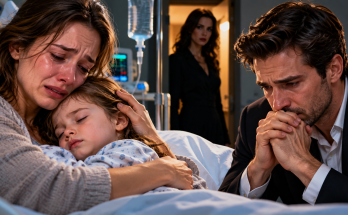
Ethan returned to the hospital shortly before dawn carrying two takeaway coffees and the expression of a man who expected a difficult conversation to disappear if he behaved normally enough. Sylvia followed a step behind him, still wearing her dark coat. Neither seemed prepared to find my father seated beside Lily's bed with a folder open on his knees. Ethan stopped in the doorway. Sylvia recovered first and asked whether everyone had finally calmed down.
I looked at the coffees. Ethan had bought one for himself and one for his mother. He hadn't asked whether I had eaten, slept, or had anything to drink since bringing our daughter to the emergency department. It was a small detail, almost absurd beside the documents lying on the table, but it clarified something that had been growing steadily harder to deny. Even now, his first instinct was not to care for us. It was to resume control.
Lily remained asleep, receiving treatment while the staff continued monitoring her. I asked Ethan to lower his voice before he started speaking. He glanced at the bed, nodded, and set the cups on a counter. Then he announced that the company was moving forward with the morning presentation and that any disagreements about paperwork should be handled privately afterward.
I asked him directly whether he had signed my name to the documents assigning Blue Lantern to LittleLight. Ethan's face tightened. Instead of answering, he said that the transaction had involved complicated corporate procedures I was unlikely to remember clearly. Sylvia added that I had been exhausted during pregnancy and shouldn't make accusations based on incomplete recollections.
I picked up the assignment and pointed to the signature. “I remember my own handwriting,” I said. “And I remember what I agreed to. Explain who signed this.”
Ethan looked toward Dad rather than at me. “Thomas, surely you understand that businesses have to consolidate intellectual property before bringing products to market.”
Dad remained seated. “The question came from your wife.”
Ethan took a breath, then shifted to a different argument. Blue Lantern, he said, had remained unused for years. LittleLight had paid engineers to transform the underlying concepts into a functional commercial platform. It would be unfair, in his view, to treat the original researcher as though she had built everything the company now possessed. He spoke with the smooth confidence I had watched him use in meetings and at dinner parties.
“I didn't ask whether your engineers worked hard,” I said. “I asked whether you transferred my research without permission.”
He pressed his lips together. “I was trying to create something that would benefit our family.”
I looked at him for a long moment. I had heard that explanation whenever he made a major decision without consulting me. It had accompanied changes to our household budget, the refinancing of our mortgage, and the increasingly restricted access I had to information about his company. He treated marriage as an arrangement in which his intentions were sufficient to excuse his methods.
Sylvia moved closer to the bed. “Claire, you need to think about the consequences of destroying Ethan's career. He has invested years in this company.”
I turned toward her. “Did you know LittleLight was using Blue Lantern?”
She glanced at Ethan. Then she told me it wasn't her place to explain corporate ownership arrangements. Her answer was more revealing than any admission would have been. She had been quick to criticize my parenting in public, but when I asked about her own financial involvement, she suddenly discovered the importance of discretion.
Ethan reached toward the small plastic bag containing Lily's monitor. “Why is that still here?” he asked.
“Because the medical team removed it,” I replied.
He said the equipment belonged to LittleLight and needed to be returned for technical evaluation. My father stood and asked him not to touch it. Ethan looked genuinely startled by the instruction. He insisted that the company had procedures for handling its own prototypes, but Dad explained that the device might be relevant to an independent investigation and that any transfer should be documented through the appropriate process.
For several seconds nobody spoke. Ethan stared at the bag, and I noticed how intently he examined the small gray band. Until that moment he had shown remarkably little concern for the object that had supposedly assured us our daughter was safe. Now, with the equipment removed and retained, it seemed to be the most important thing in the room.
I asked why he wanted it so urgently. He said that the company needed access to demonstration equipment before the meeting. I reminded him that LittleLight presumably possessed many prototypes. He didn't answer. Sylvia stepped forward and accused Dad of turning a family emergency into a corporate ambush.
Dad looked at her calmly. “This investigation began before Claire called me last night.”
That statement unsettled Ethan more than anything else. His eyes moved from Dad to the documents and then toward the doorway. For the first time, I suspected he was calculating whether staying in the room would make his situation worse.
“Tell me about the temperature records,” Dad said.
Ethan went still. My father explained that the diligence team had recovered technical information associated with LittleLight's demonstration platform. Some of it concerned the monitor Lily had worn. The system contained temperature records that did not match the reassuring values presented to ordinary users.
I felt myself become completely alert. “What records?”
Dad said that at eleven-oh-six the previous evening, the system's underlying information indicated an elevated temperature, even though the application available to us had continued displaying a normal status. He emphasized that the full technical sequence was still being examined. But the discrepancy was real enough to raise questions about what the device had recorded and what it had chosen to show.
Ethan said those were proprietary development logs and that their contents could easily be misunderstood. Dad asked whether the company had implemented a process that suppressed certain alerts during demonstrations. Ethan's face lost color. He said he would need to speak with engineering before offering an interpretation. It was a cautious answer, and I might have respected it under different circumstances. But he had dismissed my concerns without caution when Lily was lying against me with a dangerous fever.
I stepped closer to him. “Were you aware that her temperature was rising before I came to your office?”
He looked toward the bed.
“Ethan, I'm asking about our daughter.”
He swallowed and said he had been focused on preparing his presentation. He couldn't remember precisely what the application had shown at any particular moment. I reminded him that he had been confident enough to tell me my thermometer was wrong. He shrugged and said that he had trusted the information available.
There it was again: an explanation broad enough to sound reasonable, but narrow enough to avoid the actual question.
At six, Renée Lawson arrived. She was a composed woman in her late forties, dressed in a charcoal suit beneath a practical coat. She introduced herself as counsel advising Dad in connection with Aster's corporate review. After confirming that Lily was receiving care, she explained that she could provide information about the documents and their preservation, but that I would need independent legal representation for my personal claims.
I appreciated her precision. No one had spoken to me that morning as though I were incapable of understanding difficult information except Ethan and Sylvia. Renée approached the matter as a professional would, identifying separate questions about ownership, consent, data integrity, and potential misconduct. She didn't promise a simple outcome or suggest that my father's authority could settle everything.
She asked Ethan and Sylvia to allow us a private conversation. Sylvia objected immediately, insisting that this was a family matter. Ethan said he had a right to participate because the discussion concerned his company and daughter. Before the disagreement escalated, Dr. Patel came in to check Lily and said the room needed to remain quiet. She explained that Lily's care took priority over any argument among family members or visitors.
Ethan finally agreed to step outside. Sylvia followed him, though not before warning that I would regret involving outsiders in my marriage. I looked at her and said that the situation had ceased to be private when documents bearing my signature were submitted to companies and researchers without my consent.
The door closed. For the first time since Lily became ill, there was a stretch of quiet in which I could hear her breathing without another person's demands intruding. Renée placed her laptop on the table and asked whether I felt able to examine some technical material. I said yes.
The first screen contained a sequence of device events. I recognized the familiar arrangement of identifiers, timestamps, data entries, and user activity records. Renée explained that the team had obtained copies of relevant logs before permissions were changed. The records still required authentication and fuller review, but several entries had already raised serious concerns.
At ten-seventeen the previous evening, Lily's device had registered a temperature of 102.6 degrees Fahrenheit. The system generated an internal alert. I remembered how warm she had felt around that time and how I had begun checking her with the household thermometer. The timing matched my recollection closely enough to make my stomach tighten.
One minute later, an administrator account accessed the device remotely. The account identifier was EMERCER_ADMIN. I recognized Ethan's initials immediately, though Renée cautioned that an account name did not by itself establish who had been physically using it. She pointed to the next entry, which recorded a change to the alert configuration.
The screen showed that alert suppression had been enabled. I leaned forward to make certain I understood. Renée explained that the command appeared to have disabled notifications from that monitor. It required administrative privileges unavailable to ordinary users. My daughter's temperature could rise, and the monitoring system might still fail to notify the parent relying on it.
I went back through the sequence in my mind. Lily had become hot. I had measured her fever. Ethan had looked at the application's normal status and told me I was worrying unnecessarily. At eleven-oh-six, according to the recovered information, the system had recorded another elevated measurement. Yet no warning had appeared on my phone. I had carried my sick daughter through the house while a device on her ankle continued offering reassurance.
I asked whether the logs showed that Ethan had personally changed the setting. Renée said the available evidence connected the action to his administrator account, but more investigation would be required to identify the user conclusively. Her restraint was important. I knew enough about digital systems to understand that account attribution and individual responsibility weren't always the same thing.
Still, I remembered Ethan sitting alone in his office at that hour. I remembered how quickly he had looked at the band when I mentioned the fever. I remembered the irritation in his voice when he suggested the thermometer was defective. The possibility that he had been aware of the abnormal reading before I told him made me feel physically ill.
“Why would anyone disable a fever alert?” I asked.
Renée exchanged a glance with Dad. She explained that LittleLight's upcoming presentation emphasized the product's ability to avoid unnecessary notifications while maintaining reliable monitoring. A demonstration interrupted by unexpected alerts might undermine that claim. Whether the setting on Lily's device had been changed for that reason remained under investigation.
I stared at the screen. The possibility was appalling. My husband might have treated a warning from our daughter's body as an obstacle to the polished demonstration he intended to give investors and hospital executives. I thought of how carefully I had explained Lily's symptoms while he insisted on trusting his application.
I stood so abruptly that the chair scraped against the floor. I wanted Ethan back in the room. I wanted him to look at the timestamps and tell me whether he had seen the temperature rise. Dad gently suggested that any confrontation should wait until we understood the evidence more fully. I knew he was right, but I hated that doing the sensible thing required postponing the question that mattered most.
Renée closed the log window and explained the next steps. The company records needed to be preserved, the authorization documents examined, and the research ownership history reconstructed. Independent counsel would need to protect my interests, while Aster's compliance procedures continued separately. She would not promise that every troubling detail would lead to a particular legal consequence. I preferred that uncertainty to the false confidence Ethan had sold us.
At seven-fifteen, I called Nora Hart. She answered quickly, her voice sharpened by concern when she heard mine. I told her Lily was in the hospital but receiving treatment, then explained what Dad's reviewers had discovered about Blue Lantern. I described the assignment document, the copied software components, and the research authorization forms bearing my forged signature.
Nora listened without interrupting. When I finished, she asked whether Ethan had ever obtained access to my old development archives. I told her he knew where I stored research materials and had seen some documentation, though I had never authorized him to take or commercialize the code. She was silent for several seconds.
Then she told me about an inquiry she had received six months earlier. Someone claiming to represent a private healthcare company had asked whether Blue Lantern had been licensed or assigned to another organization. Nora had explained that the project had never undergone a commercial transfer. Disturbed by the questions, she had contacted me, but I had dismissed the inquiry after Ethan suggested it was routine background research connected to his startup.
I remembered the exchange with painful clarity. I had been heavily pregnant and distracted. Ethan had been standing beside me when Nora's message arrived, and he offered an explanation before I had thought to ask for one. I trusted him because he was my husband. Nora had trusted me to make my own judgment. Neither of us understood that he might have been influencing what information reached me.
Nora continued. After the unusual inquiry, she had reviewed the activity history of an old shared research archive. Someone had downloaded material from it using a network address associated with my home. She had preserved the access information because it bothered her, but she hadn't been able to identify the person behind the download.
I looked at Dad. He could see from my expression that the conversation had changed. I asked Nora whether she still had the records and the original source files. She said yes. She had preserved multiple versions, including development notes and synthetic test datasets. Some older materials were also held in the university archive.
Then she reminded me of a small feature we had built into those datasets years earlier. To help distinguish simulated records from genuine clinical information, we had embedded identifiable markers in the test materials. One was a private reference to my mother, used in a sample sequence that Nora and I would recognize immediately.
I remembered it. I had almost forgotten how often we had laughed about our strange naming conventions during long nights in the laboratory. Those identifiers were unimportant to the software's outward appearance, but they could help reveal whether someone had copied our research materials without understanding their purpose.
“Nora,” I asked, “would those markers still be present if someone simply reused our files?”
“Unless they deliberately removed them,” she replied.
I looked toward the bag containing Lily's gray monitor, then at the assignment bearing my false signature. The forged paperwork, unexplained archive access, borrowed software, and altered monitoring records were no longer isolated concerns. They pointed toward a carefully constructed deception that might have involved my husband for far longer than I had imagined.
I asked Nora to preserve every relevant record and coordinate with independent counsel before sending sensitive material anywhere. She agreed immediately. We would need a proper technical comparison, not merely our memories of old code. But for the first time that morning, I could see a practical way to establish what had happened.
After the call, I returned to Lily's bedside. Her temperature was improving under treatment, and Dr. Patel's team continued observing her. I touched her hand and felt her fingers close weakly around mine. That small movement brought tears to my eyes. Whatever became of LittleLight, my marriage, or the documents spread across the table, Lily was here, alive and receiving the care she needed.
I looked at Renée and Dad. “I want the full truth preserved,” I said. “Not a private arrangement, not a promise from Ethan, and not a version that makes the documents disappear.”
Dad nodded. Renée began explaining the steps for securing an independent examination.
At nine o'clock, Ethan intended to stand before Aster Health and persuade its decision-makers that LittleLight could be trusted with the safety of infants. He did not yet understand that the woman whose research he had apparently taken, whose signature had been reproduced without permission, and whose daughter's monitoring records had raised such troubling questions was no longer willing to remain outside that conversation.