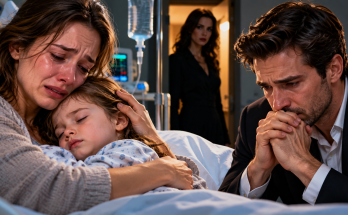
The morning Lily was cleared to leave the hospital, I stood beside her bed folding the pale yellow sleeper she had worn when we arrived. It had been washed by the hospital staff after the first night, but I could still remember how hot her body had felt through the fabric. Three days had passed since I first measured her fever. The garment looked impossibly small in my hands, and I found myself wondering how I had once believed that keeping her safe would be a simple matter of vigilance and love.
Dr. Patel arrived with the discharge instructions shortly after nine. Lily's temperature had remained stable, she was feeding more consistently, and the medical team was satisfied with her response to treatment. We discussed medication, follow-up arrangements, and the symptoms that would require prompt reassessment. I wrote down the instructions even though the hospital provided them in print. I wanted no uncertainty about what came next.
Leah came to say goodbye before her shift ended. She had been with us during the frightening first hours, when Lily's cries were weak and my hands shook so badly that I could barely fasten her sleeper. Now she smiled when Lily turned her head toward my voice.
“She looks much happier,” Leah said.
I glanced at my daughter.
“She does.”
Leah squeezed my shoulder gently. She did not ask about Ethan or the investigation. She had seen enough during our stay to understand that some questions were better left to the people involved. I thanked her for treating Lily with such care and for never making me feel foolish when I was frightened.
Dad arrived carrying the infant car seat, a clean blanket, and a bag of supplies he had purchased the previous evening. He had checked the installation instructions carefully and asked me to inspect everything before we left. The attention he gave those small details made my throat tighten.
I had spent so much time listening to Ethan describe the enormous responsibility of building a successful company that I had nearly forgotten how responsibility usually looked in ordinary life. It looked like showing up when someone called. It looked like reading instructions, arriving on time, and asking what help was needed without treating the answer as an interruption.
Before we left, the hospital social worker reviewed the arrangements we had made. Lily and I would stay temporarily at Dad's house. I had access to transportation, financial resources, and support. A family-law attorney was advising me about separation and parenting arrangements. Nothing about the plan was dramatic. Its purpose was to provide a stable place for Lily to recover while the adults addressed the problems surrounding her.
Ethan had been informed of the discharge plan through appropriate communication. He objected, but his objection did not change the immediate arrangements. I remained committed to handling his relationship with Lily through lawful, safe procedures rather than allowing the dispute to become another struggle for control.
Dad drove us to his house beneath a sky that had finally cleared. The roads were bright after the rain. I sat beside Lily in the back seat and watched her sleep, her head resting against the padded side of the car seat. The journey took less than forty minutes, but I felt as though we were crossing a distance much greater than that.
Dad's house stood on a quiet residential street lined with old trees. I had spent much of my childhood there before leaving for university. The front steps were the same, though he had replaced the railing several years earlier. The kitchen windows still faced the garden where my mother grew herbs in mismatched clay pots.
When we entered, I caught the familiar smell of polished wood and coffee. Dad had prepared the guest room with fresh sheets, a bassinet, and a small changing area. He had moved an old chair beside the window so I could sit comfortably during nighttime feedings. On the dresser stood a framed photograph of my mother holding me as an infant.
I looked at the picture for a long time.
My mother was younger than I remembered her, with short brown hair and a tired smile. I was bundled against her chest, my tiny fist resting near her collar. The image reminded me that she too had once been a young mother learning how to care for a child.
I wished I could ask her what she would do.
Dad stood quietly behind me.
“You can move anything you don't want,” he said.
I shook my head.
“No. Leave it.”
That afternoon, I called Nora from the guest room while Lily slept. Nora had been working with the independent forensic specialist and Miriam to organize the original Blue Lantern archives. She sounded relieved when I told her Lily was home from the hospital.
Then her voice became serious.
The technical comparison had advanced. The specialist had confirmed that several components in LittleLight's submitted materials closely matched the archived Blue Lantern work. More importantly, the synthetic test sequence bearing my mother's identifier appeared in material associated with the company's validation claims.
I sat down.
“Was it presented as clinical data?”
Nora chose her words carefully.
“The preliminary review indicates that some simulated records were included in a collection described as supporting clinical performance. The investigators are examining how those records were labeled, combined, and represented.”
I understood why she was cautious. A dataset might pass through many engineering stages, and its mere presence did not establish how every claim had been made. But the overlap was becoming too substantial to dismiss as coincidence.
Nora continued. The records contained the unusual combinations we had deliberately created to test whether Blue Lantern would reject unreliable input. Those combinations were not plausible measurements from genuine infants. If they appeared in a dataset represented as clinical evidence, the problem would be more serious than borrowed code.
I looked toward the photograph of my mother.
She had spent her career caring for children too young to describe their pain. She believed that measurement systems existed to help clinicians recognize danger, not to create the appearance of safety where certainty was impossible.
The idea that her name had become part of questionable evidence used to promote infant-monitoring technology felt like a violation of the principle that had inspired our work.
Nora told me the forensic specialist was preparing a formal report. The original records had been preserved with their historical timestamps and supporting documentation. The comparison would identify which elements could be established reliably and which questions still required access to LittleLight's complete development history.
I thanked her.
“Claire,” she said, “you know what bothers me most?”
“What?”
“We designed those impossible readings so the system would refuse to pretend they were normal.”
I closed my eyes.
“I remember.”
“And now someone may have used them to prove the opposite.”
We ended the call without saying much more.
At four, Miriam contacted me with news concerning Daniel Price's internal warning. The investigators had obtained a preserved copy of a message he sent before Lily's monitor was issued. It addressed the risks of activating demonstration settings on devices used outside a controlled testing environment.
The warning was specific. Daniel had explained that suppressed alerts could prevent caregivers from receiving notifications about abnormal measurements. He had recommended restricting the feature to clearly identified test configurations and ensuring that production devices could not silently enter that state.
The message had been addressed to Ethan and several members of LittleLight's management team.
I asked whether Ethan had acknowledged receiving it.
Miriam said the record included a response from his account. The reply indicated that the concern had been noted and that the team would manage demonstration settings appropriately. The investigators were examining the full correspondence to understand what actions followed.
I stared at the wall.
Ethan had told me he didn't think the settings could affect anything important. He had said he believed the device's readings were reliable. But someone responsible for the engineering had warned him that suppressed alerts could leave caregivers unaware of abnormal measurements.
That warning did not by itself establish every action Ethan took on the night Lily became ill. It did establish that he had been placed on notice of a risk that later became central to our daughter's experience.
I asked Miriam whether the preserved logs could show when the demonstration configuration was enabled on Lily's device.
She said the review had identified administrative activity before Ethan brought the monitor home, as well as the later action associated with his account during Lily's fever. The investigators were working to verify the identity of the person responsible for each event and establish whether settings had been altered remotely.
I remembered Ethan fastening the band around Lily's ankle. He had assured me the company had completed extensive testing and that the device was safe. When I asked for technical documentation, he accused me of treating everything he brought home as suspicious.
He had known that an engineer raised concerns about exactly the kind of configuration later found on our daughter's monitor.
For a long time, I sat without moving.
The discovery didn't produce the anger I expected. It produced something quieter and more final. I had spent years searching for charitable interpretations of Ethan's behavior. Perhaps he was exhausted. Perhaps he didn't understand the pressure I was under. Perhaps he was simply too ambitious to notice the small harms his choices caused.
Now I had a documented warning, a device placed on our daughter, and a father who dismissed a dangerous fever while preparing for a business meeting.
Even if every unresolved technical question eventually received the explanation most favorable to Ethan, those established choices would remain.
I called the family-law attorney Miriam had recommended. Her name was Judith Ramos, and she had already reviewed the basic circumstances. We discussed temporary arrangements, communication boundaries, and the practical steps required if I decided to pursue separation or divorce.
Judith did not tell me what decision to make. She explained what each option involved and reminded me that Lily's welfare would be central to any parenting arrangement. She encouraged clear documentation and calm communication. I appreciated her refusal to frame the situation as a contest in which one parent had to destroy the other.
When she asked what I wanted, I found the answer came without hesitation.
“I want to separate,” I said. “And I want to begin the divorce process.”
Saying it aloud hurt more than I expected.
I had loved Ethan. I had imagined growing old with him, watching Lily learn to walk, attending school concerts, arguing over holiday plans, and laughing about our early years together. Those expectations had not disappeared simply because the evidence against him was mounting.
But love could not make forged signatures genuine. It could not restore an alert that had been suppressed or undo the hours when Lily's condition worsened while her father prioritized a presentation.
Judith explained the next steps. We would review our financial circumstances, identify property and accounts, and establish appropriate arrangements for Lily. I told her about the disputed compensation entry connected to Blue Lantern and the uncertainty surrounding Ethan's company ownership. She said those matters would require careful coordination with the other legal proceedings.
When the call ended, I went downstairs.
Dad was in the kitchen preparing soup. He had always cooked when he was worried. The cutting board held uneven pieces of carrot and celery, and a pot simmered quietly on the stove. He looked up when I entered.
“I spoke with Judith,” I said.
He turned down the heat.
“And?”
“I'm going to file for divorce.”
He set the spoon aside.
For a moment, he said nothing. Then he walked around the counter and embraced me.
I began crying before I could stop myself. I cried for the marriage I had believed in, for the woman I had been before years of small concessions weakened my confidence, and for the child who would grow up with a different family arrangement than the one I had imagined for her.
Dad held me without offering advice.
When I finally pulled away, he handed me a clean dish towel because he couldn't find a tissue.
I laughed through tears.
“Mom would have hated that.”
“She would have told me to keep tissues in the kitchen,” he said.
We stood there for another moment, remembering her.
That evening, Ethan called.
I answered because I wanted to communicate my decision directly, without allowing the news to reach him first through a formal document.
He sounded tired.
“Claire, can we please stop fighting?”
I looked through the doorway toward the guest room where Lily was sleeping.
“I've spoken with an attorney,” I said.
There was a pause.
“About the company?”
“About our marriage.”
He didn't speak.
I continued. “I'm pursuing a divorce.”
His reaction came in stages. First disbelief, then anger, then an attempt to bargain. He said we could attend counseling. He promised to spend more time at home. He suggested that Sylvia had interfered too much and that he would establish boundaries with her.
I listened.
Some of the things he offered were changes I had requested for years. Hearing them now should have made me feel hopeful. Instead, I realized how readily he could produce promises once the consequences affected him.
I told him that any future discussion about Lily would remain separate from the legal questions surrounding his company. I wanted her to have appropriate contact with both parents, but I could no longer continue our marriage on the assumption that apologies would substitute for accountability.
Ethan asked whether I was doing this because Dad wanted me to.
“No,” I said. “I'm doing it because I don't trust you.”
The words hung between us.
He asked whether there was anything he could do to change my mind.
I thought about the hospital, the forged documents, and the internal warning Daniel had sent.
“You can tell the truth,” I replied. “You can cooperate with the investigation. And you can take responsibility for what happened to Lily.”
He was silent.
Then he said he needed to speak with his attorney.
I told him that was appropriate and ended the call.
Afterward, I sat beside Lily's bassinet for a long time. She slept with one hand resting near her cheek, unaware that the adults around her were making decisions that would shape her childhood.
I wondered how I would explain those decisions when she was older. I didn't want her to grow up carrying the bitterness of our marriage. I wanted her to know that adults could make terrible mistakes and still be expected to take responsibility for them.
At nine, Miriam sent a message saying the independent review had obtained additional material relating to LittleLight's financial disclosures. There were questions about the alleged seventy-five-thousand-dollar payment to me and the accounts through which the transaction had been recorded.
She said the investigators were examining whether the compensation entry reflected a genuine transfer or a constructed accounting record.
I read the message while sitting beneath the framed photograph of my mother.
For days, I had concentrated on the software and the monitor. Now I remembered the financial secrecy that had surrounded our marriage, Ethan's claims that his company was barely surviving, and Sylvia's insistence that I return to work despite my recovery from surgery.
The money might reveal another part of the deception.
I replied that Miriam should continue through the proper channels and that I would provide any legitimate financial records she needed.
Then I turned off the bedside lamp.
Before falling asleep, I heard Lily stir. I reached into the bassinet and rested my hand gently against her back. Her breathing remained steady beneath my palm.
For the first time in several nights, I was not waiting for Ethan to arrive or wondering whether he would choose us over his work.
I had made my own choice.
The investigation would continue. The disputed money, the forged documents, the altered device logs, and the company's questionable validation claims still demanded answers.
But whatever those answers revealed, Ethan would no longer be permitted to decide what I was allowed to know about my work, my finances, or my daughter's safety.