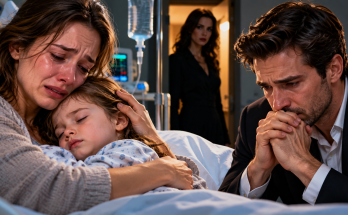
Ethan did not ask about Lily when I answered his call. He asked what Nora Hart had shared with my father, whether the board had received our research files, and whether anyone had examined the original Blue Lantern test datasets. His questions came so quickly that I had to interrupt him twice. The carefully controlled voice he used in business meetings had disappeared. For the first time since the emergency began, he sounded like someone who understood that events were moving beyond his influence.
“What did Nora give them?” he repeated.
“I don't know what you're imagining,” I said. “But the appropriate people are preserving and reviewing relevant records.”
“You don't understand the damage you're causing.”
I closed my eyes. Lily had finally settled into a peaceful sleep, and I would not allow him to turn the room into another argument.
“If LittleLight's records are accurate, an independent review will establish that,” I replied. “Why are you so concerned about Nora's archives?”
He didn't answer immediately. Then he said that old research material could be taken out of context and used to create misleading similarities. He insisted that LittleLight had developed its own commercial system through substantial engineering work. I told him that any legitimate contributions could be documented and examined alongside the original research.
He became irritated again.
“That's easy for you to say. You have your father's money behind you.”
I looked at the plastic chair where Dad had spent part of the night, still wearing the old coat he had pulled on when I called him. Ethan had always resented my father's financial security, although he rarely admitted it directly. He preferred to describe himself as a man who had built his own opportunities without assistance.
“Dad's finances have nothing to do with whether you signed my name,” I said.
Ethan fell silent.
I waited.
Finally, he told me we needed to speak privately before the situation became irreversible. He said Sylvia had already contacted an attorney and that there might be a way to resolve the ownership questions without damaging LittleLight's investors.
I asked whether he was offering to acknowledge that the assignment was unauthorized.
“No,” he said quickly. “I'm saying there's room for a reasonable agreement.”
The distinction was familiar. Ethan wanted a settlement before admitting there was anything to settle.
I told him I would communicate through independent counsel about the disputed documents. Any conversation concerning Lily's medical care could occur separately, provided it remained focused on her needs.
He accused me of turning our marriage into a legal battle. I reminded him that I had not created the documents bearing false signatures. Then I ended the call.
For several minutes, I remained motionless with the phone in my hand. The room smelled faintly of disinfectant and the warm milk Lily had recently taken. Somewhere outside, a trolley rattled across a joint in the floor. Ordinary sounds helped me remain anchored while my thoughts moved rapidly through the previous year.
I had spent months believing that Ethan's secrecy reflected professional stress. Now I was beginning to see that his financial and technical claims might have been deliberately arranged to conceal what he had done. The distinction mattered because people made mistakes under pressure, but deception required repeated decisions.
At ten-fifteen, I spoke with Miriam Cole by telephone. She was direct without being abrupt. After listening to the chronology, she asked me to identify what I knew firsthand, what others had reported, and what remained uncertain. We discussed the Blue Lantern research, the forged assignment, the unexplained compensation entry, and the authorization documents involving Lily.
Miriam explained that intellectual-property ownership could become complicated when original academic work was later incorporated into commercial products. The question wasn't merely whether LittleLight had developed additional features. It was whether the company possessed lawful rights to use the underlying material and whether the documents asserting those rights were genuine.
She also addressed the alleged compensation payment. The accounting entry might indicate an actual transfer, an internal liability, or something else entirely. Its existence did not prove that money had reached me. We would need authenticated bank and accounting records to establish what had happened.
I told her about the mortgage papers Ethan had asked me to sign during pregnancy. She asked whether I retained copies and whether any independent witness could confirm what was included. I remembered receiving electronic closing documents from the lender, but I couldn't recall where I had stored every page. Miriam told me not to worry about reconstructing everything from memory. Documents, signatures, metadata, and testimony could be compared later.
Then we discussed Lily's monitor.
Miriam listened carefully as I described the high fever, the normal status displayed by the device, the hospital visit, and the administrative action recorded in the technical logs. She reminded me that the apparent suppression of an alert required forensic authentication and that identifying the account user would be a separate question.
“I don't want to accuse him of something the evidence can't establish,” I said.
“Good,” she replied. “Our task is to determine what happened, not to invent certainty where none exists.”
Her answer eased something in me. I had grown used to defending my feelings against Ethan's confident dismissals. Miriam did not ask me to be less emotional. She asked me to be precise, and precision was something I understood.
After the call, I authorized Miriam to communicate with Nora and coordinate the preservation of my original research records. She would also review the disputed assignment and consider appropriate steps to protect my ownership interests. The separate legal and corporate investigations could proceed without requiring me to become investigator, witness, attorney, and frightened mother all at once.
Around eleven, Dr. Patel returned with an update. Lily's response to treatment remained encouraging, and her fever had continued to decrease. The team expected to refine the treatment plan once the culture results were available. I asked when she might be able to come home. Dr. Patel said discharge would depend on her condition and the remaining test results, not merely on a single improved temperature reading.
I nodded. A green indicator light had nearly persuaded my husband to dismiss obvious symptoms. I was no longer interested in shortcuts to reassurance.
When the doctor left, I held Lily against my chest. Her body felt warmer than usual but no longer frighteningly hot. She opened her eyes and looked toward my face with the solemn expression she often wore before a feeding. I kissed her forehead and felt a rush of gratitude so strong that my chest ached.
For the first time since the previous evening, I allowed myself to imagine taking her home.
Then I realized I didn't know whether the house was a place I wanted to return to.
I had once believed our home belonged equally to both of us. We had chosen the paint colors together, argued pleasantly about furniture, and planted a small maple tree in the backyard after our second anniversary. But I now knew Ethan had accessed my professional materials without permission, or at least that records raised serious questions about access from our home. I didn't know what else he had concealed or whether he would respect boundaries once he understood that I intended to pursue answers.
I called Dad. He was leaving Aster's conference center after a difficult morning. His voice sounded tired, but he immediately asked how Lily was doing. I told him her fever was improving. Only then did we discuss the meeting.
He explained that the board had suspended the proposed contract and referred the matter for independent review. The directors had not concluded that every allegation against LittleLight was proven. They had determined that the unresolved discrepancies were too serious to permit approval.
Ethan had reportedly resisted the suspension, arguing that the review process was unfairly influenced by a personal dispute. Dad said the board had documented the disclosed family relationship and his potential conflict. Appropriate procedures were being considered to ensure that decisions about the company rested on independent findings rather than his personal connection to me.
I was relieved. Whatever Ethan had done, I wanted the process to survive the accusation that my father had used his position to punish a son-in-law.
Dad then told me that LittleLight's chief technology officer, Daniel Price, had contacted Aster's compliance team after the meeting.
Daniel had been with the company for almost three years. I had met him only twice, both times at holiday gatherings where he spent most of the evening discussing engineering problems with anyone willing to listen. He was a thin, serious man in his early forties who seemed uncomfortable with networking but enthusiastic about software design.
According to Dad, Daniel had expressed concern that certain development and testing records might not be complete. He wanted guidance about preserving material that could be relevant to the investigation. Aster's attorneys were arranging an appropriate channel for him to provide information without asking him to violate legal obligations or interfere with the company's systems.
I felt a surge of hope, followed immediately by caution.
“Does he know about Blue Lantern?” I asked.
“He appears to know that questions have been raised about the origin of some components. Beyond that, I don't want to speculate.”
Dad's refusal to overstate the situation was reassuring. It was also frustrating. I wanted someone to explain everything immediately, preferably in the order it had occurred.
By noon, Sylvia had begun sending messages again.
Her first said that Ethan had been humiliated in front of influential business leaders. The second blamed me for allowing my father to interfere in matters outside his proper concern. The third was longer. She wrote that she had always considered me too independent for marriage and that my refusal to support Ethan proved her fears correct.
I saved the messages but did not answer. It struck me that Sylvia had spent years accusing me of insufficient devotion while she quietly held a financial interest in the company her son used to justify his absence from our family. She understood loyalty primarily as protection from consequences.
A little after one, Miriam called with a procedural update. Nora had supplied an inventory of preserved research materials and their original dates. She had also identified a sequence of synthetic records that might provide a useful technical comparison. Miriam emphasized that the files would be examined independently before anyone relied on them in formal proceedings.
I asked about the identifier honoring my mother.
“It may be important,” Miriam said. “But what matters is the whole sequence, its provenance, and how it appears in the other material. A single matching label could be explained away. A detailed pattern is harder to dismiss.”
I imagined Nora in Boston, sitting at her desk with years of forgotten notes spread across the screen. She had no reason to become involved in my marriage. Yet she was doing exactly what she had always done when our work was at risk: preserving the truth of what we had built together.
At two, a secure communication from Aster's legal team provided a general update to Miriam. The review had identified a concern about how certain synthetic testing records were categorized in LittleLight's validation package. The information was preliminary, and no final finding had been made. But there appeared to be inconsistencies between the records' original purpose and the descriptions used in the commercial submission.
I read Miriam's explanation twice.
Blue Lantern had included datasets deliberately designed to test what happened when information was unreliable. Some scenarios contained combinations that could not plausibly represent ordinary measurements from real infants. If those simulated records had been presented as evidence of clinical performance, the distortion would be profound.
The concern extended beyond intellectual-property ownership. A hospital evaluating a monitoring system needed accurate information about how it had been tested. Synthetic data could be valuable for engineering, but it could not simply substitute for clinical evidence without clear disclosure.
At three, Dad came back to the hospital. He had changed into a clean shirt and brought a small bag containing clothes for me, a phone charger, and the knitted blanket my mother had made years earlier. He said he had found it in the guest room at his house, where I had stored it before Lily was born.
I unfolded the blanket. Its blue edges were uneven, and several stitches near one corner were slightly loose. My mother had never been especially good at knitting. She made things because she loved the people who would use them, not because she expected them to be perfect.
I laid it across my lap and told Dad about the MARGARET_LANTERN_17 marker.
He smiled faintly when he heard the name.
“Your mother would have liked that.”
“I think she would have been angry about what happened to the project.”
“She would have been angry about what happened to you and Lily,” he replied.
For a while we sat together without discussing legal documents. He asked whether I had eaten. I admitted that I had forgotten. He went to find something from the hospital cafeteria and returned with soup, bread, and a bottle of water. I ate because he remained beside me until I finished.
In the late afternoon, Miriam contacted me with a new question. Daniel Price had indicated that he possessed contemporaneous records concerning an internal decision to alter the demonstration system's behavior. The relevant changes might have affected how warnings appeared in certain testing environments.
I felt the same tightening in my chest that I had experienced while examining Lily's device logs.
“Was Ethan involved?”
“Miriam said Daniel has identified communications that may be relevant, but those records need to be obtained and authenticated. We should not assume what they establish before reviewing them.”
I understood. But I could not forget the green light that had continued blinking while Lily's temperature climbed.
At five, a hospital social worker came to speak with me at my request. I explained that I was facing serious marital conflict and wanted to understand how to make arrangements for Lily's care and a safe place to stay after discharge. She listened without judgment and provided information about support services, practical planning, and documenting concerns. She did not tell me what decision to make about my marriage.
That conversation mattered more than I expected. Until then, I had been thinking primarily about evidence, contracts, and corporate misconduct. The social worker asked where Lily would sleep when she left the hospital, whether I had access to essential documents, and who could assist with transportation and follow-up appointments.
Those questions returned me to the ordinary obligations of motherhood. Lily would need feeding, rest, clean clothes, and medical follow-up regardless of what happened to LittleLight. A legal dispute could last months or years. My daughter's next bottle would be due in a few hours.
I told Dad I wanted to stay at his house temporarily after Lily was discharged, if the doctors agreed and the arrangements were appropriate. He answered immediately that we were welcome. He had kept my childhood room almost unchanged, though he said we could use the larger guest bedroom because it was easier to accommodate an infant there.
I thanked him.
He looked almost offended.
“You don't need to thank me for giving my granddaughter a place to sleep.”
I began to cry then, quietly and without the energy to stop. Dad waited until I could speak again. He didn't offer assurances about the outcome of the investigation or promise that everything would return to normal. He simply stayed beside me.
At six-forty, Nora called with another update. An independent forensic specialist had begun comparing the preserved Blue Lantern archives with technical material properly obtained during Aster's review. The preliminary comparison suggested substantial overlap in several structures and test sequences. The specialist would need more time to verify the relationships and determine what could be established definitively.
I asked whether the synthetic dataset had been used in LittleLight's claimed clinical results.
“The records suggest that possibility,” Nora answered. “But we need the original validation package and its supporting data before anyone can say exactly how it was represented.”
I rubbed my forehead. Every answer seemed to produce another question, but at least the questions were becoming specific.
Before ending the call, Nora told me she had found an old email exchange from the early days of Blue Lantern. In it, I had written that a monitoring system should never conceal uncertainty merely to maintain a reassuring display. I remembered the discussion. We had been arguing about whether users would become frustrated if the software sometimes refused to produce a definitive result.
I had insisted that frustration was preferable to false confidence.
Now those words felt like an accusation directed at the company my husband had helped build.
At seven, Ethan sent another message. This one said he wanted to come to the hospital to see Lily. He added that he expected us to return home together once she was discharged and that he would not tolerate my father interfering with family decisions.
I read it carefully.
I did not want to deny Lily appropriate contact with her father. But I also could not ignore the unresolved concerns surrounding his conduct, the experimental monitor, and his reaction to her illness. I forwarded the message to Miriam and asked for advice about a safe, reasonable arrangement.
Then I replied that Lily remained under medical care and that visits would need to respect hospital rules and her condition. I would discuss future arrangements through appropriate channels.
Ethan answered almost immediately.
He said I was making a terrible mistake.
A minute later, another message appeared.
He wrote that if I continued helping Aster investigate LittleLight, he would make certain everyone learned how I had supposedly misused my professional access to obtain confidential company information.
I stared at the screen.
The accusation was false. I had not accessed LittleLight's systems or taken its records. The information had come through the company's own submission to Aster, legitimate review procedures, and preserved research archives that belonged to Nora and me.
Yet Ethan was threatening to reverse the story. He intended to present himself as the victim of an improperly conducted investigation and me as the person responsible.
I showed the message to Miriam during a brief call.
“Preserve it,” she said. “And don't respond emotionally.”
“I wasn't planning to.”
“Good. We will address any specific allegation through evidence.”
After the call, I looked at Lily. She was sleeping more comfortably, one hand curled beside her cheek. The hospital lights had been dimmed, and the hallway was quieter than during the afternoon.
I thought about the days when Ethan and I had planned her nursery. He had insisted on choosing the crib, saying he wanted to contribute something meaningful to her room. I had been touched by the gesture. Now I wondered how many of our memories would become difficult to separate from the lies that surrounded them.
My phone vibrated again.
This time the message came from an unfamiliar number.
It was brief and carefully worded.
My name is Daniel Price. I worked on the alert system. I have information about the changes made before your daughter's device was issued. I have contacted the appropriate investigators, but I thought you should know that your concerns are not imaginary.
I sat very still.
Then a second message arrived.
The changes were not accidental.