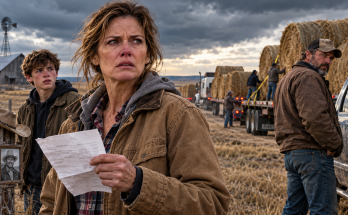
Ada Haller was waiting at the kitchen table when I arrived in Cody, with two cups of coffee, a plate of buttered toast, and a brown file folder she had apparently been saving for this conversation. She had dressed carefully in a blue cardigan and pressed trousers, her silver hair pinned back with the same tortoiseshell comb she wore to Tom's funeral. Her quad cane rested against the table. When she saw the envelope in my hand, her gaze lingered on it before she looked up at my face.
“That's Tom's writing,” she said.
I sat across from her. “He left me a letter.”
“I thought he might.”
The answer surprised me enough that I forgot my prepared questions. Ada poured coffee into my cup, moving slowly because her right hand had never fully recovered from the stroke. She noticed me watching and gave an impatient little shake of her head. “I can still pour coffee, Karen. Tell me what my son wrote.” There was affection beneath the sharpness. Ada had spent her life refusing to be treated as fragile, and she had become even more determined since moving into Dwayne and Marlene's house.
I explained that Tom had left money for us, that I had found it where his notebook directed me, and that the north eighty was now free of its remaining loan. I did not mention the exact amount. Ada listened without interruption, her fingers resting against the edge of the table. When I finished, she looked toward the window, where a line of cottonwoods moved gently in the autumn wind. “That boy,” she said quietly. “Always trying to fix things without telling anybody what he's doing.”
“He should have told me.”
“Yes,” she answered immediately. “He should have.”
Her agreement eased something in me. I had been grateful for the money, but gratitude had not erased the hurt of discovering that Tom had hidden a substantial part of our finances for years. I needed somebody who loved him to acknowledge that his intentions did not make the secrecy harmless. Ada understood without requiring me to explain. She had raised him. She knew the stubborn silence that could make him dependable in an emergency and impossible to reach when something truly mattered.
“What else did he write?” she asked.
I hesitated before placing the envelope on the table. “He was worried about Dwayne. He thought your younger son might try to interfere with the ranch after he died.”
Ada closed her eyes. She remained that way for several seconds, as if listening to a familiar sorrow arriving again. Then she opened the brown folder and withdrew a yellowed sheet covered in typed figures. “I was afraid we'd come to this,” she said. “Not the hay specifically. I never imagined Dwayne would do something quite so foolish. But I knew the old resentment was getting worse.”
The document was an inventory from the estate of Ada's late husband. I recognized the family name and the date, though I had never seen the papers before. The figures listed farm equipment, livestock interests, machinery debts, and the outstanding obligations attached to the property. Ada drew the page toward herself and tapped one column with a crooked finger. She said Dwayne had spent most of his adult life remembering the inheritance as a simple division: Tom received the land, while Dwayne received a worn pickup and one hundred dollars.
“That part is true,” she said. “But it isn't the whole story.”
I studied the page. The value of the property looked substantial until I began subtracting the debts. Equipment loans, operating expenses, and obligations connected to the livestock reduced the remaining amount sharply. Ada explained that her husband had been increasingly worried about keeping the operation solvent during his final years. Tom, who had stayed home and worked beside him, had already taken responsibility for many of those problems. Dwayne had left to find work elsewhere and had not been involved in managing the accounts.
“Your father-in-law believed Tom could keep the working property together,” Ada said. “That was why he left those interests to him. It wasn't because Dwayne mattered less. At least, I don't believe that was what he intended.”
“But that's what Dwayne heard.”
“Exactly.”
She looked down at the document. The will had been read in a lawyer's office on a wet spring morning. Dwayne sat beside her, barely twenty, expecting something that would help him start his own life. When the attorney explained the distribution, he became so quiet that Ada thought he had misunderstood. Later, outside, he asked why his father had loved Tom more. Ada had tried to explain the debts and the responsibilities. He refused to listen.
“I should've insisted their father speak to both boys while he was alive,” she said. “He was a difficult man, and I spent too much time trying to keep the peace. By the time I understood how deeply Dwayne was hurt, there was nobody left who could answer the question he kept asking.”
I imagined a young Dwayne standing outside the lawyer's office, holding the keys to an old pickup while his older brother received documents bearing the family property descriptions. Whatever the financial realities, the difference would have felt enormous. I could understand why the memory remained painful. But understanding it did not explain why a fifty-seven-year-old man believed he had the right to injure his brother's widow and son.
“Tom didn't receive a fortune,” Ada continued. “Most of what came to him was work, debt, and property that needed more money than it produced. He eventually dealt with those old obligations. The ranch you and he bought in 1998 was a different undertaking. You borrowed money, and you both earned what you have.”
“I know.”
“Dwayne knows it, too. He just doesn't like remembering it.”
Ada reached into the folder and brought out another sheet. It was a letter Tom had written years earlier after an argument with his brother. The handwriting was younger and less careful than in his final message to me, but I recognized the same square capitals. He had written that he could not undo their father's decision and would no longer apologize for the years he spent working the property. He also said he wanted a relationship with Dwayne that was not constantly measured against the estate.
“Did he send this?” I asked.
“No. He brought it to me and asked whether I thought it would help. I told him it might make matters worse. I regret that now.”
I read the letter slowly. Tom had written about childhood chores, long evenings repairing equipment, and the day he and Dwayne tried to build a shelter for an injured calf. He remembered his brother as clever and funny, quick with machinery and capable of fixing nearly anything when he applied himself. The affection in those memories was unmistakable. So was the exhaustion beneath them. Tom had wanted his brother to stop making every conversation a reckoning over the past.
Ada watched me read. “Dwayne wasn't always like this. He could be generous. When his children were small, he worked two jobs for a while. He helped neighbors with their trucks and never charged enough. Then something would disappoint him, and he'd start talking about what Tom had that he didn't. It became a way of explaining every hard thing in his life.”
“Tom tried to help him.”
“He did. Sometimes too much.”
I looked up. Ada nodded toward the folder. Over the years, Tom had paid for repairs Dwayne could not afford, helped him locate work, and once guaranteed a small equipment loan. Some of those arrangements had ended well. Others left both brothers angry. Ada had sometimes intervened, hoping they could settle their differences without making her choose between them. She admitted that her efforts to remain neutral had often allowed Dwayne to avoid confronting his own decisions.
“Tom believed if he helped enough, Dwayne would finally stop resenting him,” she said. “Dwayne believed every favor proved his brother had something to spare.”
The distinction was painful because it explained so much. My husband had spent his life trying to repair what their father left unresolved. Dwayne had interpreted those efforts through the same old grievance. Even generosity became evidence of inequality. I thought of the cash box buried beneath the windbreak, the money Tom had saved in secret because he feared we might lose everything. I wondered how much of his determination to protect our ranch had been shaped by watching his own family fracture over property.
“Did Dwayne know Tom was worried about him?” I asked.
“He knew they had problems. Whether he understood how serious they had become, I couldn't say.”
Ada moved her untouched toast aside. “When Tom's illness became worse, Dwayne came here one evening and said you would probably have to sell. He spoke about it as though it were inevitable. I told him you knew your business and would decide for yourself. He said you had never run the place without Tom.”
I felt my jaw tighten. “He said the same thing to me.”
“I know. Marlene told me.”
“What did you say when he started talking like that?”
“I told him he was treating Tom's death as an opening to settle an argument that should have ended forty years ago.”
The directness surprised me. Ada had spent much of her life softening disagreements between her sons. Hearing that she had confronted Dwayne before the hay sale made me reconsider the idea that she needed protecting from every difficult truth. She was elderly and physically limited, but she understood her family with an accuracy that neither brother had always appreciated.
“Did he listen?” I asked.
“No. He said he was only being practical.”
I almost laughed, though there was nothing funny about it. Dwayne had used that word repeatedly in our kitchen. Practical. He had presented the destruction of our winter feeding plan as a sensible adjustment to life without Tom. Now I heard the same justification in Ada's account. It seemed he had spent weeks preparing himself to believe that whatever he decided would be more reasonable than anything I chose.
Ada took a breath. “Karen, I need to ask you something. When you went to Arlen and Gene, did they understand Dwayne had no authority to sell the hay?”
“Yes. They returned everything they bought. So did Steve and Kim Reyes.”
“And they know you never planned to leave?”
“They do.”
She nodded. “Then the lie has been corrected with the people who heard it.”
“Not all of them, perhaps. I don't know who else Dwayne talked to.”
“That's something he should answer.”
I looked at her carefully. “Are you asking me to confront him?”
“I'm asking you not to carry his wrongdoing just because he's my son.”
The words were so unexpected that I had to look down at my coffee. For days, I had worried that holding Dwayne accountable would hurt Ada. I had imagined her caught between loyalty to the son who housed her and grief for the son she had buried. Yet she was refusing to let her circumstances become an excuse for his behavior.
“I don't want you to lose your home because of this,” I said.
Ada gave me an astonished look. “Marlene and Dwayne aren't going to put me on the road because you insist he answer for what he's done. And if they tried, we would deal with that. I'm old, Karen, not helpless.”
I smiled despite myself. “Tom used to say that.”
“He learned it from me.”
We sat quietly for a while. Ada opened the folder once more and showed me a photograph of the brothers as children. Tom stood on the left, perhaps twelve years old, with his hand resting on the shoulder of a smaller boy whose hair stuck out in every direction. Dwayne was grinning at the camera. Tom looked solemn, already carrying himself like somebody responsible for keeping everyone else safe. I studied the photograph and wondered whether either child could have imagined what they would become.
“Do you think Dwayne intended to force us off the ranch?” I asked.
Ada did not answer immediately. She folded her hands over the file. “I think he wanted to be the person who decided what happened next. Whether he understood how much damage that could cause, you'll have to ask him.”
“He understood enough to tell three buyers I was leaving.”
“Yes.”
“And enough to sell the hay for almost nothing.”
“Yes.”
“And then he called the Reyes family after the others started returning it.”
Ada's face tightened. “Marlene told me about that call. She was furious with him.”
I leaned back. Until then, I had assumed Marlene was either unaware of the details or unwilling to become involved. She was usually pleasant but reserved around me, careful not to contradict her husband in public. I wondered what it had been like inside their house since the buyers returned the hay. Dwayne had lost the control he tried to establish, and the people closest to him were beginning to question his behavior.
“Has Marlene said what she thinks he should do?” I asked.
“She thinks he should apologize, repay the buyers, and admit he lied. She also thinks he should speak to Ben. The boy has been hurt more than Dwayne understands.”
I looked at the photograph again. Dwayne had once been a younger brother looking toward Tom for guidance. Now Ben was a son looking toward the people who had known his father. The comparison was imperfect, but it made me realize how much damage old family resentments could pass from one generation to the next if nobody interrupted them.
Ada noticed my expression. “What are you thinking?”
“That I don't want Ben spending the next forty years telling himself his uncle destroyed something his father left him.”
“Then don't let Dwayne turn this into another family story where everybody chooses a side and stops speaking. Make him tell the truth.”
I looked at her. “And if he won't?”
“Then you'll know where you stand.”
Her answer was simple, but I could see how much it cost her. She loved both sons. One was dead, and the other had behaved disgracefully toward the people left behind. There was no version of this situation in which Ada escaped pain. Yet she was asking for honesty rather than the comfortable appearance of peace. I reached across the table and rested my hand over hers.
“I won't ask you to choose between your sons,” I said.
“You aren't. Tom isn't here to choose. Dwayne is the one making choices now.”
The clock above the stove struck eleven. Ada looked toward the driveway, apparently expecting Marlene's car at any moment. Instead, we heard the low rumble of Dwayne's pickup. He was supposed to be away until afternoon. Ada's expression changed immediately. She turned toward me, then toward the front window. The truck stopped beside the garage, and the engine cut off.
I looked down at the envelope containing Tom's letter. I had placed it beside the estate folder while we spoke. For a moment, I considered slipping it into my purse and leaving through the kitchen door. I had come to hear Ada's account, not to confront Dwayne without preparation. But I also knew that avoiding him would only postpone the conversation we had spent the morning discussing.
The front door opened. Dwayne's boots struck the entryway floor, and he called out to his mother. When he entered the kitchen, he stopped so abruptly that his shoulder brushed the doorframe. His eyes moved from Ada to me, then to the old estate papers spread across the table.
“What are you doing here?” he asked.
“Visiting your mother,” I answered.
He looked at the file again. The color left his face. “Why have you got Dad's papers out?”
Ada lifted her chin. “Because it's time we stopped pretending that old business explains what you've done.”
Dwayne's gaze shifted to the envelope beside my hand. He recognized Tom's handwriting immediately. For several seconds, nobody spoke. Then he asked, in a voice stripped of its usual confidence, “Did Tom leave something about me?”
I looked at the man who had sat in my husband's chair three days after the funeral and sold our winter feed. I had arrived intending only to listen. Now the person responsible was standing across from me, and the question he had asked could no longer be avoided.
“Yes,” I said. “He was worried about you.”
Dwayne gripped the back of a chair. His mouth moved, but no words came. For the first time since the funeral, I saw something other than arrogance or irritation on his face.
I saw fear.