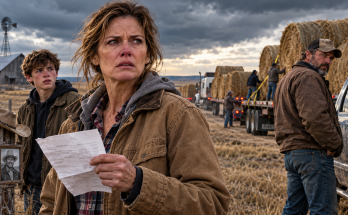
The first sentence about Dwayne was written more heavily than the rest of Tom's letter, as though he had pressed the pen against the paper while searching for the courage to continue. He knew his brother carried an old grievance. He knew that grievance had shaped the way Dwayne looked at our land, our cattle, and almost every decision we made. More troubling, Tom admitted that he had sometimes avoided confronting the problem because he hoped the years would eventually soften it.
I read those lines at the kitchen table while the cash box stood open beside me. Outside, Ben was repairing a gate near the barn. I could hear the occasional strike of his hammer and the low sounds of cattle moving through the lot. Everything appeared ordinary. Yet the letter in my hands was changing the way I understood a family I had belonged to for nearly thirty years.
Tom wrote about the death of his father, a loss that had divided the brothers long before I married into the family. Their father had left the working property and most of his agricultural interests to Tom, believing his older son would keep the operation productive. Dwayne received an old pickup and one hundred dollars. The arrangement had been unfairly abrupt, and Tom admitted that his father had done little to explain the decision. Dwayne was still young enough to believe that an inheritance measured how much a parent loved a child.
I remembered hearing pieces of that story during family gatherings. Dwayne occasionally complained that Tom had been given every opportunity while he had been forced to make his own way. Tom rarely answered. He would change the subject or leave the room, allowing Dwayne's resentment to pass without argument. At the time, I interpreted his silence as patience. Now I wondered whether he had simply been unable to find a way of discussing their father's decision without making his brother feel smaller.
The land Tom and I bought in 1998 was something we had financed and worked together. We had borrowed eleven thousand dollars from Ada and taken on obligations that frightened us for years. The fences, machinery, cattle, and improvements represented countless decisions and sacrifices. Whatever family history lay behind Tom's connection to the ground, Dwayne had never owned our present operation. Yet he seemed to treat it as an extension of an inheritance he believed had been stolen from him.
Tom's letter acknowledged that resentment without accepting it as an excuse. He wrote that Dwayne had spent much of his life comparing himself with his older brother. Every successful calf sale, every repaired barn, and every year we managed to hold the ranch together became another reminder of something Dwayne thought he deserved. Tom had tried to help him over the years, sometimes with money and sometimes with opportunities to work. But the assistance never seemed to settle what had begun when their father died.
I stopped reading and looked at the envelope Dwayne had given me after selling the hay. I could still see him sitting in Tom's chair, drinking from his brother's cup and speaking as though our future had already been decided. The memory no longer appeared merely arrogant. There had been a purpose beneath it. Dwayne had told the buyers that I was leaving the ranch because that was the outcome he expected—or wanted. Without winter feed, I might have been forced to sell cattle. With the herd gone, keeping the property would have become much harder.
I did not know whether he had planned every consequence. He might simply have seen a way to take control while I was too exhausted to resist. But the practical effect was clear. He had removed the resource that would allow Ben and me to remain on the ranch through winter. It was difficult to believe that somebody who had grown up around cattle could fail to understand what that meant.
I returned to the letter.
Tom admitted that he was worried about what Dwayne might do after his death. He described his brother as a man who often mistook fear for anger and entitlement for justice. He knew Dwayne could cause serious harm when he believed somebody else had received what should have been his. But Tom also remembered the boy who had followed him through their father's barn, the younger brother who once trusted him to handle every frightening thing in their small world.
My husband had not asked me to pretend Dwayne was innocent.
He had asked me not to let his brother take the ranch, and not to allow our family to be destroyed completely if there was a way to prevent it. He wanted me to protect Ben, protect the land, and insist that Dwayne accept responsibility. Only after those things were secure did he hope I might consider offering his brother a chance to make amends.
The request made me put the letter down.
For several days, I had been working toward a clear objective. I needed the hay returned. Arlen had helped. Gene had helped. Steve and Kim had returned their thirty-two bales, even though doing so created difficulties for their own winter plans. Their decisions had restored something Dwayne had taken. I could measure the result in rows of feed standing behind the barn.
Forgiveness could not be measured that way.
I thought about Ben standing in our kitchen, furious because his uncle had treated Tom's final cutting as something he could sell. I remembered my son's face when he learned that Dwayne had told neighbors we were leaving the ranch. Nothing in Tom's letter changed the humiliation or fear that decision had caused. Nothing made the betrayal less serious. I loved my husband, but I was not willing to sacrifice our son's security simply to satisfy a wish Tom had been unable to discuss with me.
I read the remaining lines. Tom wrote that whatever I decided, the choice should be mine. He admitted that asking me to leave any opening for Dwayne was a burden he had no right to impose. He only hoped I might remember that his brother was more than the worst thing he had done. The letter ended with an expression of love so simple and direct that I had to stop reading. Tom had spent almost thirty years showing affection through work, through repairs, through quiet gestures made when nobody was watching. Seeing the words written plainly overwhelmed me.
I folded the letter and held it against my chest. For a long time, I sat at the table without moving. The money lay in orderly bundles beside me. It could pay the remaining note on the north eighty and leave enough to ease our immediate worries. Tom had prepared a practical answer to the financial uncertainty that followed his death. But he had also left an emotional obligation, one I was not certain I could accept.
When Ben came inside, he found me staring at the closed cash box. He washed his hands at the sink and sat across from me. He asked whether I had finished reading. I nodded. He looked at the letter, then at my face.
“Was there something bad in it?”
“Nothing I didn't already know in some form.”
“Is it about Uncle Dwayne?”
I looked at him sharply. “Why do you ask?”
“Because Dad worried about him. He didn't say much, but I could tell.”
Ben leaned back in his chair. He told me about a conversation he had overheard during the previous spring, before Tom became too weak to spend much time outside. Dwayne had visited the ranch and argued with his brother near the machinery shed. Ben had been working behind the barn and could hear only parts of the exchange. Dwayne complained that Tom had benefited from their father's decisions and never understood what it felt like to be left with nothing. Tom told him that the past could not be changed by punishing people who had no part in making it.
I closed my eyes briefly. That sounded exactly like Tom.
“Did they fight?” I asked.
“Not really. Uncle Dwayne got loud. Dad stayed quiet.”
“What happened afterward?”
“Dwayne left. Dad went back to fixing the mower.”
Ben paused. “I asked him whether everything was okay. He said his brother had been angry for a long time, and sometimes anger becomes a habit.”
I thought about the years Tom had spent trying to preserve a relationship that rarely brought him peace. Perhaps he had believed that if he remained patient enough, Dwayne would eventually stop measuring their lives against each other. Perhaps he had been frightened of losing the last person who remembered their childhood from inside the same house. I could understand that fear without agreeing that my husband should have endured every accusation.
“Your father wrote something about Dwayne,” I told Ben. “He wanted me to protect this place. But he also hoped there might be a way for your uncle to take responsibility without being shut out forever.”
Ben's expression hardened. “He doesn't deserve that.”
“Maybe not yet.”
“He hasn't even apologized.”
“I know.”
“He hasn't returned the money or offered to do anything.”
“I know that, too.”
Ben looked away. I could see how difficult it was for him to hear that his father had wanted anything generous for Dwayne. My son had watched Tom weaken and die. He had helped with the harvest, the feeding, and the chores his father could no longer manage. His uncle had contributed little during those months and then created a crisis immediately after the funeral. Expecting Ben to separate that behavior from the possibility of future reconciliation would require time.
“I won't ask you to forgive him,” I said.
Ben looked back at me.
“I won't ask you to pretend that what happened was acceptable. If Dwayne wants any kind of relationship with us, he'll have to acknowledge what he did. Words alone won't be enough.”
“What does that mean?”
“It means he'll have to show us through his actions that he understands the harm.”
Ben considered that. “And if he doesn't?”
“Then we live our lives without depending on him.”
He nodded slowly. I could tell he was still angry, but he no longer looked as though he expected me to abandon him in order to honor Tom's wishes. That mattered more than whether he agreed with every decision I might make. I wanted him to know that his feelings were not obstacles to be managed. They were part of the truth we would have to face.
That afternoon, I returned the money to the cash box and locked it in the cabinet where we kept important documents. I had spent too many years balancing other people's accounts to treat such a discovery casually. Before using any of it, I wanted a complete record of what Tom had left and how it would affect our finances. I gathered the envelopes, his letter, the notebook, and the documents relating to the old tractor sale. I also found the latest statement for the note on the north eighty.
The figures confirmed what Tom had written. The hidden reserve was sufficient to discharge the remaining balance, with several thousand dollars left over. I calculated the amount twice, allowing for any accrued interest or fees. The result did not change. For the first time since we purchased the land, the north eighty could become free of the debt that had accompanied it for years.
I went to the bank in Valentine the following morning. I carried the records in a leather folder and the cash in a locked case, feeling strangely conspicuous even though nobody paid particular attention to me. The banker had known Tom for decades. He greeted me gently and asked how Ben and I were managing. I told him we were beginning to find our footing, then explained that I needed to discuss a cash deposit and the outstanding land note.
His eyebrows rose when I described the amount and its history. He asked sensible questions about the old machinery sale and the accumulated savings. I showed him the documents Tom had preserved and explained that the cash had been stored privately for years. The bank completed its required paperwork, reviewed the account details, and arranged the steps necessary to deposit the funds and settle the loan.
I had expected the process to feel triumphant. Instead, I felt oddly subdued. Money that had been hidden in a field for nearly a decade was becoming entries in a bank account. The practical change was enormous, but Tom was not there to share it. I wanted to see him leaning back in the chair across from the banker, listening with his quiet, skeptical expression before asking one brief question about the interest calculation.
The final payoff was arranged once the account and estate documents were confirmed. When the transaction cleared, the remaining note on the north eighty was satisfied. The banker gave me the written confirmation and explained when the recorded release would follow. I held the papers in both hands. For years, the land had been both our livelihood and a financial responsibility that never quite allowed us to relax. Now that particular obligation was gone.
I placed the remaining money in a savings account held for Ben and me. It was not enough to make us wealthy, and I had no intention of treating it as though it were. The ranch would still require repairs, feed, veterinary care, taxes, and the usual unpredictable expenses. But the reserve meant we could approach those demands without immediately fearing that one bad season would force us to sell.
On the drive home, I pulled over beside a stretch of pasture where Tom and I used to stop when Ben was small. There was a low rise from which we could see miles of rolling grassland. I sat in the pickup with the bank papers on my lap and looked toward the horizon. Tom had known how frightened I would be after his death. He had spent his final months trying to give me time, feed, and financial breathing room. I was grateful for what he had left. I was also sad that he had carried so much alone.
I took out his letter and read the section about Ben once more. Tom wanted our son to have an education and experiences beyond the ranch before deciding whether to spend his life there. He believed a person should choose home because it was where he wanted to be, not because he was afraid to leave. I thought about the conversations Ben and I would need to have during the coming months. His father had left us resources, but the difficult work of living without him remained.
When I returned home, Ben was in the barn repairing the gate he had started earlier. I showed him the bank documents and explained that the note had been paid. He stared at the confirmation for a long time. Then he walked outside and looked across the north eighty. I followed him, uncertain what he was thinking.
“So the bank doesn't own part of it anymore?” he asked.
“The loan is paid. The land is ours, subject to the usual taxes and responsibilities.”
He nodded. “Dad would've liked that.”
“He would.”
Ben looked toward me. “Are we staying?”
The question was so direct that I could not answer it with another practical explanation. I thought about everything the ranch represented, including the years of work, the memories, and the grief that now lived in its familiar places. I also thought about the freedom Tom had tried to give me. He had not wanted the land to become a prison simply because we loved him.
“For now, yes,” I said. “I want to stay. But we're going to make sure it's a choice we can keep making.”
Ben smiled faintly. “I want to stay, too.”
“I know. And I want you to finish school.”
“I figured you'd say that.”
“We'll talk about what comes next after graduation.”
He nodded, then turned back toward the barn. The conversation was unfinished, but for the first time it did not frighten me. We had a winter supply of hay, a paid-off note, and enough money to handle immediate needs. There would still be hard decisions, but they would no longer all be driven by the fear of losing the ranch.
Two weeks passed before I felt ready to address the remaining problem. During that time, Ben and I prepared the cattle for colder weather, repaired sections of fence, and organized the feed in the stackyard. Arlen stopped by twice, once with a borrowed piece of equipment and once simply to see how we were managing. Gene called about the Reyes family's replacement hay and confirmed that Steve had arranged a satisfactory purchase. The young couple sent a note thanking us for helping them find another supplier.
Dwayne did not contact me.
His silence was almost as irritating as his earlier arrogance. He had sold our property, lied to the buyers, and created an emergency during the worst week of our lives. Now that the hay had been returned, he appeared content to remain out of sight. I did not know whether he was ashamed, angry, or simply waiting for the matter to fade. I had no intention of allowing it to disappear without an acknowledgment of what he had done.
On a Thursday afternoon, I called Ada Haller in Cody. She had been living with Dwayne and Marlene since 2019, after managing alone became too difficult. A minor stroke the previous year had left her walking with a quad cane, but her mind remained sharp. I had visited her several times during Tom's illness, though less often than I wanted in the chaotic final weeks. When she answered, I recognized the firm voice that had guided her sons through childhood and had once insisted Tom and I accept the eleven-thousand-dollar loan that helped us purchase our ranch.
“Karen,” she said. “I've been wondering when you'd call.”
I apologized for not visiting sooner. She dismissed the apology and asked after Ben. I told her he was working hard and that we had recovered the hay. She was silent for a moment. Then she said she knew more about the situation than I might expect.
“Marlene told me what happened,” Ada said. “Dwayne hasn't been himself since the neighbors brought those bales back.”
I leaned against the kitchen counter. “Has he said anything to you?”
“Not much. He spends most evenings in the den. Marlene says he hardly sleeps.”
I did not know how to respond. Part of me wanted to say that losing sleep was a small consequence compared with what he had nearly cost us. Another part remembered Tom's letter, the old inheritance grievance, and the request to leave some possibility of repair. I told Ada I wanted to come by and speak with her privately before deciding what to do.
“Come tomorrow,” she said. “Marlene has an appointment in the morning, and Dwayne should be out.”
I agreed. Then Ada hesitated. I could hear her breathing through the telephone, the faint sound of a television playing somewhere behind her. When she spoke again, her voice had become unusually serious.
“Karen, there's something about those two boys you need to understand. Tom carried the weight of their father's decision for years. Dwayne carried the anger. Neither one ever learned how to set it down.”
I closed my eyes. The words were painfully close to what Tom had written.
“Do you think Dwayne understands what he's done?” I asked.
“I think he's beginning to,” she answered. “But understanding isn't the same as making it right.”
I looked toward the barn, where Ben was carrying tools inside before dark. Tom had given me a way to secure the ranch and a request concerning his brother. Ada was now asking me to hear the history from the person who had raised them both.
“I'll come in the morning,” I said.
After ending the call, I placed Tom's letter in a clean envelope and set it beside my coat. I did not know whether I would ever show Dwayne what his brother had written. I had no promise of forgiveness to offer, and I was not going to let an old family grievance excuse the harm he had caused. But I was willing to listen to Ada before deciding how firmly the door between us should close.
The following morning, I would hear the story of two brothers who had spent half a century measuring themselves against the same loss. And I would have to decide whether Tom's final request could become something more useful than another burden left on my shoulders.