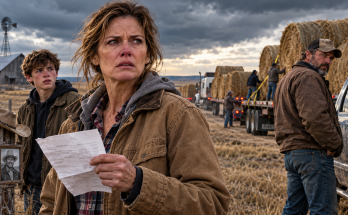
Dwayne pulled out the chair opposite me but did not sit. He kept one hand on its back, his fingers tightening around the wood as he stared at Tom's envelope. The old estate documents lay open between us. Ada remained seated at the end of the table, watching her younger son with an expression I had never seen her wear before. She looked tired, disappointed, and determined not to rescue him from the conversation he had interrupted. Outside, a gust rattled the screen door against its frame.
“What did he write?” Dwayne asked again.
I placed my palm over the envelope. “That's between Tom and me for now.”
“He was my brother.”
“He was my husband.”
The answer stopped him. Dwayne looked toward Ada, perhaps expecting her to remind me that family had a right to know what Tom left behind. She said nothing. He pulled the chair back farther and sat heavily, resting his forearms on the table. There was a grease stain on one cuff of his work shirt, and his hair had been flattened beneath his cap. He looked older than he had in my kitchen the morning he announced the sale. I could not tell whether the change came from guilt, lack of sleep, or the realization that everyone had begun questioning him.
“I didn't come home expecting this,” he said.
“Neither did I.”
“Mom could've called and told me you were coming.”
Ada's voice was quiet. “Karen came to speak with me. She doesn't need permission to visit her mother-in-law.”
Dwayne rubbed his forehead. He glanced at the estate papers and shook his head. “So now we're dragging up everything Dad did forty years ago?”
“You've been dragging it up for forty years,” Ada answered. “Karen is only trying to understand why you're still using it against Tom's family.”
He looked wounded by the accusation, and for a moment I saw the younger brother Ada had described. Then his familiar defensiveness returned. He said nobody understood how difficult it had been to watch Tom inherit the family property while he was given a truck that barely ran. He had gone away to find work, paid his own bills, and built a life without the advantages his brother received. Every time he mentioned those years, his voice grew louder, as though volume could finally make somebody acknowledge the injustice.
I let him speak. There was a time when I would have interrupted to defend Tom, explaining the debts, the years of work, and the difference between inherited obligations and actual wealth. But Ada had already presented those facts. Dwayne knew them. What he wanted was not information. He wanted permission to treat the hurt he experienced as a permanent debt everyone else owed him. I waited until he stopped, then asked the question I had come to understand was unavoidable.
“What did any of that have to do with selling my hay?”
He stared at me. “I thought you needed help.”
“Then why didn't you ask?”
“Because you were barely functioning after the funeral.”
I felt my face grow hot. I had spent that week signing paperwork, making arrangements, comforting our son, feeding cattle, and trying to remember whether I had eaten. I had barely slept, but that did not mean I had lost the ability to make decisions about property I owned. Dwayne had seen me at the worst moment of my life and chosen to interpret my grief as incompetence.
“I was grieving,” I said. “I wasn't incapable.”
“I never said you were.”
“You told three buyers I was selling the ranch because I couldn't manage it without Tom.”
Dwayne looked away. “I said it might be best.”
“Arlen heard that I had decided to leave. Gene heard the same thing. Steve and Kim Reyes were told I was getting rid of everything. Those aren't suggestions, Dwayne. You presented them as decisions I'd already made.”
He began to answer, then stopped. The silence was long enough that I could hear Ada's clock ticking on the wall. I took out the paper Dwayne had given me after the sale and placed it beside the estate documents. Three names. Two hundred and twelve bales. Eight dollars each. The figures looked almost absurd in that room, where we were discussing inheritance papers that had been examined and argued over for decades.
“Tell me why you chose eight dollars,” I said.
He shifted in his chair. “It was quick money.”
“For whom?”
“For you.”
“I couldn't replace ten bales for what you accepted on more than a hundred. You knew what hay cost.”
He looked toward the window. “People were willing to haul it themselves.”
“Because you practically gave it away.”
Ada reached for the paper. She studied the names and figures, then looked at her son. “You knew better than this.”
Dwayne's jaw tightened. “Everybody keeps saying that.”
“Because it's true.”
He pushed the chair backward and stood. For a second I thought he intended to leave. Instead, he walked to the sink, filled a glass with water, and drank while staring through the window. His shoulders were hunched beneath his shirt. I remembered him standing in our kitchen after Tom's death, trying to convince me that the sale was a favor. There had been no hesitation in him then. He had expected anger, perhaps, but he had also expected his decision to stand.
“Arlen and Gene returned the bales,” I said. “So did the Reyes family. Every one of Tom's two hundred and twelve is back.”
Dwayne turned slowly. “I heard.”
“Gene brought another twelve from his own supply.”
He gave a small, bitter laugh. “Of course he did. Everybody gets to be the hero now.”
The remark struck me harder than his earlier excuses. Those men had spent an exhausting day repairing damage they had not deliberately caused. Steve and Kim had given up a bargain that mattered to their young family. Yet Dwayne heard only a story in which other people received praise while he was blamed. He was still measuring everything by what it meant for him.
“No,” I said. “They were people who heard the truth and changed what they were doing.”
He looked at me, startled by the firmness of my voice.
“They didn't have to enjoy admitting they were wrong,” I continued. “Arlen was embarrassed. Gene told Ben he'd liked the cheap price and ignored his doubts. Steve had to buy replacement hay for his horses. But all of them accepted what had happened and tried to correct it. You're the only person who still insists there was nothing wrong with the sale.”
“I gave you the money.”
“You gave me less than two thousand dollars for nearly fifteen thousand dollars of winter feed. And you acted as though I should thank you.”
Ada pushed herself upright with one hand on the table. “Dwayne, sit down.”
He looked toward her, his face flushed. “Mom, this doesn't concern you.”
“It concerns me because you are my son and because Tom was my son. I buried one of you three weeks ago. I'm not going to watch the other destroy his family because he cannot admit he made a terrible decision.”
Dwayne sat. His expression changed again, this time with something close to humiliation. I did not take pleasure in seeing it. I had imagined confronting him many times, but in those imagined conversations my anger produced clear admissions and satisfying answers. The real discussion was harder. He looked like a frightened man who had spent years building explanations for himself and had finally reached a moment when none of them worked.
“Tom knew you were angry with him,” I said.
Dwayne's eyes moved toward the envelope.
“He wrote about it. He knew the inheritance still troubled you. He was worried that after he died, you might try to take control of things that belonged to Ben and me.”
Dwayne stared at the table. “He always thought he knew me.”
“He knew you well enough to be worried.”
“That doesn't mean he was right about everything.”
“No. It doesn't. But he was right that you weren't prepared to respect my decisions.”
His mouth tightened. For a moment I wondered whether he would attack Tom's character, telling me about every disagreement they had ever had. Instead, he spoke more quietly. “I thought you'd sell the cattle eventually. I thought the ranch was too much for you.”
“Then you should have let me reach that conclusion myself.”
“I was trying to get ahead of it.”
“By selling the feed that would let us keep the herd?”
He looked down. His fingers moved across the table, tracing the worn edge of the wood. When he finally answered, his voice was barely above a whisper. “I knew you wouldn't agree if I asked.”
The admission changed the room. Ada closed her eyes. I felt the words settle in me with a strange, cold clarity. Until then, Dwayne had hidden behind the claim that he was trying to help. Now he had acknowledged the most important fact. He knew I would refuse, so he acted while I was too overwhelmed to stop him.
“Then you knew you were taking something you had no right to sell,” I said.
He did not answer.
“Look at me, Dwayne.”
He raised his eyes reluctantly.
“Did you understand that without those bales, Ben and I might have to sell part of the herd?”
“Yes.”
“Did you understand that selling cattle could make keeping the ranch harder?”
He swallowed. “Yes.”
I waited. Ada sat motionless beside us. The house was quiet except for the faint hum of the refrigerator. For the first time, I felt no need to argue. Dwayne had said enough to establish that this had not been an innocent misunderstanding.
“Did you want us to leave?” I asked.
He looked toward his mother, then back at me. “I thought it would be better for everybody.”
“Everybody?”
“For you. For Ben. You could've moved to town. You wouldn't have to struggle with the cattle. The land could've been sold properly instead of wearing you down.”
“And who would have handled that sale?”
He hesitated. “I could've helped.”
The answer was enough. I had spent years listening to Dwayne speak as though Tom's ranch represented an opportunity he had been denied. Now, with Tom gone, he had imagined himself in charge of the decisions that followed. He had not needed to steal the ranch outright to interfere with our lives. He only needed to make staying difficult enough that I would eventually accept his version of what was sensible.
Ada's voice broke the silence. “You wanted to be the man making the decisions after Tom died.”
Dwayne looked at her. “Somebody had to.”
“Karen was already doing that.”
“She'd never run the place alone.”
“She had run it beside your brother for nearly thirty years.”
He opened his mouth, then closed it. Ada leaned forward, resting both hands on the table. “You looked at your brother's death and saw another chance to prove you should've been the one trusted with the land. That is what you've been doing all these years.”
“That's not fair.”
“Neither was selling his family's winter feed.”
Dwayne pushed away from the table again, but this time he did not stand. He covered his face with both hands. I could see his shoulders moving as he breathed. I wondered whether he was crying, but I did not try to comfort him. His distress was real, and so was the harm he had caused. I had spent too much time attending to other people's feelings while my own life was collapsing.
The front door opened, and we heard Marlene calling from the entryway. She came into the kitchen carrying a shopping bag and stopped when she saw us. Her gaze moved from the estate papers to Dwayne's bent head. She set the bag down carefully.
“I didn't know Karen was here,” she said.
“I asked her to come,” Ada answered.
Marlene looked at me. “I'm glad.”
Dwayne lifted his head. “We've already gone over everything.”
“Have you?” she asked.
He said nothing.
Marlene sat beside him. She was a quiet woman, several years younger than Dwayne, with a practical manner and a habit of straightening objects when she was nervous. She placed the shopping bag beneath the table and folded her hands. I could see that she had been living with the consequences of the hay sale since the buyers began returning it. She looked exhausted, but there was no uncertainty in her expression.
“I told him not to call the Reyes couple,” she said to me. “He did it anyway.”
Dwayne looked at her sharply. “Marlene.”
“You asked them not to return the hay. I heard you. Then you spent two days complaining that everybody was turning against you.”
“I was upset.”
“You were embarrassed because people found out what you'd done.”
He stared at her. She continued before he could interrupt. “Tom was your brother. Karen is your sister-in-law. Ben is your nephew. You should have been helping them bury a man they loved, not deciding how to dispose of what he left behind.”
I looked down at my hands. Hearing another person speak the truth so plainly was unexpectedly difficult. I had carried the confrontation in my mind for days, imagining that I would have to persuade everyone that Dwayne's conduct was serious. Instead, his own mother and wife were refusing to defend him. The isolation he seemed to feel was not the result of a conspiracy. It was the consequence of choices he had made.
Marlene turned toward me. “What do you need him to do?”
The question was practical, and I was grateful for it. I had not come to Ada's house with a written demand, but the conversation had made clear that apologies alone would not be enough. I told them that the buyers needed formal confirmation that Dwayne had acted without permission. I wanted him to correct every false statement he had made about our plans to sell the ranch. I wanted the money handled properly so that nobody was left paying for a transaction that should never have happened. And I wanted him to stay off our property unless I invited him.
Dwayne looked up. “You're banning me from Tom's place?”
“From my home,” I said. “And Ben's.”
He flinched at the distinction. I did not soften it. Tom was gone. The ranch was not an inheritance Dwayne could still contest through his brother. It was the home Ben and I had to protect. If Dwayne wanted a relationship with us, he would have to begin by respecting that boundary.
Marlene nodded. “That's reasonable.”
Dwayne looked at her in disbelief. “You're taking her side?”
“I'm taking the side of what actually happened.”
He stood abruptly and walked to the doorway. For several seconds, he remained there with his back to us. Then he turned. His face was pale, and his voice had lost its sharpness.
“I didn't think they'd give the hay back,” he said.
I looked at him. “What?”
“Arlen and Gene. I thought once they bought it, you'd be stuck. You'd sell some cattle, maybe decide it wasn't worth keeping the place. I figured by winter you'd see I was right.”
Marlene covered her mouth. Ada lowered her head. I felt a chill that had nothing to do with the autumn wind outside.
Dwayne had not merely made an unauthorized sale and hoped I would accept it. He had counted on the buyers keeping the feed. He had expected the damage to become irreversible.
For a moment, I saw the empty north eighty as it had looked the day after the funeral, the flattened circles in the grass, the tracks left by the trailers, and the fence line Tom had worked beside during his final summer. Dwayne had known exactly what removing the hay would do. He had expected necessity to force me toward the decision he wanted.
I stood, gathered Tom's letter and the estate papers I had brought, and placed them carefully into my folder. My hands were steady. I had imagined that hearing the truth would make me angrier. Instead, I felt a clear separation forming between what I could understand about Dwayne's past and what I could permit in the present.
“You've answered the question I came here to ask,” I said.
Dwayne looked frightened. “Karen—”
“No. You need to hear me now. I understand that your father's will hurt you. I understand that you spent years believing Tom received something you deserved. But Ben and I did not create that injury, and you had no right to use Tom's death to settle it.”
He lowered his eyes.
“I will not decide today whether to report what you did. I will speak to someone who understands the legal and financial consequences. You will not come onto our ranch, contact buyers on my behalf, or discuss selling our property with anyone. If you want to make amends, you'll begin by telling the truth in writing.”
Marlene nodded. Ada reached for her cane and stood slowly, refusing my offer of help. Dwayne remained near the doorway, looking as though the room had become unfamiliar to him. I could see that he wanted to say something more, perhaps to apologize, perhaps to defend himself again. I did not wait to find out.
At the door, Ada took my hand. “You do what you need to do for that boy and the ranch,” she whispered.
I squeezed her fingers. Then I stepped outside into the cool afternoon air and walked toward my pickup. I had arrived hoping to understand the family history behind Dwayne's bitterness. I was leaving with something more consequential: his own admission that he expected the missing hay to force us from the land.
I placed Tom's letter on the passenger seat and started the engine. Before driving away, I took out my notebook and wrote down Dwayne's words as closely as I could remember them. I included the date, the place, and the names of the people who heard him. This time, I would not leave an important truth dependent on somebody else's willingness to admit it later.
I drove toward Valentine with one decision settled. Before I spoke to Dwayne again, I would put the matter before an attorney and learn exactly how to protect my son, our property, and the future Tom had worked to leave us.