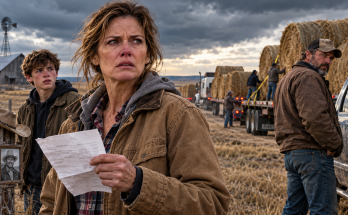
The morning after the storm, I found six fresh hoofprints in the frozen mud beside the repaired gate. They were already hardening beneath a thin crust of ice. Ben stood beside me, examining the temporary panels Dwayne had helped secure. Beyond the fence, the cattle grazed quietly near the shelter, apparently unconcerned by the trouble they had caused. The broken corner post leaned against the ditch where we had left it, its dark, rotten center exposed. Nothing about the scene looked dramatic in daylight, but I knew how close we had come to losing control of the herd.
“We can't leave this patch until the next storm,” Ben said.
“No.”
“I counted four posts that need replacing, maybe five.”
I followed his gaze along the fence. The wire sagged slightly between two braces, and another post had begun to tilt toward the draw. We could replace the worst sections ourselves, but the work would be faster with a third person, especially now that temperatures were falling. I had spent the previous evening thinking about Dwayne's offer to help with the permanent repair. He had listened during the emergency, accepted Ben's judgment, and left without claiming any special authority. That mattered. Yet I was reluctant to turn one successful morning into an invitation to resume his old place in our lives.
Ben looked toward the road. “We could ask him to come Saturday.”
“Are you comfortable with that?”
He shrugged. “If he comes to work, yes. If he starts telling us what we're doing wrong, he can leave.”
I smiled slightly. “That sounds fair.”
We returned to the barn and made a list of materials. New posts, braces, wire, fasteners, and a few replacement insulators for the electric line. Ben measured the damaged section while I checked the remaining supplies. Tom had kept everything arranged according to a system that made perfect sense to him and only partial sense to anyone else. The wire was stored beside the gate hardware, but some of the better braces were hidden behind a stack of old fencing panels. We found them after an hour of searching.
I called Dwayne that evening. He answered cautiously, as though he expected news of another problem. I told him we planned to rebuild the damaged fence on Saturday and asked whether he would be willing to help. There was a brief silence. Then he said he could come whenever we wanted.
“Eight in the morning,” I said. “Bring your post driver if it's working.”
“I'll check it tomorrow.”
“And Dwayne?”
“Yes?”
“Ben and I are deciding how the work gets done. We want another pair of hands, not somebody to take over.”
“I understand.”
I waited, expecting him to add something about his experience or the way Tom used to handle repairs. He did not. He asked whether we had enough materials and ended the call after I confirmed that we did. I stood with the receiver in my hand, surprised by the absence of an argument. It was a small change, but I was beginning to recognize that small changes might be the only kind worth trusting.
On Saturday, Dwayne arrived five minutes before eight. He parked beside the barn rather than near the house and waited outside until Ben came to meet him. I watched from the kitchen window. My son was carrying a clipboard and the measurements we had made. Dwayne listened while he explained the plan, nodding occasionally. He looked at the broken corner post, examined the slope, and suggested moving one replacement brace farther uphill to reduce pressure during heavy wind. Ben considered the idea and agreed.
They worked through the morning, removing damaged posts and setting new ones in firm ground. I handled the wire and checked spacing while Ben operated the post driver. Dwayne carried materials, held braces, and helped tighten the line. The work was tiring but straightforward. There were no raised voices, no lectures about how Tom would have done everything, and no attempt by Dwayne to turn the repair into evidence that we could not manage without him.
At one point, Ben struggled to align a new brace. Dwayne stepped closer, examined the angle, and asked whether he wanted help. Ben shook his head. “I want to figure it out.” Dwayne moved back without complaint. Several minutes later, Ben adjusted the brace and secured it properly. He looked toward his uncle, expecting criticism. Dwayne simply nodded.
“That'll hold,” he said.
I watched my son straighten, a small expression of satisfaction crossing his face. Tom had taught him to solve problems rather than merely follow instructions. Dwayne was beginning to understand that respecting Ben's independence was more useful than proving his own experience. He could contribute without becoming the person in charge. That was the difference I had been trying to explain since the day the hay disappeared.
We finished the worst section shortly after noon. The new posts stood straight along the slope, and the wire was properly tensioned. Ben tested the gate several times, checking that it latched securely despite the uneven ground. Dwayne gathered the old materials into a pile for disposal. He looked tired, with mud on his trousers and a shallow scratch across one glove, but he did not complain.
I invited him inside for lunch. He hesitated at the doorway, glancing toward the kitchen. “Are you sure?”
“Yes. We have soup.”
He removed his boots and entered quietly. Tom's chair remained empty at the end of the table. Dwayne chose the same visitor's chair he had used after the storm. I noticed Ben noticing. Neither of us said anything. There were boundaries that did not need to be discussed every time someone respected them.
During lunch, Dwayne asked about the cattle and the feeding plan. I told him we had enough hay for winter and had kept the herd at forty pairs. He looked surprised, then pleased. He asked whether the additional twelve bales Gene had brought were still separate from Tom's cutting. I said yes. We planned to use them as reserve feed if the weather became unusually severe.
“Gene told me he gave you those,” Dwayne said.
“He did.”
“He didn't have to.”
“No,” I answered. “He didn't.”
Dwayne looked down at his bowl. “I've been thinking about how many people worked to fix what I did.”
Ben set down his spoon. “You should.”
His uncle nodded. “I know.”
The conversation might once have turned into an argument. Dwayne would have defended himself, Ben would have become angrier, and I would have found myself trying to prevent the disagreement from growing. Instead, Dwayne remained quiet. He seemed to understand that Ben's bluntness was not an invitation to debate. It was a reminder of something he needed to continue acknowledging.
After lunch, Dwayne took a small envelope from his coat pocket. He placed it on the table and pushed it toward me. I felt myself tense. I had spent weeks untangling the money connected with the hay sale. The documented refunds and expenses were being handled through Lorraine's office, and I did not want another private payment creating confusion.
“What is this?” I asked.
“A receipt.”
I opened the envelope. Inside was a copy of the statement confirming that he had completed the agreed payments to the buyers and that the original sale proceeds had been accounted for. Lorraine had already sent me preliminary confirmation, but I appreciated seeing the final figures. Dwayne had included a short note listing the three buyers and the amounts returned. He had written it in the same large, uneven handwriting that appeared on the original sale paper.
“I wanted you to know it's finished,” he said.
I looked over the document. Arlen's six hundred forty dollars, Gene's eight hundred, and the Reyes family's two hundred fifty-six had been addressed through the agreed process. The reasonable documented expenses caused by the return and replacement arrangements had also been settled. The figures were not enormous by the standards of a ranch, but they mattered. Dwayne had finally accepted that his actions cost other people money, time, and trust.
“Thank you for following through,” I said.
He nodded. “I know it doesn't make everything right.”
“No. But it was necessary.”
Ben looked at the papers. “Did you apologize to Steve and Kim?”
“Yes. I went over after they got the letter. Steve talked to me outside. Kim came out, too.”
“What did they say?”
“That they accepted the correction. They weren't interested in arguing about it again.”
Ben considered that. “Good.”
Dwayne folded his hands. “Gene told me he'd help with the cattle if you needed anything. Arlen said the same. I don't want either of them thinking I'm trying to take their place.”
I looked at him carefully. “They aren't taking anyone's place. They're neighbors who helped when we needed them.”
He nodded. “I understand.”
I was not certain he fully did, but I was willing to believe he was learning. For years, Dwayne had interpreted every relationship as a contest. If somebody else helped Tom, Dwayne sometimes acted as though he had been excluded. If Tom succeeded, he heard an accusation against his own life. Now he was beginning to see that people could contribute without displacing one another. It was an overdue lesson, but perhaps not a useless one.
When Dwayne left that afternoon, he asked before taking the old damaged posts to the disposal site. I agreed. He loaded them into his truck, checked that no loose wire remained in the yard, and drove away without coming back to the house. Ben watched from the barn doorway.
“He's different,” my son said.
“A little.”
“Do you believe him?”
“I believe what he's done so far.”
Ben nodded. “That's not the same as trusting him.”
“No,” I said. “It isn't.”
The distinction remained important through the following weeks. Dwayne occasionally called to ask whether we needed help, but he did not arrive uninvited. Once, when I said we could manage a repair ourselves, he accepted the answer without another question. Another time, he offered to haul supplies from Valentine because he was already going there. I thanked him but told him I had arranged the trip. He said all right and changed the subject.
Those ordinary refusals mattered more than he might have realized. During Tom's final illness, I had become accustomed to people offering assistance and then becoming irritated when I did not accept it. They seemed to believe that grief required me to surrender control of daily life. Dwayne had carried that attitude to a destructive extreme. Now I was watching him learn that an offer was not a command and that accepting a refusal did not diminish the person who made it.
Winter settled over the ranch gradually. The grass lost its remaining color, and frost gathered along the fence wires most mornings. We began feeding hay regularly when the pastures stopped providing enough grazing. Ben kept careful records of how much the cattle consumed. I checked the figures against Tom's estimates and found that his calculations were sound. The original cutting was carrying us through the season exactly as he intended.
Some evenings, I stood beside the stackyard after the chores were finished and looked at the remaining rows. I could still remember the field when it was empty, the flattened circles where the bales had rested, and the tracks left by the buyers' trailers. The sight had frightened me more than I admitted at the time. Now the hay was being used for the purpose Tom intended, one bale at a time. It was not a monument. It was feed, and the cattle needed it. I found comfort in that practical truth.
Ada visited in early December. Marlene drove her over on a clear afternoon when the roads were dry enough for an easy trip. It was Ada's first visit since the funeral. She walked slowly through the kitchen, leaning on her quad cane, and paused beside Tom's chair. I watched her expression change as she looked at the place where her older son had sat for so many years.
“He always leaned back too far in this chair,” she said.
“He did.”
“I told him he'd break it.”
“He said the floor would give way first.”
Ada laughed softly. Then she reached down and touched the worn wood along the armrest. I stood beside her without speaking. She had buried a son. I had buried a husband. There were parts of that loss we understood differently, but we were standing in the same room, looking at the same empty chair.
After coffee, Ada asked to see the hay. Ben helped her into the pickup, and we drove slowly around the barn to the stackyard. The rows were smaller now because feeding had begun, but the cutting remained substantial. Ada looked at them for a long time. Then she turned toward me.
“Tom did this for you,” she said.
“Yes.”
“And people helped bring it back.”
“Yes.”
She nodded. “That's how it should have been from the beginning.”
Marlene stood beside us, looking toward the north eighty. She had been quiet during most of the visit, but now she told me that Dwayne had been talking about Tom more often. Not the inheritance, not the arguments, but the things they did as boys. He had remembered the time they built a crooked sled out of scrap lumber and nearly broke a barn door trying to test it. He had told Marlene about fishing trips, machinery repairs, and long evenings when the brothers slept in the hayloft because the house was too hot.
“He's remembering his brother again,” she said. “Not just the things he thought Tom owed him.”
I looked toward Ada. Her eyes had filled. She wiped them with the back of her hand and smiled faintly. “I hope he keeps doing that.”
We returned to the house as the afternoon light faded. Ada sat at the kitchen table with Ben, asking about school and the agricultural programs he had been considering. My son brought out several brochures and showed her the courses that interested him. He was especially drawn to agricultural mechanics and equipment technology, though he had also begun looking at broader agricultural programs. I watched him explain the differences with an enthusiasm I had not seen since before Tom became ill.
Ada listened carefully. “Your grandfather would've liked seeing you understand machinery,” she said.
Ben smiled. “Dad said I should learn enough to stop making the same mistakes he made.”
“That sounds like him.”
Marlene asked whether he planned to attend a program close to home. Ben hesitated, then admitted he was considering one in North Platte. He had not applied yet, and the idea of leaving the ranch still made him uneasy. I told him again that he did not have to decide immediately, but he should not reject an opportunity because he worried about leaving me alone.
Ada reached across the table and squeezed his hand. “Your father didn't spend all those years working this land so you'd be afraid to leave it.”
Ben looked down, embarrassed by the emotion in her voice. “I know, Grandma.”
“Then promise me you'll at least apply.”
He smiled faintly. “All right.”
The promise changed something. Until then, Ben had spoken about education as a possibility he might eventually explore. Now he had agreed to take a concrete step. I could see that the decision frightened him, but it also excited him. He began asking Ada about the years when Tom worked away from the ranch during winter. She told him stories about his father's first jobs, the machinery he learned to repair, and the mistakes he made before becoming the careful man Ben remembered.
After Ada and Marlene left, Ben returned to the brochures. He spread them across the kitchen table and began making notes about application requirements. I watched him for a while, then sat beside him. We discussed tuition, housing, transportation, and how often he might come home. The remaining savings from Tom's hidden reserve would help, though I wanted to preserve enough for ranch emergencies. We would still need to plan carefully.
“Do you think Dad would've wanted me to go?” Ben asked.
“Yes.”
“Even if you need help here?”
“Especially then. He wanted you to know you had choices.”
Ben studied the brochure. “I could learn things that would make the ranch easier to run.”
“You could. And you might discover you want to do something else.”
He looked surprised. “Would that bother you?”
“It would change things. But I wouldn't want you staying because you thought I couldn't manage.”
He nodded slowly. Then he began filling out the first application.
The following week, Dwayne called to ask whether he could stop by with something that belonged to Tom. I was cautious. I asked what he had found. He explained that Tom had lent him a set of specialized wrenches years earlier, and he had discovered them while cleaning his garage. He wanted to return them to Ben rather than leave them buried beneath old parts.
I asked Ben whether he wanted the tools. His expression changed immediately. He remembered the set. Tom had used it for a particular repair on the baler and complained for years that Dwayne never returned it. Ben laughed despite himself, recalling how his father would search the shop and mutter about lending equipment to relatives.
“Tell him he can bring them,” Ben said.
Dwayne arrived the next afternoon carrying a metal toolbox. He handed it directly to Ben without stepping inside. The set was complete, though the case had scratches and a broken latch. Ben opened it and examined the sockets, running his thumb over the familiar markings.
“Dad thought these were lost,” he said.
“I kept meaning to bring them back.”
Ben looked at him. “You could've.”
“I know.”
The exchange was simple, almost painfully ordinary. Dwayne did not invent an excuse. He had borrowed something, failed to return it, and finally corrected the matter. It was a small version of the larger problem he had created with the hay, and I suspected he understood the comparison.
Ben closed the toolbox. “Thanks for bringing them.”
Dwayne nodded. “Your dad was proud of that set. He said it was the first decent one he'd bought after you two got the ranch going.”
“He used it all the time.”
“I know.”
They stood beside the porch for a moment, neither certain how to end the conversation. Then Ben surprised me.
“We've got a gate hinge that needs replacing next Saturday,” he said. “If you're free, you could come help.”
Dwayne looked at him. “You want me to?”
“I want another pair of hands. Mom and I know what needs doing.”
A faint smile crossed Dwayne's face. “Then I'll bring my gloves.”
Ben nodded. He picked up the toolbox and went inside, leaving his uncle standing beside the steps.
I looked at Dwayne. He seemed moved, but he did not attempt to turn the invitation into something larger than it was. He simply thanked me for letting him return the tools and walked back to his truck. I watched him drive away, thinking about how different the moment was from the day he sat in Tom's chair and announced that he had sold our hay.
He had arrived then believing family entitled him to decide for us. Now his nephew had invited him to help with a repair, but only on terms that respected our independence.
The difference was small enough that a stranger might have missed it.
To us, it was the first sign that the relationship might survive without repeating the old harm.