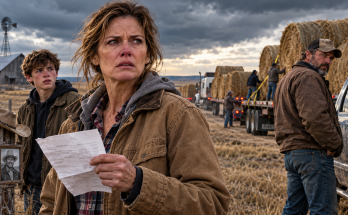
The first cow broke through the curtain of freezing rain just as Ben reached the west draw. She was running awkwardly, her hooves slipping on ground that had begun to glaze with ice. Behind her, two more animals moved along the collapsed fence, searching for an opening that would lead them back toward familiar pasture. I heard Ben shout, but the wind carried his voice away. Farther downhill, beyond the shallow ditch and a stand of leafless brush, the county road lay almost hidden beneath the gray morning. If the cattle reached it, a driver might not see them until there was no room to stop.
I left the pickup near the cattle guard and continued on foot, keeping close to the fence where the grass offered better footing. Every few steps, the wind shoved against my shoulder. Sleet struck my cheeks hard enough to sting. The fence had failed beside an old wooden corner post, where several strands of wire hung loose and dragged through the weeds. One brace had split near the ground. The damage was worse than Ben had described over the telephone, though I understood why he had not stopped long enough to examine it. His first concern had been the animals moving toward the road.
“Don't push them downhill,” I called when I reached him. “Give them room to turn.”
Ben nodded. His face was red from the cold, and ice had gathered along the edge of his father's Pioneer cap. He had brought a bucket of range cubes, hoping the familiar rattle would attract the animals without frightening them. Two cows had already paused near the creek crossing, but the others remained nervous. They were not wild cattle. They were accustomed to people, feed trucks, and the daily routines of our ranch. The storm had simply made an ordinary opening in the fence seem like an escape route.
We moved slowly, using our bodies and the pickup as boundaries rather than trying to chase the animals. I shook the bucket and called in the low voice Tom had used during feeding. One cow lifted her head. Another turned toward the sound. For a moment, I thought we might coax the entire group toward the upper gate without help. Then a gust rattled the loose wire, and the animals scattered again. Ben swore under his breath. I wanted to do the same.
“Go back to the truck,” I told him. “Get the temporary panels from the trailer. We need to block that lower opening.”
“I can help turn them first.”
“We'll lose more time if they reach the road.”
He looked toward the gray strip of pavement beyond the draw and understood. He went without another argument. I remained near the broken fence, holding the feed bucket and watching the six animals move uncertainly through the storm. Three had drifted toward the upper pasture. Two stood near the crossing. The sixth, an older red cow with a white patch beneath her jaw, had moved farther downhill than I liked. I recognized her immediately. She was one of Tom's favorites, a steady animal that rarely caused trouble.
My telephone vibrated inside my coat. Dwayne's name appeared on the screen. I answered with numb fingers, expecting him to say the roads were too dangerous or that his truck had become stuck. Instead, he asked where I wanted him to enter the property. He had reached our lane and was waiting beyond the cattle guard. I looked toward the road, where his headlights glowed faintly through the rain.
“Come through the main gate,” I said. “Follow the track along the barn, but don't drive into the draw. The ground's slick.”
“All right. I've got fence posts, wire, chains, and two portable panels. Do you need anything else?”
“Just another pair of hands.”
There was a short silence. Then he said, “I'm coming.”
I put the telephone away and felt an unexpected uneasiness. A month earlier, Dwayne had walked into our kitchen and behaved as though every decision belonged to him. Now he was approaching the ranch I had forbidden him to enter without permission. I had invited him because we needed help, but that did not mean I had forgotten what he had done. I reminded myself that calling him was not an act of forgiveness. It was a practical decision made in bad weather, when frightened cattle and a dangerous road mattered more than the discomfort of asking a difficult man for assistance.
Ben returned with the first panel just as Dwayne's pickup came around the barn. The truck moved slowly, its tires crunching through the thin crust of ice. Dwayne stopped on firm ground and climbed out wearing a heavy canvas coat, insulated gloves, and a wool hat pulled low over his ears. He surveyed the damaged fence without speaking. For several seconds, he seemed to be assessing the situation in the familiar way that had so often ended with him telling everybody else what to do.
Then he looked at me.
“Where do you want me?” he asked.
The question was small, but I noticed it. Dwayne had never been good at asking where he was needed. He preferred arriving with a plan and expecting everyone else to accept it. Now he stood beside his truck with tools in his hands, waiting for instructions from the woman whose judgment he had once dismissed.
“The lower gap needs closing first,” I said. “Ben's bringing panels. I'll keep the cattle away from the road while you two secure the opening.”
Dwayne nodded. “I'll work on the broken brace after that.”
“Not until the animals are safe.”
“All right.”
He did not argue. He carried the first panel toward Ben, who took the opposite end without offering a greeting. Together they moved it across the rough ground, carefully avoiding the loose wire. I watched them work while keeping an eye on the cattle. Dwayne explained how he wanted to position the panel, but when Ben suggested a different angle to account for the slope, he stopped and examined it.
“You're right,” Dwayne said. “It'll hold better that way.”
Ben looked briefly startled. Then he helped set the panel in place.
The work took longer than any of us wanted. Ice gathered on the metal rails, making them difficult to grip. The wind pushed against the temporary barrier, and the ground near the broken post was too soft to hold a permanent repair. Dwayne used chains to secure the panels to sound fence posts farther uphill. Ben tightened the fastenings while I monitored the animals. Several times, we had to stop and wait for a gust to pass before continuing. Nobody raised their voice except to warn of a hazard.
Once the lower opening was secure, we turned our attention to the cattle. Four had gathered near the creek crossing, drawn by the sound of the feed bucket. A fifth stood farther uphill, watching us. The red cow remained near the road, her head lowered against the wind. I could see that she was frightened but not injured. The problem was getting her to turn without driving her onto the pavement.
Dwayne studied the slope. “If I take the truck down the old track, I can block her from the road.”
“Not with the ground like this,” I said. “You'll slide straight into the ditch.”
He opened his mouth, then looked at the ice forming along the grass. “You're right.”
Ben glanced at him. I saw the exchange and understood its significance. Dwayne had offered an idea, heard an objection, and accepted it. There had been a time when he would have treated disagreement as a challenge to his authority. Now he seemed to recognize that listening might be more useful than proving himself correct.
We decided to move on foot, using the slope and the existing fence line to guide the cow toward the upper gate. Dwayne took the outer position, staying far enough away that she would not feel trapped. Ben carried the feed bucket. I stood near the gate, ready to open it once the animal turned. The rain had begun to change into snow, and visibility was improving slightly as the wind shifted.
The red cow lifted her head when Ben rattled the bucket. She took several uncertain steps uphill, stopped, then moved again. Dwayne walked slowly behind and to one side, giving her space. The cow hesitated at the shallow ditch. My heart tightened as she tested the frozen edge with one hoof. Then she crossed without slipping and followed the others toward the gate.
“Easy now,” Ben murmured. “Come on, girl.”
He sounded so much like Tom that I had to look away for a moment.
One by one, the cattle passed through the opening. I counted each animal as it crossed the gate. Four. Five. Six. Ben secured the latch while Dwayne checked the fence line behind them. The final cow moved into the pasture and lowered her head toward the grass as though the entire morning had been nothing more than an inconvenience.
I leaned against the gate and closed my eyes. The relief made my legs feel weak. We had recovered the animals before they reached the road. Nobody was hurt, and the temporary barrier would hold long enough for a proper repair once the storm passed. The danger had been real, but it had ended through patient work rather than any dramatic rescue. That, too, reminded me of Tom.
Dwayne approached carrying the broken brace. He examined the splintered wood and shook his head. “This post has been rotting from the inside. It looked sound until the wind put pressure on it.”
“We checked this stretch last week,” Ben said.
“You couldn't have seen it from outside.”
My son looked toward the damaged post, clearly frustrated. Dwayne turned the broken wood in his hands and showed him where moisture had entered through a narrow split near the base. The center was dark and soft, while the outer surface remained relatively firm.
“Your dad would've wanted this replaced before winter,” Dwayne said.
Ben's expression tightened. For a moment, I feared the reference to Tom would reopen the argument between them. But Dwayne continued more carefully. “I should've offered to help with this kind of work when he was sick. Instead, I spent my time talking about what you couldn't manage.”
Ben looked at him. “You did.”
Dwayne nodded. “I know.”
The admission was brief, but it seemed harder for him than the physical work. He had spent the morning in freezing rain, carrying heavy panels and handling wire with numb fingers. Yet acknowledging that he had failed Tom while his brother was dying appeared to cost him more. I did not offer reassurance. He had made the statement, and it deserved to remain his responsibility.
We replaced the broken brace with a temporary support and checked the adjoining posts. Several would need attention before the next major storm. Dwayne offered to return with proper materials once the weather improved. I told him I would decide what repairs we wanted done and let him know. He accepted that without complaint.
By the time we reached the barn, snow had begun collecting along the roof edges. Ben parked the pickup under shelter while Dwayne put away his tools. I went inside to prepare coffee and something warm to eat. My hands shook so badly that I dropped a spoon onto the floor. The sound startled me. I bent to retrieve it and found myself suddenly overwhelmed by the morning's events.
We had come close to losing animals on an icy road. We had needed help from the person who had nearly forced us to sell those same cattle. And for several hours, Dwayne had behaved not like a man trying to take control, but like a neighbor doing a difficult job because somebody needed him.
I stood at the sink until my hands steadied.
When the men came inside, Ben was laughing at something Dwayne had said about an old tractor that once stalled in a snowdrift. The sound stopped when they saw me, as though both were uncertain whether laughter was permitted. I told them to take off their wet coats and sit down. Ben went to wash his hands. Dwayne remained near the doorway, looking toward Tom's chair.
He did not sit in it.
Instead, he chose the chair beside the wall, the one normally used by visitors. I noticed that decision more than I expected to. The morning after the funeral, he had occupied Tom's place without a thought. Now he seemed to understand that certain things were no longer his to claim.
I served coffee, scrambled eggs, and toast. We ate quietly at first. Then Ben began describing how the red cow had hesitated at the ditch. Dwayne listened, occasionally asking a question about the slope or the gate. He did not turn the conversation into an account of his own cleverness. When Ben said he thought the panel placement had been the reason the animals turned uphill, Dwayne agreed.
“That was your idea,” he said. “It worked.”
Ben looked down at his plate, but I saw the small change in his expression. Praise from his uncle was not something he had been seeking, yet hearing his judgment respected mattered. Tom had always encouraged Ben to think through problems rather than simply follow orders. Dwayne, by listening, had given my son a little of the independence he had been trying to claim since his father's death.
After breakfast, Dwayne stood to leave. He thanked me for the food and said he would return the borrowed panels to their owner after the weather cleared. I told him to wait a moment. I wanted to speak with him before he went.
We stepped onto the porch, where the snow had begun to settle in the corners of the railing. The wind was quieter now, though the air remained bitterly cold. Dwayne stood with his hands in his coat pockets, looking toward the pasture.
“You helped us today,” I said.
“I should've been helping all along.”
“Yes.”
He nodded. The word seemed to land more heavily than if I had offered praise. I was not going to pretend that several hours of useful work erased the weeks of damage he had caused. But I also did not want to ignore a genuine change in behavior merely because it came from somebody who had hurt us.
“I appreciate that you came,” I continued. “And I appreciate that you listened when Ben and I told you what needed doing.”
Dwayne looked at me. “I know I used to make everything harder.”
“You did.”
He stared toward the yard. “Tom would've handled that fence faster than I did.”
“Maybe. But he isn't here.”
The words were plain, and they hurt us both. Dwayne lowered his head. I could see his jaw tighten. For years, he had compared himself with his brother, usually finding reasons to resent him. Now he was standing on the porch of the house Tom had built into a home, facing the fact that the comparison had ended. There would be no more arguments, no more chances to prove himself better, no final conversation in which their father’s decision could somehow be corrected.
“I miss him,” Dwayne said.
It was the first time I had heard him say it.
I looked at him. His eyes were wet, though whether from the cold or from grief I could not tell. “So do I,” I answered.
He nodded slowly. “I spent so much time being angry with him that I forgot I could lose him.”
I did not know what to say. The admission was too painful to answer with something easy. We stood together while snow collected along the porch steps. For the first time, I saw Dwayne not only as the man who had sold our hay but as someone confronting the loss of a brother he had never managed to love without resentment.
“I can't give you what you lost with Tom,” I said. “And you can't undo what you did to Ben and me. But you can decide what kind of man you're going to be now.”
He looked toward the barn, where Ben was putting away tools. “I want to be someone he doesn't have to be ashamed of.”
“Then keep listening to him. Don't try to become his father. He had one, and he loved him.”
Dwayne nodded. “I understand.”
I watched him walk toward his truck, moving carefully over the icy ground. He stopped beside the broken fence panel and examined the chain one last time before loading it into the bed. He did not turn around to ask whether he could come back the following week. He did not offer another apology. He simply finished the work he had agreed to do and drove away.
Inside, Ben was washing the breakfast dishes. He looked at me when I entered. “Did you tell him he could come back?”
“Not yet.”
“Good.”
I smiled faintly. “You did well today.”
“So did he.”
The words surprised us both. Ben seemed to realize what he had said and looked back at the sink. “I mean, he helped. He didn't make things worse.”
“No,” I answered. “He didn't.”
My son was quiet for a moment. Then he turned off the water and dried his hands. “I still don't forgive him.”
“You don't have to decide that today.”
He nodded. “But if we need help fixing the fence properly, maybe he could come. As long as he asks first.”
I looked toward the window. The storm had begun to move east, leaving a thin layer of snow across the pasture. The cattle were safe, the gate was secure, and the hay stood in its rows behind the barn. We had faced the first serious test of winter without Tom, and we had managed it through work, judgment, and help accepted on our own terms.
For the first time, I could imagine a future in which Dwayne remained part of the family without controlling it.
But the possibility was fragile. One good morning could not repair decades of resentment or the harm of the unauthorized sale. The real test would come afterward, when there was no storm demanding immediate action, no audience to impress, and no urgent reason for him to behave differently.
I looked at Ben, who was already pulling on his coat to check the cattle again. “We'll see how he handles ordinary days,” I said.
My son nodded, and together we went back outside to inspect the fence that would have to be rebuilt before the next storm.