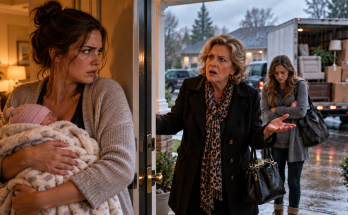
The first time someone knocked after the moving vehicles disappeared, I nearly dropped my daughter's bottle. I had been standing in the kitchen, measuring water for myself and trying to remember whether I'd taken my medication, when three light taps sounded against the front door. My heart began racing before I could think. Clara was asleep in her bassinet, and every instinct told me to keep the house perfectly quiet. I stood motionless, listening for another knock. Then my phone vibrated with a delivery notification. The groceries I had ordered were waiting on the porch.
I checked the security camera before opening the door. A young delivery driver was already walking back toward his car, leaving two paper bags beside the welcome mat. I felt foolish for the intensity of my reaction, but the feeling didn't disappear when I recognized him. Yesterday, a person turning my doorknob had been an ordinary visitor or neighbor. Today, the same sound could pull me back into the confrontation with Nancy, the trailer in the driveway, and my sister's frightened face. I waited until the car left before unlocking the door.
The groceries were exactly what I'd ordered: oatmeal, eggs, bread, fresh fruit, yogurt, and several containers of soup. I carried them inside in two trips, moving carefully because my body still protested anything more demanding than walking across the room. When I finished putting everything away, I leaned against the counter and closed my eyes. The house was silent. There were no moving boxes in the hallway, no relatives discussing which bedroom they wanted, and no one telling me that my medical recovery was an inconvenience. Yet my muscles remained tense, as though the argument had continued somewhere I couldn't hear it.
Clara woke while I was putting the last carton of milk into the refrigerator. Her cry was soft at first, then increasingly determined. I went to her immediately, relieved by the straightforwardness of what she needed. She was hungry, uncomfortable, and entirely uninterested in adult disputes. I lifted her against my shoulder, changed her diaper, and settled into the velvet couch with a nursing pillow supporting my arms. Outside, a patch of sunlight moved across the front lawn. I watched it shift over the grass while Clara fed, reminding myself that this was the life I'd fought to protect.
My phone remained on the side table, facedown. I had turned off the sound for most notifications, but I hadn't blocked my mother's number. Rebecca had advised preserving written communications while the dispute remained unsettled. I could choose not to engage without destroying evidence of what had occurred. Before lunch, I finally checked the screen. Nancy had sent four messages. The first accused me of humiliating her. The second asked whether Victor had been planning the confrontation for weeks. The third insisted that Krista would eventually recognize who had truly helped her. The fourth contained only five words: "I hope you're satisfied now."
I looked at the messages for a long moment. There had been a time when I would have answered each accusation separately, trying to demonstrate that I hadn't intended cruelty. I would have explained how frightened I'd been after the attempted entry, how exhausted I felt, and why the house mattered to me. By the end, I'd probably have apologized for making my mother uncomfortable. The old impulse was still present. I could feel it pressing against my ribs, urging me to correct her version of events. Instead, I saved the messages and placed the phone down again.
An hour later, Rebecca called. She asked first about my health and whether anyone had returned to the property. I told her about the delivery driver and admitted how strongly I'd reacted to the knock. She didn't dismiss it. "Your sense of safety has been challenged," she said. "It may take some time before ordinary sounds stop feeling threatening." Then she moved to practical matters. She had prepared a formal written notice confirming that no relative had permission to occupy my home and that any previous access arrangement had ended. She would send copies through appropriate channels and retain the correspondence with her records.
I asked whether Nancy might be able to create some kind of legal problem simply by continuing to insist the family had an agreement. Rebecca explained that claims could be made, but claims were not the same as evidence. The deed, purchase documents, messages, security footage, and absence of any occupancy agreement established a clear record of my position. She encouraged me to avoid informal negotiations that could later be mischaracterized. If Nancy wanted to communicate about the house, she could do so in writing. If she arrived without permission, I could decline to open the door.
After the call, I went through the folder of documents again. The closing statement bore my signature on the final page, slightly uneven because Clara had been pressing against my ribs when I signed. I remembered the attorney at the closing office sliding the papers toward me and asking whether I had any questions. I had asked several, including whether any other person's approval would be necessary for ordinary decisions about the property. He had explained that, as sole owner, those decisions were mine. I hadn't imagined then that I would need to defend such a simple fact against my own mother.
The relocation company returned my voicemail that afternoon. A woman named Marlene explained that the reservation had been made under Nancy's name and that my address was listed as the destination. She confirmed that the scheduled unloading had been canceled after a call from Gil that morning. I told her that I had never authorized the reservation or agreed to receive anyone's belongings. Marlene apologized for the confusion and said the company would update its records to reflect that the homeowner had not consented to the move. I asked for written confirmation and received it by email shortly afterward.
The message relieved me more than I expected. It was one less open arrangement, one less possibility that another truck would appear outside while Clara slept. I forwarded the confirmation to Rebecca and added it to the folder on my computer. Then I closed the laptop. There were more things I could have checked, more calls I might have made, and countless scenarios I could have imagined. But I had begun to understand that vigilance could become its own form of captivity. My mother was no longer inside my home. I didn't want to spend every waking hour letting her occupy my thoughts.
Late in the afternoon, Krista called. I hesitated before answering, remembering the note she had slipped into my hand and the sight of her turning the emergency key. Then I pressed the screen and said hello. Her voice was tired but less guarded than it had been the previous day. She and Pete had found a temporary place to stay with Victor's assistance. The children were safe, and they had managed to eat and rest. She didn't give me the address, and I didn't ask for it. I understood that she needed a little privacy of her own.
"We're trying to figure out the next step," she said. I could hear one of the children laughing in the background. The sound eased something in my chest. Krista explained that Pete was contacting employers again and that she had begun gathering the documents required for rental assistance. Victor had helped them understand which organizations to approach, but he hadn't taken over the process. "He keeps asking what we want to do," she said with a small, embarrassed laugh. "I'm not used to that." I smiled despite myself. "It takes practice."
There was a pause. Then Krista asked whether I was still angry. I looked down at Clara, who was sleeping against my arm. "I'm not as frightened as I was," I said. "But I'm still hurt about the key." Krista exhaled slowly. "I know. I keep thinking about it." I told her I didn't want her to punish herself forever for one mistake, but I needed her to understand why it mattered. If she had managed to enter, she might have turned my home into the center of a conflict I was physically unable to manage. She said she understood and didn't try to excuse herself.
We talked for a few minutes about the children. The oldest had been confused about why they hadn't stayed at Auntie's house. Krista had explained that adults sometimes made arrangements before checking whether everyone agreed. She told them I loved them and that Clara and I needed privacy while I recovered. I thanked her for choosing those words. It would have been easy to tell the children I'd changed my mind or didn't want them. Instead, she had accepted some responsibility for what happened. That small decision meant more to me than another apology would have.
Before ending the call, I asked whether Nancy had contacted her. Krista was silent long enough that I wondered whether the connection had failed. "She's sent messages," she admitted. "I haven't answered most of them." I asked whether the messages included threats about the children. Krista said not directly, but Nancy had written that people who rejected family support sometimes discovered how alone they really were. I recognized the language immediately. It was broad enough to deny later, but pointed enough to frighten someone who already feared losing stability.
"Keep those messages," I said. "Rebecca can help you find someone to review them if you need advice." Krista agreed. She sounded reluctant to discuss our mother further, so I changed the subject. We talked about the children's school routines and the inconvenience of keeping their belongings packed in a vehicle. The practical details were almost comforting. They suggested a future that could be managed through ordinary effort rather than emotional coercion. When we said goodbye, Krista thanked me for answering. I told her she didn't have to thank me for wanting to know she was safe.
Afterward, I sat for a long time thinking about my sister's circumstances. I had spent years creating distance from Nancy because distance was the only reliable protection I'd found. Krista had stayed closer, partly because she valued family gatherings and partly because our mother's assistance had become woven into the structure of her life. When money was tight, Nancy provided groceries. When the children needed something, she bought it. When a difficult decision arose, she supplied an answer. Over time, generosity had become inseparable from authority. The debt Krista owed wasn't merely financial. It had accumulated in years of being told she couldn't manage without help.
I opened a blank page in my notebook and made two columns. On one side, I wrote what Krista needed: safe housing, reliable income, a manageable repayment plan, and confidence that her children wouldn't become bargaining chips. On the other side, I wrote what I could offer without compromising my recovery or my home. I could help research apartments. I could contribute financially if I chose to. I could offer encouragement and practical information. What I couldn't offer was unlimited availability, a place for seven people to live, or the role of mediator between my mother and every other member of the family.
The exercise reminded me of something I often explained to parents at the clinic. Support worked best when it increased a child's ability to act independently rather than making every task dependent on an adult's intervention. The principle was different with adults, but the underlying respect was similar. I didn't want to rescue Krista in a way that left her feeling permanently indebted to me. I wanted her to have enough stability to make decisions without fear. That required more thought than simply writing a check or offering the spare bedrooms.
When I checked my finances, I was surprised by how much anxiety the numbers produced. I had spent years saving for the house, and the closing costs had taken a substantial portion of what I'd accumulated. I still had an emergency fund, but Clara's arrival made every dollar feel consequential. There would be medical expenses, maintenance, childcare arrangements when I returned to work, and repairs to the aging house. I couldn't afford to become the financial foundation of another household. Yet a carefully chosen contribution might make an enormous difference if it helped Krista move into a stable apartment.
I closed the banking application without transferring anything. I wasn't ready to decide. The lesson of the previous morning was still fresh: loving someone didn't require making immediate promises. I could consider the family's needs, my own resources, and the consequences of any assistance before choosing what to do. For once, there was nobody standing over me demanding an answer. I made myself a cup of tea, ate a bowl of soup, and returned to the couch. Clara woke shortly afterward, and I spent the next hour attending to her without checking my phone.
That evening, Victor called. He said Krista and Pete had been cooperative and were beginning to approach their situation more realistically. They had gathered documents for several assistance programs and arranged to speak with an independent legal adviser about Nancy's threats. The temporary accommodation was secure for the immediate future. Victor sounded cautiously hopeful, but he didn't pretend the family was out of difficulty. "They've got a lot to sort through," he said. "The important thing is that they're making decisions together again."
I asked whether he thought Krista would accept help from me. Victor considered the question. "Probably," he said. "But she'll worry that accepting it means she owes you something. That's what she's been taught." I told him I'd been thinking about contributing to an apartment deposit if they found a suitable place. He was quiet for a moment. "That could be useful," he said. "Especially if it helps them avoid another unstable arrangement. But make sure you're not compromising your own security." I assured him I wouldn't make a decision without reviewing my finances carefully.
Victor asked whether I wanted him to mention the idea to Krista. I said no. Not yet. I wanted to know whether there was a realistic apartment available before offering anything. More importantly, I didn't want my sister to spend another week waiting for a relative to decide what she deserved. If I helped, I wanted it to feel different from Nancy's assistance. No speeches about gratitude. No instructions about how she should arrange her household. No expectation that she would repay me through visits, favors, or agreement. Victor understood. "Then we'll keep the focus on their search," he said.
After the call, I checked on Clara and prepared for the night. The nursery was softly lit by a small lamp near the dresser. Her bassinet stood where I could reach it easily, and the clean blankets were stacked within arm's length. I had arranged the room before she was born, imagining that the practical details would make motherhood feel more manageable. They did, but not because they eliminated uncertainty. They gave me something familiar to rely on when everything else felt new. I touched the edge of the sage-green curtain and remembered choosing the color without asking anyone's opinion.
The next morning, a message from Krista arrived while I was feeding Clara. She had found two possible apartments in neighborhoods close enough for the children to remain at their schools. One was smaller than their previous home but had a reasonable rent. The other needed repairs and might not be available immediately. Pete was arranging viewings, and they planned to compare the terms before making a decision. Her message ended with a sentence that stayed with me: "For the first time in months, we're looking at places because we want to live there, not because Mom says we should."
I smiled at the screen, then opened my notebook and wrote down the questions I would ask if I were choosing between the two properties. The deposit. The lease terms. The condition of the heating system. Whether the children would have enough room to sleep comfortably. I didn't send the questions to Krista. Not immediately. I wanted to offer useful help without repeating our mother's habit of taking over every decision. Instead, I replied that I was glad they had options and would be happy to look over the details if they wanted another opinion.
Later that day, Krista called again. She sounded breathless, as though she'd been walking quickly. Pete had spoken with the manager of a modest apartment complex near the children's school. A suitable unit might become available soon, and the monthly rent was within reach if their employment and assistance plans worked out. But there was a problem. The deposit would be due quickly once the application was approved, and the money they'd saved had already been swallowed by overdue expenses. Krista didn't ask me for anything. She simply explained the situation, then fell silent.
I looked toward the blue folder on my desk, where the deed to my home rested beside the paperwork from Rebecca. For years, financial independence had been the means by which I'd protected myself from Nancy. Now I was beginning to understand that a carefully chosen act of generosity could help my sister achieve something similar. I didn't want to purchase obedience or gratitude. I wanted to help open a door she could close behind herself. "Let me know what the manager says," I told her. "Make sure you understand the lease before agreeing to anything." When we ended the call, I opened my banking records again, this time prepared to make a decision.