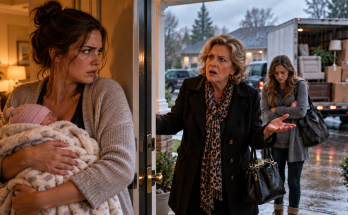
Nancy stood motionless after Krista finished speaking. For several seconds, she seemed unable to understand that her older daughter had refused her in front of witnesses. Her face had gone pale beneath the flush of anger, and one hand remained suspended near the strap of her handbag. I knew that expression. It was the moment before she decided whether to shout, cry, or retreat into wounded silence. In childhood, I had learned to fear all three. Now, sitting on the couch with Clara asleep against me, I watched without trying to anticipate what would make my mother easier to manage.
"You have no idea what you're saying," Nancy told Krista. Her voice was low, almost gentle. "You're frightened and exhausted. You're letting people confuse you." Krista shook her head. "I'm frightened because you told me I could lose my children." Nancy looked toward Rebecca and Victor. "You see? They've put ideas into her head." Pete stepped forward before anyone else could answer. "Nobody put anything into her head. You made her afraid. I didn't even know how bad it had gotten." My mother turned toward him, her expression sharpening. "And whose fault is it that your family is in this position?"
Pete flinched. I could see how deeply the accusation struck him. He had spent months searching for work and watching bills arrive faster than he could pay them. Nancy knew exactly where his shame lived, and she went straight for it. But he didn't retreat. He looked at Krista, then at the window where their children were waiting. "I've made mistakes," he said. "I haven't been able to fix everything. But that doesn't mean you get to frighten my wife into doing something she knows is wrong." His voice was rough, and he swallowed before continuing. "We'll find another place. We shouldn't have brought everyone here."
Nancy laughed, a brittle sound that carried no amusement. "You'll find another place? With what money?" Victor answered before Pete could. "We've already discussed practical assistance." My mother turned toward him. "And you think they'll accept charity from you?" Victor remained calm. "I think they'll make a decision about the help that's available. That's their responsibility." Nancy opened her mouth again, but he raised one hand slightly. "You don't need to approve the arrangement. It doesn't involve your money or your property." The distinction was so clear that even Nancy seemed unable to find an immediate answer.
Rebecca stepped toward the front door. "The immediate matter is simple," she said. "No one is moving into this house. The vehicles need to leave, and any third-party moving arrangements must be canceled. My client has made her position clear." Nancy looked at her with undisguised hostility. "You're enjoying this, aren't you?" Rebecca's expression didn't change. "No. I'd much rather my client could recover from childbirth without a legal dispute on her doorstep." She glanced toward Clara, then back at Nancy. "That remains possible if everyone respects her decision."
I felt my daughter's weight shift against my chest. She made a tiny sound, then settled again. The room had become strangely quiet. After hours of calls, messages, arguments, and preparations for a confrontation I had never wanted, the practical outcome was finally visible. Nobody had brought a box inside. My furniture remained where I had placed it. The nursery door stood open, revealing the pale green walls and the small dresser I had chosen myself. Yet I didn't feel triumphant. I felt as though I had been holding a heavy object for a long time and had only just realized how much my arms were shaking.
Nancy looked toward the hallway. "I suppose I'm not welcome here anymore," she said. The statement was designed to invite reassurance. I knew that if I rushed to tell her she was always welcome, she would use the words to reopen the argument about who could enter and when. I took a breath. "You're not welcome to move into my house or make decisions about it," I said. "You're not welcome to visit without arranging it with me first. That doesn't mean I want you out of my life forever. It means I need you to respect the limits I've set." My mother looked away before I finished.
"Limits," she repeated, as though the word were distasteful. "Everything is limits with you now. Boundaries. Rules. Permissions. I raised you better than this." I remembered my childhood bedroom without a lock, the drawers she searched, and the way she read private notes while insisting that good children didn't need privacy. I thought about my father's quiet attempts to make space for me. Perhaps Nancy believed she had raised me to surrender whenever family demanded it. But she had also taught me what happened when one person's authority went unquestioned. I wasn't going to allow Clara to learn the same lesson through fear.
Krista moved toward the doorway. "Mom, it's time to go." Nancy ignored her. She looked at me once more, searching for some sign that I might soften. "Those children came here expecting a home," she said. I felt the accusation land, but I refused to carry it. "You told them they could live here without asking me," I answered. "Please don't make their disappointment another thing I caused." Nancy's eyes filled suddenly. I couldn't tell whether the tears were genuine, strategic, or some mixture of both. The distinction mattered less than it once would have. Her feelings were real to her, but they didn't create an obligation for me to give up my home.
Pete stepped outside and began speaking to Gil near the pickup truck. Through the window, I could see the two men examining the straps around the trailer. The children were restless in the minivan. One had pressed a face close to the glass, leaving a foggy patch that vanished and reappeared with each breath. I wanted to go outside and tell them they hadn't done anything wrong. I wanted to explain that adults had made promises without permission and that the failure of those promises did not mean they were unwanted. But I was exhausted, and Clara needed me. I had to accept that I couldn't repair every consequence of Nancy's decisions in a single morning.
Krista approached our mother and placed a hand gently against her forearm. "Come on," she said. Nancy pulled away. "Don't touch me." My sister lowered her hand but remained beside her. "We need to leave. Pete's going to take the kids somewhere to eat, and we have to decide what to do with the trailer." Nancy looked toward me with a final expression of disbelief. "You're really going to let this happen?" I answered quietly. "I'm going to let you leave. I'm not going to let anyone move in." Krista stepped closer to her again. This time Nancy didn't pull away when my sister guided her toward the porch.
The sight unsettled me more than the shouting had. Krista, who had spent so much of her life adjusting herself around our mother's moods, was now walking beside her with a hand near her elbow, gently but firmly directing her away from a place she had intended to control. Nancy moved stiffly, her handbag pressed against her side. She didn't look back until she reached the top step. Then she turned toward the open doorway, her face set in a way I recognized from the worst disagreements of my childhood. "You will regret treating your family like this," she said.
I didn't answer immediately. Rebecca was standing beside me, and Victor remained near the couch. Clara slept peacefully against my shoulder. I looked past my mother toward the vehicles and the children who had spent the morning waiting for an arrangement that never should have been made. Regret was likely. I would regret the pain Krista had endured, the fear those children had experienced, and the fact that my relationship with Nancy had reached this point. But regret didn't necessarily mean a decision was wrong. "I regret that you didn't listen when I said no," I replied. "I don't regret protecting my daughter."
Nancy's face tightened. For a moment, I thought she might return to the argument. Instead, she turned and descended the steps. Krista followed close enough to guide her around a broken edge of the walkway. I watched them cross the driveway, where Gil was waiting beside the truck. Nancy spoke rapidly to him, gesturing toward the house and then toward Victor, who had come to stand just inside the doorway. Gil listened without interrupting. Finally, he opened the passenger door for her. She climbed inside with sharp, irritated movements and slammed it harder than necessary.
Pete returned to the porch a few minutes later. He stood below the steps rather than approaching the doorway. "I'm sorry," he said. "I should have called you myself before we packed anything. I thought everything had been settled." I studied his face. There was no defensiveness left in his expression, only exhaustion. I told him I understood that he had been under pressure, but I needed him to recognize that my refusal had to be respected even when the family was desperate. He nodded. "It will be," he said. Then he looked toward the minivan. "The kids don't know what's going on. I'm going to tell them there was a mistake and that we're finding somewhere else."
I thanked him for being careful with the explanation. Children often blamed themselves for circumstances they couldn't understand, and I didn't want my nieces and nephew believing they had been rejected personally. Pete said he would make sure they knew that. He hesitated before adding, "I know you love them." The words almost undid me. "Of course I do," I answered. "This was never about not wanting them." Pete nodded again. He seemed to want to say more, but the morning had exhausted all of us. He returned to the driveway, where Gil was checking the trailer lights.
Krista came back alone. She stopped at the bottom of the porch steps, looking uncertain. I stepped just outside the doorway while keeping Clara securely against me. The air was cool, carrying the smell of wet leaves and engine exhaust. My sister looked at the new lock, then at my face. "I'm sorry about last night," she said again. "I know I shouldn't have tried the door." I wanted to tell her the attempt had frightened me more than anything else, because it showed how far our mother had pushed her. But I could see she already understood the seriousness of it.
"I gave you that key because I trusted you," I said. Krista nodded, tears gathering in her eyes. "I know." I waited until she looked at me. "I still want us to have a relationship. But it has to be one where you can tell me the truth, even when Mom is angry." She pressed her lips together, trying to control her breathing. "I don't know how to do that yet," she admitted. The honesty of the answer moved me. For years, both of us had survived by predicting Nancy's reactions. Learning to speak without fear would not happen simply because we had opposed her once.
I shifted Clara slightly, and Krista looked at her niece. "Can I see her?" she asked. The question was simple, respectful, and entirely different from the way Nancy had reached for my daughter earlier. I turned enough for her to look at Clara's face. My sister smiled through her tears. "She looks like you did when you were little," she whispered. I had no idea whether that was true, but I found myself smiling too. Krista touched one finger lightly to the edge of the blanket, then withdrew her hand. "She's lucky," she said. I looked at her. "Why?" Krista swallowed. "Because you're already making sure she has room to be herself."
For a moment, I couldn't speak. My sister had seen more of my childhood than anyone still alive, and she understood the significance of the house in a way even David never had. She knew why I had insisted on living independently, why I protected my private spaces, and why I had been so determined to buy a home before Clara was born. She also knew the cost of remaining close to our mother. I wanted to tell her that she could build a different life too, but I resisted the temptation to turn a moment of vulnerability into another instruction. She had heard enough instructions for one morning.
"Call me when you know where you're staying," I said. "Not because I need to approve it. Because I want to know you're safe." Krista nodded. "Victor said he'd help us look at options this afternoon." I told her that was good. She hesitated, then asked whether I was angry with her. I considered the question. "Yes," I said. "I'm hurt, and I'm still trying to understand everything that happened. But I love you." Her eyes filled again. She didn't ask me to withdraw the anger or pretend it was over. She simply accepted the answer. That felt like the beginning of something different.
She returned to the minivan, where Pete was waiting. I watched him take her hand briefly before climbing into the driver's seat. The children were still in the back, their faces turned toward the house. I lifted one hand in farewell. After a moment, the oldest child waved back. It was a small gesture, but it eased something inside me. They weren't disappearing from my life. They were leaving a situation that should never have been forced upon us. I hoped there would be a day when they could visit Clara without carrying any memory of the morning's confusion.
Gil finished securing the trailer and climbed into the truck. Nancy sat rigidly in the passenger seat, facing forward. She didn't look toward the porch. I wondered what she was thinking. Perhaps she was furious with Krista for refusing her. Perhaps she was calculating whether Victor's offer could be undermined. Perhaps she genuinely believed she had tried to help and had been unfairly humiliated. I couldn't know. The impulse to interpret every movement of her face was another habit I had carried from childhood. I was beginning to understand that I didn't need to solve her feelings in order to make decisions about my own life.
The pickup started with a low mechanical rumble. Its headlights swept across the front of my house as Gil eased away from the curb. The trailer followed, its tires bumping over a shallow dip in the road. Pete's minivan pulled out behind them. I stood on the porch until both vehicles reached the end of Clover Ridge Drive and turned out of sight. Then I remained there a little longer, listening to the quiet return. A bird called from a tree near the corner. Somewhere across the street, a garage door opened. The neighborhood continued its ordinary morning, unaware that a conflict which had shaped much of my life had just reached a turning point.
Rebecca stepped onto the porch beside me. "Are you all right?" she asked. I considered answering automatically that I was fine. Instead, I told her I felt exhausted and strangely empty. She nodded. "That's understandable. You've been under considerable pressure, and you're still recovering." She reminded me to rest and to contact my medical team if any concerning symptoms appeared. Then she explained the next practical steps: preserving the recordings, retaining the written communications, documenting that the attempted relocation had been refused, and keeping my locks and security procedures secure. She also said she would follow up with written confirmation that nobody had permission to occupy the property.
I thanked her. She looked at Clara, then back at me. "You handled a difficult situation without letting it become a physical confrontation," she said. "That matters." I wasn't sure whether I had handled it well. There were moments I wished I'd been firmer, and others when I worried I had been too harsh. Rebecca seemed to understand. "You don't need to decide today how every future family interaction will work," she added. "For now, your home is yours, and everyone has been told what that means." The simplicity of the statement was almost startling.
Victor stayed after Rebecca left. He helped me bring the breakfast bag into the kitchen and warmed the tea he'd brought earlier. I sat at the table while he arranged a plate with toast and fruit, moving quietly through the unfamiliar cupboards. He didn't ask whether I wanted to discuss Nancy. Instead, he asked about Clara's feeding and whether I had everything I needed for the next few days. I told him my groceries were arriving later and that a colleague had offered to help with errands. He nodded, satisfied that practical matters were covered. Then he sat opposite me and took a long sip of tea.
"I didn't know she'd gone that far with Krista," I said eventually. Victor set down his cup. "Neither did I." I looked toward the window, where the driveway was finally empty. "Do you think she really would have tried to take the children?" He considered the question carefully. "I don't know. She may have believed the threat would be enough. She may have convinced herself she was protecting them. But once someone begins using children as leverage, you can't afford to treat it as an ordinary family argument." His answer was measured, and I trusted it because he didn't pretend to know what he couldn't.
I asked whether he could truly help Krista and Pete. Victor nodded. He had already spoken with Rebecca about finding independent legal guidance for them, and he intended to help identify a temporary housing option while they completed assistance applications. He emphasized that any financial help would be documented clearly and offered without personal conditions. "Your sister needs a chance to make decisions without being afraid of punishment," he said. "She also needs to take responsibility for rebuilding. Those things can happen together." I thought about the note Krista had passed me and how frightened she'd been even to let Rebecca read it. The path ahead would be difficult, but for the first time I could imagine her walking it without Nancy directing every step.
Victor glanced toward my father's photograph on the mantel. He studied it for a moment before speaking. "Your dad used to worry that one day you'd both be pushed so far apart you wouldn't know how to find each other again." I looked at him, surprised. "He said that?" Victor nodded. "More than once. He knew your mother could make affection feel competitive. He didn't want either of you to believe there was only room for one daughter to be loved properly." My throat tightened. I had spent years believing that distance from Nancy necessarily meant distance from Krista. Perhaps that had been another part of the pattern we needed to change.
Clara began to stir, making the soft, restless sounds that usually preceded waking. Victor rose without being asked and carried the empty dishes to the sink. I lifted my daughter from the bassinet and settled her against me. The morning light had shifted across the living room floor, illuminating the edge of the velvet couch and the unopened boxes beside it. Everything looked ordinary again, but I knew the house had become something different. It was no longer merely the place I had bought to escape my mother's control. It was the place where I had finally refused to let that control determine my choices.
Before leaving, Victor placed a hand on my shoulder. "Rest now," he said. "Let the practical arrangements happen without you carrying all of them." I nodded, though I knew resting would require effort. My thoughts were already moving toward Krista, the children, and the possibility that they might spend the next few nights somewhere temporary and uncomfortable. I wanted to help them. I also needed to resist the old family habit of turning compassion into immediate self-sacrifice. There had to be a way to contribute without inviting another household into my home or handing Nancy control over the solution.
After Victor left, I closed the front door and turned the new deadbolt. The sound was solid and reassuring. I stood for a moment with my palm against the cool brass, remembering how helpless I'd felt when I first discovered the moving postcard. Less than a day had passed, yet the terms of my life had changed. Nancy had been told no by both daughters. Krista had begun speaking honestly. Pete understood that the move had never been authorized. Victor had offered help that didn't depend on obedience. And I had learned that I could protect my home without abandoning everyone I loved.
I carried Clara to the couch and sat down carefully. She opened her eyes for a moment, dark and unfocused, then turned toward the warmth of my chest. I kissed her forehead and listened to the quiet house. There were no footsteps in the hallway, no raised voices, no boxes scraping across the floor. My body ached, and I was far too tired to make any more decisions that morning. But one thought remained clear beneath the exhaustion. I didn't want Krista to exchange fear of Nancy for dependence on another relative. When I had recovered enough to think properly, I would find a way to help her secure a home of her own, just as I had secured mine.
I reached for my phone and opened the message thread with my sister. I wrote slowly, choosing words that wouldn't sound like another demand. "I'm glad you spoke up today. I know things are difficult, and I want to help you find a stable place for your family. You don't owe me access to my house, and you don't owe me agreement about anything. We'll talk when we're both rested." I read the message once, then sent it. A few minutes later, Krista answered. "Thank you. I want to do this differently."
I placed the phone aside and leaned back into the velvet cushions. Clara's breathing settled against my chest, warm and regular. The house was silent again, but it no longer felt like the silence of waiting for trouble. It was the quiet I had wanted when I signed the closing papers, the kind that allowed a person to hear her own thoughts without anticipating someone else's demands. I knew the conflict with Nancy wasn't finished. Years of control would not dissolve after one confrontation, and the damage between us would require more than an apology. But the moving vehicles were gone, my sister had chosen a different path, and the door remained locked. For the first time since Clara's birth, I allowed myself to believe that our home could become the peaceful place I had imagined.