My mother waited for an answer with her hands folded beside her teacup. I had imagined this moment many times during the three weeks since Clara's birth, but never quite like this. There was no demand, no wounded reminder that grandmothers had rights, no sudden movement toward my daughter. Nancy sat across from me at the dining table, watching Clara with an expression I couldn't immediately interpret. The rain continued tapping against the windows. I looked down at my daughter's face, then back at the woman who had spent so much of my childhood treating permission as something she granted rather than requested.
"Yes," I said. "You can hold her for a little while. Let me get you settled on the couch first."
Nancy nodded without comment. She stood, waited while I moved a cushion into place, and sat where I indicated. I offered her a clean cloth for her lap, then asked her to wash her hands before taking Clara. Ordinarily, that small request would have provoked a remark about how she'd raised two children without needing instructions. Instead, she walked to the kitchen sink. I heard the tap running, followed by the soft rustle of the towel I'd left beside it. When she returned, she held out her hands and waited.
I placed Clara carefully in the bend of her arm, keeping one hand beneath my daughter's head until Nancy had adjusted her hold. My mother looked down with an expression of such concentrated tenderness that, for a moment, she seemed to forget I was there. Her shoulders relaxed. One finger moved lightly along the edge of Clara's blanket, smoothing a fold without touching her face. "Hello, little one," she whispered. "We've taken our time meeting each other, haven't we?" Clara opened her mouth, made a tiny sound, and settled against her grandmother's chest.
I sat in the chair opposite them. I had planned to remain calm, but seeing my daughter in Nancy's arms brought memories I'd spent years trying to sort into separate categories. I remembered my mother brushing my hair before school, making soup when I was ill, and sitting beside me through a long night when I'd had a fever. I also remembered her reading my private notes, opening my bedroom door without knocking, and treating independent choices as personal insults. Those memories had always been difficult to reconcile. Now they occupied the same room, while Clara slept peacefully in the arms of the woman who had inspired both gratitude and fear.
"She's so small," Nancy said. Her voice was barely above a whisper. I smiled despite myself. "She's getting bigger every day." My mother studied Clara's hands, which had emerged from the blanket and were resting against her sweater. "You had fingers just like these." She hesitated, then added, "Your father used to sit for ages watching you move them. He said he couldn't understand how someone so tiny could have so much determination." I looked toward the photograph on the mantel. Hearing Nancy speak about him without using his memory to support an argument felt unexpectedly gentle.
"He was probably right about the determination," I said. Nancy smiled faintly. "He usually was about things like that." For several seconds, we watched Clara without speaking. I had forgotten how much ordinary affection existed in our family history, hidden beneath years of conflict. My father hadn't been perfect, and my mother hadn't been unkind every moment of my childhood. There had been laughter, meals, holidays, and quiet afternoons when nothing needed defending. Acknowledging those things didn't make the controlling behavior harmless. But refusing to remember them had sometimes made my own history feel less real.
Nancy shifted Clara slightly, supporting her head with practiced care. I noticed how naturally the movement came to her. Whatever else I felt about my mother's behavior, she had experience caring for babies. I didn't need to pretend otherwise in order to maintain my authority as Clara's mother. I could appreciate her skill without surrendering my decisions. That distinction was new enough that I found myself examining it closely. For years, any acknowledgment of Nancy's strengths seemed to become an invitation for her to decide everything. Today, I wanted to allow a compliment to remain just a compliment.
"She looks comfortable with you," I said. Nancy glanced up, surprised. "Thank you." She looked back at Clara. "I wasn't sure you'd let me hold her." The admission was quiet. I considered answering that I hadn't been sure either, but the truth seemed unnecessarily sharp in that moment. Instead, I said, "I wanted us to have a visit where we could respect each other's choices." My mother nodded slowly. "I'm trying," she replied. The words didn't erase the past, but they were different from the certainty I'd grown accustomed to hearing.
Clara stirred and made a small restless sound. Nancy adjusted her position, then looked toward me. "Do you think she's hungry?" she asked. I checked the time. It hadn't been long since her last feeding, but her patterns were still changing from day to day. "Possibly," I said. "She may just need to settle." Nancy nodded and continued holding her gently. She didn't tell me what the sound meant or insist that I was misreading my own child. I realized that I was waiting for a correction that never came. The absence felt almost louder than a remark would have.
My mother looked around the living room, her gaze pausing on the velvet couch. "This is comfortable," she said. I laughed softly. "It's the most expensive piece of furniture I've bought in years." She ran one hand along the fabric, careful not to disturb Clara. "I can see why you wanted it." I told her how I'd spent weeks comparing different styles before choosing this one, and how the delivery had arrived only two days before Clara was born. Nancy listened with an attention I wasn't accustomed to receiving when discussing my purchases. She didn't ask how much it cost or suggest that a cheaper option would have been wiser.
For a few minutes, we talked about furniture. The conversation was ordinary enough that I nearly forgot how carefully I'd prepared for it. Nancy mentioned a chair she'd owned when Krista and I were small, one with wooden arms and cushions that always slipped out of place. I remembered it immediately. My father used to sit there on Sunday afternoons, balancing a newspaper across his knees while one of us climbed onto his lap. Nancy laughed when I described how the chair squeaked whenever he stood up. The sound of her laughter surprised me. It was warm and unguarded, without the sharp edge that often followed when she believed someone was challenging her.
Then her gaze moved toward the hallway. I felt my shoulders tighten automatically. The nursery door was partly open, revealing a narrow strip of sage-green wall. Nancy looked at it for a moment, and I waited for the familiar comment about the color. She had preferred pink when I was preparing the room, sending photographs of floral wallpaper and elaborate furniture I'd declined to buy. Today, she merely said, "The green looks peaceful from here." I turned slightly to see what she saw. The color was softer in the rainy light. "That's why I chose it," I answered.
Nancy nodded. "I remember." There was something restrained in her voice, as though she'd begun to say more and stopped herself. I didn't ask what she'd been thinking. She was allowed to dislike the color. She was allowed to believe another choice would have looked better. The important thing was that the walls belonged to my daughter's room, and the decision had already been made. I felt a small release of tension. Perhaps learning to respect boundaries wouldn't require my mother to agree with every choice. Perhaps it would begin with allowing disagreements to remain unspoken when they served no useful purpose.
Clara began fussing more insistently. I stood and moved toward the couch. Nancy looked up at once. "Would you like her back?" she asked. "Yes, please." My mother adjusted the blanket and held Clara toward me, supporting her carefully until I had her secure. There was no complaint that she'd barely had enough time, no suggestion that I was being overprotective. She simply returned my daughter. The gesture lasted only a few seconds, yet I felt something shift inside me. My mother had been asked to give something back, and she had done it without turning the request into a test of love.
I settled into the other corner of the couch and adjusted Clara's blanket. She calmed after a little rocking, then began searching against my shirt. I prepared to feed her, moving the nursing pillow into place. Nancy looked toward the window rather than watching closely. I appreciated the privacy without having to request it. For much of my childhood, she'd treated private physical needs as opportunities for commentary: whether I looked tired, ate enough, dressed properly, or seemed too sensitive. Now she sat nearby while I attended to Clara, making no attempt to direct the process.
"The delivery was difficult, wasn't it?" Nancy asked after a while. I looked up. She knew the basic details, but we'd never discussed them without the conversation turning toward how she'd managed childbirth herself. "Yes," I said. "Thirty hours. I was exhausted by the end, and the blood pressure problem frightened me." Nancy's face changed. "I knew they were watching it, but I didn't realize how worried you were." I adjusted Clara's position before answering. "I was very worried. That's part of why I needed those first weeks without visitors."
My mother looked down at her hands. "I thought you were keeping me away." I considered the words. They weren't an apology, but they revealed something I'd suspected for years. Nancy had interpreted my need for space as a judgment about her importance. If I wanted quiet, she heard rejection. If I made a decision without consulting her, she heard an accusation that she wasn't needed. The meaning of my choices became secondary to what they seemed to say about her. "I wasn't trying to hurt you," I replied. "I was recovering from childbirth and learning how to care for Clara."
Nancy nodded slowly. "I know that now." I wasn't sure whether she did. Understanding a fact while sitting calmly in a living room was easier than remembering it during disappointment. Still, I allowed the statement to stand. My mother looked toward the rain and said, "I suppose I've always been afraid that if I wasn't involved, I wouldn't matter." The sentence surprised me because it was neither an accusation nor a demand. She said it as though describing something she'd only recently begun to notice. I waited, uncertain whether she wanted me to reassure her.
After a moment, she continued. "When you moved away for university, I told everyone you were determined to be independent. I said it like a criticism." She rubbed one thumb against the other. "But you were eighteen. Of course you wanted your own life." I felt an ache rise behind my ribs. I remembered the morning I left, my father placing a suitcase into the trunk while Nancy described my departure as embarrassing. I had wanted her to say she was proud of me. Instead, I'd spent the drive to university wondering whether choosing my future had made me a bad daughter.
"I needed to leave," I said. Nancy looked at me. "I know." I shook my head slightly. "I don't think you understood how much I needed it. I couldn't have a private conversation without worrying you would read it or ask questions. I couldn't make plans without preparing for an argument." My voice remained quiet, but the memories sharpened as I spoke. "I wanted to love you without having to ask permission to be myself." Nancy didn't answer immediately. She looked toward the hallway, then back at Clara. For once, she didn't tell me I was remembering things incorrectly.
The silence lasted long enough that I wondered whether I'd gone too far for a first visit. I had promised myself not to make the morning responsible for healing thirty-two years of family history. Yet the words had come naturally, and I couldn't pretend they weren't important. I considered changing the subject, but Nancy spoke first. "I didn't know you felt watched all the time," she said. I almost answered that I'd told her many times. I had, in different ways, throughout childhood and adulthood. But I also knew she'd rarely been able to hear the explanation without becoming defensive. "That's how it felt," I said.
Nancy looked down at her teacup, now sitting on the coffee table. "I thought I was protecting you," she replied. I felt the old argument approaching, the familiar explanation that good intentions made every intrusion reasonable. I shifted Clara against my shoulder and chose my next words carefully. "I believe you thought that sometimes. But being protected and being controlled can feel very different to the person living with it." My mother looked at me for a long moment. The rain grew louder against the window. Then she nodded once, slowly, without insisting that I accept her version instead.
I thought about Krista, whose life had remained entangled with Nancy's assistance long after mine had become separate. The note she'd slipped into my hand was still preserved among our records. Her fear hadn't vanished simply because Victor had helped her family find housing. I wanted to ask Nancy about the threats involving the children, but I knew the conversation would become more difficult. I glanced at Clara, now resting quietly against me, and reminded myself that I could choose how much to discuss during this visit. There was no requirement to resolve every injury before my mother could leave the house.
Nancy seemed to sense the change in my expression. "You're thinking about your sister," she said. I looked up, surprised. "Yes." My mother pressed her lips together. "Krista has had a hard time." I agreed. She continued, "I was worried about the children. I thought if everyone lived together, I could make sure they were safe." I felt my shoulders tighten. "You didn't ask whether that was what anyone wanted," I said. "You decided that my house was available, and you frightened Krista when she resisted." Nancy looked away. The room seemed suddenly smaller.
"I didn't mean to frighten her," she said. I resisted the urge to answer sharply. Intent had dominated too many conversations between us. Whenever someone described an injury, Nancy defended what she had meant rather than acknowledging what she'd done. "But you did," I said. "She believed you might try to take her children away if she didn't follow your plan." Nancy's eyes returned to mine. For a moment, I expected her to deny everything. Instead, she looked toward the photograph of my father on the mantel and said, "I said things I shouldn't have said."
The admission was incomplete, but it was the first time I'd heard her describe those words as wrong. I waited to see whether she would continue. She rubbed her palms together and looked at the floor. "I was frightened that their situation would get worse," she said. "I kept thinking about the children having nowhere to go." I nodded. "I was frightened too. I wanted them safe. That's why I offered to help find another solution." Nancy glanced at me. "I know. Victor told me they found somewhere." I didn't mention the anonymous deposit. That decision had been made for Krista's benefit, not as evidence in an argument with our mother.
Clara shifted against me, and I adjusted her blanket. Nancy watched the movement with a subdued expression. "I thought if I could organize everything, nobody would have to suffer," she said. I looked at her carefully. "But you were organizing other people's lives without their consent." She nodded again. I couldn't tell how deeply the words had reached her, and I didn't want to exaggerate the moment. Acknowledging a mistake while sitting beside a sleeping baby didn't guarantee different behavior during the next crisis. Still, the conversation had moved farther than I'd expected without becoming a shouting match.
For a while, we returned to ordinary subjects. Nancy asked about the old kitchen cupboards and whether I planned to replace them. I told her I liked them and intended to keep them for now. She studied the wood from her place on the couch, then said they looked sturdy. I mentioned the loose bathroom tile and the squeaky floorboard near the hallway. She smiled when I described learning to step around it so Clara wouldn't wake. "Every old house has a sound like that," she said. "Your father's first apartment had a door that squealed no matter how much oil he put on it."
We laughed quietly about the memory. I hadn't known that story, and I asked her to tell me more. She described my father as a young man, stubbornly repairing things rather than replacing them, convinced that patience could solve almost any household problem. Her expression softened as she spoke. The details were ordinary: an unreliable window latch, a kitchen table bought secondhand, a neighbor who always borrowed tools and never returned them promptly. I listened because these were pieces of my father's life I hadn't heard before. For several minutes, my mother wasn't trying to direct the future. She was simply sharing the past.
Then Clara stirred again, and I looked at the clock. We were approaching the end of the visit I'd arranged. I felt a brief impulse to extend it because the conversation had gone better than I'd expected. The impulse surprised me. For years, I'd wanted my mother to stop controlling my time. Now I found myself considering whether to change my own plan to reward her for behaving respectfully. I recognized the danger. A positive visit didn't require me to abandon the limits that had made it possible. I could appreciate the morning and still end it when I intended.
Nancy followed my gaze toward the clock. "I've nearly used up my time, haven't I?" she asked. There was a faint sadness in her voice, but no accusation. I nodded. "Clara will need feeding again soon, and I should rest afterward." My mother looked at the baby, then at me. "Of course." She stood slowly, smoothing the front of her sweater. I expected her to suggest staying another hour or helping in the kitchen. Instead, she asked whether I wanted her to put the teacups in the sink. I told her she could leave them. She nodded and reached for her raincoat.
Before moving toward the door, she stopped beside the couch. "I owe you an apology," she said. My hands became still against Clara's blanket. Nancy looked directly at me. "I had no right to arrange that move. I had no right to tell you what to do with your house, and I certainly had no right to suggest you leave it. You had just given birth. You needed peace, and I made everything harder." Her voice trembled slightly. "I can't undo that." I searched her face for the familiar turn toward excuses. None came.
I felt an unexpected pressure behind my eyes. For weeks, I'd imagined the apology I wanted and doubted I'd ever hear anything resembling it. Now the words were in the room, plain and imperfect, without the dramatic certainty I'd once expected. I didn't know whether Nancy understood every consequence of her choices. I didn't know whether she would behave differently under stress. But she had named what she'd done without asking me to minimize it. "Thank you for saying that," I answered. "It mattered."
Nancy nodded, then glanced toward Clara. "And I need to speak to Krista about what I said to her." I looked at my mother carefully. "That's between you and Krista," I replied. "She gets to decide whether and when she wants that conversation." Nancy drew a breath, as though preparing to argue that a mother should always be able to contact her daughter. Then she stopped herself. "I understand," she said quietly. I wasn't certain she did, but I was willing to let the statement become a promise she would have to demonstrate through her actions.
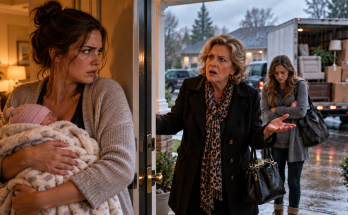
I stood slowly and carried Clara toward the hallway. Nancy picked up her coat and umbrella, then turned back to the lasagna on the kitchen counter. "There's enough for several meals," she said. "You can freeze the rest if you want." I thanked her. She didn't ask when she'd be invited back or whether she could take another photograph of the baby. She simply moved toward the entrance, pausing beneath the small light fixture where she'd stood demanding entry on the morning of the attempted move. The contrast was so striking that I felt almost dizzy.
At the threshold, Nancy turned to face me. Her eyes moved from Clara to my face. "I'm glad you let me come," she said. I nodded. "I'm glad we could have a quiet visit." She looked as though she wanted to say more, then thought better of it. Outside, the rain had eased to a light mist. I handed her the umbrella and watched her step onto the porch. She opened it carefully, adjusting the handle so it wouldn't strike the doorframe. Then she looked back once and said, "I'll let you decide when you're ready again."
I remained in the doorway as she walked toward her car. There was no moving truck waiting behind her, no trailer loaded with furniture, no relatives expecting rooms. She reached the curb, folded the umbrella, and climbed into the driver's seat. I watched until the car pulled away. Only then did I close the door. The new deadbolt turned smoothly beneath my hand. Clara was warm against my chest, and the house was quiet. My mother had entered because I invited her, held my daughter because I agreed, and left when the visit was over. I couldn't call our relationship healed. But for the first time, I had seen what respect might look like when it was practiced instead of promised.