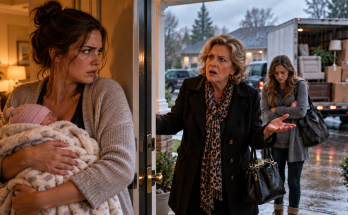
The next time my mother asked about visiting, she began her message with a question. It arrived on an ordinary Tuesday morning while I was sitting on the velvet couch with Clara asleep against my chest. Nancy wanted to know whether I might feel comfortable seeing her again the following week. She said she could come alone, keep the visit short, and bring nothing unless I wanted something. I read the message twice, noticing what was absent. There was no announcement that she'd be arriving, no suggestion that being Clara's grandmother entitled her to enter, and no attempt to make refusal sound cruel.
I didn't answer immediately. Clara had been awake much of the night, and I wanted to spend the morning resting rather than arranging a visit. I placed the phone beside me and watched the light move slowly across the living room floor. Hours later, when I felt more rested, I checked my calendar and chose an afternoon that suited us. I sent Nancy a reply confirming the date and the same basic conditions we'd established before. She answered with a simple acknowledgment. The exchange required less energy than almost any conversation we'd had during my adult life.
It would have been tempting to describe the change as a reconciliation. The word sounded satisfying, as though the family had reached the end of a difficult chapter and everyone could return to loving one another without hesitation. But I knew better. I still remembered the moving trailer at the curb, the way Nancy had turned my recovery into evidence that I couldn't make sound decisions, and the note Krista had slipped into my hand. Those events hadn't become harmless because my mother was now using polite language. They remained part of our history.
What had changed was the arrangement of responsibility. Nancy could ask whether a visit was possible. I could decide. If the answer was no, I didn't have to produce an explanation elaborate enough to defeat every objection. If the answer was yes, the invitation applied only to the time and circumstances we'd agreed upon. I was no longer attempting to persuade my mother that I deserved authority over my own life. I was exercising that authority and allowing her to decide whether she wanted a relationship within its limits.
Clara continued growing through those weeks, almost indifferent to the emotional importance of our household's new routines. Her cheeks became rounder, her movements more purposeful, and her awake periods longer. She began responding to familiar voices with an alertness that made me laugh. I spent hours watching her discover the ordinary world: sunlight moving across a wall, the sound of running water, the texture of a soft blanket beneath her fingers. I knew that her curiosity would expand far beyond these rooms. For now, I was grateful that the rooms were peaceful enough for her to explore them.
My recovery continued steadily. The medical concerns following delivery required attention and follow-up, but I was no longer spending every day frightened by my body's unfamiliar sensations. I learned which activities left me tired and which could wait. I stopped apologizing to myself for resting in the middle of the afternoon. When I felt well enough, I unpacked another box or organized a shelf. When I didn't, I sat with Clara and watched the rain. The house had become a place where my needs could exist without being evaluated by someone else.
Krista's family was finding its own rhythm in the apartment. Pete's work remained uncertain for a while, but the longer assignments gave them enough stability to keep up with current expenses while they continued addressing their debts. Krista increased her hours gradually and maintained the routines that helped the children feel secure. They still worried about money. Some evenings, the budget required difficult choices. But those choices belonged to Krista and Pete, and they were learning to make them together without asking Nancy to settle every disagreement.
The children were doing well. The youngest continued collecting leaves beneath the maple tree. The oldest had made friends nearby, and the middle child was proud of the paper stars decorating the bedroom. Krista sent photographs occasionally, always asking before sharing anything involving the children more widely. I found myself smiling at the ordinary details. Their new home wasn't large or impressive. It was a place where they could sleep, study, laugh, and disagree without worrying that a relative might claim control over the household because she'd paid a bill.
The apartment deposit remained a private gift. Victor retained the documentation, and I kept my own records without discussing the contribution with Krista. Sometimes I wondered whether she would eventually learn what I'd done. If she asked me directly, I intended to answer honestly. But I no longer felt a strong need for recognition. The money had served its purpose. It helped her family secure a home without requiring obedience, gratitude performed on demand, or access to somebody else's property. That was enough.
Victor continued checking on both households without treating himself as the person responsible for managing them. He occasionally called to ask how Clara was doing or whether Pete had found steadier work. He offered advice when asked and withdrew when the conversation was finished. I noticed how different his assistance felt from Nancy's earlier involvement. He didn't need to be indispensable. He seemed genuinely pleased when people became less dependent on him. I thought often about my father's friendship with Victor and understood a little more clearly why he'd trusted him.
Rebecca closed the immediate property matter once there was no indication of further unauthorized entry or attempted occupation. I retained the recorded messages, security footage, moving-company confirmation, and correspondence in case they were ever needed again. The locksmith's invoice remained tucked beside the closing documents. I hoped none of it would require further attention. Knowing the records existed gave me confidence, but I stopped reviewing them every time a family member called. I no longer needed to rehearse the confrontation to remember that my rights were real.
My mother's second visit was quieter than the first. She arrived alone at the agreed time, carrying a small bag of fruit after asking in advance whether it would be useful. I welcomed her inside and offered tea. She sat at the dining table while I settled Clara, then asked whether she might hold her when she was comfortable. We discussed the weather, the garden I hoped to plant, and a recipe my father had once tried unsuccessfully to make. Nancy laughed at the memory without turning it into a lesson about how things should be done.
There were still moments when the old habits appeared. At one point, Nancy glanced toward the hallway and began, "You really should—" Then she stopped. I looked up. She pressed her lips together, apparently reconsidering what she'd intended to say. "I was going to suggest something about the furniture," she admitted. "But I suppose you have your own plans." I nodded. "I do." My mother looked around the room once more, then returned her attention to Clara. The exchange lasted less than a minute, but it mattered more than a long speech would have.
I didn't need Nancy to stop having opinions. She was free to believe the couch belonged on another wall or that the nursery would look better with different curtains. What I needed was for her to recognize that those opinions didn't become instructions simply because she expressed them. She could disagree privately without treating my choices as mistakes requiring correction. I could hear a suggestion without accepting it. The relationship didn't depend on identical tastes or constant approval. It depended on whether we allowed one another to remain separate people.
When the visit ended, Nancy checked the time and stood without being prompted. She thanked me for allowing her to see Clara and asked whether she should take the empty cup to the kitchen. I said I'd handle it. She didn't insist. At the front door, she paused beside the brass lock, looking toward the porch where she'd once stood demanding entry. For a moment, I wondered whether she remembered that morning as vividly as I did. She didn't mention it. She simply said goodbye and walked to her car.
I watched her leave without the crushing exhaustion that used to follow our conversations. There had been no dramatic revelation, no agreement about every grievance from my childhood, and no promise that we would never disagree again. We had spent a little time together, and the time had been manageable. I realized that I had begun measuring our relationship differently. I was no longer asking whether my mother could make me feel loved enough to excuse her behavior. I was asking whether our contact could be respectful enough to continue.
Krista's relationship with Nancy developed more cautiously. My sister exchanged occasional messages and allowed brief telephone conversations about the children, but she continued keeping the apartment address private. She and Pete agreed that any future visit would happen at a neutral location until they felt comfortable making another arrangement. Nancy wasn't pleased with the distance, but she had stopped treating the lack of access as proof that Krista was an ungrateful daughter. The restraint was imperfect, and there were days when old complaints resurfaced. Still, my sister could end a conversation without the family falling into immediate crisis.
The threats concerning the children did not resume. Krista and Pete retained the messages and letters, and they continued seeking independent advice when necessary rather than relying on our mother's interpretation of their responsibilities. No custody proceedings arose from Nancy's earlier statements. The fear she'd created took longer to fade than the immediate housing crisis, and I didn't expect a single apology to erase it. But Krista was no longer making decisions under the belief that disagreement would automatically cost her children their home or family.
One afternoon, Krista called while folding laundry in her apartment. She told me she'd just ended a conversation with Nancy after our mother began criticizing Pete's work schedule. "I said we had it handled and changed the subject," she explained. "When she brought it up again, I told her I'd call another day." I waited for the rest of the story, expecting another argument. Krista laughed. "That's it. I hung up, finished the laundry, and made lunch." I smiled. The absence of drama was becoming one of the most encouraging developments in our family.
My sister and I also began speaking about subjects that had nothing to do with Nancy. We discussed our jobs, recipes, the children's school projects, and the small repairs our homes needed. Sometimes we disagreed about ordinary things. Krista thought I should replace the old living room lamp; I liked its slightly crooked shade. I teased her about keeping too many children's drawings. Neither disagreement became a struggle. We could express different opinions and continue the conversation. I had almost forgotten how enjoyable that kind of closeness could be.
The old brass spare key remained inside the blue folder. I came across it one afternoon while looking for the warranty on the heating system. I held it in my palm, remembering Krista standing beneath the rear porch light, turning it in the lock while I watched through the security camera. The memory still troubled me. It reminded me how fear and pressure could push someone toward a choice they knew was wrong. But the key also reminded me of what happened afterward: Krista told the truth, accepted responsibility, and returned it without expecting immediate access to my home.
I placed the key back in the folder. There was no need to display it or turn it into a permanent accusation. The locks had been changed. Krista understood why she no longer had one. Our relationship was becoming stronger through something more meaningful than the ability to enter each other's houses whenever we pleased. She could call. She could ask. She could visit when we agreed. Trust was returning through respect, not through the removal of every boundary.
Sometimes, late at night, I thought about David. His departure during my pregnancy had frightened me in ways I hadn't fully admitted while concentrating on buying the house and preparing for Clara. I'd imagined raising our daughter with someone beside me, sharing the interrupted nights and difficult decisions. When he left, I worried that independence would feel like abandonment. Yet the weeks after Clara's birth had shown me something unexpected. I could be supported by friends, colleagues, Victor, and eventually Krista without surrendering control over my life. I wasn't isolated simply because I was making decisions for myself.
There were still moments when I wished my father could see the house. I imagined him standing in the living room, examining the old hardwood floor and making suggestions about the loose bathroom tile. He would probably have insisted on repairing the squeaky board near the hallway, then laughed when I told him I'd grown fond of it. I wished he could meet Clara, hold her carefully, and tell her stories about the strange objects he'd repaired over the years. The longing remained sharp, but it no longer felt entirely lonely. His influence survived in the people who loved us and the choices I was learning to make.
One quiet evening, I carried Clara through the house after her bath. The rooms were dim except for the lamp beside the couch, and the air smelled faintly of clean cotton and the rain beginning outside. We passed the two spare bedrooms. One was gradually becoming my office, with books arranged on shelves and a desk positioned near the window. The other remained mostly empty. I paused in the doorway, looking at the sunlight-faded floor and the patch of wall where I'd once taped paint samples. I still hadn't decided what to do with it.
For the first time, the uncertainty felt pleasant. Perhaps the room would become a playroom when Clara grew older. Perhaps I'd use it for work, or fill it with books and a comfortable chair. Perhaps it would remain empty until some future need made its purpose obvious. I didn't have to decide now. Nobody was standing beside me explaining why unused space should be surrendered to someone else. The room could wait, just as so many of my decisions could wait until I was ready to make them.
I returned to the living room and sat on the velvet couch. Clara rested against my chest, her small fingers curled around the edge of my sweater. I remembered carrying her into the house when she was eight days old, too exhausted to bend comfortably for the key I'd dropped on the porch. I'd cried because the walls belonged to us, because the deed bore my name, and because I'd believed a home of my own would finally make me safe. I hadn't understood then how quickly someone could attempt to occupy a place without owning it.
The confrontation had been painful, but it had clarified the difference between love and entitlement. My mother had loved us in ways that were sometimes generous and sometimes controlling. Krista had needed help, but her need didn't create an obligation for me to surrender my home. Victor had offered assistance without demanding authority. Rebecca had defended the facts without requiring me to prove that my feelings were sufficiently justified. And I had discovered that saying no could protect a relationship from resentment rather than destroy it.
My mother and I were not suddenly close in the way I'd once imagined. The scars in our relationship remained. There were subjects we approached cautiously, memories we understood differently, and limits she sometimes found uncomfortable. I no longer expected her to become an entirely different person. I expected her to respect the decisions that belonged to me. When she managed that, we could share ordinary moments with Clara. When she struggled, I could end the conversation and try again another time, or not, depending on what felt right.
I checked my phone before preparing for bed. There was a message from Nancy asking whether Clara had enjoyed the small fabric book she'd brought during her last visit. I smiled at the thought of my daughter staring solemnly at its bright pages. I replied that she seemed interested in the pictures and that we were having a quiet evening. My mother answered with a simple goodnight. No new plans followed. No request for a key. No reminder of what she believed I owed her. I placed the phone aside and carried Clara toward the nursery.
At the front door, I stopped for a moment and rested my free hand against the new brass deadbolt. Outside, Clover Ridge Drive was quiet beneath the streetlights. The house still needed repairs, my life remained complicated, and motherhood would bring challenges I couldn't yet imagine. But the central question had been settled. I owned my home, my daughter was safe within it, and the people I loved could be part of our lives without directing them. I turned the lock gently, listened to the solid click, and walked back toward Clara's room. The door would open again when I chose to open it. That was enough.
The End
Read more original stories on Feel Every Story.