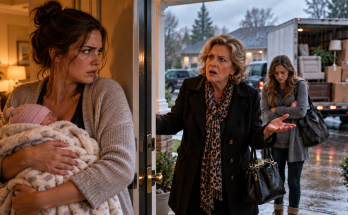
I didn't cut into the lasagna until late that afternoon. It sat on the kitchen counter beneath its carefully folded foil while I fed Clara, changed her, and settled her for another nap. The house smelled of tomato sauce, garlic, and warm cheese, a combination so familiar that I kept expecting to hear my father's voice from another room. When I finally lifted the foil, I found the pasta arranged in neat layers with the corners browned exactly as I remembered from childhood. Nancy had even used the same shallow baking dish, the one with a tiny chip along one handle.
I served myself a small portion and sat at the dining table. The chair opposite me was empty again. Only an hour earlier, my mother had occupied it, speaking about the rain and the old kitchen cupboards before admitting that she had no right to arrange the move. I replayed the apology while eating, examining it from different angles. She had named the unauthorized relocation. She had acknowledged telling me to leave my own house. She had recognized that I'd needed rest. For once, she hadn't followed those admissions with a demand that I acknowledge how much she had sacrificed.
I wanted to feel uncomplicated relief. Instead, I found myself waiting for the next message, the one that might turn the entire morning into an obligation. Nancy might remind me that she'd apologized and therefore deserved another visit. She might ask why Krista still hadn't invited her to the apartment. She might tell Gil that I'd finally admitted she was a good mother. I recognized the unfairness of judging an interaction by things that hadn't happened, but years of experience made trust difficult to restore. My relief was real. So was my caution.
My phone vibrated as I was washing the plate. A message from Nancy appeared on the screen. "Thank you for letting me see Clara today. I enjoyed our conversation. I hope you can get some rest." I read it twice, searching for a hidden request. There wasn't one. She hadn't asked for another invitation or suggested that her lasagna entitled her to anything. I considered replying immediately, then dried my hands and returned to the couch before deciding what to say. Eventually, I wrote, "Thank you for the food. Clara and I are having a quiet afternoon. I'll be in touch when we're ready."
The reply came several minutes later. "All right. Take care of yourselves." I placed the phone down and watched Clara sleeping. It was a brief exchange, ordinary enough that most people would hardly have remembered it. But I did. My mother had accepted that I would initiate future contact, and she hadn't tried to negotiate a date. I wanted to recognize that choice without converting it into proof that everything had changed. A respectful message was a beginning. It wasn't evidence that decades of habits had disappeared.
That evening, Victor called. He hadn't asked me to report immediately after the visit, and I appreciated the space he'd given me. I told him Nancy had come alone, asked permission to hold Clara, and returned her when I requested it. I described the conversations about my father, the house, and my recovery. When I reached the apology, Victor grew quiet. "She said all that?" he asked. I repeated the essential words as accurately as I could. He listened without interrupting, then said he was glad I'd heard them.
I asked whether he thought she meant it. Victor took his time answering. "I can't know what she understands beyond what she says and does," he replied. "But she acknowledged specific actions, and she left when you asked. Those are meaningful things." I looked toward the front door. "I keep worrying that if I trust her even a little, I'll lose the ability to protect myself." Victor considered that. "Trust doesn't have to be given all at once. You can recognize one good visit without promising a second. You can accept an apology without returning to the old arrangement."
The words steadied me. I had been treating trust as though it were a single door, either locked permanently or thrown open without conditions. The morning suggested another possibility. I could allow contact in measured ways, observing what happened and adjusting accordingly. I didn't have to decide today whether Nancy would eventually attend every birthday, holiday, or family gathering. I had only to decide whether the interaction we'd just shared was something I might choose to repeat.
Victor asked about Krista. I told him Nancy had acknowledged that she needed to speak with her older daughter about the custody threats. His voice grew more serious. "That's a separate responsibility," he said. "Krista deserves a direct acknowledgment, but she also deserves the right not to hear it until she's ready." I agreed. I didn't want to become the messenger who carried apologies, objections, and emotional demands between them. I'd spent too much of my childhood managing the space between my mother and everyone she disappointed.
After the call, I opened my notebook and wrote a brief account of the visit. I described what Nancy had actually done rather than what I hoped it meant. She arrived alone at the agreed time. She asked before holding Clara. She respected the end of the visit. She apologized for the moving arrangements and acknowledged the need to address Krista separately. I left space beneath the entry for later observations. Looking at the page, I realized how much easier it was to assess behavior when I stopped trying to predict motives.
The following morning, Krista called while I was preparing breakfast. She wanted to know how the visit had gone. I told her the truth without suggesting she should follow my example. Nancy had been calm, the conversation had remained manageable, and she'd apologized for trying to take over my home. Krista listened carefully. "Did she say anything about the kids?" she asked. I told her Nancy had admitted saying things she shouldn't have and understood that she needed to address them directly with her.
My sister was silent for several seconds. Then she said, "I don't know whether I want to hear it." I looked toward Clara, who was awake in her bassinet, watching the light shift across the ceiling. "You don't have to decide now," I answered. Krista exhaled. "Part of me wants her to say she's sorry. Another part thinks I'll just get frightened again if we start talking about it." I understood. The threat hadn't been an ordinary angry remark. It had reached toward the deepest fear a parent could have, the possibility of losing the people they were trying to protect.
I asked whether she and Pete had discussed what contact with Nancy might look like. Krista said they'd agreed not to provide the apartment address for now. They were willing to exchange occasional messages about the children, but they didn't want unscheduled visits or conversations about their parenting decisions. Pete remained especially upset that Nancy had encouraged the move while allowing him to believe I'd agreed. "He says he should have called you himself," Krista told me. "I told him we both should have."
I remembered the morning Pete stood in my doorway, looking bewildered by the lawyer and the blue folder. His embarrassment had been genuine, but so had his failure to check with me before loading the trailer. I wasn't interested in punishing him indefinitely. I wanted the family to learn that practical decisions required actual consent. "I'm glad you're talking about it together," I said. Krista answered that they were trying. Their apartment still contained unpacked boxes, but every conversation about where something belonged ended with one of them making a choice rather than asking Nancy.
We talked about the children for a while. The youngest had collected enough maple leaves to fill an entire shopping bag, and Krista was trying to persuade him to keep only a few favorites. The oldest had made a friend in the apartment complex. The middle child wanted to bake cupcakes for a neighbor who'd helped carry furniture upstairs. These details made me smile. Their family was becoming ordinary again, with small arguments about toys, schoolwork, and how many leaves could reasonably be stored in a bedroom.
Before we ended the call, Krista asked something that caught me unprepared. "Do you think Mom knows how frightened I was?" I considered the question. Nancy had acknowledged that she'd said things she shouldn't have, but I couldn't know how fully she understood the consequences. "I think she knows she frightened you," I answered. "I don't know whether she understands what it was like for you. That's something only you can decide whether to tell her." Krista was quiet. Then she said, "Maybe one day. Not yet."
I respected the answer. For years, I'd believed that family conflict had to be resolved quickly before someone became angry enough to withdraw affection. Now I saw the value of allowing painful experiences to remain unfinished while people gathered the strength to address them. Krista didn't have to accept a conversation merely because Nancy was prepared to offer one. Her recovery from the threat belonged to her, just as my recovery from childbirth and the attempted relocation belonged to me.
Two days later, Nancy sent another message. She asked whether Krista had mentioned receiving her letter. I stared at the screen, surprised. I hadn't known she'd written to my sister. My first instinct was to ask what the letter said, but I stopped myself. Nancy and Krista were adults. If the communication didn't require my involvement, I didn't need to place myself between them. I answered that I wasn't discussing Krista's private conversations and that Nancy would have to respect whatever response her older daughter chose to give.
My mother took longer than usual to reply. I imagined her rereading my words, feeling excluded from a process she'd once expected to direct. Eventually, she wrote, "I understand. I shouldn't have asked you to speak for her." I placed the phone down, unsettled by how simple the exchange had been. I had declined a request. She had accepted the refusal. No argument followed. I couldn't remember the last time we'd managed that sequence without someone becoming wounded or angry.
That afternoon, Krista called again. Her voice was quiet. "Mom wrote to me," she said. I sat down at the dining table, suddenly attentive. I asked whether she wanted to talk about it. She said yes. The letter had arrived that morning, addressed to the temporary mailing arrangement she and Pete were using rather than their new apartment. Nancy had apparently obtained the appropriate address from an earlier family record, but she hadn't attempted to discover their residence. Krista seemed relieved by that distinction, even though the envelope itself had frightened her.
I asked what the letter contained. Krista took a breath. "She said she was wrong to suggest that our money problems meant we couldn't take care of the kids. She said she should never have used the possibility of someone taking them away to make me agree to her plan." My sister's voice trembled. "She wrote that she was scared for us, but that being scared didn't give her the right to frighten me." I closed my eyes briefly. The words sounded painfully simple. Yet they addressed the actual injury rather than describing how misunderstood Nancy felt.
Krista continued reading portions of the letter in her own words. Nancy had acknowledged arranging the move without my permission and allowing Pete to believe the housing question was settled. She said she should have listened when both daughters refused. She didn't ask Krista to provide the apartment address or schedule a visit with the children. At the end, she wrote that she hoped they might eventually speak, but she understood if Krista needed time. My sister stopped reading. I could hear her breathing unevenly.
"What do you think?" I asked. Krista gave a small, uncertain laugh. "I don't know what to do with it." I understood. For years, we'd learned to expect explanations that defended Nancy's intentions while leaving the injured person responsible for restoring peace. This letter was different enough that Krista didn't have a familiar response. I asked whether the apology felt specific to what had happened. She said it did. Then she added, "I still remember how she looked at me when she said nobody would believe us. I don't know how to stop remembering that just because she wrote a letter."
"You don't have to stop remembering," I said. My sister was silent. I continued, "You can accept that she apologized and still need time. The memory doesn't disappear because the words were better this time." Krista exhaled shakily. I heard Pete speaking quietly in the background, asking whether she wanted water. She told him she was all right, then returned to the phone. "He thinks I should keep the letter," she said. "The legal adviser told us to preserve the earlier messages too."
I agreed. An apology could become part of the record without erasing what had preceded it. Krista wasn't threatening to use the documents against Nancy. She was protecting herself from confusion if the story changed later. I remembered how Nancy once reinterpreted arguments until I questioned my memory of them. Written words were different. They remained what they were, even after someone's feelings shifted. I told Krista she could decide whether to answer, and that no response was required simply because the letter had arrived.
She was quiet for a long time. Then she said, "I think I want to write back, but I don't want to promise a visit." I told her that sounded reasonable. She asked what I thought she should say. I almost began suggesting sentences, then stopped. This was exactly the moment when well-intended assistance could become another person taking over. "What do you want her to understand?" I asked instead. Krista considered the question. "That I received it. That I believe she knows she hurt me. And that I'm still not ready to let her into our new life."
I told her those were enough words if she wanted to use them. She thanked me, and we ended the call. I returned to the kitchen, where Clara had begun stirring. As I lifted my daughter, I thought about the difference between our childhood and the conversations Krista and I were having now. We weren't deciding who was the good daughter or who had hurt our mother more. We were helping each other recognize our own needs without requiring agreement. The closeness felt quieter than the family unity Nancy used to demand, but it was also more dependable.
That evening, a message from Krista arrived. She'd written to Nancy and wanted me to know, not because she needed approval but because we'd been discussing it together. Her reply was short. She thanked Nancy for acknowledging the threat, said she still needed space, and repeated that visits with the children would be arranged only when she and Pete felt ready. She hadn't provided their address. She hadn't apologized for protecting them. I read the message with a sense of pride I couldn't easily describe.
A little later, Krista sent one more message. Nancy had replied. "I understand. I'll wait until you contact me." There were no complaints about ingratitude, no references to money she'd spent, and no insistence that a grandmother shouldn't be excluded. Krista wrote that she'd stared at the answer for several minutes, almost expecting another message to appear. None came. I recognized the feeling exactly. We had both spent years preparing for consequences whenever we refused our mother. Now we were beginning to experience the strange quiet that followed when a refusal was allowed to stand.
I put the phone away and carried Clara to the nursery. Rain had returned, tapping gently against the window. The sage-green walls looked soft beneath the night-light, and my father's photograph rested on the dresser where I'd placed it. I thought of Nancy holding Clara on Saturday morning, then of Krista reading her letter and choosing her own response. Neither moment repaired the past. But both involved something we'd once lacked: the ability to make a choice without another person immediately trying to overrule it.
As I settled Clara, I realized that the most important result of the weekend wasn't that my mother had apologized to me. It was that the apology hadn't become another demand. Nancy had spoken, and we'd been allowed to decide what her words meant for our separate lives. Krista had answered when she was ready. I had chosen not to mediate. The distance between us remained, but it was no longer maintained only through fear. For the first time, it seemed possible that we might eventually build relationships in which each person remained responsible for her own decisions.