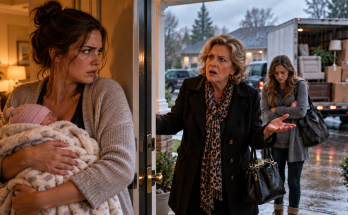
"Marianne survived?" I repeated. Mrs. Dalton looked toward the kitchen door, where the soft clatter of dishes continued as though the world had not changed. She nodded, but her expression was troubled. "That's what I believe. I can't prove where she's been all these years." I struggled to understand how a woman could vanish in a fire and remain hidden for twelve years while her daughters mourned her. "You told me you were there," I said. "Did you actually see her afterward?" Mrs. Dalton tightened her fingers around the linen towel. "I saw someone take her away."
I waited while she gathered herself. "The fire happened at Marianne's house in Vermont. By the time I arrived, the firefighters had already pulled two people out. One was a neighbor who had tried to help. The other was Marianne." Mrs. Dalton swallowed. "She was badly burned and unconscious. I saw her being carried to an ambulance. Later, someone told the family she'd died before reaching the hospital." I stared at her. "Who told them?" "A man who said he represented the medical transport company. I never learned his real name."
"Why would you believe a stranger?" I asked. Mrs. Dalton looked wounded, but she did not turn away. "Because there was a hospital report. Because people in uniforms were moving around the property. Because I was frightened and trying to care for two girls who had just lost their mother." Her voice trembled. "Emily was twenty, Clara was seventeen. They were sitting in a neighbor's kitchen when I arrived. Emily kept insisting her mother would have known how to escape through the back door." She paused. "I told them what I'd been told."
I thought about the years that followed. Emily had taken responsibility for Clara, found work, and eventually established herself as an architectural historian. She rarely spoke about her family, and I had assumed that the silence came from grief. Now I wondered whether she had spent those years sensing something wrong but lacking evidence to challenge an official account. "When did you begin to suspect Marianne hadn't died?" I asked. Mrs. Dalton took a slow breath. "A few weeks later. I went to the hospital to ask about her belongings. They told me they had no record of a woman named Marianne Carter being admitted."
"Did you report it?" I asked. "I tried. The hospital said the ambulance had taken her elsewhere. The transport service denied having a vehicle at the scene. The local police believed the death certificate settled the matter." Mrs. Dalton rubbed her forehead. "I eventually spoke to a lawyer. He advised me not to make accusations without evidence." I looked at her sharply. "And then you stopped?" "I was frightened. Someone left a note on my car telling me to stop asking questions if I wanted the girls to remain safe." Her eyes filled. "I kept that note for years."
"Do you still have it?" I asked. She nodded. "In a box at my apartment." I considered the practical value of a twelve-year-old threat. It might reveal handwriting, paper, or a pattern of language, but its greater significance lay in what it told me about the people involved. They had been willing to frighten a household employee into silence while two young women believed their mother dead. That wasn't an ordinary dispute over property. Someone had considered Marianne dangerous enough to remove her from public life.
"Why was Marianne involved with Eleanor's inheritance?" I asked. Mrs. Dalton looked relieved to have a question she could answer more directly. "Because Eleanor raised her. Marianne was adopted when she was eight years old. Eleanor had no biological children, and she wanted Marianne to inherit everything she owned." I felt an unexpected loosening in my chest. "Adopted?" "Yes. Eleanor loved her completely. Margaret recognized the adoption in the trust documents. Your grandfather disliked the arrangement, but he had already refused to acknowledge Eleanor herself."
I thought of Emily and Clara. If Marianne was Eleanor's adopted daughter, they shared a legal connection with my family, but not a blood relationship. The distinction mattered to me in ways I wasn't prepared to examine while Emily remained missing. More immediately, it helped explain why the inheritance had become contentious. "Did Eleanor ever challenge the altered trust?" I asked. Mrs. Dalton nodded. "She tried. The lawyers told her the documents were genuine. She couldn't afford a prolonged dispute, and she became ill before anything was resolved."
"And the pendant?" I asked. Mrs. Dalton touched the silver circle beneath her collar. "Margaret gave it to Eleanor before she died. Eleanor left it with me because she feared it would disappear like the other things connected to her mother." I looked toward the hall leading to the library. Margaret's portrait had shown her wearing the same circular pendant. It was not merely jewelry. It connected the women whose names had been removed from the family's official history. "Why give it to you?" I asked. Mrs. Dalton's eyes softened. "Because she trusted me when almost no one else did."
I leaned against the pantry wall. Mrs. Dalton had served my family for twenty-six years, yet I had never considered that her loyalties might extend beyond the people who signed her paychecks. She had known Margaret, Eleanor, and Marianne. She had witnessed the consequences of decisions my father had spent decades concealing. "Did Marianne know the blue ledger existed?" I asked. "Yes. Eleanor told her about it before she died." "Then why didn't Marianne recover it?" "She believed your grandfather had destroyed the original records."
"Someone must have told Emily differently," I said. Mrs. Dalton nodded. "Marianne had kept copies of correspondence that mentioned Margaret's handwritten accounts. Emily discovered those papers while sorting her mother's belongings after the fire. She didn't understand their importance until she began working on the Ashford Hotel." I thought of Emily's desk and the strange questions she had asked before disappearing. She had been piecing together evidence from her own family's history, unaware that it led directly into mine. The realization made her silence easier to understand and harder to forgive.
"Why didn't she tell me about Marianne?" I asked. Mrs. Dalton looked at me steadily. "Because she didn't know whether your family was responsible for what happened to her mother." The answer struck me with uncomfortable force. Emily had fallen in love with a man whose father controlled the company connected to her family's stolen inheritance. When she began finding evidence of wrongdoing, she must have faced the possibility that the person she trusted most belonged to the same system that had harmed her mother. I remembered her guarded questions, her sudden silences, and the way she studied my reactions whenever I mentioned my father.
"Did you know we were together?" I asked. Mrs. Dalton nodded. "Emily told me she was seeing you before she began working on the Ashford project. She sounded happy." I looked away. "And later?" "Later she sounded frightened." Mrs. Dalton hesitated. "She said you weren't the man she feared. But she worried that someone close to you was using your name and authority without your knowledge." I thought about the black Mercedes parked at the estate while I was in New York. Someone had wanted Emily to believe I was involved. Someone had understood exactly how devastating that belief would be.
"Tell me about the photographs," I said. Mrs. Dalton lowered her eyes. "Emily showed me one before she disappeared." My attention sharpened. "Clara said she destroyed them." "She destroyed the copies she received, yes. But I saw one first." "What was in it?" Mrs. Dalton looked toward the ceiling, searching her memory. "You were standing outside the Ashford Hotel beside a woman. The photograph appeared to show you handing her a folder." I frowned. "When was it supposedly taken?" "A few days before Emily vanished."
I tried to recall visiting the Ashford site during that period. I had been there several times, usually accompanied by engineers or contractors. "What did the woman look like?" I asked. "Tall. Dark coat. Her face was partly hidden by her hair." "Did Emily recognize her?" Mrs. Dalton nodded slowly. "She thought she did." My pulse quickened. "Who?" Mrs. Dalton looked directly at me. "Her mother." I stared at her. The implications arrived almost too quickly to separate. Emily had received a photograph suggesting that I was secretly meeting a woman who had supposedly died nine years earlier.
"She believed I knew Marianne was alive," I said. Mrs. Dalton nodded. "And that you had been hiding it." I ran one hand through my hair. "I didn't even know Marianne existed." "I believe you." "Why didn't Emily ask me?" Mrs. Dalton's expression was sorrowful. "She tried to. She told me she came to the estate that night because she wanted an explanation. But when she saw someone leaving your study with the Ashford files, she became frightened. She believed the documents were being removed before she could prove what she'd found."
"Did she recognize that person?" I asked. Mrs. Dalton hesitated. "She told me she thought it was Marianne." I stared at her. "Then why did she leave without speaking to her?" "Because someone followed Emily when she returned to her car. She drove away before she could identify him." I remembered Clara saying Emily had seen something impossible. A mother believed dead, walking through the house of the man Emily loved, carrying documents connected to a stolen inheritance. No wonder she had been unable to explain it without sounding irrational.
"Was the photograph genuine?" I asked. Mrs. Dalton shook her head. "I don't know. Emily later questioned it. She noticed that the shadows around your feet didn't match the light on the woman's coat." I looked at her sharply. Emily had always been meticulous about visual evidence. She would have studied the photograph until every inconsistency became apparent. "She thought it had been altered?" "Yes. After she disappeared, she obtained other images taken at the site. She told me something about the perspective was wrong."
I stepped away from the wall and began pacing the narrow pantry. The story was becoming more coherent, but not less disturbing. Someone had shown Emily a photograph that might have been fabricated. Someone had used my car to suggest I was present at the estate while I was in New York. Someone had removed or handled the Ashford files. If those actions were coordinated, their purpose was obvious: persuade Emily that I was protecting the people responsible for her family's stolen inheritance, and frighten her into abandoning the investigation.
"Did she ever identify who was behind it?" I asked. Mrs. Dalton shook her head. "Not with certainty." "Then why stay hidden for three years?" "Because the people involved weren't finished." I stopped pacing. "What does that mean?" She looked toward the kitchen door. "Emily discovered that the Ashford transfer wasn't the only questionable transaction. Other properties had been moved through the same chain of companies. Some were sold, others refinanced, and the proceeds disappeared into accounts she couldn't trace."
I thought of the ledger in my library. Margaret's handwritten figures might establish a pattern stretching back decades, but there would also be modern records showing what happened after the trust was altered. "Did Emily obtain those records?" I asked. "Some of them." "Where are they?" Mrs. Dalton shook her head. "She wouldn't tell me." I felt frustration rise again, but I understood her caution. The fewer people who knew where the evidence was kept, the harder it would be for someone to recover it by threatening a single witness.
"Why bring Rosie to the coastal house last autumn?" I asked. Mrs. Dalton's face softened. "Emily wanted to see her niece. She hadn't seen Rosie since the child was a baby, and Clara couldn't safely travel to meet her. I agreed to take Rosie for an afternoon while Clara was working." I stared at her. "You took a three-year-old into a situation you believed was dangerous?" "I know." She looked ashamed. "I convinced myself it was safe because the house was isolated and Emily had arranged everything. Looking back, I shouldn't have put Rosie in that position."
"Was anyone else there?" I asked. Mrs. Dalton hesitated. "An older woman. I didn't see her face clearly. She stayed inside while Emily met us near the garden." "Could it have been Marianne?" "Perhaps." "Did Rosie meet her?" "She went into the kitchen with Emily for a few minutes while I waited on the porch." Mrs. Dalton looked troubled. "When she came out, she called the woman Grandma. I assumed she was copying something Emily had said. I didn't ask enough questions."
I thought of Rosie's description of ducks, the necklace, and the woman who had spoken to Aunt Emmy. She might have been referring to Mrs. Dalton in some memories and the stranger inside the house in others. At three, she could hardly be expected to distinguish family relationships she had never been told about. "Did the older woman wear a pendant?" I asked. Mrs. Dalton shook her head. "I couldn't see." "But you were wearing Eleanor's pendant." She nodded. "Yes. Rosie sometimes calls me Grandma Dot."
"Did Emily ask about Clara?" I asked. Mrs. Dalton's expression changed. "Repeatedly. She wanted to know whether Clara had made any unusual telephone calls or received messages from strangers." I thought of the unused emergency phone and the silent calls. "What did you tell her?" "That Clara had been frightened by calls she couldn't identify. Emily became very upset." "Did she explain why?" "She said Clara had unknowingly revealed something important through her ordinary telephone."
I looked at Mrs. Dalton. "What information?" "I don't know." She folded the towel again. "Emily told me Clara was being watched, perhaps through her telephone, perhaps through someone she trusted. She asked me not to tell Clara where we had met." The warning behind Margaret's portrait suddenly acquired a more precise meaning. Emily wasn't necessarily accusing her sister of deliberate betrayal. She was warning that Clara might unknowingly reveal whatever I discovered. The distinction did not eliminate the danger, but it changed how I intended to handle her.
"Who put Emily's latest letter behind the portrait?" I asked. Mrs. Dalton looked startled. "Latest letter?" "A white envelope addressed to me. Emily warned me not to trust Clara yet." Mrs. Dalton shook her head. "I didn't put it there." I studied her expression. "You knew the compartment existed." "Yes, but I haven't opened it since Margaret's funeral." "Then someone else placed that letter there recently." She looked genuinely alarmed. "Lucas, if the paper is new, Emily may have come into the house herself."
I considered that possibility. Emily knew the library and the household routines. She could have entered through an unlocked service door or persuaded an employee to let her in. But why leave a message in a compartment she couldn't be sure I would discover? Unless she had deliberately arranged for Rosie to reveal it, or intended someone else to guide me. I looked toward the kitchen, where the child was now singing softly. The sequence of events no longer seemed accidental, but I could not yet distinguish planning from coincidence.
"There's something I need to show you," Mrs. Dalton said. She reached into the pocket of her apron and withdrew a small folded receipt. "I found this in an old kitchen account book last month. I didn't know what it meant until you started asking about the Ashford records." I unfolded it. The paper was from a private vehicle service, dated three years earlier, on the night Emily had come to the estate. The destination was listed as Whitmore House, and the passenger's name had been entered by hand.
I stared at the name. Marianne Carter. Mrs. Dalton watched my reaction. "The driver was paid in cash," she said. "The receipt was charged to a household account that should only have covered staff transportation." I looked at the signature beneath the name. The ink had faded slightly, but the letters were clear. Someone had signed for a journey to my house using the identity of a woman officially declared dead nine years earlier. Whether Marianne herself had traveled or someone had used her name, the record placed that identity inside my household on the night Emily disappeared.
"Who authorized the payment?" I asked. Mrs. Dalton pointed to a code printed beside the amount. I recognized it immediately. It belonged to the private expense account my father had controlled before his retirement. But beneath the code, in a different hand, was a small notation I had never seen before. Mrs. Dalton touched the paper. "That mark appears on several old receipts. Emily asked me about it once." I looked closer. Three letters had been written beside a narrow diagonal line: M.V.C.
"Marianne Vale Carter," I whispered. Mrs. Dalton nodded. "That's what Emily thought." I folded the receipt carefully. There was no longer any question that the events surrounding Emily's disappearance had involved someone using Marianne's identity. The question was whether the woman in the photograph had been Marianne herself or part of another deception. I looked toward the pantry door, aware that every answer seemed to lead back to people who had moved through my house unnoticed.
Mrs. Dalton took a slow breath. "There's one more thing about that night, Lucas. Something I never told Emily." I waited. "I heard a woman crying in the library after the car arrived. She kept saying she wouldn't sign another document." My throat tightened. "Did you see her?" Mrs. Dalton nodded. "Only briefly, when she came into the corridor." She looked down at the receipt. "Her face was badly scarred. But she had Emily's eyes."