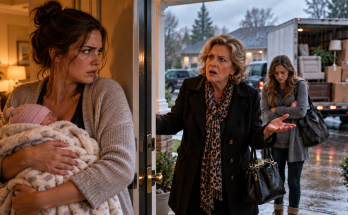
Clara reached for the envelope, but I moved it beyond her grasp. The movement was instinctive, almost involuntary, and I regretted it when I saw her expression. She withdrew her hand as though I had struck it. Rosie stood between us, her small face troubled by a disagreement she could not understand. "Mommy?" she whispered. Clara looked down immediately. "It's all right, sweetheart." But the reassurance sounded thin, and her eyes remained fixed on the letter I was holding.
I read Emily's warning again. There were only a few words, written with the same rightward slant I remembered from her notebooks. She had not asked me to dismiss Clara, accuse her, or prevent her from seeing Rosie. She had written that I must not trust Clara yet. The final word troubled me more than the warning itself. It suggested a condition that might change, something Emily expected me to discover before Clara could safely be included. That was different from accusing her sister of deliberate betrayal, but it offered little comfort.
"Rosie," I said gently, "would you take your cookie to the kitchen?" The little girl looked uncertain. Mrs. Dalton, who had remained near the library doorway, stepped forward. "Come along, darling. We can find somewhere to put the rest of that icing." Rosie hesitated, then held up her plate. "Can I make another one?" Mrs. Dalton smiled. "Perhaps a smaller one this time." She guided Rosie into the hallway, but before following her, she glanced at the open compartment behind the portrait. The look was brief, and something about it stayed with me.
When they had gone, Clara sank into Emily's old chair. "I didn't know that letter was there," she said. "I didn't even know the compartment existed." I placed the envelope on the desk beside the blue ledger. "I believe you about the compartment." She looked up. "But not about anything else?" I studied her for a moment. Until that afternoon, I had considered Clara an unusually dependable employee. She had managed the house through illness, difficult guests, and more than one emergency without asking for recognition. Now every ordinary memory seemed to require reconsideration.
"Tell me about last autumn," I said. Clara frowned. "What about it?" "Rosie remembers seeing Emily at a coastal house. She remembers an older woman wearing a circular pendant. You told me you hadn't seen Emily for eighteen months." "I haven't." "Then how did Rosie see her?" Clara's hands tightened together. "I don't know." "Think carefully. Was there a day when someone took Rosie somewhere without you?" She looked toward the door, and I saw the first sign that the question had reached something she recognized.
"Mrs. Dalton sometimes watches her on my days off," she said. "And occasionally she takes Rosie into town when I have errands." "Did she take her away from Boston last autumn?" Clara shook her head. "Not that she told me." I thought about Rosie's description of ducks, a little house, and an elderly woman who had spoken to Emily. Children of that age could confuse details, but Rosie's recognition of the photograph had been immediate. She had not looked at Emily as though she were a stranger.
"Has Rosie ever called Mrs. Dalton Grandma?" I asked. Clara considered the question. "Sometimes she calls her Grandma Dot. Mrs. Dalton doesn't have grandchildren nearby, and she enjoys looking after Rosie." I felt my attention sharpen. "Grandma Dot?" "Yes." "Then perhaps the woman Rosie remembers is Mrs. Dalton." Clara stared at me. "Why would she take Rosie to Emily without telling me?" It was the right question. I had no answer, and the possibility introduced a new and uncomfortable uncertainty about someone who had worked for my family longer than almost anyone else.
Mrs. Dalton had been employed at the estate for twenty-six years. She had arrived when I was six, initially as an assistant cook, and gradually assumed responsibility for the kitchens and much of the domestic staff. She knew the building's routines, the old storage rooms, the servants' passages, and the people my family had employed before I was born. If someone needed to enter the library unnoticed, she might know how. If someone needed to protect a secret hidden behind my grandmother's portrait, she might know that too.
I opened the blue ledger. The first page bore Margaret Whitmore's name and a date from the late 1970s. The handwriting was small, angular, and remarkably consistent. Every page contained columns of figures, abbreviated property descriptions, and references to account numbers. Some entries were marked with colored pencil, while others had notes squeezed into the margins. Near the middle of the book, a blue ribbon separated two sections. I turned to that page and found a heading written in darker ink: Eleanor Vale, Beneficial Interest.
Clara rose and came closer. We examined the figures without speaking. There were references to rental income, property transfers, and periodic distributions. Several entries concerned buildings later acquired by Whitmore Development. I recognized the Ashford Hotel immediately. Beside its name, Margaret had recorded a percentage interest and a handwritten instruction that proceeds from any future sale were to remain protected for Eleanor and her descendants. The instruction was followed by Margaret's initials. I felt something cold settle beneath my ribs.
"My father knew," I said. Clara looked at me. "About Eleanor?" "About the trust. He admitted the records were changed after Margaret died." I showed her the relevant entries. "This doesn't look like a minor administrative error. Margaret recorded specific rights she expected to survive her death." Clara traced the edge of the page without touching the writing. "Emily would have recognized the importance immediately." I nodded. She had spent years distinguishing original documents from later reproductions. She knew that dates, inks, and marginal corrections could change the interpretation of an entire record.
At the back of the ledger, I found a folded piece of tissue paper. Inside lay a narrow strip of old photographic negative, protected in a transparent sleeve. Four miniature frames showed what appeared to be pages of a legal document. Beneath the sleeve, Margaret had written a date and the words, Original schedule retained. I held the strip toward the lamp but could make out only a few lines. "Why would she keep a photographic copy?" Clara asked. "Perhaps she knew the original documents might be altered." I returned the negative to its sleeve.
Another note lay beneath it, written on stationery bearing the name of an old Boston law firm. Most of the text was ordinary correspondence, but one paragraph referred to a sealed deposit entrusted to an independent custodian. There was no address, only a file reference beginning with the letters MV. I recognized those initials from Margaret's records of Eleanor Vale. The lawyer who had written the letter was probably dead, and the firm might no longer exist. Nevertheless, the document suggested Margaret had anticipated a dispute over the trust long before her death.
"Lucas," Clara said quietly, "you shouldn't keep all this in the house." I looked up. "Why not?" "If Emily was frightened because of these records, someone else may know they exist." The warning was sensible, and that made it more difficult to judge her. I closed the ledger. "Who knew you worked here?" "Emily. The employment agency. My family." "Anyone connected to Whitmore Development?" "Not knowingly." "Have you discussed this house with anyone outside the staff?" Clara hesitated. "Only ordinary things. Schedules, Rosie's childcare, errands."
I remembered Emily's instruction not to trust her yet. "What telephone do you use to contact people?" I asked. Clara frowned. "My own." "Did Emily ever tell you not to use it?" She looked startled. "Once. After we met eighteen months ago, she asked me to buy another telephone and use it only for emergencies." "Did you?" "Yes." "Where is it now?" Her gaze dropped. "I stopped using it." "Why?" "Someone called it repeatedly without speaking. After a while I was too frightened to answer."
"Did you tell Emily?" Clara shook her head. "I had no way to reach her." She looked ashamed. "I convinced myself they were wrong numbers. Then the calls stopped." I considered that answer. If Emily believed Clara's communications were being watched, she might have hidden the warning for that reason alone. Clara could be entirely innocent and still dangerous to confide in. A person who unknowingly revealed information could be as useful to an adversary as someone acting deliberately.
"Do you still have the telephone?" I asked. Clara nodded. "In my room." "Don't turn it on. I'd like an independent specialist to examine it." She looked relieved to have something practical to do. "All right." I placed Emily's letter back inside its envelope. "Until then, please don't discuss what we found with anyone. Not the staff, not your relatives, not even someone you think is helping Emily." Clara stared at me. "You think someone has been listening to me?" "I think Emily believed it was possible."
Clara sat down again. For several moments she looked at the photograph of her sister without speaking. "She protected me when we were children," she said at last. "After our mother died, Emily practically raised me. She learned to manage bills, argue with landlords, and make ordinary meals from whatever was in the cupboard. I was seventeen and furious at everyone. She never seemed to have permission to be furious herself." Her voice tightened. "If she's warning you about me, there must be something I don't understand."
I wanted to tell Clara that the warning meant nothing, that Emily would never suspect her own sister. But I remembered how little I had understood about the woman I loved. Emily had concealed her investigation from me. She had hidden evidence inside my grandmother's desk and behind a portrait. She had arranged for her sister to enter my household under another name. Her decisions might have been necessary, but they were not the decisions of someone who trusted easily. The only reasonable course was to follow the evidence rather than the comfort of our assumptions.
I wrapped the ledger in a clean cloth and placed the photographic negative in a separate envelope. Then I photographed every page with my telephone, making sure the dates, marginal notes, and page numbers were visible. Clara watched silently. When I finished, I locked the originals in a small steel case used for private documents. It was not a permanent solution, and I intended to move them to a more secure location, but I needed to separate the records before anyone realized they had been found.
"There's one more thing," Clara said. I looked at her. "When Emily met me eighteen months ago, she asked whether Mrs. Dalton was still working here." My attention sharpened. "What did you tell her?" "That she was." "How did Emily react?" "She seemed relieved. She said Mrs. Dalton had been kind to her." I remembered Emily and Mrs. Dalton talking in the kitchen during the weekends Emily stayed at the estate. They discussed recipes, old furniture, and sometimes my grandmother. I had never thought their conversations particularly significant.
"Did Emily ever ask you to trust Mrs. Dalton?" I said. Clara shook her head. "No. She only asked whether she was still here." I considered the distinction. Emily might have wanted to know whether someone who remembered Margaret remained in the household. Or Mrs. Dalton might have played a much larger role in Emily's disappearance than I imagined. The fact that Rosie called her Grandma Dot suddenly seemed important. I decided to speak with her privately, without involving Clara in the conversation.
I found Mrs. Dalton in the kitchen, standing beside a rack of cooling biscuits. She was sixty-four, broad-shouldered, with close-cropped gray hair and a habit of wiping her hands on a folded linen towel whenever she was thinking. Rosie sat at the long table drawing with colored pencils. The moment I entered, Mrs. Dalton looked up. "Is something wrong, Mr. Whitmore?" "I'd like a word." She glanced at Rosie. "Of course." I waited while she asked another employee to sit with the child.
In the adjoining pantry, I closed the door. Mrs. Dalton turned toward me with the composed expression she used whenever a guest complained about dinner. "How can I help?" I looked at her carefully. "Rosie calls you Grandma Dot." Her face softened. "She does. I hope that hasn't caused a problem." "Not at all. She seems very fond of you." "And I of her." I paused. "Did you take her to the coast last autumn?" Mrs. Dalton's hands became still against the towel.
"Which part of the coast?" she asked. "A small house near the water. A place where Rosie saw ducks." Mrs. Dalton looked at the floor, then toward the closed door. "I see." The words were scarcely audible. I felt my pulse quicken. "You know what I'm talking about." She folded the towel once, then again, pressing the creases flat with her thumbs. "I hoped the child wouldn't remember the visit so clearly." I stared at her. "Then it happened." She nodded.
"Why would you take Clara's daughter somewhere without telling her?" I asked. Mrs. Dalton raised her eyes. "Because someone asked me to." "Who?" She looked at me for a long moment. "Emily." I felt the room shift beneath my feet. "You spoke to Emily last autumn?" "Yes." "Where?" Mrs. Dalton's voice grew quieter. "I don't think I should answer that here." "You brought Rosie to her. You knew she was alive. You watched me spend three years wondering what had happened to her." Her expression tightened with grief.
"I know," she said. "And there's no apology sufficient for that." I struggled to control my breathing. "Then give me an explanation." Mrs. Dalton stepped closer, lowering her voice. "Emily wasn't trying to punish you. She was trying to keep you alive long enough to discover the truth." I stared at her. "Alive?" She nodded. "She believed the people who frightened her would turn their attention to you if they knew you understood what she'd found."
I thought of the years I had spent working inside the same company, signing documents and negotiating deals without suspecting that any of it might be dangerous. "Who are these people?" I demanded. Mrs. Dalton shook her head. "I don't know all their names." "But you know some." She looked toward the corridor. "I know someone connected to this house has been helping them." I felt a sharp surge of anger. "You should have told me." "I wanted to. Emily begged me not to until she had proof."
"Did she tell you about the blue ledger?" Mrs. Dalton's face changed. The answer was written across it before she spoke. "Yes." "Did you know where it was hidden?" She nodded. "Then why let a three-year-old child lead me to it?" Mrs. Dalton's eyes filled. "Because I couldn't be certain someone wasn't watching what I did. Rosie had seen the compartment opened before, and she remembered. I never asked her to reveal it. I only hoped that when you noticed the face she copied, you might begin asking the right questions."
I stared at her, uncertain whether to believe such an extraordinary explanation. Mrs. Dalton reached beneath the collar of her dress and drew out a circular pendant on a thin chain. It was tarnished silver, with a tiny notch along one side. The shape matched the necklace reflected in Emily's coastal photograph. "This belonged to Eleanor Vale," she said. "She gave it to me before she died. It had once belonged to Margaret Whitmore." I looked toward the kitchen, where Rosie was humming over her drawing. The child had been telling the truth.
"Why would Eleanor give you something so personal?" I asked. Mrs. Dalton's composure faltered. She closed her fingers around the pendant, and for a moment her face looked older than I had ever seen it. "Because I was there when Eleanor's daughter tried to recover the inheritance," she answered. "I was there when the first threats began." She slipped the pendant back beneath her collar. "And I was there on the night everyone was told Marianne Carter died in the fire."
I felt my throat tighten. "Clara's mother?" Mrs. Dalton nodded. "Yes." "What happened that night?" She looked at the pantry door, then back at me. "Not here. Not while Rosie can hear." "Was Marianne murdered?" I asked. Mrs. Dalton's eyes filled again. "That's what the family was meant to believe." I stood motionless. "What do you mean?" She reached for the towel and slowly folded it into a square. "Marianne survived the fire, Lucas."
The words seemed to drain every sound from the room. I thought of Clara, who had spent twelve years believing her mother dead, and Emily, who might have been living with that same belief. "Where is she?" I whispered. Mrs. Dalton shook her head. "I haven't seen her in years. But Emily found evidence that she was alive." I looked toward the kitchen and heard Rosie laugh at something the other employee had said. Mrs. Dalton followed my gaze. "That little girl may have met her grandmother last autumn," she said. "And if she did, someone has kept Marianne hidden for twelve years."