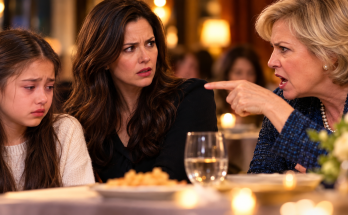
My daughter was thirteen years old when my mother leaned across a restaurant table and told her she didn't belong with us. There was no shouting, no slammed fist, no dramatic accusation. My mother spoke quietly enough that the people at the next table probably heard nothing. But I heard every word. More importantly, Sole heard them. I watched my daughter's expression change as she understood what her grandmother was saying, and something inside me finally reached its limit.
We had been sitting beneath amber-colored lights in a restaurant my parents liked because the waiters remembered their names. Outside, the evening was cold enough to frost the edges of the windows. Inside, silverware chimed against plates, someone laughed near the bar, and an old song played softly through the speakers. Everything seemed arranged to make the evening pleasant. My mother had even insisted we dress nicely. Sole had chosen her favorite cream blouse and spent nearly twenty minutes deciding how to wear her hair.
Her grandmother had barely looked at her when we arrived. My father had complained that our table was too close to the entrance, then made the waiter replace a drink because it contained more ice than he wanted. My brother Chris sat opposite me, checking his phone between mouthfuls and occasionally mentioning something about his sons. Sole sat beside me, attentive and careful, answering every question with a politeness that sounded nothing like the spirited girl who lived in my house.
I noticed the change in her immediately. At home, Sole talked while she cooked with me, sang songs she only half remembered, and left pencils scattered across the kitchen counter. She had opinions about everything from movie endings to the proper way to make pancakes. She could spend forty minutes explaining the plot of a mystery novel. But when we visited my parents, she became unnaturally quiet. Her back straightened. Her sentences shortened. She watched their faces before deciding whether it was safe to speak.
For years, I had convinced myself that her behavior was ordinary nervousness. My parents were difficult people, and Sole had experienced enough uncertainty before coming into my life to make her cautious around unfamiliar emotions. But they weren't unfamiliar anymore. She had known them for six years. She had tried repeatedly to build a relationship with them, even when they made it clear that my brother's children occupied a different place in their hearts.
I am Marlo, and I adopted Sole when she was seven. Before the adoption was finalized, she had lived with me through foster care for eleven months. I remember the first evening she arrived, holding a small bag and a stuffed rabbit whose damaged eye had been repaired with mismatched thread. She stood in my hallway wearing a jacket that was too large and refused to take off her shoes until I showed her exactly where she could put them.
During those early months, I learned that she disliked thunderstorms, loved books about animals, and ate cereal one piece at a time when she was anxious. She learned that I hummed while washing dishes, drank coffee before attempting serious conversations, and kept bandages in the second kitchen drawer. We developed routines without making announcements about them. She began leaving drawings on my desk. I began keeping an extra blanket in the living room because she always got cold during movies.
The first time she called me Mom, we were standing in a grocery store deciding which apples to buy. She said it without looking up, as naturally as asking for another carton of milk. I didn't respond immediately because I was afraid that if I made the moment too important, she might withdraw it. Instead, I placed the apples in our basket and asked whether she wanted to make cinnamon muffins that afternoon. She smiled, and we went on shopping.
When the adoption became official, I believed the hardest part of our journey was behind us. I knew there would be challenges. Sole's early experiences had left her with fears that wouldn't vanish simply because a judge signed paperwork. But I was prepared to work through them with her. What I wasn't prepared for was the realization that the people who had raised me would become another source of pain in her life.
My mother had never openly opposed the adoption in front of other people. At family gatherings, she smiled for photographs and introduced Sole as my daughter when someone asked directly. She was careful about appearances. She organized church fundraisers, remembered neighbors' anniversaries, and delivered meals to families going through difficult times. My father had coached children's baseball teams for years. People thought they were unusually generous.
Their generosity, however, came with conditions. They believed family meant blood, that loyalty followed biological lines, and that a person could be welcomed into a household without ever being considered an equal member of it. They rarely stated those beliefs plainly. Instead, they revealed them through choices small enough to dismiss individually but painful enough to accumulate.
The first year after Sole came to live with me, my mother forgot her birthday. I told myself she had been busy. The next year, she remembered Chris's sons with envelopes containing money and affectionate cards, but sent Sole nothing. When I raised the subject, Mom said she didn't know what children like Sole enjoyed. I explained again that she liked drawing materials and mystery stories. My mother nodded as though the information were new.
Christmas made the difference impossible to ignore. My nephews received carefully chosen presents, often personalized with their names. Sole unwrapped things that appeared to have been purchased without much consideration: bath products one year, a decorative candle another. She was a child who would have been delighted with an inexpensive sketchbook. Instead, she thanked my parents politely and later wrote them notes in her neat handwriting.
I still remember one afternoon when she was nine. We had returned from visiting my parents, and I found her sitting on the bedroom floor with her stuffed rabbit beside her. She was turning a pencil between her fingers instead of drawing. When I asked what was wrong, she wanted to know whether her grandfather remembered her name. My father had referred to her indirectly throughout the visit, calling her things like "the girl" whenever he was annoyed.
I assured her he knew exactly who she was. I wanted to believe that answer. More accurately, I wanted her to believe it, because the alternative seemed too cruel for a child who had already spent years wondering whether adults would keep her. She accepted my reassurance and returned to her drawing, but I remember how long she studied my face before looking down. Children who have experienced instability often learn to recognize the difference between comforting words and certainty.
Over time, my parents began asking questions about Sole whenever she wasn't present. My mother wondered whether children with difficult early experiences could develop lasting attachments. My father asked whether I worried about behavioral problems appearing when she became a teenager. Both spoke as though Sole belonged to a separate category of human beings whose love and loyalty were fundamentally uncertain.
I challenged those remarks repeatedly. My mother accused me of interpreting everything negatively. My father said I couldn't expect them to understand an experience they hadn't chosen. When I reduced visits, they complained that I was depriving them of time with their granddaughter. That contradiction should have warned me. They wanted the public identity of loving grandparents without accepting the responsibility of treating Sole with love.
Approximately a month before the restaurant dinner, I visited my mother alone. We sat in her kitchen while she stirred coffee she had already sweetened. I told her I would no longer excuse remarks that made Sole feel unwanted. I explained that another deliberate insult would mean the end of our visits, not a temporary argument followed by another uncomfortable holiday. My mother listened, pressed her lips together, and said she understood. I left hoping she meant it.
Now, at the restaurant, I watched her adjust the silverware beside her dessert plate. Chris was looking at something on his phone. Dad was telling the waiter that the coffee should be hotter. Sole had barely touched her dessert. A spoon rested between her fingers, and her eyes moved briefly toward the window whenever the conversation stopped. I reached beneath the table and squeezed her hand. She gave me a quick smile that vanished as soon as my mother turned toward her.
Mom leaned forward. Her voice became unusually soft. She looked directly at Sole and told her that people in our family didn't share their table with children they considered mistakes. The wording was brief, but the meaning was unmistakable. She wasn't criticizing a decision Sole had made. She was describing Sole herself as something that should never have belonged among us.
My daughter stopped moving. The spoon shifted against the edge of her dish. Her shoulders drew inward, and her eyes dropped to her lap. I recognized that expression from the earliest months after she came to live with me. It was the look she wore when she believed the safest response to cruelty was to become invisible.
For a moment, I wanted to confront my mother in front of the entire restaurant. I imagined asking her to repeat what she'd said loudly enough for the other diners to hear. I wanted my father to explain why he hadn't objected and Chris to put his phone away long enough to acknowledge what had happened. I wanted witnesses. I wanted consequences.
Then Sole glanced at me, and I understood that she didn't need a public argument. She needed someone to remove her from the room.
I placed my napkin beside my plate, stood, and offered her my hand. I told her we were going home. My father frowned as if leaving before everyone had finished dessert were a violation of etiquette. Chris finally looked up. My mother asked whether I intended to turn an ordinary family dinner into a spectacle.
I told her that she had called my daughter something unforgivable. Mom immediately attempted to reinterpret her words, insisting that Sole understood what she had meant. I answered that I understood perfectly as well, and that was why we were leaving. I didn't raise my voice. There was nothing else I wanted to discuss with her.
Sole stood beside me without protesting. Her fingers were cold, and she kept her gaze on the floor as we walked toward the entrance. Behind us, my father called my name once. I didn't turn around. The hostess held the door, and a rush of freezing air struck our faces. I guided Sole toward the car, unlocked it, and watched her climb into the passenger seat.
I had imagined that walking away would feel like an ending. Instead, as I fastened my seat belt, I realized the most important conversation of the night was still ahead of me.
Sole stared through the windshield, breathing carefully. After several minutes, she finally turned toward me. Her voice was so quiet that I almost missed the question.
"Mom, do you think she was right about me?"