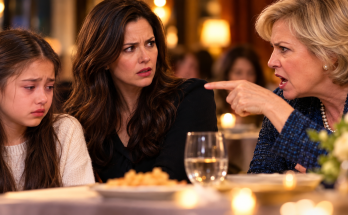
The dinner with Helen and Rachel took place on Saturday evening, one week after Sole received her award at the community center. By four o'clock, our kitchen smelled of tomato sauce, garlic, and the chocolate cake Sole had insisted on making herself. Flour dusted the counter, and a mixing bowl stood beside the sink.
My daughter moved between tasks with serious concentration. She checked the oven, adjusted the table settings, and reminded me twice that the pasta water needed more salt. I let her take charge where she wanted, stepping in only when something required adult supervision.
It was an ordinary family dinner.
That was precisely why it mattered.
For years, gatherings at my parents' house had followed a predictable pattern. Mom decided the menu and seating arrangements. Dad complained about something before everyone finished eating. Chris's sons received most of the attention, while Sole sat quietly beside me, careful not to interrupt.
Tonight, Sole had chosen the menu.
She had helped prepare the food.
And the people coming to dinner were people she wanted to see.
Helen arrived first, carrying a small bunch of flowers and a paper bag containing fresh bread. She greeted Sole warmly and asked whether the cake was finished.
Sole led her immediately into the kitchen to inspect it.
Rachel arrived a few minutes later with a bottle of sparkling juice and a small card congratulating Sole on her competition recognition.
My daughter thanked her, then invited everyone to sit while she finished arranging the salad.
I watched from the doorway, feeling an unexpected warmth.
No one had to remind Sole to speak politely.
No one expected her to earn attention through perfect behavior.
She was comfortable because she knew she was welcome.
During dinner, Helen asked about the bookstore display. Sole described how the owner had placed her drawing near the front window and how customers had begun asking about it.
Rachel wanted to see a photograph, so Sole retrieved her phone and showed everyone.
The conversation moved naturally from art to books, school, and travel. Helen told a story about getting lost during a trip years earlier, and Rachel laughed so hard she nearly spilled her drink.
Sole laughed too.
I realized how rarely I'd heard her laugh that freely at my parents' table.
After dinner, we brought the cake into the living room. Sole had decorated it with small chocolate curls, though several had melted slightly because she'd placed them before the icing cooled.
She seemed dissatisfied with the result.
Helen examined the cake seriously.
"I think it looks excellent."
Sole frowned.
"The curls were supposed to stand up."
Rachel smiled.
"Then we'll call it modern art."
Sole laughed and began cutting slices.
We ate while looking through her newer sketches. Helen asked about the morning version of the city street, and Rachel admired the way Sole had changed the light.
My daughter explained her choices in detail, occasionally moving her hands as though drawing invisible lines in the air.
I sat back and listened.
This was what family attention could look like when it wasn't mixed with judgment.
Later, while Sole and Rachel were discussing a mystery novel, Helen followed me into the kitchen to help with dishes.
She asked quietly whether I'd heard anything from my mother.
I told her about the latest email.
Helen stopped drying a plate.
"She admitted the messages were wrong?"
"Yes."
"And the restaurant remark?"
"She called it cruel."
Helen placed the plate on the counter.
For several seconds, she said nothing.
Then she told me she was glad my mother had finally acknowledged those things, though she hoped I wouldn't feel pressured to treat the apology as a complete repair.
I assured her I didn't.
Helen nodded.
"Good. She has to learn that saying the right thing once isn't the same as becoming someone people can trust."
I looked toward the living room, where Sole was laughing at something Rachel had said.
"I know."
Helen continued drying dishes.
Then she said she hoped Mom would eventually recognize how much she'd missed by refusing to know Sole properly.
I understood what she meant.
My mother had missed the early drawings, the school exhibitions, the quiet conversations about books, and the gradual growth of Sole's confidence.
She had also missed the chance to become someone my daughter naturally wanted nearby.
Those opportunities couldn't simply be recreated by agreeing to a visit.
When Helen and Rachel left, Sole hugged them both. Helen promised to send information about another illustrated-book exhibition, and Rachel asked whether she could see the finished morning street drawing when it was ready.
Sole agreed enthusiastically.
After closing the door, she leaned against it and smiled.
"That was fun."
"It was."
"Can we do it again sometime?"
"Of course."
She nodded, satisfied.
Then she looked toward the dining room.
"No one argued."
I felt a small ache.
"No," I said. "No one did."
Sole began collecting the remaining plates.
I helped her clear the table, and we worked together in comfortable silence.
The next morning, I received another email from my mother.
It was brief.
She wrote that she'd received my earlier response and understood that I wasn't ready for contact. She said she would stop asking Sole to visit and would no longer send gifts or messages directly to her.
She also wrote that she intended to respect the financial boundary and wouldn't ask me to resume the payments.
I read those sentences carefully.
They addressed the two issues my parents had resisted most strongly: access and money.
For the first time, my mother appeared willing to accept that she couldn't simply demand either.
I didn't know whether the change would last.
But I acknowledged it privately.
Later that day, I called the attorney and asked whether there was any reason to respond. She suggested a short acknowledgment confirming that I expected the boundaries to be respected.
I agreed.
We drafted a message stating that I'd received my mother's email and appreciated her commitment not to contact Sole directly or pressure us about financial support. I made no promises about reconciliation.
The attorney reviewed it, and I sent it.
Then I closed the correspondence folder.
I wanted to see whether my mother could demonstrate respect through silence.
For several days, she did.
There were no new emails from unfamiliar numbers, no requests through relatives, and no surprise packages.
Chris remained angry. Rachel mentioned that he'd complained about the situation during a conversation with another cousin. But he didn't contact me directly, and I didn't seek updates about his opinions.
My father's silence was harder to interpret.
He hadn't offered an apology, and I had no evidence that his beliefs about family responsibility had changed. I wasn't going to assume agreement simply because he stopped writing.
Still, the absence of pressure gave us room to live.
Sole returned to schoolwork, art projects, and the ordinary concerns of being thirteen.
She spent one afternoon helping a friend prepare for a science presentation. Another evening, she asked whether she could reorganize her bedroom. I helped move the bookshelf, though she changed her mind halfway through and decided it looked better in the original position.
I pretended to complain about the wasted effort.
She laughed and offered to make hot chocolate.
We settled for that arrangement.
The following Friday, I attended another consultation with the therapist. We discussed how Sole had responded to her grandmother's more specific apology.
I explained that she'd expressed cautious hope but didn't want contact.
The therapist asked whether I felt disappointed by that decision.
I considered the question.
"No," I said. "I think I expected to feel relieved if my mother apologized. But now I understand that the apology is only one part of the situation."
The therapist nodded.
She asked whether I had any desire to reconcile with my parents separately from Sole.
I admitted that I wasn't sure.
Part of me missed the idea of having parents I could call when something important happened. I missed certain memories from childhood and the feeling that family relationships would remain stable regardless of disagreements.
But I didn't miss the criticism, the financial expectations, or the way my mother could make a conversation feel like a test I was destined to fail.
The therapist suggested that I distinguish mourning the relationship I'd wanted from deciding whether the relationship actually available was healthy.
I wrote that down.
It was a simple distinction, but one I hadn't fully considered.
After the appointment, I picked Sole up from school. She was carrying a folder of sketches and talking excitedly about a new assignment.
On the way home, she asked whether Grandma had kept her promise not to contact us.
I said she had, so far.
Sole looked thoughtful.
"Maybe she really means it."
"Maybe," I said.
Then she asked whether I thought Grandma was lonely.
I told her I didn't know, though she might be. The change in our relationship had probably been difficult for everyone involved.
Sole looked out the window.
"I don't want her to be lonely."
I felt my heart tighten.
"I know."
"But I don't want to visit."
"You don't have to."
She nodded.
For a few moments, we drove in silence.
Then Sole said something that surprised me.
"I think I can feel sorry for her without going back."
I looked toward her.
"Yes," I said. "You can."
She smiled faintly.
That evening, Sole asked whether we could take another photograph for the living-room shelf.
I laughed and asked what occasion we were celebrating.
She shrugged.
"Nothing special."
I thought about that.
For years, photographs in my parents' house had marked formal events: birthdays, holidays, graduations, carefully arranged family gatherings.
Sole wanted a picture of an ordinary evening.
I agreed.
We set the camera on a shelf and used the timer. The first photograph caught me blinking. In the second, Sole laughed because I'd moved too soon. The third showed us sitting close together on the couch, both smiling naturally.
She chose the third.
We printed it the following day and placed it beside the photographs from the exhibitions.
The shelf was becoming crowded.
Sole didn't mind.
On Sunday afternoon, Helen stopped by briefly to return a book Sole had lent her. They spent nearly half an hour discussing the ending before Helen left.
As I walked her to the door, she asked whether things were still quiet with my parents.
I said they were.
Helen smiled sadly.
"I hope they use the quiet to think."
I nodded.
After she left, I found Sole sitting beside the living-room shelf, looking at the photographs.
She held the old family portrait from Christmas in her hands. I'd kept it in a drawer rather than displaying it, but she'd found it while searching for another picture.
I sat beside her.
"Everything okay?"
She nodded.
Then she looked at the photograph again.
"I used to think this was what family was supposed to look like."
I waited.
She placed the portrait on the table and gestured toward the newer pictures.
"But I like these better."
I followed her gaze.
There was the photograph from the school exhibition, the picture with Helen at the café, the competition award, and the ordinary photograph from our living room.
None showed every relative.
None had been arranged to prove that our family was complete.
They simply showed people who wanted to be together.
Sole stood and returned the old portrait to the drawer.
Then she came back and sat beside me.
"Mom?"
"Yes?"
"Do you think Grandma will ever understand why I don't want to visit?"
I considered the question carefully.
"I hope she will," I said. "But even if she doesn't, your feelings still matter."
Sole nodded.
She leaned against my shoulder, and we sat together for a while without speaking.
Outside, the afternoon light moved slowly across the yard.
I thought about everything that had happened since the restaurant dinner: the canceled payments, the messages, the family meeting, the lawyers, the competition, and my mother's belated acknowledgment.
The conflict had changed shape.
For weeks, I'd been responding to demands.
Now, for the first time, I was no longer being asked to prove that my daughter deserved to belong.
Sole had stopped asking for that proof too.
But I knew the story wasn't entirely finished.
My mother had begun to acknowledge the truth.
My father hadn't.
And Chris had spent weeks defending a version of events that treated Sole's feelings as an obstacle rather than something worthy of respect.
I didn't know whether any of them would change.
What I did know was that Sole's peace could no longer depend on their decisions.
As evening approached, my daughter rose from the couch and asked whether we could make pancakes for dinner.
I looked at the clock.
"Again?"
She smiled.
"Why not?"
I laughed and followed her into the kitchen.
For once, there was no urgent message to answer, no family demand to explain, and no reason to postpone the ordinary pleasure of being together.
We made pancakes.
And when Sole laughed because the first one came out crooked, I laughed with her.