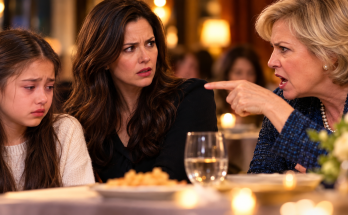
Three months after the restaurant dinner, my father sent me a letter that contained no request for money. I recognized his handwriting on the envelope before I opened it. His letters had always been severe and angular, as though even his pen disliked taking unnecessary turns. For several seconds, I stood beside the kitchen counter, wondering whether I wanted to read what he'd written. The house was quiet. Sole was at school, her latest sketchbook lay open beside the fruit bowl, and the afternoon sunlight reached across the table where we had made pancakes the night before.
I had grown accustomed to the quiet. My mother had kept her promise not to contact Sole directly, and the strange messages from unfamiliar numbers had stopped. Chris had apparently found a way to pay his own phone bill. My parents were managing their vehicle, utilities, and prescription expenses without contributions from me. I knew very little about their arrangements because I had stopped asking relatives for updates. Their circumstances belonged to them, just as the life I was building with my daughter belonged to us. Still, seeing my father's handwriting brought back the familiar feeling that an obligation was waiting inside the envelope.
I opened it carefully and unfolded a single sheet of paper. Dad wrote that he had spent a great deal of time thinking about what happened at the community center. He said he disliked remembering Sole standing before him with her certificate while he told her that her disappointment concerned something from years earlier. At the time, he had believed he was defending his wife. Looking back, he recognized that he had dismissed a child who was trying to explain why she had been hurt. He wrote that she had spoken respectfully and that he had been wrong to treat her words as an offense against his authority.
I sat down before continuing. My father had rarely acknowledged mistakes, particularly when they involved someone younger than himself. He could apologize for arriving late or forgetting an appointment, but disagreements about respect and family responsibilities usually ended with someone else yielding. I read the paragraph again, searching for the familiar qualification that would turn his admission into another accusation against me. There wasn't one. Instead, he wrote that he had failed to protect Sole when my mother insulted her at dinner and that his silence had made him responsible for part of the hurt.
The final section was shorter. He acknowledged that the financial support I had provided was voluntary and that he shouldn't have treated it as a permanent entitlement. He had been angry when the payments ended, he admitted, and had allowed that anger to become more important than the reason I'd withdrawn from the family. He said he was ashamed that his first message after the restaurant dinner had concerned the vehicle payment instead of asking whether Sole was all right. Then he apologized without asking me to restore the payments, arrange a visit, or forgive him immediately.
I placed the letter on the table and looked toward the living room. Sole's special recognition certificate stood beside the photographs from her art exhibitions. Next to it was the small wooden frame containing the picture of us laughing on the couch. The shelf was crowded now, with books and drawings leaning against one another, but I had no intention of rearranging it. Sole liked seeing the evidence of ordinary, happy days accumulated together. My father had written the words I'd once desperately wanted to hear. Yet I felt neither sudden relief nor an urgent desire to pick up the telephone.
I had learned that acknowledgment and reconciliation were different things. My father's letter mattered because it named specific behavior without demanding that I excuse it. It didn't erase the forgotten birthdays, the Christmas photographs, or the years of standing by while Sole struggled to understand her place. It also didn't require me to reject his admission simply because it arrived late. I could recognize an effort toward accountability while keeping the boundaries that had allowed my daughter to feel safe.
That afternoon, I forwarded a copy to my attorney and asked whether she saw any reason to respond formally. She replied that the letter didn't create a legal issue and that the decision was personal. The financial arrangements had ended, and no further claims were pending. She suggested I take time before deciding whether to acknowledge receipt. I thanked her, placed the letter inside a folder separate from the earlier demands, and returned to my work. I no longer needed to treat every communication from my parents as an emergency.
When Sole came home, she dropped her schoolbag beside the kitchen counter and announced that her art teacher had recommended another project. This time, the class would create a collection of drawings illustrating a place that mattered to them. Sole wanted to draw our kitchen from several different perspectives. She had already decided to include the chipped blue mugs, the window above the sink, and the corner of the table where she usually worked. She spoke for nearly ten minutes before noticing the envelope beside my laptop.
"Is that from Grandma?" she asked.
"From Grandpa," I said.
Her expression became cautious. "Is he angry again?"
"No. He wrote an apology."
Sole sat down slowly, as though she'd heard something that needed careful consideration. She asked whether he'd apologized for arriving at the competition. I explained that he'd acknowledged dismissing her feelings there, failing to defend her at the restaurant, and treating my financial assistance as something he was owed. I told her he hadn't asked for a visit or demanded anything in return. She listened, turning the corner of her sketchbook between her fingers.
"Did he say I was disrespectful?"
"No," I answered. "He said you spoke respectfully, and he was wrong not to listen."
My daughter looked toward the window. For a while, she didn't speak. Then she asked whether she could read the letter herself. I gave it to her and remained nearby without watching her face too closely. She read slowly, pausing over several sentences. When she finished, she placed the paper carefully on the table instead of pushing it away.
"I'm glad he wrote it," she said.
"So am I."
"But I don't want to visit him."
I told her that was all right. She seemed relieved, though I hadn't expected a different answer. The letter was important, but it didn't transform years of uncertainty into trust. Sole wasn't obligated to offer closeness simply because an adult had finally recognized that he'd behaved badly. I asked whether she wanted me to acknowledge his apology. She thought about it, then said I could thank him for writing without promising anything else.
A few days later, I sent a short response through the attorney. I told my father I'd received his letter and appreciated his willingness to acknowledge specific mistakes. I said Sole had read it and that we weren't ready to resume contact. I wished him well and made no commitments about the future. He didn't argue. There was no second letter insisting that an apology should earn a visit. That restraint mattered more to me than another page of emotional promises.
My mother remained quiet too. Helen occasionally mentioned that my parents were learning to manage their expenses differently, but she didn't provide details unless something directly affected us. She had become careful about remaining a relative rather than a messenger. Her own relationship with my parents belonged to her, and she could decide how much contact she wanted. When Sole invited Helen over, she came because she wanted to spend time with my daughter, not because she was helping me make a point.
Chris never apologized. For a while, I expected him to send another angry message whenever he heard that my parents were no longer asking me for financial help. But the messages stopped. Rachel eventually mentioned that he was handling his phone service and that relatives had become less willing to entertain his complaints. I didn't ask for further details. I had no interest in collecting proof that he was unhappy. His silence was enough for the moment, and I left the possibility of a healthier relationship where it belonged: with the choices he might make in the future.
The following Saturday, Sole and I went to the bookstore downtown. Her city-street drawing still hung near the front window, though the owner planned to make room for a new display soon. He'd kept the print in a protective frame, and several customers had asked whether the artist had created other work. Sole listened while he described their comments, her cheeks turning pink with pleasure. Before we left, he asked whether she would consider allowing him to display a second drawing when she completed her kitchen project.
She looked at me, then back at him. "I think I'd like that."
The owner smiled and said he'd be delighted. As we walked outside, Sole held the new mystery novel she'd chosen against her chest. The weather had turned cooler, and a light breeze moved along the street. We stopped near the bookshop window so she could look once more at her drawing. The two figures beneath the umbrella stood together in the reflected light, surrounded by a city that seemed quiet despite the rain. I remembered how she'd explained that the street looked too empty without them. She liked the idea of having someone to walk home with when the weather was bad.
On the drive home, she asked whether I still felt sad about my parents. I considered the question honestly. There were moments when I missed them, especially when I remembered something good from childhood. I missed my mother's cooking on winter evenings and the sound of my father laughing at a ridiculous joke. I missed believing that all the people I loved would naturally care for one another. Those memories hadn't vanished because I had finally recognized the harm that existed beside them.
"Sometimes," I admitted. "But missing someone doesn't always mean the relationship was good for you."
Sole nodded thoughtfully. Then she asked whether I regretted helping them financially for so long. I told her I didn't regret wanting to help. I'd made that decision because I believed they needed assistance and because I had the means to provide it. What I regretted was allowing the arrangement to continue without honest conversations about responsibility and treating their expectations as more important than the effect their behavior had on us. She listened, then returned her attention to the passing houses.
That evening, we worked on her new art project. Sole arranged the blue mugs on the kitchen table and moved a chair to examine the room from a lower angle. She wanted the drawing to show the window, the cabinets, and the place where we prepared meals together. I asked whether she planned to include the pile of mail that seemed permanently attached to one corner of the counter. She said no because it ruined the composition. I accused her of artistic dishonesty, and she laughed so hard that she had to put down her pencil.
Over the next several weeks, the project became part of our evenings. Sole sketched while I cooked, occasionally stopping me to examine the way light fell across my hands or the steam rising from a saucepan. She included the slightly crooked shelf above the refrigerator, the fruit bowl, and the magnet holding a photograph from her adoption day. She didn't try to make our kitchen look grander than it was. The chipped paint near the doorway remained, as did the uneven floor tiles we'd always intended to replace. I loved the drawing more because she included those details.
One afternoon, she showed me the nearly finished piece. Two people stood at the counter, preparing dinner together. One was taller, with a loose strand of hair falling across her cheek. The smaller figure held a wooden spoon and appeared to be arguing about something. Sole had captured the scene so precisely that I knew immediately it was us. I asked whether we were discussing the amount of garlic in the sauce.
"Obviously," she said. "You never use enough."
I laughed and studied the picture again. The kitchen looked ordinary. There were no dramatic shadows or elaborate decorations. But the warm light made the room feel inhabited, and the two figures seemed entirely comfortable in one another's company. I recognized the quality she'd been searching for since her earliest drawings of houses beneath trees. She wanted to show what safety looked like without needing to explain it.
As the school year continued, Sole became increasingly willing to express disagreement without fearing that doing so would damage our relationship. She argued about bedtime, complained when I insisted she finish homework before using her phone, and occasionally sulked when I refused something she wanted. We worked through those ordinary conflicts like any parent and child. I didn't interpret them as a loss of gratitude. If anything, I was relieved that she trusted me enough to be annoyed.
I continued meeting with the therapist for occasional parent consultations. We discussed the difference between reassuring Sole and trying to prevent her from experiencing every difficult emotion. I was learning that protecting her didn't mean controlling all the situations she might encounter. It meant providing a stable relationship in which she could ask questions, set appropriate boundaries, make mistakes, and recover from disappointment without fearing abandonment. The therapist also encouraged me to examine the guilt I still carried about the years before the restaurant dinner.
I couldn't change those years. I could acknowledge that I'd overlooked too many warning signs, and I could apologize without asking Sole to comfort me. More importantly, I could demonstrate that my choices had changed. I no longer arranged visits because I believed biological relatives automatically deserved access. I no longer treated a public display of generosity as proof that someone behaved kindly in private. And I no longer asked Sole to tolerate discomfort while waiting for adults to become the people I hoped they might be.
One evening, Helen joined us for dinner and brought a small photograph album she'd begun assembling. Inside were pictures from the school exhibition, the art competition, the café visits, and several ordinary afternoons. Rachel had contributed a photograph from the dinner Sole organized, capturing her standing in the kitchen with a serving spoon in one hand and an expression of mock outrage on her face. Sole laughed when she saw it, remembering that she'd accused me of stealing a piece of garlic bread before the meal.
Helen told her the album wasn't meant to replace any other family photographs. It was simply a record of happy days they had shared. Sole turned through the pages slowly, stopping to examine details she'd forgotten. Then she thanked Helen and asked whether they could add more pictures over time. Helen said she'd like that.
After dinner, Sole carried the album upstairs. She returned a few minutes later with her old journal, the one my mother had given her years before. I recognized the faded floral cover and felt the familiar ache of remembering how eagerly she'd once tried to show its contents to her grandmother. Sole placed it on the table beside the new album and opened both.
She began comparing the drawings with the photographs, pointing out how often she'd sketched houses, windows, and families seated together. There was the rabbit near the window, the house beneath a tree, and the crowded dinner table where she'd placed herself beside Grandma. Then she turned to the newer pictures of the art exhibitions and the quiet evenings at home. She studied the pages without becoming upset.
"I think I kept drawing the same thing," she said.
I asked what she meant.
"A place where people wanted to be together."
I looked at the old drawing of the family dinner. Every figure smiled, though the relationships behind the picture had never been as simple as the child's imagination suggested. I remembered how she'd waited with that notebook beside my mother's chair, hoping Grandma would look. The memory still hurt, but Sole didn't seem trapped by it anymore. She turned to the photograph of herself laughing with Helen and Rachel.
"These are better," she said. "Nobody had to pretend."
I reached across the table and squeezed her hand. She smiled, then closed the journals and began describing another drawing she wanted to attempt. She was thinking about a winter landscape, perhaps a road winding through trees toward a house with light in the windows. I asked whether she intended to put people in it.
"Maybe," she said. "But I want the house to look welcoming even if you can't see anyone."
I loved that idea.
A few weeks later, my mother sent a birthday card for me through the attorney. She didn't include a gift or a separate message for Sole. Inside, she wrote that she hoped I was well and that she was continuing to think about our conversations. She wished me a peaceful year. There were no demands, accusations, or reminders of what she believed I owed her. I acknowledged receipt but didn't begin corresponding with her personally. The boundary remained, not because I wanted to prolong her suffering, but because I needed more than a handful of improved messages before reconsidering a relationship that had been painful for years.
My father remained respectful of the distance. Chris remained absent. None of those outcomes was entirely satisfying. I had once imagined that all our relatives would gather around Sole as she grew older, celebrating graduations, birthdays, and ordinary accomplishments. That future no longer seemed likely in the form I'd expected. I allowed myself to grieve it without treating the grief as a reason to undo the decisions that had protected her.
On the anniversary of Sole's adoption, we stayed home and made cinnamon muffins. It was a tradition we'd developed after the grocery-store afternoon when she first called me Mom. We didn't celebrate the legal paperwork as though it marked the beginning of her worth or the end of every difficulty she'd experienced. We celebrated the years we'd spent learning how to be a family, including the mistakes, disagreements, laughter, and small routines that held our days together.
Sole helped mix the batter, insisting that I had measured the cinnamon incorrectly. I handed her the spoon and told her she could take responsibility for the entire recipe if she felt so strongly about it. She accepted immediately, then complained that I wasn't helping enough. We argued playfully until the muffins were in the oven, and the smell of cinnamon filled the kitchen.
While we waited, she asked whether I remembered the first time she called me Mom.
I told her I remembered the grocery store, the apples, and the way she'd spoken so naturally that I was afraid to react too strongly. She laughed and insisted again that I'd bought the wrong apples. Then she grew quiet.
"I was scared you'd change your mind," she admitted.
I looked at her.
"About adopting you?"
She nodded.
I remembered that frightened seven-year-old standing in my hallway with a stuffed rabbit and a bag of belongings. I remembered the questions she'd asked about whether adults could stop keeping children, the way she'd watched my face whenever I made promises, and the careful trust we'd built one ordinary day at a time.
"I know," I said. "I'm glad you told me."
Sole leaned against the counter.
"I don't worry about that anymore."
The words were spoken casually, almost as an afterthought. She didn't know how deeply they affected me. I turned toward the oven for a moment, pretending to check the muffins because I needed a second to compose myself.
When I looked back, she was smiling.
"Are they done?"
"Almost."
She sighed dramatically and asked why baking always took so long.
I laughed.
That evening, after Helen called to wish us a happy adoption anniversary, Sole placed the finished kitchen drawing in a frame. She'd chosen the title herself: Home on an Ordinary Day. The two figures stood at the counter beneath warm light, surrounded by chipped mugs, crooked shelves, and all the small details that made the room ours.
We hung it in the living room beside her other artwork.
I stepped back to examine the arrangement. There was the rainy street, the house beneath the tree, the photographs from the exhibitions, the special recognition certificate, and now the kitchen scene. The shelf and wall had become a record of how much Sole had grown, not only as an artist but as a person who could recognize affection without fearing it would disappear.
She stood beside me for a while.
Then she asked whether I thought Grandma would like the new drawing.
The question no longer frightened me. I didn't hear it as a desperate request for approval. Sole sounded curious, nothing more.
"I don't know," I said. "But I think it's beautiful."
She smiled.
"Me too."
We left the drawing where it was and went to make dinner.
Later, after Sole went upstairs, I sat alone in the living room and thought about the night that had changed our family. I remembered the amber lights of the restaurant, my mother's quiet words, and the way Sole had folded inward when she heard them. I remembered standing up, taking my daughter's hand, and walking out without the argument everyone seemed to expect.
For a long time, I'd believed that leaving was the bravest thing I'd done that night.
But leaving had been only the beginning.
The harder choices came afterward: ending years of financial dependence, resisting the demands of relatives, allowing Sole to make decisions about contact, acknowledging my own mistakes, and refusing to confuse an apology with restored trust. Those choices required patience, clarity, and the willingness to disappoint people whose approval I'd sought since childhood.
I thought about my parents. My mother had finally acknowledged some of the harm she'd caused. My father had written a specific apology without demanding anything in exchange. Their financial responsibilities were their own again, and they had stopped approaching Sole. I hoped those changes would last. I hoped they might continue learning, even if they never became part of our daily lives again.
I couldn't guarantee what the future would bring. Perhaps one day I would speak with them again. Perhaps Sole would decide, when she was older, that she wanted to hear what they had to say. Or perhaps the distance would remain. Any future contact would have to be built on consistent respect, not guilt, money, or the expectation that a child should forgive simply because an adult had finally apologized.
What I knew was that our central conflict had ended.
My parents no longer controlled our family through financial expectations or demands for obedience. Sole was no longer required to attend gatherings where she felt unwanted. Her private history was not a subject for relatives to debate, and her place in my life wasn't open to negotiation.
I looked toward the drawing of our kitchen.
For years, Sole had tried to make herself acceptable to people who offered affection reluctantly. She'd been polite, patient, grateful, and painfully careful. When those efforts failed, she wondered whether something was wrong with her.
Now she understood that their failure to love her well had never been evidence of her inadequacy.
The old photograph from Christmas remained in a drawer. I hadn't destroyed it, because pretending the past never happened wouldn't make us wiser. But it no longer occupied the living-room shelf. That space belonged to photographs and drawings representing relationships built through attention, honesty, and care.
As I turned off the lights, Sole called from upstairs.
"Mom?"
"Yes?"
"Can we make pancakes tomorrow?"
I smiled.
"We just had muffins."
"That's not an answer."
I laughed and told her we'd see.
She groaned, then wished me good night.
I stood in the hallway for a moment, listening to her footsteps retreat toward her bedroom. The house settled around us, familiar and peaceful. There was no frightened child waiting for permission to belong. There was no grandmother's judgment hanging over our dinner table.
There was only my daughter, safe in her room, planning breakfast and another drawing.
My mother had once looked at Sole and called her a mistake.
She was wrong.
Sole was my daughter. She was thoughtful, stubborn, funny, talented, and wonderfully herself. I hadn't rescued her from being unwanted, and she hadn't been placed in my life to repair something missing in me. We had become a family through a deliberate commitment that deepened with every ordinary year we shared.
That was enough.
I switched off the hallway light and went upstairs.
And for the first time, I knew that I wasn't walking away from my family.
I was finally standing firmly inside it.
The End
Read more original stories on Feel Every Story.