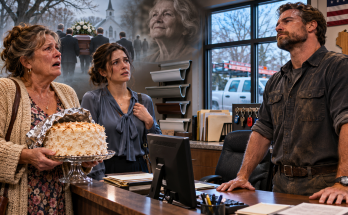
That Sunday, Nina and I drove to Holmen.
Erika came with us.
LaVerne was already there when we arrived.
We met outside Our Savior's Lutheran Church.
It was a familiar building.
I'd been there on countless occasions before Grandma's funeral, and I'd returned many times afterward.
But this was the first occasion on which the four of us had come together to visit Pearl.
There was something particularly important about having Erika with us.
She hadn't needed persuading.
Nobody had told her that going to the cemetery was necessary to demonstrate her loyalty to anybody.
She had decided to come.
And she had brought something.
Two pieces of coconut cake.
They were the remaining slices from the cake she had made on Friday.
The cake she thought had come out too dry.
She had placed them on a cardboard plate.
I looked at the plate and smiled.
Somehow, those two imperfect slices seemed exactly right for the occasion.
We didn't enter the church.
We walked around the outside of the building.
I knew the route well.
So did LaVerne.
For nine years, I had associated that short walk with a particular Saturday in March.
The day we carried Grandma outside.
I remembered the pressure of the coffin handle against my hand.
I remembered the dampness of the grass.
I remembered keeping pace with the men beside us.
That Sunday, I wasn't carrying anything.
Erika was carrying the cake.
Nina walked with us.
And LaVerne was there, just as he'd been there nine years before.
The grass was damp with morning moisture.
We made our way toward the third row from the fence.
The lilac bush had grown considerably since LaVerne planted it.
I could remember when it had been much smaller.
Now some of its branches extended across the headstone.
You needed to move one aside to read the inscription properly.
I did that when we reached the grave.
There was Grandma's name.
Pearl Ann Hegge.
Below it were the words I had known since the stone was placed there.
Beloved Mother and Grandmother.
Nothing about the property she once owned.
Nothing about the money she had received when she sold it.
Nothing about the disagreement that had kept part of her family away during the final years of her life.
Just the relationships that had mattered.
I was glad those were the words somebody had chosen for her.
I thought about how much Grandma had done during her eighty-seven years.
She had worked on a farm.
She had raised children.
She had helped raise grandchildren.
She had grown food.
She had taught me things I continued using as an adult.
She had lived long enough to see her body become incapable of doing work she had performed for decades.
And when that happened, she'd made the arrangements necessary to look after herself.
She hadn't owed anybody an explanation for living those final years.
Yet she had attempted to give Mom one.
I wondered whether Sonnie had ever stood where we were standing.
I had no way of knowing.
She attended services inside the building.
She now sat closer to the entrance leading toward the cemetery.
But I hadn't heard that she had visited the grave.
I didn't look toward the church expecting to see her come outside.
I didn't want our visit to become another occasion spent waiting for somebody who might not arrive.
The people who were there were enough.
Erika approached the headstone.
She looked down at the cardboard plate.
Then she took one of the slices of cake and placed it on the grass in front of Grandma's name.
It was a simple little gesture.
I didn't try to make it mean more than she intended.
She had made Grandma's recipe.
She had brought some of it to the woman who had taught the recipe to our family.
That was enough.
I watched her.
Only a few weeks earlier, she'd needed me to tell her where the grave was located.
She'd written the directions on a sticky note.
Now she knew precisely where to go.
There would be no need for her to ask again.
I found myself remembering the photograph she had taken during her lunch break.
Her kneeling beside the stone.
The tears in her eyes when she returned to the office.
The wet shoes.
She had arrived that first time carrying nine years of regret.
This time, she had arrived carrying cake.
I preferred seeing her carry that.
She still understood what she had missed.
I doubted she would ever entirely stop regretting her absence from the funeral.
But regret wasn't the only thing connecting her to Grandma anymore.
She had the recipe box.
She had the memories she was finally willing to discuss.
She had the freedom to visit whenever she wanted.
She had a relationship with the past that didn't require her to remain ashamed every time she thought about it.
I was glad.
Erika offered the remaining slice to LaVerne.
He accepted it.
My uncle wasn't somebody who required a special reason to eat cake on a Sunday morning.
He finished it in a couple of bites.
Then he considered the flavor.
I watched his expression.
LaVerne had grown up eating Pearl's cooking.
He knew her coconut cake as well as anybody.
I wondered whether he would identify the same difference I had noticed on Friday.
He did.
"Needs a little orange peel in that icing."
I laughed.
Erika looked at him.
"I forgot it."
LaVerne nodded.
That was the extent of his criticism.
He had eaten the whole slice.
He hadn't suggested that she shouldn't attempt the recipe again.
He hadn't complained that it wasn't identical to what his mother used to make.
He'd simply identified the missing ingredient.
There was something comforting about how quickly he recognized it.
The recipe had survived in more than the written instructions.
It survived in what people remembered.
LaVerne knew the taste.
I knew the taste.
Erika was learning how to produce it.
And even my mother, whatever she chose to do with that knowledge, knew exactly how much the little bit of orange mattered.
I imagined Grandma watching her children and grandchildren discuss frosting.
I imagined her being amused that people could become so serious about something she had made dozens of times.
She would probably have reminded us that there were other things to do.
I looked at the headstone again.
The lilac branch had settled partly across the inscription.
I moved it gently.
It occurred to me that I had spent considerable time thinking about how to defend my grandmother's memory.
I had wanted people to know that she hadn't abandoned her family.
That she hadn't selfishly withheld money.
That she hadn't been the woman my mother described when explaining why she refused to speak to her.
But standing there, I didn't feel any particular need to continue making those arguments.
Pearl had lived the life she lived.
People who knew her remembered it.
Mrs. Torsgard remembered the Saturdays on the porch.
Marit remembered the cake and the funeral.
LaVerne remembered the financial responsibilities he'd accepted when Grandma needed assistance.
I remembered the tractor, the cards, and the lemonade.
Erika was beginning to remember those things in her own way too.
My mother's opinion hadn't managed to erase them.
That was something I found enormously reassuring.
I had spent years believing that silence allowed a person's version of events to become the accepted truth.
Sometimes it did.
But not always.
People had been paying attention.
They had remembered.
And when Mom finally made her accusations publicly, several of those people had refused to remain silent any longer.
They had given Pearl something I couldn't have given her alone.
Their own memories.
Their own accounts.
Their willingness to acknowledge what they had witnessed.
I was grateful for all of them.
I looked away from the stone.
My attention wandered toward the church building.
Occupational habit, I suppose.
Whenever I stood near a building, I found myself examining its gutters.
Nina had probably noticed me doing that hundreds of times.
It wasn't something I consciously decided to do.
My eyes simply followed the roofline.
I looked at the rear corner of the church.
Then I noticed something.
One section of gutter wasn't sitting properly against the building.
It had separated from its bracket.
I studied it for a moment.
From where we stood, the problem was clear enough.
Water collecting along that portion of the roof wouldn't be carried away the way it was supposed to be.
Instead, it would escape from the loose section and fall directly onto the ground behind the church.
I looked at the grass beneath it.
Then I looked toward Grandma's grave.
I could picture what happened during a substantial rainstorm.
Water would pour from the roof onto the grass.
It would follow the ground toward the row where Pearl was buried.
That bothered me.
Not because I considered myself responsible for maintaining every building in Holmen.
And not because I was looking for another reason to perform work near the church.
I simply didn't like what I was seeing.
I'd spent years visiting Grandma when she needed her lawn maintained.
After she moved into Maple Ridge, there hadn't been any lawn.
I'd brought cards instead.
When she died, the opportunities to do those ordinary things for her disappeared.
Now I was standing beside her grave, looking at a practical problem that I knew how to solve.
That was something I could do.
I couldn't give her back the five years my mother had refused to speak to her.
I couldn't return to Maple Ridge with another deck of cards.
I couldn't repair the relationship between Pearl and Sonnie.
But I could prevent rainwater from running where it shouldn't.
I decided to come back the following Saturday.
There was no complicated decision involved.
I already knew what needed doing.
I knew what equipment would be required.
And I knew somebody who could help me.
When Saturday arrived, Gandy came with me.
We brought a ladder.
I examined the corner of the roof more closely.
The condition of the existing gutter confirmed what I had noticed the previous Sunday.
It needed replacing.
We installed a new section.
I paid particular attention to the slope.
A gutter could look perfectly straight from the ground and still fail to move water in the intended direction.
What mattered was where the water actually went.
I wanted it carried away from the cemetery.
Toward the parking lot.
That was the sensible direction.
There was no reason for rainwater to be discharged near the graves when it could be directed elsewhere.
Gandy understood what I wanted.
We did the work.
It wasn't an especially complicated installation.
There were no unusual technical challenges.
There was no reason for somebody to consider it an extraordinary achievement.
It was the sort of job we performed regularly.
And that's precisely why it meant something to me.
I hadn't needed to make a grand gesture.
I didn't need a ceremony.
I didn't need the congregation to gather outside and hear an explanation of why I had returned.
There was just a gutter that needed attention.
I knew how to fix it.
So I fixed it.
I didn't send the church a bill.
When I spoke to Pastor Angstrom, I explained that the work wasn't something I'd undertaken on behalf of the congregation.
I had another reason.
He understood.
I thought about all the ordinary work Grandma had done during her lifetime without asking anybody to recognize her for doing it.
She hadn't presented me with a bill for the summers I'd spent on her farm.
She hadn't demanded payment for teaching me how to drive the tractor.
She hadn't treated the hours we spent making cakes as favors I would eventually owe her.
Those things had been given freely.
I was grateful that I could give her something freely too.
When we finished the installation, I stepped back.
The new gutter sat securely against the roof.
The slope was correct.
The water would travel in the direction I wanted it to.
I could have packed up the ladder and gone home.
I knew the work was good.
But there was one thing I always did before leaving.
Gandy knew it.
All the men knew it.
I took out a glass of water.
I thought about the gutter near the entrance to my company.
The one that had been making an unpleasant little sound after the October storm.
Somebody had repaired it without telling me.
I never discovered who.
I remembered standing there that Friday afternoon, listening to the water move through properly.
Somebody had noticed a problem and quietly taken care of it.
Now it was my turn.
I poured the water into the newly installed gutter.
Then I listened.
It traveled through the section without any interruption.
There was no irregular noise from a poorly fitted joint.
No water escaping from somewhere it shouldn't.
Nothing to suggest we'd overlooked something.
I listened a little longer than I normally would have.
Then I looked toward the third row from the fence.
The lilac bush was still there.
Behind its branches was the stone bearing Grandma's name.
The next time rain fell on that corner of the church roof, it would be carried away from her grave.
It wasn't much.
But it was something I understood how to do.
I thought about my mother for a moment.
Nine years earlier, she had told me that helping carry Pearl to that spot meant I no longer belonged to her family.
I had accepted the consequences of refusing to obey her.
I hadn't understood how much time would pass before I saw her again.
I hadn't anticipated that my sister would eventually become my employee.
I hadn't imagined a coconut cake bringing our lives together in the office I would one day own.
And I certainly hadn't expected my uncle's account of the funeral to introduce my business to so many new customers.
Life had taken directions I couldn't have predicted.
My mother's decisions had cost me things.
There was no point pretending otherwise.
There were years with my sister I would never recover.
There were family occasions that couldn't be repeated.
There was a wedding my parents hadn't attended.
There was an apology I still hadn't received.
But I had never regretted attending Grandma's funeral.
Not when Mom told me to stay away from her house.
Not when nobody telephoned.
Not when my sister stood across from me expecting to lose her new job.
Not when Mom tried persuading strangers that I didn't deserve their business.
I had done something I believed was right.
And if somebody had placed me back inside that church on the same Saturday in March, knowing everything that would follow, I would have taken the same handle.
The front one on the left.
LaVerne would have been opposite me.
We would have carried her outside together.
There was no amount of money, no promise of approval, and no opportunity to avoid an argument that could make me wish I'd stayed home instead.
I looked down at the empty glass in my hand.
My grandmother hadn't left me the kind of inheritance my mother had once expected.
She had left me a recipe box.
She had taught me how to work.
She had shown me how to make people feel welcome.
And she had given me enough memories to understand why showing up mattered.
I had passed the original recipe box to Erika.
I had kept copies of the cards.
There would be more cakes.
Some would probably come out too dry.
Somebody would occasionally forget the orange zest.
Gandy would eat them anyway and announce that he'd never tasted anything better.
I liked knowing that.
I liked knowing that my sister could make another cake inside her own apartment whenever she felt like it.
Nobody needed to give her permission.
Nobody needed to pretend the recipe belonged to somebody else.
And Grandma's name could be spoken without anybody treating it as an act of disloyalty.
That was enough for me.
My mother could still call someday.
Whether she ever did remained her decision.
I wasn't closing that possibility.
I simply wasn't organizing my life around waiting for it anymore.
I had work to do.
I had Nina to go home to.
I had a sister who was learning to live on her own terms.
And I had an uncle who had stood beside me when it mattered.
I turned my attention back to the gutter.
The last of the water had reached the outlet and drained toward the parking lot.
I stood quietly for another moment.
Then I lowered the glass.
Nine years earlier, I had helped carry Grandma across that grass because she couldn't make the journey herself.
That Saturday, I had returned because there was still one little thing I could do for her.
I had done it properly.
The water went where it belonged.
And everything was quiet.
The End
Read more original stories on lastestdrama.com.