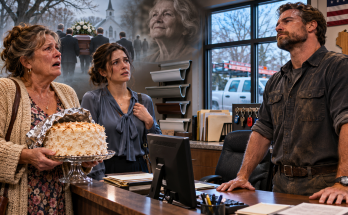
At exactly ten o'clock on Friday morning, Paula looked through the front office window.
She stopped what she was doing.
Then she turned toward my desk.
"Fletch."
I looked up.
"Your mother's here."
I followed her gaze.
Mom's car had pulled into the parking lot.
For a moment, I simply sat there.
I had told Erika on Monday what would happen if Sonnie returned.
I had said Paula would notify me and I would meet Mom outside.
There was no reason to handle things differently now.
I got up.
Erika was sitting at reception.
She looked toward the window.
I could see the tension return to her face.
It was remarkable how quickly the presence of that car changed her expression.
She had spent the morning working normally.
Now she looked like somebody expecting to be called away from something she wasn't supposed to be doing.
I didn't ask her to move.
I didn't tell her to hide in another room.
She hadn't done anything wrong.
I walked toward the entrance.
The little bell sounded when I opened the door.
Then I stepped outside and closed it behind me.
Mom was approaching the building.
She wore the coat she normally saved for Sunday mornings.
Seeing her in it on a Friday seemed strange.
She looked tired.
Considerably more tired than she had looked when she brought the coconut cake on Monday.
Her purse was held in front of her with both hands.
She stopped when she realized I wasn't going to move aside and let her enter.
"I need to speak to Erika."
"She's working."
Mom looked past me toward the entrance.
"I want her out here."
I stayed where I was.
"She's in the middle of her workday."
My mother tightened her grip on her purse.
She looked impatient.
Apparently, she had expected me to interrupt whatever Erika was doing and deliver her to the parking lot.
"I've come to take her home."
I looked at her.
There was something absurd about hearing a mother speak that way about a thirty-four-year-old daughter.
Erika wasn't a child being collected from school.
She wasn't attending an activity that required a parent's permission.
She had accepted employment.
She was performing the responsibilities associated with that employment.
And she was being paid for doing so.
"She can decide when she wants to go home."
Mom's expression hardened.
"This has gotten completely out of hand."
I agreed with that much.
We probably disagreed about what had caused it.
Four days earlier, she had arrived with dessert.
Now she was standing outside the same building after publicly accusing its owner of mistreating her daughter.
The entire situation could have been avoided if she'd simply accepted that Erika had found a job.
But here we were.
"She's not behaving like herself," Mom insisted.
I waited.
"You've put all these ideas into her head."
I glanced through the glass.
Erika had gotten up from her chair.
She was standing near the reception counter.
She could see us.
I assumed she could also make out at least some of what Mom was saying.
I turned back toward my mother.
"What ideas?"
She gave me an irritated look.
"You know perfectly well."
I was tired of that expression.
Mom had always used it when she didn't want to explain the reasoning behind an accusation.
If I challenged her, she acted as though my request for clarification was another example of bad behavior.
But I wasn't going to accept that anymore.
Not standing outside my own business.
"Erika came here looking for a job," I said.
"Paula offered her one."
Mom shook her head.
I continued.
"She does the work we need her to do, and she does it well."
"That's not what I'm talking about."
"Then what are you talking about?"
She looked toward the entrance again.
I realized she wanted Erika to see her standing there.
Perhaps she believed my sister would eventually come outside simply because she was waiting.
That was how things had worked for much of our childhood.
Mom would make her displeasure known.
Then everybody else would adjust their behavior to make the displeasure go away.
Erika remained inside.
She didn't approach the entrance.
Mom looked back at me.
"You've been encouraging her to go against me."
I felt my patience thinning.
The previous day, she had told people that Erika was being harassed at work.
She had suggested that her daughter wasn't permitted to have contact with her.
Now she was standing in front of me complaining that Erika wouldn't immediately abandon her job and come home.
I wondered whether she could hear the contradiction.
"You told people I'm making her miserable here."
Mom's mouth tightened.
"You made that accusation in front of the entire community."
She started to speak.
I continued before she could change the subject.
"And the people who were at Grandma's funeral told you what actually happened."
I thought about LaVerne's response.
Mrs. Torsgard's capital letters.
Marit's reminder about the cake.
Those people hadn't coordinated their accounts.
They hadn't gathered together to decide how they were going to embarrass Sonnie.
They had independently recognized things that weren't true.
And they had said so.
My mother hadn't expected that.
I could see how angry she still was about it.
"Everybody's against me now," she said.
I shook my head.
"People remember what happened, Mom."
She looked at me with an expression I remembered from years earlier.
It was the expression she wore whenever she believed somebody was refusing to give her the acknowledgment she deserved.
"I haven't told anybody what to think about you."
She seemed ready to dispute that.
I reminded her what I'd contributed to the discussion.
One picture.
That was all.
I hadn't written a long response.
I hadn't accused her of being a bad mother.
I hadn't described the argument on Grandma's porch or explained what Maple Ridge had cost.
I'd shown people a page containing the signatures of those who attended a funeral.
Nothing else.
Mom's jaw trembled slightly.
She wasn't used to discussing family matters under circumstances she couldn't control.
Especially not when her daughter was standing close enough to witness the conversation.
I looked through the glass again.
Erika hadn't moved.
She wasn't standing behind Paula.
She wasn't pretending to be occupied with something on her computer.
She stood where Mom could see her plainly.
That seemed significant.
My sister had spent years trying to avoid situations in which our mother might openly accuse her of disobedience.
She had learned to keep uncomfortable opinions to herself.
She had remained silent when Mom claimed the coconut cake as her own.
She had stayed away from the cemetery.
Now she was standing beside the reception counter, allowing our mother to look directly at her while refusing to come outside.
There was no theatrical gesture.
She didn't wave.
She didn't shake her head.
She simply remained where she was.
Mom noticed.
Her eyes moved between Erika and me.
Then her voice became louder.
"She's my daughter!"
I looked directly at her.
"And Pearl was your mother."
The words came out before I had much opportunity to consider them.
I hadn't planned to say that.
I wasn't searching for something particularly clever that might bring the conversation to an end.
It was simply the most obvious answer to what she had said.
Mom stopped.
Her mouth opened.
For a second, I expected another accusation.
Nothing came out.
She closed it again.
I watched her face.
There had been many occasions when I reminded her of her relationship to Grandma.
Usually, she changed the subject.
Sometimes she became angry.
Once, two days before the funeral, she had tried to dismiss that relationship entirely.
Now she was demanding that I recognize the authority she believed came with being Erika's mother.
And I had reminded her that she had once been somebody's daughter.
She seemed unable to answer.
We stood there.
Her hands remained wrapped around the purse.
I could hear ordinary sounds coming from inside the building.
People moving.
The activity of a business continuing through its working day.
Then Mom spoke again.
"You don't understand what she did to me."
Her voice was different.
Less certain.
For the first time that morning, she sounded genuinely upset rather than angry.
I waited.
"She had enough money to help us."
I thought about the moving boxes inside Grandma's little house.
Fourteen years earlier.
Grandma had just given up the farm.
She was eighty-two.
She had been trying to explain that her health might eventually require expensive care.
Mom had wanted a house with three garage spaces and a sunroom.
That was the argument we were still having.
Fourteen years later.
Grandma was dead.
The money was gone.
And my mother was still speaking as though Pearl had deliberately withheld something that should have belonged to her.
"She knew we wanted that house," Mom continued.
"She could have made things easier for us."
I looked at her.
She genuinely seemed unable to understand why Grandma's circumstances should have taken priority over her plans.
I had heard LaVerne explain the expenses.
I knew Grandma's savings had been exhausted before she died.
But I wasn't the person who had managed those accounts.
LaVerne was.
He had seen the statements.
He had dealt with the payments.
He had taken responsibility when Mom refused to participate in arrangements for Grandma's care.
"Talk to your brother," I said.
Mom frowned.
"About what?"
"Ask him where the farm money went."
She dismissed the suggestion immediately.
"I know where it went."
I waited.
"She wouldn't spend it on anybody except herself."
I felt something unpleasant rise in my chest.
There was a difference between spending money selfishly and spending money to maintain a place where somebody could look after you.
Grandma hadn't purchased another farm.
She hadn't taken expensive trips.
She hadn't surrounded herself with luxuries while refusing to provide for anybody else.
She had paid for her care.
And eventually, even the proceeds from selling the farm hadn't been enough.
I could have explained all of that.
I could have repeated what LaVerne told me over coffee nine years earlier.
But I knew my mother.
Coming from me, the information would probably become another thing she felt obligated to dispute.
She needed to hear it from the person who had handled the records.
"Please ask LaVerne."
I didn't raise my voice.
I didn't tell her what I knew about Medicaid.
I didn't describe Grandma's final months.
I simply repeated the recommendation.
"He's the one who can explain it."
Mom stared at me for a long time.
I wondered whether she remembered the telephone conversation LaVerne had attempted to have with her after the funeral.
He had tried telling her what happened to the savings.
She had disconnected the call before he could finish.
Perhaps she didn't remember.
Perhaps she had never considered it important enough to remember.
Whatever the explanation, she had spent nine years continuing to believe that the money existed somewhere it didn't.
Now she had another opportunity to find out the truth.
Whether she took it was her decision.
Mom eventually shifted her attention toward the glass entrance.
She looked at Erika.
I turned slightly.
My sister was still standing near the counter.
She met Mom's eyes.
She didn't move.
I knew there would probably be another argument when Erika returned home that evening.
She still lived under our parents' roof.
She couldn't avoid every confrontation.
But at that moment, she was at work.
And she had decided to remain there.
Mom looked at her for several seconds.
Then she turned away.
She began walking back toward her car.
I stayed beside the entrance.
There was nothing else I wanted to say.
I had enforced the boundary I established on Monday.
She hadn't entered the building.
She hadn't interrupted Erika's work.
And I hadn't prevented her daughter from speaking to her.
Erika had made her own choice.
When Mom reached the car, she opened the door and got inside.
She closed it quietly.
That surprised me.
On Monday, she'd slammed it hard enough for us to hear from inside the office.
This time, there was no dramatic sound.
She remained sitting behind the wheel.
Both hands rested against it.
I waited.
For a little while, she didn't appear to be doing anything.
She simply sat there.
Then the engine started.
The car moved out of the parking lot.
I watched until she was gone.
I didn't feel particularly victorious.
What I felt was tired.
There had been something painfully familiar about hearing my mother return to her grievance over Grandma's savings.
All the years that had passed.
Everything that had happened.
And beneath the accusations about Erika, beneath the message intended to damage my company, beneath her anger about the funeral, there was still that same refusal on that little porch.
A woman who needed to preserve her savings had told her daughter no.
Her daughter had never accepted the answer.
I turned and went inside.
The bell sounded overhead.
Erika remained near reception for another moment.
Then she released a long breath and sat down heavily in her chair.
I walked toward her.
"Are you doing all right?"
She looked at me.
Her expression was exhausted.
But there was something unusually definite in her voice when she answered.
"I need my own place."
I nodded.
She wasn't asking whether I thought she should move out.
She was telling me she had decided to.
Paula spoke from her desk.
"There's a vacant apartment in my building."
Erika turned toward her.
Paula continued looking at her computer.
"At least, there was the last I heard."
She explained that the rent was roughly two hundred dollars less each month than comparable places around La Crosse.
That got Erika's attention.
Two hundred dollars was a meaningful difference when somebody was trying to establish a household after a marriage had ended.
Erika looked at me.
"I could manage it after my second paycheck."
I waited.
"End of the month."
She sounded as though she had been calculating the possibilities for some time.
Now there was an actual place to consider.
Not simply an imagined apartment somewhere beyond our parents' house.
Paula added that the building was generally quiet.
She described it as a pleasant place to live.
Then she made one additional observation.
"And I've never had trouble with anybody delivering coconut cakes there."
Erika laughed.
So did I.
The sound seemed particularly welcome after the conversation in the parking lot.
Paula kept working.
She had offered my sister transportation.
She had helped her reach the cemetery.
Now she had told her about a place where she might begin living independently.
At no point had she demanded anything in exchange.
She hadn't told Erika what she should think about me.
She hadn't asked her to choose a side.
She had simply recognized practical problems and offered practical solutions.
I thought Grandma would have liked Paula.
For the remainder of Friday, the office continued operating normally.
There were estimates to arrange.
There were still names on the yellow legal pad.
And Erika had something new to think about when she eventually returned to Holmen.
An apartment.
Her own front door.
A bedroom that belonged to the woman she had become rather than the teenager she used to be.
Before leaving that afternoon, I remembered a small maintenance problem I had been meaning to address.
The gutter near our front entrance had been producing an irregular sound since a storm in October.
I had noticed it more than once.
Each time, something else required my attention before I could inspect it properly.
Considering the nature of my business, there was something embarrassing about leaving a troublesome gutter on my own building.
I went outside with a glass of water.
It was the same simple test I performed at customers' properties.
I poured the water into the gutter and listened.
I expected that familiar little disturbance.
The sound made by water passing through a joint that wasn't functioning properly.
But I didn't hear it.
The water moved through without hesitation.
I listened carefully.
Everything sounded exactly as it should.
Apparently, somebody from one of my crews had already taken care of the problem.
Nobody had mentioned doing it.
I didn't know which of the men was responsible.
Even afterward, I never found out.
I stood beside the entrance holding the empty glass.
Somebody had noticed something that needed attention.
They had fixed it.
They hadn't needed an announcement or a special acknowledgment.
They hadn't made me feel indebted to them.
They had simply done the work.
I appreciated that more than they probably realized.
Then I went back inside to finish my day.
Erika was still at reception.
Paula's yellow legal pad was still beside the telephone.
And somewhere in Holmen, my mother finally had a question she could ask the person who knew exactly what had happened to Grandma's money.
For once, I hoped she would be willing to hear the answer.