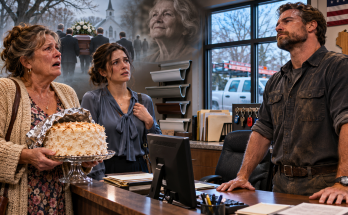
LaVerne drove to Holmen the following morning.
It was Saturday.
I wasn't there when he arrived, so what I knew about that visit came from him and Erika afterward.
My uncle didn't particularly enjoy driving into town.
He preferred being somewhere he could see his cattle and get on with whatever work needed doing.
Visiting my parents certainly wasn't part of his usual Saturday routine.
He hadn't been inside their house for nine years.
Not since the family had divided over Grandma's funeral.
This time, he arrived carrying a beige folder.
There was nothing remarkable about its appearance.
It was the sort of folder anybody might use to keep household records together.
But the papers inside it answered a question that had been responsible for fourteen years of bitterness.
Where had Pearl's money gone?
LaVerne didn't arrive with a speech prepared.
He didn't bring the funeral guest book.
He didn't come to discuss the messages people had written beneath Mom's accusations.
He had something considerably more useful.
Bank statements.
Records of payments.
Documents concerning Grandma's stay at Maple Ridge.
Two years of paperwork that he had carefully retained after her death.
Mom let him inside.
Erika was in the living room when he arrived.
Dad was in his usual place.
His recliner.
The television was on.
LaVerne went into the kitchen and sat at the table.
It was strange hearing about him sitting there again.
For years, that had been an ordinary place for members of our family to gather.
People drank coffee there.
They discussed the weather.
They talked about people they knew from church.
Then Grandma sold the farm, and ordinary gatherings became increasingly difficult.
Eventually, some of us stopped entering that house altogether.
LaVerne placed the folder on the table.
Mom sat across from him.
I don't know whether she expected an argument.
I don't know whether she had spent the previous evening thinking about what I'd told her outside my office.
But she didn't ask him to leave.
And for once, when somebody attempted to explain what had happened to Grandma's money, she remained there long enough to listen.
LaVerne opened the folder.
He began showing her the records.
The figures were there.
The dates were there.
The payments were there.
He hadn't needed to reconstruct anything from memory.
He had kept the documents because he had been responsible for handling Grandma's affairs when she could no longer manage everything herself.
Somebody needed to deal with the expenses.
Somebody needed to make arrangements with the care center.
Somebody needed to sign the necessary paperwork.
Mom had refused to involve herself.
LaVerne had accepted that responsibility.
He now had a complete record of the money that had been used during the final two years of Grandma's life.
He showed Sonnie what the care had cost.
Not an approximate amount.
Not a figure he had arrived at through speculation.
He showed her actual payments, right down to the cents.
I thought afterward about how different that conversation must have been from the one on Grandma's porch fourteen years earlier.
Back then, Pearl could only explain what she believed might happen.
She could tell her daughter that professional care was expensive.
She could explain that she was getting older and needed to protect her savings.
But she couldn't produce bills for expenses she hadn't yet incurred.
Mom had apparently interpreted that uncertainty as an excuse.
Now there was no uncertainty.
Grandma had become ill.
She had required care.
And that care had consumed her money.
LaVerne explained what happened to the proceeds from the farm.
Then he explained what happened to the money from the sale of her smaller house in Holmen.
Both had gone toward supporting her.
Mom turned a page.
Then another.
Erika told me that she watched from the living room.
She could hear LaVerne speaking.
Her mother wasn't saying much.
That alone was unusual enough to make Erika pay attention.
Normally, when somebody offered an explanation Sonnie didn't particularly like, she interrupted before they reached the end.
She questioned their motives.
She challenged individual details.
She found something that allowed her to redirect the discussion.
This time, she apparently couldn't find anything.
The information wasn't coming from somebody else's opinion.
It was printed on the papers in front of her.
She could see how much Maple Ridge had received.
She could see how steadily the savings had diminished.
She could see what happened when the money finally ran out.
During the last months of Grandma's life, Medicaid had been paying for her care.
There hadn't been a hidden account.
There hadn't been a substantial inheritance quietly transferred to somebody else.
There hadn't been a sum of money sitting untouched while Grandma refused to assist her daughter.
The money was gone because Grandma had needed somewhere to live where people could look after her.
LaVerne had tried explaining precisely that nine years earlier.
Mom had ended the telephone call before he could finish.
Now he was sitting directly across from her.
And every document he needed was within reach.
"She told you what was going to happen, Sonnie."
That was how Erika remembered him putting it.
I could imagine his voice.
My uncle wasn't a man who used unnecessary words.
He spent much of his life dealing with practical matters.
When something needed explaining, he generally explained it plainly.
He didn't have much patience for making a simple thing sound complicated.
Grandma had predicted she would need her money.
She had been correct.
There was really nothing more complicated than that.
Yet our family had spent fourteen years living with the consequences of Mom's refusal to accept it.
Five years during which Grandma hadn't received a telephone call from her oldest daughter.
Nine years during which I hadn't received one acknowledging why I'd attended the funeral.
I wondered whether Mom was thinking about those years as she turned the pages.
I hoped she was.
But I couldn't pretend to know.
Erika said her mother remained unusually quiet.
She looked at each statement for a long time.
Occasionally, she returned to something she had already examined.
Perhaps she was checking whether she'd misunderstood a figure.
Perhaps she was looking for something that would allow her to continue believing what she'd believed before.
Whatever she was looking for, there wasn't any indication that she found it.
The figures told the same story no matter how often she examined them.
Grandma's savings had paid for Grandma's needs.
I remembered the first conversation I'd had with LaVerne after the funeral.
He had brought the recipe tin and the guest book to my apartment.
We'd sat drinking coffee while he explained what happened to the money.
I'd accepted what he told me.
Not because I particularly enjoyed hearing that Grandma's savings had disappeared.
I accepted it because the explanation made sense.
I'd visited Maple Ridge.
I'd seen the place where she lived.
I'd seen the people who helped care for her.
I knew her health had deteriorated.
It wasn't difficult for me to understand why professional assistance over several years could become enormously expensive.
Mom had apparently needed every figure placed directly in front of her.
Even then, the truth couldn't restore what she'd lost.
There wasn't a payment on any of those statements that could purchase another afternoon with Pearl.
There wasn't a refund available for the birthdays she hadn't acknowledged.
Nothing inside that folder could return Grandma to the porch of her little house.
The documents could only demonstrate that an elderly woman had been telling the truth when she said she needed to keep her savings.
That was all LaVerne had come to establish.
And he established it.
Then something happened that Erika considered almost as remarkable as the visit itself.
Dad turned off the television.
She made a particular point of mentioning that when she told me about Saturday.
"He actually switched it off, Fletch."
I understood why that detail mattered.
Throughout our childhood, the television had provided Dad with somewhere to direct his attention whenever Mom was upset.
He could remain seated while arguments unfolded only a few feet away.
He could behave as though he hadn't heard something.
And afterward, nobody expected him to explain what he thought.
That morning, he switched it off.
He got out of his recliner.
Then he walked into the kitchen.
Mom was still sitting at the table.
LaVerne was still there.
The beige folder remained open.
Dad looked at the records.
Erika watched him.
I wondered how many times he'd considered saying something about Grandma over the previous fourteen years.
I wondered whether he'd ever regretted remaining home on the morning of the funeral.
I'd never had an opportunity to ask him.
Mom had told me not to contact him.
He hadn't contacted me either.
For nine years, I'd been left to form my own conclusions about what my father believed.
Now he was standing beside the kitchen table, looking down at the financial records of a woman he'd known for much of his adult life.
He spoke.
"We ought to have been at her funeral, Sonnie."
That was it.
One sentence.
He didn't accuse Mom of controlling the family.
He didn't apologize to LaVerne.
He didn't explain why he had allowed her to make that decision for him.
He simply acknowledged that they should have gone.
Then he walked out to the garage.
When Erika repeated those words to me, I sat quietly for a moment.
I wasn't expecting them.
Of everybody in that house, Dad had always seemed the least likely to contradict Mom directly.
Especially in front of her brother.
He had perfected the art of remaining uninvolved while somebody else determined what happened.
I had sometimes mistaken that behavior for kindness.
Dad didn't want arguments.
He didn't like seeing people upset.
But preventing an argument and doing the right thing weren't always the same.
I'd learned that the hard way.
So had Grandma.
I was glad he had finally spoken.
I also wished he'd done it nine years earlier.
He could have put on a suit that Saturday morning.
He could have driven to the church.
He could have sat beside LaVerne and Evie.
He could have encouraged Erika to come with him.
He didn't need to persuade Sonnie to join them.
He only needed to make his own decision.
Instead, he had stayed home.
That had been his choice, even if it didn't feel like one to him at the time.
Now he had acknowledged that it was the wrong choice.
I appreciated hearing that.
But I wasn't going to pretend it meant that everything between my father and me had been repaired.
He hadn't said those words to me.
He hadn't telephoned.
He hadn't explained his absence from my wedding or the other occasions that had passed without him.
Still, it was the first indication I'd received in years that Dad might be willing to recognize what happened without simply repeating Mom's opinion.
I supposed that was something.
LaVerne eventually gathered himself to leave.
He had accomplished what he came to do.
He hadn't asked Sonnie for money.
He hadn't demanded that she make a public statement.
He hadn't insisted that she call me while he sat there watching.
He'd brought the documents.
He'd explained them.
The next decision belonged to her.
Erika told me Mom remained at the kitchen table after LaVerne left.
She didn't immediately return to the usual Saturday activities.
She didn't follow Dad into the garage.
She didn't begin another argument with Erika.
She stayed where she was.
For quite some time.
When I heard that, I found myself looking at my telephone.
I remembered exactly what I'd told her on the evening of Grandma's funeral.
I had asked her to acknowledge that Pearl was her mother before contacting me again.
That condition hadn't changed.
I'd never demanded that she compensate me for anything.
I'd never asked her to admit that I was a better person than she was.
I'd never required some elaborate apology delivered in front of the congregation.
There was one relationship I wanted her to recognize.
Her relationship with Pearl.
Now she had seen the records.
She had heard LaVerne.
She had even heard her own husband acknowledge that staying away from the funeral had been wrong.
I wondered whether that would finally be enough.
I left my telephone where it was.
I wasn't going to initiate the conversation.
I wasn't going to remind her that I was waiting.
She knew.
She had always known.
And if she ever made that call, I wanted it to be because she understood why it mattered, not because somebody had instructed her to do it.
For the first time, my mother had been given the truth in a form she couldn't easily argue with.
What she chose to do with it was entirely up to her.