At Thanksgiving, Mom said, “No pie for your daughter—she didn’t say thank you.” My sister’s kids got extra slices. I smiled, helped my daughter put on her jacket, and we left. At 9:10 p.m., Dad texted me, “Don’t forget to send the payment tomorrow.” I didn’t get angry. I simply made an announcement—and he froze…
The worst part wasn’t even what my mom said.
It was the way my daughter looked at me afterward. Quiet, confused, like she’d done something wrong but didn’t know what.
For the rest of the day, I couldn’t get that look out of my head.
I felt ashamed. Not for myself, but for her. For letting it happen. For standing there as though it were normal. For bringing her into a house that had made it perfectly clear she didn’t belong.
I don’t even think she understands why they act that way.
She’s only five years old, but she feels it.
And the fact that I smiled through the whole incident, trying to keep things calm, made me feel like a coward.
The truth is, I should have walked away a long time ago.
It started like every Thanksgiving.
Tight smiles. Overloaded centerpieces.
Kelly’s kids were running around like they owned the place. Mom was in full swing, as usual, fussing over the gravy, complimenting the boys’ little shirts, and barely looking at me.
My daughter walked in and greeted her.
Nothing.
Just a glance.
Then Mom went right back to the stuffing.
Dad didn’t even bother getting up from the couch. The Cowboys were playing, and he’d already opened his second beer.
I helped my daughter with her shoes and set her puzzle at the end of the table.
I’d brought our own booster seat again.
Mom always makes some kind of comment about it.
This year, it was, “Oh, yes. The throne returns.”
I don’t even respond anymore.
Dinner was quiet.
I sat across from Kelly and her husband.
The kids were loud, but everyone laughed at their interruptions like they were charming.
My daughter said, “Thank you,” before eating.
Kelly smiled at her.
Nobody else reacted.
The food was decent.
I’d helped prepare half of it the night before.
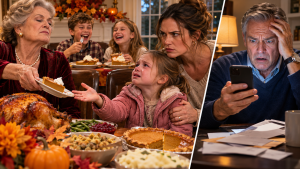
But when my daughter asked if she could have another serving of mashed potatoes, Mom said, “Let’s save some for people who actually finish everything on their plates.”
There were two bites of turkey left on my daughter’s plate.
That was it.
Kelly’s expression changed, but she didn’t say anything right away.
I felt my daughter’s hand on my sleeve.
She was trying not to look upset.
I told her she didn’t have to finish anything and that we were fine.
After dinner, Mom made a big production out of dessert.
She announced pie time like it was the prize at a competition.
“Only for those who said thank you,” she joked.
I should have known.
Then Kelly’s kids each got two slices of pie, complete with whipped cream and ice cream.
My daughter waited quietly.
I think she assumed they were serving everyone by age or something.
When she stepped forward, Mom looked at her and then at me.
“She didn’t say thank you for dinner.”
Kelly looked up so quickly that her fork clattered against her plate.
“Yes, she did. She said it. I heard her.”
Mom was already turning away.
“Well, I didn’t hear it. Maybe next time she’ll speak louder.”
Nobody else said anything.
Not Dad.
Not Kelly’s husband.
My daughter stepped backward without saying a word.
I crouched down and zipped up her jacket.
We said goodbye only to Kelly, who looked like she couldn’t decide whether to hug me or yell at our mother.
Then we left without another word.
The entire drive home, I stared at the road, trying not to cry.
I knew my daughter wasn’t asleep yet.
I could hear the way her breathing changed whenever I glanced at her in the rearview mirror.
She didn’t understand why she hadn’t gotten any pie.
She didn’t understand what she’d done wrong.
At 9:10 that night, Dad texted me.
“Don’t forget to send the payment tomorrow.”
As though nothing had happened.
As though I were nothing more than an ATM with a daughter he couldn’t even be bothered to greet.
I didn’t get angry.
I didn’t respond.
The next morning, I simply opened the family group chat and typed one sentence.
“You’ll have to take care of your own bills from now on.”
Dad froze.
And that wasn’t even the worst part for him.
Not yet.
The group chat stayed silent for a few hours after I sent that message.
That was a record.
Normally, if I so much as hinted that something might change, especially anything involving money, Dad would respond immediately with his usual tone of disbelief.
Like I was an unreliable assistant instead of his daughter.
This time, though, nothing.
Just the little read receipt sitting there, almost mocking me.
I put my phone on the kitchen counter and tried to focus on making lunch for my daughter.
She was sitting at the table drawing something that looked like our house.
She drew three stick figures.
Herself, me, and our cat.
No grandparents.
No aunts.
No cousins.
Just us.
It hurt to realize she’d already started editing her world, reducing it to the people who actually made her feel safe.
Around noon, my phone buzzed.
A message from Kelly.
“You okay?”
Simple, but it said everything.
She always notices when things get out of balance.
I didn’t answer right away.
I didn’t even know how to explain what I was feeling.
Angry, yes.
But mostly disappointed.
Not just in them, but in myself for continuing to hope things would be different.
At 12:43, Dad finally broke the silence.
“Wait. What’s this about?”
I almost laughed.
He knew exactly what it was about.
He just couldn’t believe I’d actually done it.
For years, I’d been paying their bills.
Their phone plan.
Their car insurance.
Mom’s little online shopping subscriptions.
They acted like it was the natural order of things.
I was the oldest daughter, so apparently that meant I was their built-in financial safety net.
When I first started covering expenses, it was right after my divorce.
I thought helping them would keep the peace and preserve some kind of connection between us.
It didn’t.
It just turned me into the family bookkeeper they never had to thank.
When my daughter was born, they were polite for maybe a month.
Then Mom started making comments about how much she looked like her father.
Which was just her way of reminding me that he’d left.
Dad never said anything directly, but his silence spoke loudly enough.
They looked at my daughter like she was a walking reminder of the man who had disappointed them.
And somehow, they turned that into my fault.
So when Dad asked what this was about, I replied with a single sentence.
“I’m not paying for anything else. No bills, no extras, nothing. Please plan accordingly.”
I put my phone back on the counter.
Ten minutes later, it started lighting up with calls.
I didn’t answer any of them.
The last time I tried explaining anything to them, it ended with Mom saying I was too emotional and Dad asking whether I was seeing someone about it.
Eventually, another message came.
This time from Mom.
“How classy of you to make a scene over a piece of pie.”
I stared at that sentence for a long time.
That small, arrogant remark proved she hadn’t heard a single word I’d been trying to say for years.
It wasn’t about the pie.
It was about the fact that she’d looked my daughter in the face and decided to humiliate her for absolutely nothing.
Just to remind me where we belonged in her little family hierarchy.
I texted Kelly privately.
“I’m done. I mean it this time.”
She responded almost immediately.
“Good. So am I.”
That caught me off guard.
Kelly never said things like that.
She was the glue.
The peacemaker.
The one who always found a way to make our parents’ behavior seem like it came from a place of love.
“What do you mean?” I asked.
She said, “Just come to dinner at our place next weekend. Bring your daughter. I’ll explain then.”
It wasn’t like her to sound mysterious, but I could tell something had changed.
Maybe she’d finally seen enough.
Maybe she was tired of being the perfect one, too.
Two days later, Mom sent me a Venmo request.
Fifty dollars for household expenses.
The note underneath said, “Maybe this will refresh your memory.”
I declined it without hesitation.
Ten minutes later, Dad called again.
I didn’t answer.
He left a voicemail.
His tone was tense and irritated, like he was reprimanding an employee.
“We had an agreement, Rachel. You can’t just walk away from your responsibilities over some emotional nonsense.”
That word, responsibilities, echoed in my head all afternoon.
They genuinely believed I owed them something.
To take their side.
To pay their bills.
To stay silent while they undermined my daughter’s confidence.
All of that was supposedly my duty.
And for years, I’d believed it, too.
But not anymore.
When I picked up my daughter that evening and tucked her in, she asked if she’d done something wrong at Grandma’s house.
I told her no.
That Grandma sometimes forgets how to be kind.
She smiled like that was enough for her, at least for now.
But I knew things were only beginning to fall apart.
Because when my parents finally realized I was serious, that I wasn’t coming back to fix things, they wouldn’t stay quiet.
They would become cruel.
And that was when Kelly stepped in in a way I never saw coming.
Three days passed without a word from either of them.
No messages.
No calls.
No surprise Venmo requests.
Just silence.
It should have felt peaceful.
Instead, it felt like the moment right before a storm, when the sky is too still and you know something is coming.
That something arrived on the fourth morning.
Mom posted one of those weaponized Facebook statuses she knew would stir up her friends.
It said, “Funny how some daughters forget who sacrificed everything for them. Family means loyalty, even when it’s hard. Especially when it’s hard. But these days, emotions matter more than morals.”
Twelve likes.
Three comments.
And the kind of silence that dares you to speak.
I didn’t.
I simply took a screenshot and sent it to Kelly.
Her response was, “She’s losing control.”
Later that day, I received a fraud alert from Amazon.
Except it wasn’t really fraud in the usual sense.
It was a set of towels, two pairs of sneakers, and a rose-gold oil diffuser.
My old account, the one I’d used years ago when I lived at their house after my divorce, was still logged in on Mom’s tablet.
She had to know it was still connected to my card.
She just assumed I’d keep cleaning up her messes like always.
I canceled the order, locked the account, and changed every password I could remember.
Ten minutes later, a missed call from Dad.
I didn’t answer.
Then came the text.
“You’re making this harder than it needs to be.”
I stared at that message for a while.
The nerve.
The sheer, quiet sense of entitlement.
Like I was an employee who had suddenly stopped showing up for her shift.
But I didn’t respond.
I wasn’t going to get pulled back in.
I’d made my decision.
That weekend, I drove to Kelly’s house.
My daughter bounced excitedly in her car seat, looking forward to seeing her cousins.
I hadn’t told her much, only that we were going somewhere fun.
Honestly, I needed the break as much as she did.
Kelly welcomed us like guests she’d been waiting for all week.
Her kids came running out in socks and pajamas, shouting my daughter’s name like she was one of their own.
Her husband handed me a mug of cider before I even had time to take off my coat.
The house smelled like garlic bread and roasted vegetables.
It smelled like family.
The good kind.
After dinner, once the kids had gone into the next room to watch a movie, Kelly leaned back and said it.
“I’m done, too.”
I blinked.
For a second, I thought she meant dinner.
She didn’t.
She meant them.
She said she was tired of playing the golden daughter.
Tired of translating Mom’s little digs and softening Dad’s silences.
Tired of being the buffer between them and me and everything they didn’t want to face.
She admitted that even as a child, she’d always known there was a difference in how they treated us.
She just hadn’t known what to do about it.
“I thought if I made them happy enough, maybe they’d be nicer to you.”
That part hit me the hardest.
She wasn’t gloating.
She wasn’t angry.
She was just sad.
I asked what had changed.
She said, “Thanksgiving.”
She couldn’t stop thinking about how our mother had looked at my daughter like she didn’t even exist.
Like she was just some inconvenient shadow following me around.
Not a person.
Not family.
Just a problem.
“She’s five years old,” Kelly said.
“She said thank you. I heard her. And Mom pretended she didn’t because it fit the version of things she wanted to believe.”
Kelly told me she’d already canceled her usual Sunday call.
She wouldn’t bring the kids over anymore.
No more messages.
No more playing diplomat.
She wanted out of the system, too.
That night, while we sat on her couch watching our children fall asleep in a pile of blankets, she told me she had one more idea.
A dinner.
Just us, the kids, and our parents at her house.
One last chance to make them see.
I didn’t say no.
I didn’t say yes, either.
Because part of me didn’t believe it would matter.
But then, just before I left, she said, “I’m not asking you to forgive them. I just want them to see what they’re losing.”
That stayed with me.
Two days later, Dad showed up at my workplace.
Not inside.
Just outside, pacing, like he couldn’t decide whether to knock or disappear.
I didn’t see him until a coworker said, “Hey, there’s some guy outside staring at the door.”
I went out.
He didn’t yell.
He didn’t apologize, either.
He simply said, “This has gone too far. We’re your parents.”
I looked him straight in the eyes and said, “You don’t treat me or my daughter like family. You treat us like a punishment.”
He didn’t say a word.
He just stood there like I’d slapped him.
Eventually, he left.
I didn’t tell my daughter about it.
I just made her hot chocolate and let her choose a movie.
That night, she picked one about a big family that eventually learns how to get along.
I let her believe in that for now.
But I knew the truth.
The dinner was coming.
And this time, we weren’t the ones being tested.
Kelly planned the dinner like it was a peace summit.
She sent me a list of the dishes she was making.
Roast chicken.
Garlic mashed potatoes.
Her husband’s baked mac and cheese.
The kind of food you only make when you want something to go right.
She even said she’d ask Mom to bring dessert.
That part surprised me.
“You’re inviting them?” I asked.
She said yes.
“They don’t know what the dinner is really about. I just told them we’re having a quiet evening. Nothing special.”
I asked whether she thought they’d come.
“They never turn down a chance to pretend everything is fine.”
That part was true.
So Saturday arrived.
My daughter wore the dress Kelly had given her for her birthday.
The one Mom had pretended not to notice at the party.
She was excited.
She had no idea her grandparents would be there.
I didn’t tell her because I didn’t want her to worry and rehearse her manners, like she always did before seeing them.
As though she were trying to earn their basic decency.
We arrived early.
The kids were already playing.
Everything smelled like rosemary, cheese, and warmth.
For a moment, it seemed like it might be a normal evening.
A little after six, Dad arrived first.
Then Mom, carrying a pumpkin pie.
Of course.
She barely looked at me when she came in.
She greeted my daughter like a stranger she wasn’t quite sure she remembered.
A quick nod.
A tight smile.
Dinner started well.
The adults made small talk.
Kelly’s husband poured wine.
Dad laughed too loudly at something that wasn’t funny.
Mom complimented the napkins.
Everything was fake, but carefully held together.
Then, halfway through dinner, Kelly cleared her throat and said, “I think we should talk about Thanksgiving.”
Just like that.
No introduction.
No warning.
A knife straight into the center of the table.
Mom blinked.
“What about it?”
Kelly didn’t flinch.
“About how you humiliated Rachel’s daughter over a piece of pie. About how you’ve been treating her for years.”
Mom put down her fork.
Dad leaned back like he was bracing for impact.
“I don’t think this is the time or place,” Mom began.
“It’s the perfect time,” Kelly said.
“You’re in my house. I invited you here so you’d finally listen.”
I watched the color drain from Dad’s face.
He wasn’t used to Kelly being anything other than accommodating.
She continued.
“You treat Rachel like she owes you something. You treat her daughter like she’s some kind of stain on the family name. And it’s disgusting.”
Mom gave a short laugh.
“Oh, come on. That’s not fair.”
Kelly turned toward her.
“Then tell me what’s fair. Ignoring her? Embarrassing a five-year-old in front of a room full of people? Acting like you’re still owed something because you sacrificed a few years raising children thirty years ago?”
Silence followed.
My daughter looked at me, unsure whether she could keep eating.
I nodded.
Dad finally spoke.
“You don’t understand how hard it was for us. We did the best we could.”
Kelly shot back immediately.
“You didn’t do the best you wanted to do. There’s a difference.”
Then she turned toward me and said, “You don’t need to say anything. I invited them here because I needed to say this.”
But I did say something.
I looked at my mother and said, “When you refused to give her pie, you weren’t punishing her. You were punishing me for raising her without the man who left and for not being ashamed enough about it.”
That was when something happened that I didn’t expect.
My daughter, quiet, sweet, always careful, looked at my mom and said, “I don’t think you like me.”
Just like that.
My mother looked as though she’d been slapped.
She tried to speak, but the words wouldn’t come.
And then Kelly’s husband, who had barely said a word all evening, put down his fork and said, “We’re not going to keep doing this. You can be part of this family, or you can be guests we stop inviting.”
Nobody spoke for a while after that.
Dinner ended early.
My parents left without saying goodbye.
No hugs.
No dessert.
They took the pie with them.
I stayed until the kids fell asleep.
I helped Kelly with the dishes.
She looked tired, but her eyes were clear.
“I don’t know if they’ll recover from this,” she said.
“I don’t care if they do,” I replied.
But a week later, something happened that I genuinely didn’t expect.
They showed up together at my front door.
And they brought gifts.
One was wrapped in pink paper.
Then my father got down on his knees.
The doorbell rang once.
Not in a hurry.
Just one long, quiet ring.
I almost didn’t get up.
I assumed it was a delivery or maybe someone selling something.
But then I looked through the window and saw two motionless figures on the porch.
When I opened the door, I froze.
It was them.
Both of them.
Dad was wearing a heavy coat he rarely used.
Mom was holding a pink-wrapped box that didn’t look like it had come from a store.
The edges were wrinkled, and the tape was uneven, like someone had tried to remember how to wrap a present after years of letting other people do it.
They didn’t say anything right away.
They just stood there like they were waiting for permission.
I didn’t invite them in.
I simply stepped aside.
They entered slowly, their eyes moving around the room like it was unfamiliar.
My daughter was lying on the rug in front of the television.
Crayons scattered everywhere.
Watching cartoons.
She turned when she heard the door.
Her eyes went straight to them.
Then to the box.
Then back to me.
She didn’t move.
Neither did they.
And then, out of nowhere, Dad did something I don’t think I’ll ever forget.
He knelt down.
At first, I thought he’d dropped something or was trying to get down to my daughter’s level to talk to her.
But then he stayed there, both knees on the floor.
His eyes weren’t on her.
They were on me.
“I don’t deserve to be here,” he said. “But I needed to say I’m sorry out loud. Face-to-face.”
Mom gently set the pink box on the coffee table.
She was trembling a little.
She looked at my daughter, then at me.
Her voice came out in a whisper.
“I thought I was right,” she said. “I thought I was teaching her something. But now I see it. I see what I’ve done. What we’ve done.”
She looked older than I’d ever seen her.
My daughter stayed where she was, just watching and listening.
Dad looked at her now, still on his knees.
“You didn’t do anything wrong. You never did. You were never the problem.”
Then he looked at me.
“We were. We are. And now I know it.”
There was no big speech.
No excuses.
Just words that sounded like they cost something.
Mom picked up the pink box and held it out without stepping closer.
“I saw this in a little shop last week,” she said. “I don’t even know if she’ll like it, but I thought of her. For once, I thought of her.”
My daughter stood up and approached slowly.
She didn’t take it immediately.
She looked at me first.
Not frightened.
Just unsure.
I gave her a small nod.
She carefully took the box and sat back down to open it.
Inside was a white music box with a ballerina in the center, gold trim around the edges, and tiny roses painted on the sides.
She turned the little crank.
The figure spun in slow, clumsy circles, playing a gentle melody.
My daughter stared at it.
Then, very softly, she whispered, “Thank you.”
And for the first time in five years, I saw my mother cry without trying to hide it.
Dad still hadn’t gotten up.
I stepped closer and told him, “You don’t have to kneel. But if you’re only here to make yourselves feel better, then you can leave.”
He looked at me and said, “I’m here because I need you to know that I believe you now. About everything.”
I nodded once.
They stayed for about ten minutes.
Nothing profound was said after that.
Just small comments.
A few attempts at kindness.
They didn’t push.
They didn’t try to fix everything in one visit.
Before leaving, Mom crouched down and told my daughter, “I want to learn how to be better. You don’t have to believe me yet, but I’ll show you.”
My daughter didn’t answer.
But she didn’t pull away when Mom gently placed a hand on her back.
After they left, we sat together in silence.
My daughter kept winding the music box and watching the ballerina spin.
Finally, she said, “They were different.”
“Yeah,” I said. “They were.”
Then she asked, “Is it okay if I like the music?”
I smiled.
“Of course. You can like whatever you want.”
She fell asleep that night curled up on the couch, with the music box still playing beside her.
And for the first time in years, I allowed myself to think about something I hadn’t considered in a very long time.
Maybe, just maybe, this wasn’t the end of something.
Maybe it was the beginning.
The next morning felt quieter than usual.
Not in a bad way.
Just still.
Like the house was resting, like something heavy had finally been lifted.
My daughter woke up curled around the music box, her hair messy and her eyes half-closed.
The first thing she whispered was, “Do you think she meant it?”
I didn’t ask who she meant.
I just said, “I think she’s trying.”
She nodded and pulled the blanket up to her chin.
That was enough for her.
Over the next few days, nothing dramatic happened.
No calls.
No sudden visits.
No guilt-filled messages.
But the silence no longer felt like punishment.
It felt like everyone was holding back for the first time.
Like they were choosing their words carefully.
Maybe even thinking about them.
Then, on Wednesday afternoon, a small box arrived at the door.
No return address.
But I recognized Mom’s handwriting immediately.
Inside was a folded note.
Not typed.
Not corrected.
Just ink and lined paper, with a few words crossed out, like she’d written the whole thing in one sitting without starting over.
The letter didn’t ask for forgiveness.
It didn’t defend anything.
It simply admitted everything.
She wrote about the early years.
How she watched me worry too much and said nothing.
How she let her disappointment in my ex turn into resentment toward my daughter.
How Thanksgiving wasn’t the first time she’d let that resentment show.
Just the ugliest.
She wrote, “I thought being hard on you made me strong. I thought not showing softness made me a good mother. But all it did was teach you to carry pain without asking for help.”
“And now I see you teaching your daughter something better. Something I never gave you.”
She ended the letter with:
“You don’t owe us your trust. We owe you our change. I’m going to keep trying, even if it takes the rest of my life.”
I sat on the couch holding that letter for a long time.
Not crying.
Not even really thinking.
Just letting the words settle.
They weren’t perfect.
But they were real.
And that was new.
Later that week, Kelly invited us over again.
Just us and her family this time.
Homemade pizza night.
Kids making a mess in the kitchen.
Laughter that felt effortless.
The kind of evening that fills you up in a way you don’t notice until you’re driving home and realize you’re smiling for no reason.
Halfway through dinner, Kelly poured us both a glass of wine and said, “You know what’s weird? I think they’re scared now. Really scared.”
I raised an eyebrow.
She nodded.
“For the first time, they’re afraid of losing something real. Her. Me.”
Then she looked at me more seriously.
“You saved us, you know.”
I laughed.
But she didn’t blink.
“You were the first one to say enough. The first one to stop pretending. And when you did, you gave the rest of us permission to stop pretending, too.”
I didn’t know what to say to that.
I’d always felt like the damaged one.
The disappointment.
But maybe I was just the one who broke the mirror first and gave everyone else a chance to see their own reflection.
That Sunday, I asked my daughter what she wanted to do.
She chose the library.
On the way there, she asked if she could bring the music box in the car.
I said yes.
She held it in her lap and watched the ballerina spin as we drove.
Out of nowhere, she said, “I think Grandma likes me now.”
I said, “I think she’s starting to.”
Then she said something that completely caught me off guard.
“She’s learning, like I’m learning to tie my shoes.”
And there it was.
The clarity that only children seem to have.
No drama.
No history.
Just an honest view of people trying or not trying, and the slow grace of watching someone improve.
That evening, after dinner, my phone buzzed.
A photo from Mom.
Dad was sitting on their living room floor, leaning over a puzzle with his reading glasses halfway down his nose.
Underneath was a caption.
“He says he wants to teach her to do the edges first.”
No pressure.
No guilt.
Just a message.
A beginning.
And I realized that real revenge wasn’t about shutting them out.
The real power came from showing them what love actually looks like and letting them decide whether they wanted to rise to meet it.
Yeah.