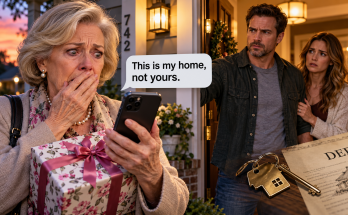
Almost exactly one year after David sent the message about his home, my phone buzzed while I was watering basil on the back patio.
His name appeared.
For a fraction of a second, my body remembered.
The kitchen.
The damp cloth.
The words that had exposed five years of confusion.
Then I opened the message.
Are you home?
I smiled.
Yes.
Can we stop by?
Who is we?
Me, Sarah, Leo.
I checked the time.
Sunday afternoon.
No emergency.
At least none announced.
Yes.
Thirty minutes later, a modest gray sedan pulled into my driveway.
Sarah drove.
David sat beside her.
Leo climbed out before the car had fully settled and ran toward the porch.
“Grandma!”
I opened the door.
He held something behind his back.
“What are you hiding?”
“Dad says I have to wait.”
David approached carrying a folder.
I looked at it.
He laughed.
“Relax.”
“No one in this family is allowed to approach me with folders casually.”
Sarah came up beside him.
“That is fair.”
They looked different.
Not dramatically.
No magical transformation.
Sarah still carried tension around money. David still avoided conflict longer than he should. Their marriage still required counseling every few weeks.
But they looked like people living inside the same truth.
That changed faces more than happiness did.
“Come in.”
“No,” David said.
I stopped.
“We actually want you outside.”
Suspicious.
I stepped onto the porch.
Leo bounced in place.
“Can I?”
David nodded.
Leo pulled a brass key from behind his back and held it toward me.
“We got a house.”
For several seconds, I forgot how to speak.
Then I looked at David.
“A house?”
He nodded.
“Small.”
Sarah smiled.
“Very small.”
“Two bedrooms,” David said.
“Three,” Leo corrected.
“The third is basically a closet.”
“It has a window.”
Sarah laughed.
“Three according to the listing.”
I looked at the key.
“You bought it?”
“Yes.”
“With a mortgage?”
“Yes.”
“In your names?”
“Yes.”
“Both?”
“Yes.”
“No LLC?”
David burst out laughing.
“No LLC.”
“No family financing?”
“No.”
“No borrowed down payment?”
“No.”
“Did you read everything?”
“All of it.”
Sarah raised one hand.
“Twice.”
My throat tightened.
Leo still held out the key.
“What is this for?”
“Spare.”
I looked at David.
He understood immediately.
“We’re asking if you want it.”
Not assuming.
Asking.
That mattered so much I nearly cried before anything else happened.
“Why me?”
“In case Leo locks us out,” Sarah said.
“That happened one time,” Leo protested.
David smiled.
“Emergency only.”
“No surprise visits?”
“Absolutely not.”
I took the key.
It was ordinary.
Silver metal with a blue plastic cap.
Nothing sentimental.
Yet it felt heavier than any document Daniel had ever placed before me.
This house belonged to them.
Not because Arthur meant it to.
Not because I supplied it.
Not because Mark manipulated paperwork.
Not because future inheritance became present permission.
They had saved.
Qualified.
Signed.
Paid.
Bought.
“Congratulations.”
Sarah’s eyes filled.
“Thank you.”
David looked away.
Apparently he was crying too.
I hugged him first.
Then Sarah.
That surprised both of us.
The hug was brief.
Real.
No declarations.
No need.
Leo shoved himself between everyone because children hate adult moments they do not control.
“Do you want to see it?”
“Now?”
“Yes!”
David checked the time.
“If you’re free.”
I smiled.
“I’m free.”
They had not arranged my afternoon without asking.
Another small miracle.
I grabbed my purse.
The house was fifteen minutes away in a neighborhood I knew but rarely visited.
Older homes.
Modest yards.
Mature trees.
The kind of street where bicycles lay on lawns and nobody had replaced every original front door with something oversized and fashionable.
Their new house was pale yellow.
One story.
A narrow driveway.
A porch barely deep enough for two chairs.
The roof looked relatively new.
I noticed automatically.
Then reminded myself.
Not my roof.
David parked at the curb so I could pull into the driveway.
I laughed when I realized.
“What?”
“You own the driveway.”
He smiled.
“I know.”
The front door stuck slightly.
David shoulder-bumped it.
“Seller disclosed that.”
“Good.”
“Already on the list.”
“Your list.”
“Yes.”
Inside, the living room was smaller than the Craftsman’s dining room and living room combined.
The carpet had seen better years.
The kitchen cabinets were oak from an era nobody currently found fashionable.
The countertops were laminate.
I loved everything immediately.
Not aesthetically.
Morally.
They could afford it.
That made it beautiful.
Leo gave me the tour.
His room first.
Blue walls.
A closet large enough for actual clothes.
Then the alleged third bedroom, which was indeed barely larger than a generous pantry.
“My science room.”
Sarah looked alarmed.
“No experiments without an adult.”
“Grandma can help.”
“Grandma gave you the volcano.”
“Exactly.”
I accepted responsibility.
The primary bedroom had an attached bathroom.
Small.
Functional.
I looked at the intact vanity.
David noticed.
“Don’t.”
I started laughing.
Sarah did too.
“No renovation planned.”
“Excellent.”
“Maybe paint.”
“Ask the owner.”
Sarah pointed at herself.
“I am the owner.”
The words hung for half a second.
Then we all smiled.
Yes.
She was.
Legally.
Honestly.
So was David.
They could paint.
Replace.
Repair.
Sell.
Refinance—carefully.
Every privilege came with responsibility.
Exactly as ownership should.
We stood in the kitchen while David showed me the paperwork.
Not because he needed approval.
Because he was proud.
Purchase price.
Down payment.
Fixed-rate mortgage.
Inspection report.
Emergency reserve still intact after closing.
I did not ask how much remained.
Growth.
He showed me one page with closing costs.
“Painful.”
“Yes.”
“I understand why Dad complained about fees.”
“Arthur complained about free parking if the walk was too far.”
“True.”
Sarah leaned against the counter.
“We almost waited another year.”
“What changed?”
“The numbers worked.”
Not emotion.
Not fear.
Numbers.
She continued.
“We found this below the top of our range.”
David added, “We could’ve qualified for more.”
“But?”
“We didn’t want more.”
I smiled.
Arthur would have liked that.
I almost said it.
Then stopped.
This was not Arthur’s purchase.
It was theirs.
“I like that,” I said.
David understood the change.
His eyes softened.
“Thanks.”
In the backyard, a maple tree leaned toward the fence.
Leo had already claimed one corner for experiments.
Sarah wanted herbs.
David wanted a grill.
Nothing grand.
Nothing funded by imagined future wealth.
They had plans proportionate to what they owned.
That was enough.
We ordered pizza because the kitchen had almost nothing unpacked.
We ate on folding chairs.
At one point, Leo dropped cheese onto the carpet.
Sarah sighed.
David said, “Our carpet.”
She looked at him.
Then laughed.
“Unfortunately.”
I watched them.
Not perfect.
Not absolved.
Not restored to who they had been before.
Better.
Because before had contained the seeds of everything that went wrong.
This version contained scars.
And systems.
Separate savings.
Joint household account.
Budget meetings.
Counseling.
Rules about debt.
Honesty about fear.
None romantic.
All useful.
After dinner, Leo disappeared into his room.
Sarah began opening boxes.
David walked me to the front porch.
The same setup as the day a year earlier.
Mother.
Son.
House.
But everything underneath had changed.
“Do you remember the text?” he asked.
“Yes.”
“I wish I could delete that day.”
“No.”
He looked at me.
“Really?”
“No.”
“I was an ass.”
“Yes.”
“Mom.”
“You were.”
He laughed.
Then grew serious.
“I thought setting a boundary meant telling you where you were allowed.”
“That is one kind.”
“I didn’t understand the financial part.”
“No.”
“I wanted you to act like the house was mine while still paying as if it was yours.”
“Yes.”
He stared at the quiet street.
“That sounds terrible.”
“It was convenient.”
He smiled bitterly.
“I’m sorry.”
“I know.”
“No.”
He turned toward me.
“I’m sorry for that specific message.”
I waited.
“You left Leo a birthday present.”
“Yes.”
“You didn’t come inside.”
“No.”
“And I treated you like you were invading us because Sarah and I had already started thinking of any reminder of your ownership as a threat.”
That was new.
I had never framed it so clearly.
“You were afraid I might take the house back.”
“Yes.”
“So you tried to make me feel like I had already given it away.”
His face tightened.
“Yes.”
I appreciated the honesty.
“I’m sorry.”
“Thank you.”
The apology did not erase the message.
It put it in the correct place.
Past.
He looked down at the porch boards.
“This place is ours.”
“Yes.”
“I still hate saying that.”
“Why?”
“Because it sounds like before.”
I understood.
“Then say something else.”
He thought.
“We bought this.”
I smiled.
“Better?”
“Yes.”
There was work in the sentence.
History.
Responsibility.
Choice.
Not entitlement.
Sarah came to the doorway.
“Your mother wants coffee?”
“My mother?”
David looked at me.
“Do you?”
“No. I should go.”
“Already?”
“It’s your first night.”
Leo appeared behind Sarah.
“Grandma has a key.”
I held it up.
“Emergency only.”
“What if I miss you?”
“Phone.”
“What if the phone breaks?”
“Borrow Dad’s.”
“What if Dad breaks?”
David stared.
“What kind of emergency planning is this?”
Leo grinned.
I hugged him.
Then Sarah.
Then David.
As I walked toward my car, he called after me.
“Mom.”
I turned.
“Thanks.”
“For what?”
He glanced at the house.
A year ago, I would have expected him to mean financial help.
The five rent-free years.
The repairs.
The down payment I had not given.
Instead he said:
“For finally making me leave.”
I felt tears sting.
“You chose to leave.”
“Eventually.”
“Yes.”
“That mattered.”
He nodded.
“It did.”
I drove home in the dark.
My own house looked peaceful when I pulled into the driveway.
No drama waited inside.
No envelope beneath the door.
No unknown vehicle at the curb.
I made tea.
Then opened the small drawer where I kept Arthur’s letters.
Not to ask what he thought.
Only because I missed him.
I reread the last paragraph of the private letter.
Please live after me.
I smiled.
“I am.”
Portugal had been wonderful.
Lisbon hills brutal.
Hotel overpriced.
Exactly as instructed and not instructed.
I bought Jenna ceramics.
Leo got a small cork boat.
David received nothing expensive.
Sarah got a postcard because I wanted to send one.
Life had become less organized around correction.
More around living.
I closed the drawer.
Months passed.
David’s mortgage payment became automatic.
So did his old debt payment.
Sarah eventually completed her probation-related financial requirements.
Mark served his sentence and later entered supervised release.
We did not resume a relationship.
He sent one final apology through Daniel.
I read it once.
Then filed it.
Not with Arthur’s letters.
With the legal papers.
That distinction mattered.
Elaine never contacted me.
Denise sent a Christmas card.
I sent one back.
No one needed every damaged relationship rebuilt.
Some only needed to stop causing harm.
Jenna and Marcus remained happy in the Craftsman.
The green wall stayed.
The pantry marks accumulated.
Jenna added one for Leo each birthday visit.
Not because the house belonged to him.
Because memory was welcome there.
My estate plan remained clear.
Equal treatment.
Protected structure.
No hidden promises.
David knew.
Jenna knew.
I knew.
The day David made his final payment on Mark’s old loan came almost three years after everything began.
He did not call me immediately.
He waited until that evening.
“I’m done.”
“With what?”
I knew.
He laughed.
“Debt.”
“All debt?”
“Other than the mortgage.”
“That hardly counts.”
“It absolutely counts.”
“Fair.”
“How do you feel?”
He thought.
“Lighter.”
“Good.”
“Dad was right.”
“Dangerous habit.”
“He said debt would keep making decisions for me if I didn’t make decisions about it.”
I did not remember Arthur saying those exact words.
Maybe he had.
Maybe David had finally learned to hear him.
“I’m proud of you.”
This time, I let the sentence stand without qualification.
He had earned it.
A few weeks later, I visited their house for Leo’s birthday.
Science theme.
Of course.
The backyard contained children wearing goggles and launching small rockets with baking soda reactions.
I remained a safe distance away.
Sarah brought me lemonade.
David grilled hamburgers.
Leo was ten now.
Tall.
Loud.
Secure.
At one point, he ran past carrying a plastic volcano.
I called, “Not near the house.”
He shouted, “I know!”
Sarah smiled.
“Some rules survive.”
“Useful ones.”
We stood watching him.
Then she said quietly, “Thank you for letting us get here.”
I looked at her.
“You got yourselves here.”
She nodded.
That answer mattered to her now.
Good.
Later, David and I stood near the maple tree.
He had repaired the fence himself.
Not perfectly.
Arthur would have criticized the alignment.
I did not.
“You know,” David said, “this backyard is smaller than the old one.”
“Yes.”
“The kitchen too.”
“Yes.”
“Everything is smaller.”
“Except the mortgage.”
He groaned.
“Definitely.”
“Regret it?”
“No.”
He looked toward Sarah and Leo.
“Nothing here belongs to someone else.”
The sentence contained the whole journey.
Not only property.
Responsibility too.
His debt.
His marriage.
His choices.
His future.
Mine as well.
When I left that evening, I did not check the roof.
I did not ask whether the property taxes were paid.
I did not remind him about insurance.
I did not offer grocery money.
I hugged my grandson.
Thanked Sarah for the party.
Kissed David’s cheek.
Then went home.
There was no dramatic moment when our family became healed.
No final speech.
No perfect forgiveness.
Healing turned out to be hundreds of smaller choices repeated until they became ordinary.
Ask.
Do not assume.
Pay what you owe.
Say no clearly.
Say yes intentionally.
Tell the truth before the truth becomes expensive.
Help without taking over.
Love without claiming.
And never confuse being needed with being loved.
Sometimes I still think about the message David sent that Tuesday evening.
This is my home, not yours.
He was right about one thing.
A home should have boundaries.
What none of us understood then was that a healthy boundary is not a wall built to keep one person giving while another keeps taking.
It is a clear line around responsibility.
Mine.
Yours.
Ours.
Not yet.
Not anymore.
David finally has a home that is his.
Jenna has the house Arthur and I once owned because she bought it honestly.
Sarah has learned that tomorrow’s hoped-for success does not give her permission to spend today’s reality.
Leo has savings in his own name that nobody touches.
And I have a life that no longer exists mainly to preserve what Arthur left behind.
On the shelf in my living room sits the photograph David gave me.
Arthur in his tool belt.
The little brass plate beneath it still reads:
GOOD WOOD DESERVES PATIENCE.
Every time I dust the frame, I smile.
Arthur had been talking about floors.
We made it mean something larger because families do that.
We turn ordinary sentences into inheritance.
This one, at least, became useful.
The floor survived.
The house survived.
Our family survived.
Not unchanged.
That would have meant we learned nothing.
We survived with better joints.
Stronger boundaries.
A few visible repairs.
And enough humility to know that love works best when nobody has to forge a signature, hide a debt, or surrender themselves to prove it.
The End
Read more original stories on Feel Every Story.