Leo arrived on Sunday carrying a spiral notebook, two sharpened pencils, and the expression of someone assigned serious investigative authority.
David and Sarah followed him through my front door.
“Remember,” Sarah said, “Grandma is not required to answer anything classified.”
Leo looked at her.
“What’s classified?”
“Things Grandma doesn’t want to tell you.”
“That’s not what classified means,” David said.
Sarah took off her coat. “Close enough.”
I laughed and led them into the kitchen.
The school assignment sounded simple on paper. Interview an older relative about someone important in the family’s past. Ask what that person did, what they believed, and what the interviewer should remember about them.
Leo had chosen Arthur.
I was glad.
And unexpectedly nervous.
For years, I had made Arthur useful after his death.
I asked what he would want.
Quoted what he believed.
Treated his habits like instructions.
Now a seven-year-old was asking me simply who he had been.
That was harder.
Leo sat opposite me at the table and printed GRANDPA ARTHUR across the top of his page.
“Ready?”
“I think so.”
His first question was prepared.
“What job did Grandpa do?”
I told him Arthur had spent most of his career managing equipment and facilities for a manufacturing company, then gradually invested some of what we saved.
“Was he rich?”
“No.”
Leo looked disappointed.
“Not even a little?”
“He would have said anyone with a roof, enough food, and money left after bills was doing pretty well.”
“That means yes?”
“It means Grandpa disliked simple answers.”
David smiled.
“That’s true.”
Leo wrote something down.
Probably not what I had said.
“What did he like?”
“Baseball. Coffee too strong for any reasonable person. Fixing things that could have been replaced for less money. Road maps.”
“Maps?”
“He didn’t trust phones.”
“Why?”
“Because maps don’t lose battery.”
Leo considered that brilliant.
David considered it evidence of stubbornness.
Both were right.
“What was he bad at?”
That question stopped me.
Sarah looked toward David.
David looked at me.
We were still learning not to protect the dead from humanity.
“Dancing,” I said first.
David laughed.
“Very bad.”
“Cooking anything that required timing.”
“He burned grilled cheese,” David added.
“Once,” I said.
“Many times.”
Leo grinned.
I continued.
“He could also be impatient.”
That changed the tone.
“With what?”
“Mistakes.”
David went still.
I looked at him before continuing.
“Especially mistakes he thought people should have known better than to make.”
Leo frowned.
“Was he mean?”
“No.”
Then I corrected myself.
“Sometimes he could sound mean when he was worried.”
David looked down.
Arthur deserved accuracy.
Not sainthood.
“He expected people to learn quickly,” I said. “But people don’t always learn quickly.”
“Dad doesn’t.”
Sarah covered a laugh with her hand.
David stared at his son.
“Thank you.”
Leo wrote vigorously.
“What are you writing?”
“That Dad learns slow.”
“That is not about Grandpa.”
“It is family history.”
I laughed so hard I had to wipe my eyes.
Then came the question David had warned me about.
“What was Grandpa most proud of?”
I had thought about it for days.
The answer that came was the one I had found after David and Sarah left.
“He liked building things that could stand without him.”
Leo stopped writing.
“What does that mean?”
“Sometimes it meant actual things. Floors. Shelves. Repairs. He liked knowing he fixed something well enough that nobody had to worry about it again for a long time.”
I looked at David.
“Sometimes it meant people.”
Leo glanced at his father.
“Did he build Dad?”
“In a way.”
“That sounds weird.”
“It does.”
David smiled.
I tried again.
“He wanted your dad and Aunt Jenna to grow into people who could make their own decisions, earn their own money, fix some of their own problems, and ask for help when they truly needed it.”
“Dad asks for help.”
“Yes.”
“Did Grandpa like that?”
“He liked useful help.”
“What’s useless help?”
I hesitated.
The answer had taken our family years to understand.
“Help that keeps someone from learning something they need to learn.”
Leo thought.
“Like if you do my homework?”
“Exactly.”
“Mom says that too.”
Sarah nodded.
“Grandpa and I finally agree on something.”
I smiled.
Leo asked whether Arthur had owned the Craftsman.
“Yes.”
“With you?”
“Yes.”
“Did he give it to Dad?”
“No.”
“Why not?”
David started to speak.
I held up one hand.
Let the question remain simple.
“Because your grandpa believed adults should not treat something as theirs until it actually became theirs.”
Leo tapped his pencil.
“Like toys?”
“Like toys. And houses.”
“What if someone says you can use it?”
“Then you can use it.”
“But it’s not yours.”
“Exactly.”
He nodded as if no adult could possibly have struggled with something so obvious.
Maybe childhood was wisdom before rationalization became sophisticated.
He wrote another note.
Then asked, “Did Dad forget?”
The kitchen went quiet.
David answered before I could.
“Yes.”
Leo looked at him.
“For a long time?”
“Yes.”
“Why?”
David leaned both elbows on the table.
“Because pretending it might become mine someday made me feel safer.”
Leo accepted that.
No shame.
No judgment.
“Is your house yours now?”
“We rent.”
“So no.”
“Correct.”
“Do you want one?”
“Someday.”
“Can you buy one?”
“Not yet.”
“Okay.”
That was all.
Not yet.
No humiliation.
No failure.
Just current reality.
I wished we had spoken that plainly years earlier.
Leo moved on.
“What did Grandpa say all the time?”
That opened the floodgates.
Good wood deserves patience.
Put the tool back where you found it.
If you borrow a car, return it with more gas than it had.
Measure twice.
Call before you dig.
Never buy tomatoes in January.
David objected to the last one.
“He bought canned tomatoes.”
“That wasn’t his point.”
“What was the point?”
“I don’t know. Arthur had complicated feelings about produce.”
Leo filled nearly two pages.
Then he asked one question that was not on the assignment sheet.
“Do you miss him every day?”
I looked toward the photograph on the shelf.
For years, I would have answered yes automatically.
The truth was different now.
“No.”
Everyone looked at me.
“I don’t think about him every minute anymore.”
Leo waited.
“But sometimes something happens and I know exactly what he would say.”
“Like what?”
“Your dad buys something stupid.”
David groaned.
Sarah laughed.
“Or I see a road he would have liked. Or hear a baseball score. Or notice someone fixed something carefully.”
I touched the brass plate beneath the photograph.
“Then I miss him all at once.”
Leo wrote slowly.
“Is that sad?”
“Sometimes.”
“Bad?”
“No.”
That distinction mattered too.
Sadness was not always a problem requiring repair.
The interview lasted nearly an hour.
When Leo finished, he read his final question.
“What should I remember about Grandpa?”
I looked at David.
Then Sarah.
Then back at Leo.
“That he loved you before he ever met you.”
Leo frowned.
“How?”
“He knew your dad would probably have children someday.”
“Probably?”
“Your dad was thirty.”
David raised one finger.
“Twenty-nine when Dad died.”
“Still overdue for planning.”
“Mom.”
I smiled.
“Arthur wanted the family after him to have something solid.”
“The house?”
I shook my head.
“That’s what we thought for too long.”
“What then?”
“Habits.”
Leo’s pencil paused.
“Tell the truth about money.”
Sarah lowered her eyes.
“Return what you borrow.”
David nodded.
“Do not make promises for other people.”
I thought of Mark.
“And if you help someone, help them become stronger instead of making them need you forever.”
Leo wrote carefully.
Then looked up.
“That’s a lot.”
“It took us a long time to learn.”
“Can I just write ‘be responsible’?”
I laughed.
“Yes.”
He did.
The assignment ended.
But none of us moved immediately.
The kitchen had grown quiet in an easy way.
Then Leo said, “Can we go see Grandpa’s floor?”
I knew exactly what he meant.
The Craftsman.
I looked at David.
He looked at Sarah.
Sarah smiled.
“Ask Aunt Jenna.”
Leo called her himself.
Twenty minutes later, we were driving across town.
Not because we needed closure.
Not because the house still belonged emotionally to any of us.
Because a child wanted to see something his grandfather had built.
That was different.
Jenna opened the door before we reached the porch.
“You people travel in packs now?”
“School project,” Leo announced.
Marcus appeared behind her.
“Dangerous.”
Leo ran inside.
The floors looked exactly as they always had.
Honey-colored.
Smooth.
Arthur’s work.
Jenna had placed a rug across part of the living room, but the hallway remained exposed.
Leo knelt and touched the boards.
“This?”
“Yes.”
“He made them?”
“He restored them.”
“What’s restored?”
“Made old things useful again.”
Sarah went still.
So did David.
I noticed.
Said nothing.
Leo ran one hand along a seam between boards.
“Was it broken?”
“No.”
“Then why restore it?”
“Because old things sometimes need work before they can keep going.”
David looked at Sarah.
She looked back.
Again, nobody said anything.
We had all become suspicious of metaphors by then.
Sometimes a floor was enough.
Jenna offered coffee.
We stayed.
The visit became dinner almost accidentally.
Marcus ordered pizza.
Leo abandoned the assignment and found toys.
David helped Jenna move a bookshelf.
Sarah and I sat at the kitchen counter discussing Lisbon.
Ordinary family life.
No one mentioned title.
No one mentioned inheritance.
No one asked what the house was worth.
At one point, I stood alone in the pantry.
The height marks remained.
Leo had another one now.
Jenna had added it since Christmas.
I touched the oldest mark.
Three years old.
Five.
Seven.
Time recorded without asking who owned it.
Jenna came up behind me.
“You okay?”
“Yes.”
“You keep standing in my pantry like it’s a shrine.”
I smiled.
“I’m retiring.”
“From what?”
“Being emotionally attached to your trim.”
“Thank God.”
She stood beside me.
After a moment, she said, “I’m glad you sold it to us.”
“So am I.”
“Not because it stayed in the family.”
I looked at her.
“Why then?”
“Because we wanted it and could afford it.”
I smiled.
“That’s the correct answer.”
“Do I get a certificate?”
“No.”
“Typical.”
We returned to the kitchen.
When the evening ended, David lingered near the porch.
Leo and Sarah were already in their car.
“You okay?” I asked.
“Yeah.”
He looked back through the window.
“I thought coming here would hurt.”
“Did it?”
“A little.”
“That’s allowed.”
He nodded.
“But mostly it just feels like Jenna’s house now.”
“Good.”
He smiled.
“Dad would like what she did with it.”
“The green wall?”
“No.”
We laughed.
Then David said, “I finished paying the first third of the debt.”
“Good.”
“I wanted to tell you.”
“I’m glad.”
“Not because I want help.”
“I know.”
“Or praise.”
I raised an eyebrow.
“Some praise.”
“Reasonable.”
I hugged him.
“You’re doing well.”
He held on longer than usual.
“Thanks.”
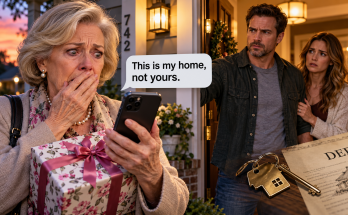
As he walked to his car, I thought about the first message that started all of this.
This is my home, not yours.
At the time, I heard arrogance.
Later, I understood there had also been fear.
David wanted one place in his life where he felt secure.
The mistake was believing security came from claiming something before it was his.
Now he rented a townhouse.
Owed money.
Rebuilt savings slowly.
Had no guaranteed inheritance beyond whatever my estate someday contained.
And he seemed more secure than he had in years.
Because the foundation was finally real.
That night, Leo emailed me his completed school assignment.
The final sentence read:
My grandpa Arthur fixed floors and taught our family stuff even after he died because everybody took a long time to understand.
I laughed until I cried.
Then I printed it.
Not for evidence.
Not for a lawyer.
For me.
I placed it beside Arthur’s photograph.
The past no longer needed to control the house.
It had done something better.
It had finally taught us how to leave it standing behind us.