I kept thinking about the parking lot outside Northlake Trust.
It wasn't something I particularly wanted to remember.
But sometimes, when I passed a closed building early in the morning, the memory returned without warning.
I could almost feel the dampness of my socks.
I could remember the way my hands had felt while holding Grandpa's business card.
Most of all, I remembered the uncertainty.
I hadn't known whether anyone would answer my call.
I hadn't known whether there was enough money available to help me.
And I hadn't known where I would sleep that night.
Mr. Alden had answered.
He had come to the bank on Christmas morning.
But what would I have done if I hadn't possessed that little card?
The question bothered me.
I was thirty-two.
I had a job.
I had a car.
I had more opportunities available to me than many people who found themselves suddenly without somewhere to live.
Yet I had still felt frightened.
I began thinking about people younger than me.
People who might be sent away from unstable homes before they had managed to establish themselves.
People who didn't have dependable income or savings.
People who couldn't telephone a banker and explain that their grandfather had told them to ask for help.
I knew I couldn't solve every problem somebody like that might encounter.
But I also knew I had resources that could make certain problems easier.
I didn't want to pretend I hadn't noticed.
As I considered what to do with part of the proceeds from Maple Grove, an idea began taking shape.
I wanted to establish something in Grandpa's name.
Something practical.
Not a monument.
Not an expensive object that would sit somewhere collecting dust while people admired the generosity behind it.
I wanted it to provide assistance to people who needed somewhere safe to begin again.
I started considering the kinds of assistance that would have mattered most to me on Christmas morning.
Temporary accommodation was the obvious one.
A warm room.
A place where somebody could sleep without wondering whether they would be required to leave again before morning.
But there were other things.
Legal advice.
Help understanding rights and responsibilities.
Guidance finding work and preparing to support yourself.
I remembered how frightened I had been by the amount of paperwork Mr. Alden initially placed in front of me.
I hadn't needed somebody to tell me I was incapable of understanding it.
I had needed somebody to sit down and explain it.
That was something I wanted other people to experience.
The more I thought about it, the more certain I became.
I didn't want the sale of Maple Grove to represent only the end of something unpleasant.
I wanted a portion of that money to accomplish something Grandpa would have appreciated.
I considered the idea carefully.
The inheritance gave me a level of financial freedom I hadn't anticipated, but that didn't mean I wanted to make large commitments without understanding how they would work.
Grandpa had invested thoughtfully.
He had maintained arrangements over decades.
I wanted to respect the care with which he had built everything.
The charitable fund needed a sound foundation.
It needed to provide genuine assistance rather than simply make me feel good about having contributed.
With the appropriate arrangements, I established the fund in Grandpa's name.
Its purpose was to assist young adults who had been forced to leave difficult or unstable family homes.
Housing assistance.
Access to legal guidance.
Help finding employment and preparing for independent living.
Those were the things I wanted it to support.
I looked at Grandpa's photograph while thinking about what we were trying to accomplish.
I remembered how he noticed things other people overlooked.
He had noticed that I was uncomfortable asking for help.
He had noticed that my parents' requests frequently came before my own needs.
He had noticed how often I allowed other people to make decisions that should have belonged to me.
He hadn't responded by telling me what kind of life I had to live.
He had arranged practical ways for me to take care of myself.
That was the spirit I wanted the fund to reflect.
I didn't want the people receiving assistance to feel that they owed somebody permanent gratitude.
I didn't want them to believe they had to behave a certain way to prove they deserved help.
I wanted them to be given enough stability to start making choices again.
Because when you are worried about where you will spend the night, everything else becomes harder.
Planning for work becomes harder.
Understanding paperwork becomes harder.
Even deciding whom you can trust becomes harder.
I remembered how exhausted I had been when I reached the hotel on Christmas Day.
The room had smelled of soap and clean linen.
I had ordered food, taken a shower, and fallen asleep for nearly six hours.
Nothing extraordinary happened in that hotel room.
Nobody presented me with an award.
Nobody congratulated me for surviving something difficult.
I was simply allowed to rest.
And that had been more valuable than I would have understood beforehand.
I wanted other people to have that opportunity.
Once the charitable arrangements were established, I began giving some of my own time to the work as well.
I hadn't intended to abandon my ordinary life and turn the inheritance into my entire identity.
But I found the work meaningful.
There was something grounding about being involved in a project where money represented practical assistance rather than an argument about who deserved more of it.
For years, I had listened to my mother describe money as something the family constantly needed from me.
There had always been a shortage.
Always another expense.
Always a reason my plans needed to be postponed.
Now I was involved in something where assistance had a different purpose.
It was supposed to help someone become independent.
That mattered enormously to me.
I also became involved with a local organization that helped people understand personal finances and prepare to live independently.
I was interested in that work for personal reasons.
I knew how easy it was to confuse earning money with having control over your own financial life.
I had been employed full-time for years.
I had paid expenses.
I had tried to save.
But I hadn't felt free to make decisions about the money I earned whenever my mother insisted the household needed it.
The figures in my bank account had been mine.
The decisions often hadn't been.
I wanted to help people recognize the importance of understanding their own circumstances.
Knowing what they could afford.
Knowing what they were agreeing to.
Knowing when they needed advice before accepting a responsibility somebody else wanted them to carry.
Being involved in that work taught me things too.
I wasn't interested in pretending I had suddenly become an expert simply because Grandpa had left me a considerable amount of money.
There were people who understood budgeting, employment assistance, and independent living far better than I did.
I listened to them.
I learned from them.
And I appreciated being part of something where asking questions was regarded as a useful thing to do.
As the months passed, my ordinary life began changing in quieter ways.
I started making plans without automatically checking whether my mother needed me.
I could arrange something for an evening and assume that I would be able to attend.
I could decide how to spend a weekend without calculating how much trouble the decision might create.
The freedom felt strange at first.
I would sometimes catch myself preparing an explanation for something nobody had questioned.
Then I would remember that I didn't owe one.
By June, I had moved into another apartment near the lake.
It had two bedrooms, and I loved the peaceful surroundings.
I hadn't chosen the place because it looked expensive.
I had chosen it because I liked being there.
That was still a relatively new consideration for me.
Did I like something?
Did it make me comfortable?
Would I enjoy waking up there?
Questions like those had always seemed less important than whether my decisions inconvenienced somebody else.
Now I was learning to consider them first.
I brought the walnut box with me.
I placed it somewhere safe and familiar.
Grandpa's photographs and letters remained inside.
The new red stocking was carefully put away until Christmas came around again.
I had no reason to leave it hanging during the summer.
But I liked knowing it was there.
The apartment began feeling like mine.
Not because I had spent enormous amounts decorating it.
Because the things inside reflected decisions I had made.
I could sit on the sofa in the evening and listen to the quiet.
Sometimes I would look toward the lake and think about the cottage near Lake Superior that Grandpa had mentioned in his recording.
I hadn't forgotten it.
I remembered visiting the property when I was twelve.
I remembered the trees and the feeling of being somewhere far removed from the ordinary concerns of home.
It was comforting to know that place still existed.
I didn't feel pressured to decide immediately what to do with it.
Grandpa had wanted me to have somewhere peaceful.
There was no reason I couldn't appreciate that gift when the time felt right.
I was also becoming more comfortable meeting people without explaining my financial circumstances.
I didn't introduce myself as someone who had inherited millions of dollars.
Most conversations didn't require anybody to know about the trust.
I could speak about my work.
Things I enjoyed.
The neighborhood.
The weather near the lake.
The charitable work I had become involved with.
Ordinary subjects.
I liked being known through those things.
There was something reassuring about building relationships that didn't begin with an assessment of what I could provide.
I hadn't appreciated how much that had affected my relationships before.
Whenever my mother was particularly affectionate, I often found myself wondering whether she was about to ask for something.
Whenever Chloe became unusually friendly, I wondered whether she needed a favor.
That wasn't a pleasant way to think about people you loved.
I didn't want to carry those expectations into every new relationship.
But I also didn't want to ignore what my experiences had taught me.
I wanted to take my time.
To notice whether people's words and actions matched.
To allow trust to develop naturally rather than offering it simply because somebody expected it.
I understood that my relationship with my family might never become what I once wanted.
The sale of Maple Grove had settled the property dispute.
It hadn't settled everything else.
Dad's apology remained something I thought about occasionally.
I believed he regretted certain decisions.
But I hadn't forgotten how long he had been willing to remain silent.
Chloe's telephone call had also remained in my memory.
Especially the change in her voice when she discovered the value of the inheritance.
I wondered whether she had spent any time thinking about the recording independently of its consequences for her.
I wondered whether she understood why I hadn't agreed to defend her publicly.
And Mom?
I didn't know.
I had stopped treating her approval as something I needed to obtain before continuing with my life.
That didn't mean I had stopped caring about her.
It meant I had finally accepted that I couldn't make her treat me differently by trying harder.
The distinction made my days considerably more peaceful.
One afternoon in June, I was at home when someone knocked on the apartment door.
I wasn't expecting a visit.
I put down what I was doing and went to answer it.
When I opened the door, I saw Chloe.
For a moment, I simply looked at her.
Her hair was tied back.
She was wearing a plain sweater.
There was no expensive-looking designer handbag hanging from her shoulder as there usually was.
She looked nervous.
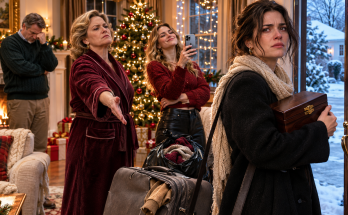
And she looked very different from the woman who had stood beside the dining-room archway with her telephone raised on Christmas morning.
“Hi, Lila.”
“Hello.”
She glanced at me, then down toward the floor.
I kept one hand on the door.
I wasn't ready to pretend we were having an ordinary visit between sisters.
She seemed to understand that.
For several seconds, neither of us spoke.
Then she looked directly at me.
“Would you be willing to talk?”
I considered her question.
I had spent months building a life in which I felt comfortable.
I wasn't going to give that up merely because somebody from my old life appeared at the door.
But I didn't have to send her away simply to prove I was capable of refusing her.
I could listen.
I could decide afterward what, if anything, I wanted our relationship to become.
I stepped aside.
“All right.”
Chloe entered slowly.
I closed the door behind her.