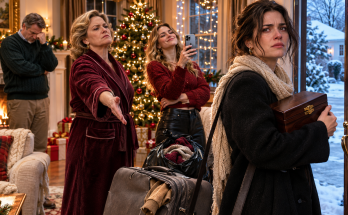
When I stepped outside Margaret's office, I discovered that my mother had called three times.
Chloe had also sent several messages.
I stood beneath the entrance of the brick building, reading the latest one while people walked past me on the sidewalk.
Chloe said Mom wanted me to come home.
Apparently, everything had become unnecessarily complicated.
I read the word home again.
Twenty-four hours earlier, my mother had made it perfectly clear that I wasn't welcome there.
Now she was sending my sister to persuade me to return.
I wondered when she had changed her mind.
More importantly, I wondered what she had discovered.
I slipped Grandpa's photograph deeper into my purse and called her.
She answered before the second ring.
“Where on earth have you been?”
“Good morning, Mom.”
“Your father has been calling you. Why aren't you answering?”
“I had an appointment.”
“What appointment?”
“With an attorney.”
There was a short pause.
“What would you need an attorney for?”
“I've been speaking with Margaret Ellis.”
My mother didn't say anything.
I waited.
I could hear a faint sound in the background, probably something happening in the kitchen.
Finally, she spoke.
“How do you know Margaret?”
“Grandpa asked me to contact her.”
“When?”
“He left instructions.”
Another silence.
Then my mother's voice became softer.
It was a particular voice I recognized from childhood.
She used it when she wanted to convince me that something I understood perfectly well was actually beyond my understanding.
“Lila, your grandfather kept all sorts of unnecessary paperwork. You shouldn't upset yourself trying to understand it.”
“I'm not upset about the paperwork.”
“You've always taken things too seriously.”
I looked down at the snow along the edge of the sidewalk.
“Margaret explained everything quite clearly.”
“Well, your father and I think it's time you came back.”
“Why?”
“Because this is getting ridiculous.”
“What is?”
“All this running around. Staying away. Refusing to speak to us.”
I almost interrupted her.
Instead, I allowed her to finish.
“We should be able to resolve these things privately. We're a family.”
I had spent most of my life being reminded of that whenever someone wanted something from me.
Family helped each other.
Family made sacrifices.
Family didn't complain about money.
But apparently, family could also put someone's belongings in a garbage bag and send her outside on Christmas morning.
“Yesterday you told me I couldn't live there anymore.”
“Oh, Lila.”
“Do you remember saying that?”
“Everyone was emotional. Christmas is stressful.”
I looked toward the office entrance behind me.
Margaret's name was visible on the brass plaque.
I thought about the letter she had shown me.
My mother's handwriting.
November 2018.
The explanation that I was supposedly too dependent to receive an inheritance.
I wondered whether Mom remembered writing those words.
“You packed my clothes before I came downstairs.”
“I put a few things together. Don't make it sound worse than it was.”
“You emptied my purse.”
“That doesn't matter.”
“You burned my stocking.”
She sighed.
“It fell into the fireplace. It wasn't some terrible thing I planned.”
I actually pulled the telephone away from my ear.
I stared at it.
Then I brought it back.
“You took it off the mantel and threw it in.”
“I don't remember doing that.”
“I do.”
My mother became quiet again.
I remembered the white wool curling against the flames.
I remembered Grandpa helping me make those uneven letters.
I hadn't imagined any of it.
And I wasn't going to pretend that I had.
“Why did you want me gone?”
“We've been having difficulties with you for a long time.”
“What difficulties?”
“You know perfectly well.”
“No. I'd like you to explain.”
She made an impatient noise.
“You've become very unpleasant to live with.”
“How?”
“You question everything.”
I waited.
She continued.
“You have this attitude, Lila. You act as though the rest of us aren't good enough for you.”
I looked at the people crossing the street.
An accusation like that would have bothered me for days before.
I would have examined every recent conversation, wondering whether I had accidentally sounded disrespectful.
Sometimes I had apologized without understanding what I was apologizing for.
I wasn't going to do that again.
“Is there anything specific you want to tell me?”
“Oh, don't start talking like a lawyer.”
“I'm asking you a question.”
“You always have to make everything difficult.”
I took a slow breath.
There was no point continuing in circles.
“All right, Mom.”
She sounded surprised.
“What do you mean, all right?”
“I understand that's how you feel.”
I think she had expected me to defend myself.
Without an argument to continue, she changed the subject.
“What exactly did Margaret give you?”
There it was.
I held the telephone a little tighter.
“Why are you asking?”
“Because your grandfather's affairs concern the whole family.”
“Not necessarily.”
“Did she give you documents?”
“Yes.”
“What documents?”
“Personal documents.”
My mother made another impatient sound.
“Lila, your father has some important financial obligations. We need to know whether Arthur made provisions for those.”
I remembered the figure Margaret had shown me.
Four hundred and thirty thousand dollars.
Dad's unpaid debt.
The meeting in December 2018.
Grandpa's refusal to keep financing their decisions.
I wondered how much of that history my mother was prepared to discuss with me.
“Why would Grandpa's arrangements for me have anything to do with Dad's obligations?”
“Because he promised to look after us.”
“Did he?”
“Of course he did. We were his family.”
I almost asked whether she remembered the conditions of the occupancy agreement.
But Margaret had advised me to handle legal questions carefully.
I wasn't going to discuss documents while standing outside in the cold with my mother demanding answers.
“Grandpa provided for me.”
“What does that mean?”
“It means he made arrangements concerning my future.”
“How much?”
She asked it so quickly that I barely had time to register the change in her voice.
I didn't answer.
“Lila?”
“I'm not discussing the amount.”
“Why not?”
“Because it's private.”
She gave a sharp little laugh.
“Since when do you keep things like that from your own parents?”
Since yesterday, I thought.
Since I watched the corner of my stocking disappear into the fire.
Since Dad turned his face toward the window.
Since Chloe decided my humiliation would make an entertaining video.
But I didn't say those things.
“I've been advised to take some time before making any financial decisions.”
“Advised by whom?”
“Margaret.”
My mother became angry.
“Your grandfather had no business making arrangements that affected us without consulting your father.”
I looked down at my shoes.
They were still the old sneakers I had worn when I left the house.
That morning, I could afford to replace them.
But I hadn't gotten around to it.
“Why would Grandpa have needed Dad's approval?”
“Because Arthur's money belonged to the family.”
“No, Mom. It belonged to Grandpa.”
“He was your father's father!”
“And he was my grandfather.”
She stopped speaking.
For several seconds, I heard nothing except her breathing.
I had rarely contradicted my mother so plainly.
Even when I knew she was wrong, I usually found a gentler way of disagreeing.
Something that allowed her to preserve her dignity.
Something that left me carrying the discomfort.
This time, I didn't soften it.
“If you have questions about the estate, you can arrange to speak with Margaret.”
“We are not paying attorneys to interfere in our personal affairs.”
“Then I don't know what else to tell you.”
“You can't just walk away from your family.”
I closed my eyes.
There was a time when hearing my mother say something like that would have made me feel guilty.
But she wasn't asking me to return because she missed me.
She hadn't even asked where I had spent the night.
She wanted information.
Information about Grandpa.
Information about the house.
Information about money.
“I didn't walk away from you, Mom. You made me leave.”
“You're never going to let that go, are you?”
“Not by pretending it didn't happen.”
She started speaking again.
I ended the call.
My hand was trembling so badly that I had trouble putting the telephone back into my purse.
I stood beneath the entrance for another minute.
Then I started walking.
I wasn't happy.
I hadn't enjoyed hearing her become nervous.
I hadn't enjoyed refusing to answer her questions.
There was nothing satisfying about discovering that a conversation with my mother could change so dramatically once money was mentioned.
I simply felt tired.
And beneath that tiredness was something unfamiliar.
Relief.
I hadn't agreed to return.
I hadn't promised to discuss the inheritance.
I hadn't apologized for speaking to Margaret.
The conversation had ended without my mother receiving what she wanted.
And I was still standing.
Back at the hotel, I took Grandpa's photograph out of my purse.
I placed it on the table beside the walnut box.
I thought about the man on Margaret's computer screen.
He had spoken so calmly about my choices.
He hadn't instructed me to remove my parents from Maple Grove.
He hadn't told me to cut contact with them.
He hadn't demanded that I prove my loyalty to him by punishing anybody.
He had simply made sure I was able to decide.
That distinction mattered to me.
I didn't want my mother's behavior to determine the kind of person I became.
I didn't want to spend the rest of my life imagining ways to make her regret Christmas morning.
But I also didn't want to return to the house and resume the same responsibilities as though nothing had happened.
There had to be something between revenge and surrender.
I wanted to find it.
Over the next few days, I kept the important documents together.
Whenever I had questions about them, I wrote them down instead of trying to reach conclusions on my own.
I was especially careful with the paperwork concerning Maple Grove.
The ownership documents were clear enough for me to recognize what Grandpa had arranged.
The occupancy agreement was more complicated.
I didn't want to misunderstand my rights or my parents' responsibilities.
They had lived in that house for years.
Whatever happened next needed to be handled properly.
Three days after my conversation with Mom, Margaret contacted me.
My parents had formally requested a meeting.
Dad had also submitted a written account of the events on Christmas morning.
Margaret let me read it.
I recognized his careful, uncomfortable way of expressing himself.
He described the situation as a disagreement that had become more serious than anybody intended.
He said Mom had been under considerable stress.
He explained that Chloe had been behaving foolishly.
Then he wrote that I had decided to leave the house of my own accord.
I stopped reading.
I looked at Margaret.
“That's not what happened.”
“I understand.”
“They had already packed my things.”
She nodded.
I looked back at the letter.
My father had described my mother as overwhelmed.
He had described Chloe's behavior as a joke that went too far.
But somehow, the person responsible for leaving was still me.
I read the remainder.
I was looking for something very small.
One sentence acknowledging that I had been hurt.
One expression of concern about where I had ended up.
Even a simple statement that he regretted not intervening.
There was nothing.
I put the letter down.
“Has he said anything about the agreement?”
“He and your mother would like to discuss the property arrangements.”
“Of course.”
Margaret removed her glasses.
“You don't have to attend a personal meeting if you would rather communicate through representatives.”
I considered that.
Part of me wanted to avoid seeing them entirely.
I could already imagine Mom's expression when she realized I wasn't going to hand over the documents.
I could imagine Chloe sitting beside her, acting as though I was being unreasonable.
And I could imagine Dad trying to persuade everyone to stop arguing without addressing the reason we were arguing.
But I wanted to hear what they had to say.
Especially my father.
He had known about the house.
Mr. Alden had confirmed it.
I needed to hear that acknowledgment from him directly.
“I'll meet with them.”
Margaret looked at me carefully.
“Are you comfortable doing that?”
“I think so. But I don't want to be alone with all three of them.”
“You won't be.”
“I want you in the room.”
“Certainly.”
I looked down at Dad's letter again.
He had written that I had chosen to leave.
I knew the suitcase had been waiting beside the door before I entered the living room.
I knew my mother had removed my stocking.
I knew Chloe's recording existed.
I wasn't going to allow three people to persuade me that those events had happened differently.
Margaret arranged the meeting for the following Monday.
Before leaving, I gathered my copies of the documents.
I tucked Grandpa's photograph inside the folder so it wouldn't become bent.
Then I looked once more at Dad's account of Christmas morning.
For years, I had allowed his silence to persuade me that perhaps my mother's behavior wasn't as unreasonable as it seemed.
If Dad wasn't objecting, I assumed there must be something I was failing to understand.
But now he had written something I knew wasn't true.
There was no confusion about that.
And when Monday came, I intended to ask him why.