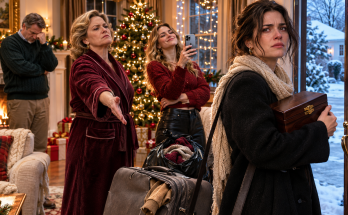
I was enjoying the quiet when somebody knocked on the cottage door.
It was almost noon.
I hadn't arranged for anyone to visit, so I remained seated for a moment, wondering whether I had heard correctly.
Then came another knock.
I put down my coffee and walked toward the entrance.
When I opened the door, I saw my father standing outside.
He was wearing a thick winter coat and holding a small gift bag.
There was snow on his shoulders.
He looked at me nervously.
“Hello, Lila.”
“Dad?”
He gave a little smile.
“Merry Christmas.”
I was too surprised to answer immediately.
Of all the people I might have imagined standing outside Grandpa's cottage, he wasn't the person I expected.
I looked beyond him toward the snowy road.
He appeared to have come alone.
“Would it be all right if I came inside?” he asked.
I considered that for a moment.
My first instinct was to move aside automatically.
He was my father.
It was Christmas.
That would once have been enough to make me agree to almost anything.
But I wanted to invite him inside because I was comfortable doing so.
Not because I felt that I had no other choice.
I looked at his face.
He appeared genuinely uncertain whether I would welcome him.
“All right.”
I stepped aside.
He entered slowly.
I closed the door, shutting out the cold.
For a few moments, he looked around the living room without speaking.
His eyes moved across the wooden walls and toward the windows overlooking the lake.
Then he noticed the Christmas tree.
“This is a beautiful place.”
“I think so too.”
He looked toward the fireplace.
The red stocking hung beside it.
Dad studied the white letters for a moment.
“Your grandfather helped you make one of those when you were little.”
“Yes.”
“I remember that.”
“So do I.”
He remained looking at the stocking.
I wondered whether he was thinking about the last time he had seen one hanging beside a fireplace on Christmas morning.
I certainly was.
One year earlier, he had stood in his robe while Mom removed my childhood stocking from the mantel.
He had looked away instead of intervening.
Now he was standing beside a different fireplace, remembering the afternoon Grandpa and I had made it.
I wasn't sure whether he understood how much that contrast affected me.
He turned toward the table.
“I brought you something.”
He placed the little gift bag on it.
I looked at the bag.
“You didn't need to.”
“I wanted to.”
I reached inside and removed a framed photograph.
The picture showed Grandpa sitting in his garden.
I was beside him, about ten years old, looking pleased with myself.
I recognized the scene almost immediately.
He had been teaching me how to plant roses.
I remembered the soil beneath my fingernails and the care with which he explained what we were doing.
He hadn't simply handed me a shovel and told me to get on with it.
He had shown me where to dig.
He had explained why we needed to be careful with the roots.
And when I became impatient, he had laughed and reminded me that growing something took time.
I looked at the photograph for several seconds.
“Where did you find this?”
“It was among some things your mother had stored away.”
I ran my fingers along the edge of the frame.
I hadn't seen the picture in years.
I was grateful Dad had thought to bring it.
“Thank you.”
He nodded.
“I thought you'd like to have it.”
“I do.”
I placed it carefully on the table.
Grandpa looked happy in the photograph.
So did I.
It was nice to see an image of myself from a time when I hadn't spent much energy worrying about whether I was disappointing anybody.
I looked at Dad again.
“How's Mom?”
He took a breath.
“She gets by.”
I waited.
He didn't immediately elaborate.
I wasn't going to press him for information he didn't want to offer.
But after a moment, he continued.
“We've settled into a smaller apartment.”
I nodded.
It was the first time he had personally told me much about their circumstances since the sale of Maple Grove.
He explained that they had sold some of their possessions.
They had needed to adjust to having less space.
The arrangement was considerably different from the house where they had spent so many years.
I wondered how difficult that had been for them.
I understood that losing a familiar place could be unsettling, even when the circumstances were handled with considerable care.
But I also remembered how much time they had been given to prepare.
Their departure had been arranged through their attorneys.
They had known when they needed to leave.
Nobody had gathered their belongings while they slept.
Nobody had required them to find somewhere to stay on a holiday morning.
I was glad we had handled it differently.
Dad looked down at his hands.
“I've been working again.”
I looked up.
“You have?”
“Part-time. Someone I used to work with had an opportunity for me.”
“That's good.”
He nodded.
“It's not what I used to do, exactly. But I'm grateful to have something.”
I was genuinely pleased to hear that.
For years, his financial difficulties had affected all of us.
I hoped having work again would give him some confidence in his ability to support himself.
I also hoped he would learn to judge his circumstances realistically.
Grandpa had given him so many opportunities.
It was encouraging to know he had found another one without needing me to arrange it.
“I'm glad things are improving for you, Dad.”
“Thank you.”
He glanced toward the sofa.
I invited him to sit.
He lowered himself carefully into a chair.
I sat opposite him, near the fireplace.
For a while, we simply looked at each other.
It reminded me a little of Chloe's visit in June.
Neither of us seemed quite sure how to begin.
Dad rubbed his hands together.
“I didn't come here because I need something.”
I looked at him.
“All right.”
“I wanted you to know that.”
I nodded.
He appeared to be searching for the right words.
Eventually, he leaned forward slightly.
“I've been thinking about what you said to me at Margaret's office.”
I remembered the hallway immediately.
His tears.
His admission that he knew the truth about Maple Grove.
The way he had tried explaining why he didn't want to upset my mother.
Dad looked at the fireplace.
“You were right.”
I remained quiet.
He continued.
“I shouldn't have let things happen the way they did.”
I waited.
I didn't want to assume he was talking only about Christmas morning.
There had been a great many things leading up to that day.
Apparently, he understood that.
“For years, I thought that if I avoided disagreements with your mother, everything would eventually settle down.”
He rubbed his thumb against his fingers.
There it was again.
The little nervous movement I remembered so clearly.
“I told myself I was doing what was best for the family.”
“Were you?”
He shook his head slowly.
“No.”
I watched him.
He looked genuinely uncomfortable, but he kept speaking.
“I was trying to avoid difficult conversations.”
I appreciated hearing him describe it that way.
It was a much more accurate explanation than the ones he had offered me before.
He hadn't kept the family together by refusing to challenge Mom.
He had maintained an arrangement in which she could behave however she wanted because he rarely objected.
And I had carried many of the consequences.
Dad looked up.
“Whenever your mother became upset with you, I thought you'd manage.”
I felt my chest tighten.
“What made you think that?”
“You always seemed to get through things.”
I didn't answer immediately.
He continued.
“You were sensible. You worked hard. You could usually take care of yourself.”
He looked down.
“I used that as a reason not to get involved.”
I thought about how often I had looked toward him during an argument.
Sometimes he had left the room.
Sometimes he had pretended to be interested in whatever was happening outside the window.
Occasionally, he had asked me afterward to be patient with Mom because she was having a difficult time.
I had interpreted those requests as evidence that he understood her difficulties better than I did.
Now I wondered whether he had simply been passing another responsibility to me.
I was supposed to understand her.
He didn't have to confront her.
And everybody could continue living in the same arrangement.
“Being able to manage something doesn't mean I should have had to manage it alone,” I said.
Dad nodded.
“I know.”
“I needed you sometimes.”
His expression changed.
“I know that too.”
I felt tears gathering.
I looked toward Grandpa's photograph on the table.
For most of my life, I had wanted to believe my father was somebody who would protect me if things ever became serious enough.
I had kept moving that imaginary limit.
A cruel comment wasn't serious enough.
An unfair demand wasn't serious enough.
A humiliating argument wasn't serious enough.
Then Christmas morning happened.
And even that hadn't been enough.
Dad took a deep breath.
“I should have defended you.”
“Yes.”
“I should have stopped your mother.”
“Yes.”
“And I should have told you about the house long before any of that happened.”
I nodded.
He looked at me with tears in his eyes.
“I can't tell you how much I regret it.”
I swallowed.
Hearing those words brought back the pain of standing beside the fireplace.
But something about this conversation felt different from the one in Margaret's office.
That afternoon, Dad had apologized while the future of his home remained uncertain.
He had been frightened about what might happen.
Now Maple Grove was sold.
The occupancy agreement had ended.
His living arrangements no longer depended upon a decision I might make.
He had come to speak with me without asking for any of those decisions to be reversed.
That mattered.
It didn't guarantee that everything would change.
But it mattered.
“I appreciate you telling me this,” I said.
He nodded.
“I don't expect things to be the way they were.”
“That's good.”
He gave a small, sad smile.
“I know I haven't earned the right to expect that.”
We sat quietly.
I watched the fire for a while.
There was something comforting about not having to fill every silence between us.
In the past, Dad's discomfort had often made me uncomfortable enough to rescue him from it.
Now I allowed him to sit with whatever he was feeling.
I allowed myself to do the same.
After a few minutes, he looked toward the framed photograph.
“Your grandfather would have liked what you're doing.”
“What do you mean?”
“The fund you started.”
I smiled slightly.
“I hope he would.”
“He always noticed how you were with other people.”
I looked at him.
Dad continued.
“He used to say that you paid attention when somebody was having a difficult time.”
I hadn't known Grandpa said that about me.
It touched me more than I expected.
Dad looked toward the fire.
“He thought that was something special.”
I glanced at the walnut box.
The final letter was inside.
Grandpa had written about being proud of the way I treated people.
Now my father was telling me he had expressed similar thoughts while he was alive.
I felt grateful.
Not because Dad's approval confirmed Grandpa's opinion.
Because it gave me another little glimpse of conversations my grandfather and father had shared.
Another piece of Grandpa's life I hadn't known about.
“I wanted the money from the house to help people,” I said.
Dad nodded.
“I think he'd understand that.”
I smiled.
For a little while, we talked about Grandpa without discussing the financial problems that had complicated the last years of his life.
It was nice remembering him as the person he had been.
Not simply the man whose estate had caused a disagreement.
Not the owner of a property my parents wanted.
Not the person who had lent Dad money.
Just Grandpa.
The man in the garden photograph.
The man who liked his old Buick.
The man who never seemed particularly worried about whether his winter coat looked respectable.
Eventually, Dad stood.
“I should probably get going.”
I rose with him.
He looked around the cottage once more.
“I'm glad you've got this place.”
“So am I.”
He put on his coat.
I accompanied him to the door.
Then he hesitated.
“Lila?”
“Yes?”
“Would you mind if I called you occasionally?”
I considered the question.
He wasn't asking to move into the cottage.
He wasn't asking me to help with expenses.
He wasn't demanding that I forget anything.
He was asking whether I might allow occasional contact.
That was something I felt comfortable considering.
“You can call.”
His face softened.
“Thank you.”
“But I don't want us rushing into anything.”
“I understand.”
“And if Mom doesn't like you speaking to me, that's something you'll have to deal with yourself.”
He looked at me.
I continued.
“I don't want our relationship to depend on whether she's happy about it.”
Dad nodded.
“It won't.”
I hoped that was true.
But I wasn't going to spend the rest of Christmas wondering whether he would keep the promise.
Time would provide the answer.
He opened the door.
Cold air entered the cottage.
“Merry Christmas, sweetheart.”
“Merry Christmas, Dad.”
He stepped outside.
I watched him walk toward his car.
Then I stood by the window while he drove away along the snowy road.
The gift bag remained on the table.
Beside it was the framed photograph of Grandpa and me planting roses.
I picked it up again.
I was glad Dad had come.
I was glad he had said the things he said.
And I was glad I hadn't needed to promise anything beyond what I was genuinely willing to offer.
For once, I could appreciate a good moment with my father without asking that moment to repair every painful one that came before it.
I placed the photograph beside the walnut box.
Then I returned to the fireplace.
It was still Christmas Day.
And the rest of it was mine.