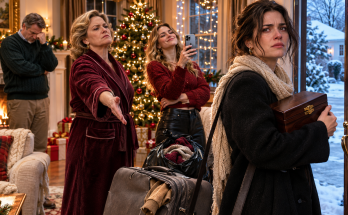
“Hello?”
Chloe didn't bother greeting me.
“Have you seen what people are saying?”
I sat down.
“About what?”
“You know what.”
“The recording?”
“Yes, Lila. The recording.”
I looked toward the walnut box.
“What about it?”
“People have been sending it to each other. They're saying horrible things about Mom.”
I waited.
Chloe seemed to expect me to respond immediately.
When I didn't, she continued.
“It's getting completely out of hand.”
“Why did you put it online in the first place?”
She sighed.
“That's not important anymore.”
“I think it is.”
“People are making us look terrible.”
I thought about the screenshot my former colleague had sent me.
Nobody had needed to alter the recording to make my family look bad.
They were simply watching what Chloe had decided to show them.
“What do you want me to do?”
“Tell them it wasn't like that.”
“Wasn't like what?”
“Tell them there was a misunderstanding.”
I stared at the wall.
Dad had used essentially the same explanation in his letter to Margaret.
Apparently, my family had settled on a version of Christmas morning that required my cooperation.
I was supposed to deny the meaning of events other people could see happening in front of them.
“Which part did they misunderstand?”
“Lila, seriously.”
“I'm asking.”
“Everybody was upset. Things got a little crazy.”
“I wasn't the one recording people.”
“I know that.”
“You laughed when Mom told me to leave.”
She became quiet.
I continued.
“You put the recording online with a caption suggesting that I was causing problems for the family.”
“It wasn't meant to become this huge thing.”
“Then what was it meant to become?”
She didn't answer.
I could almost hear her trying to find an explanation that would sound reasonable.
Finally, she said that Mom had told her I was being dramatic.
I leaned back.
“Did you ever ask me how I felt?”
“Mom said you'd been causing trouble for weeks.”
“What trouble?”
“I don't know.”
“Then why did you believe her?”
“She's our mother.”
“And you've known me your entire life.”
Chloe made a frustrated noise.
“I don't understand why you're making me the bad person.”
I closed my eyes briefly.
I wasn't making her anything.
I was asking her to acknowledge her own behavior.
Even now, after people had criticized what she posted, she seemed to believe the problem was my refusal to protect her from their opinions.
“I'm not going to make a public statement saying something happened differently.”
“So you're just going to let everybody think we're horrible?”
“I'm not responsible for what people think about a recording you shared.”
“You're enjoying this.”
“No, I'm not.”
“Really?”
“Do you think I enjoyed seeing myself standing there with my clothes in a garbage bag?”
She didn't reply.
I remembered her smile when she told me to see how well I managed without them.
It had been such a confident smile.
She hadn't seemed to consider the possibility that the situation might affect her later.
Now she wanted me to help her repair it.
“Chloe, you could have stopped recording.”
“I know.”
“You could have put your phone away and asked Mom what she was doing.”
“I know.”
“You could have asked Dad to help.”
She remained silent.
I wasn't sure whether she understood the difference between acknowledging that something could have happened differently and accepting that she should have acted differently.
Then she changed the subject.
“Mom said Grandpa was leaving the house to Dad.”
I sat straighter.
“When did she tell you that?”
“She'd been saying it for ages.”
“What else did she tell you?”
“That Dad would take care of the important things. She said Grandpa was leaving you something too, but not much.”
I looked at the walnut box.
“Why not much?”
“Because she said he didn't think you'd know what to do with a lot of money.”
I almost laughed.
It wasn't funny.
I was simply tired of hearing the same description of myself.
My mother had apparently spent years telling people that I couldn't manage my own affairs.
She had told Grandpa.
She had told Chloe.
And whenever I started making plans independently, she had given me reasons not to trust my own judgment.
“Grandpa never said that to me.”
“Well, that's what Mom told me.”
I thought about the statement Mr. Alden had placed on his desk.
The total printed near the bottom.
The figure I had read several times because it seemed impossible.
“Apparently, Grandpa had a different opinion.”
Chloe hesitated.
“What do you mean?”
“He didn't leave me a small amount.”
“How much did he leave?”
I should probably have refused to answer.
Margaret had advised me to be careful about discussing the inheritance.
I understood why.
But I was tired of having this particular conversation built around something my mother had invented.
I wanted Chloe to understand that Grandpa had trusted me.
“More than eight million dollars.”
There was silence.
Not the usual kind where Chloe waited for an opportunity to interrupt me.
Complete silence.
Then she spoke very quietly.
“Eight million dollars?”
“Approximately.”
“Are you serious?”
“Yes.”
“All of it?”
“I'm the beneficiary of the trust.”
She didn't speak for several seconds.
I could hear faint background noises.
Then she asked about the house.
“Is Maple Grove included?”
“Yes.”
“You actually get the house?”
“That's what Grandpa arranged.”
“But Dad lives there.”
“I know.”
“And Mom?”
“There's an occupancy agreement.”
She seemed unable to find another question.
I waited.
Finally, she said my name.
Her voice sounded different.
“Lila.”
“Yes?”
“We should sit down somewhere and talk about this.”
“We're talking now.”
“No. I mean properly.”
I looked at the photograph beside the box.
The date on its back had once seemed mysterious.
Now I understood why Grandpa and Margaret had taken it.
“I don't want to discuss anything else tonight.”
“But we need to figure things out.”
“Not tonight.”
“Can you at least tell me what you're planning?”
“I haven't made those decisions yet.”
She started to object.
I ended the call.
For a while, I remained sitting with the telephone in my hand.
I thought about the difference between the beginning and the end of that conversation.
At first, Chloe had been irritated.
She had wanted me to defend her and Mom against the people criticizing them.
After learning about the inheritance, her irritation had almost completely disappeared.
She had become careful.
Quiet.
Interested in talking properly.
I wished the change had happened when I described how much the recording had hurt me.
But it hadn't.
It happened when she heard the amount Grandpa had left.
That was something I needed to remember.
I didn't want to decide that Chloe was incapable of changing.
She was my sister, and despite everything, I still cared about her.
But I couldn't treat a sudden change in her tone as evidence that she understood what she had done.
I needed to give her time.
And I needed to protect myself during that time.
Over the following weeks, I began meeting with the people responsible for administering Grandpa's trust.
Mr. Alden explained the financial structure to me.
Margaret helped me understand the legal arrangements.
A professional financial adviser reviewed the investments and discussed how they had been organized.
I asked plenty of questions.
Some of the terminology was unfamiliar.
I didn't pretend otherwise.
There was a strange satisfaction in being able to admit that I didn't understand something without having the admission used against me.
When I asked a question, somebody answered it.
If the explanation was complicated, they explained it again.
Nobody suggested that my inability to understand a particular financial document meant I was incapable of making decisions about my life.
I discovered that Grandpa had been a patient investor.
He had acquired commercial properties over many years.
He had maintained a variety of investments rather than depending entirely on one business or one source of income.
There were longer-term securities and the private business interests Mr. Alden had mentioned.
It took me some time to understand how everything fitted together.
I also learned that having a trust worth millions wasn't the same as having that entire amount available to spend immediately.
There were properties to manage.
There were administrative responsibilities.
There were decisions that needed proper consideration.
I was grateful Grandpa had arranged for professionals to assist me.
I didn't want to make careless decisions simply because I had suddenly been given the opportunity to make expensive ones.
I thought about Dad's business.
The money he had borrowed.
The additional opportunities Grandpa had provided.
I wanted to be careful not to repeat the same mistakes merely under more comfortable circumstances.
Meanwhile, I continued driving my old car.
It still got me where I needed to go.
I still bought the ordinary coffee I liked.
I still found myself comparing prices when shopping.
Having financial security didn't immediately erase habits I had developed over many years.
But I began noticing small changes in the way I felt.
I no longer checked my telephone expecting Mom to ask whether I could cover another household expense.
I could consider buying something necessary without calculating what might happen if she needed money the following week.
And I could choose where I wanted to live.
That was the decision I began addressing first.
I wasn't interested in remaining indefinitely at the hotel.
It had been exactly what I needed on Christmas morning.
But I wanted somewhere I could put my belongings away properly.
Somewhere I could leave a cup on the kitchen counter without wondering whether anybody would complain about it.
I rented a furnished apartment overlooking a park.
There were two bedrooms, large windows, and a balcony.
It wasn't an extravagant place.
I hadn't chosen it to demonstrate anything about the inheritance.
I liked the windows.
I liked the quiet.
And I liked knowing I could close the front door whenever I wanted.
When I moved my things inside, I looked at the black garbage bag that still held some of my clothes.
For a moment, I stood beside it without moving.
Then I opened it.
I took out my belongings and placed them where they belonged.
Clothes in the drawers.
Other things in the wardrobe.
There was something unexpectedly emotional about having enough space to put everything away.
Nobody had decided how much room I was allowed to occupy.
Nobody had shoved my possessions together because they wanted them out of sight.
I bought new towels.
I arranged for a comfortable mattress.
Little purchases that wouldn't have interested anybody looking for evidence of a millionaire's lifestyle.
But they interested me.
I wanted a bed where I could sleep without hearing my mother moving through the hallway.
I wanted towels that were mine.
I wanted ordinary possessions that nobody could gather up and place beside the front door without my permission.
I also bought a little Christmas tree.
The holiday had already passed, but I hadn't experienced anything that felt much like Christmas.
I decided there was no reason I couldn't enjoy the decorations a little longer.
I placed the tree beside the apartment window.
At night, its lights reflected faintly against the glass.
Then I bought some red wool and made myself a stocking.
I chose white thread for the letters.
LILA.
I worked slowly.
I wasn't particularly skilled at sewing, although I was considerably better than I had been at nine.
I remembered Grandpa correcting the way I held the needle.
I remembered how patient he had been whenever I became frustrated.
The new letters came out reasonably straight.
I ran my fingers across them.
They looked different from the ones he had helped me make.
Of course they did.
I was making something new.
I wasn't trying to reproduce something that belonged to a different time in my life.
When the stocking was finished, I sat looking at it for several minutes.
I wished I could show Grandpa.
I knew he would probably have commented on how much my sewing had improved.
Then he would have made some gentle joke about my first attempt.
I placed the stocking near the tree.
That evening, I opened the walnut box again.
I had been keeping Grandpa's photographs and letters together inside it, and I wanted to make sure nothing had been damaged during the move.
As I lifted one of the photographs, a small folded piece of paper slipped into view.
I hadn't noticed it before.
I picked it up.
Grandpa's handwriting.
There was only a brief message.
He had written that no building was worth sacrificing my peace of mind to keep.
I read it again.
Then I sat down on the floor beside the box.
I had been thinking about Maple Grove almost every day.
I knew I had rights concerning the house.
I knew Grandpa had wanted me to have it.
But every time I imagined walking through the front door again, I saw my suitcase beside the entrance.
I saw the fireplace.
I saw my father looking toward the window.
The house contained wonderful memories of Grandpa.
It also contained memories I wasn't sure I could live comfortably with.
I had been wondering whether selling it would somehow mean failing to appreciate what he had left me.
Now I was holding another message that answered the question.
Grandpa hadn't expected me to preserve the house at the expense of my happiness.
He had left it to me because he wanted me to be secure.
Security didn't have to mean living at the same address.
I looked around the apartment.
The new towels were folded.
My belongings were put away.
The little tree was glowing beside the window.
There was nothing particularly impressive about the room.
But I felt comfortable there.
I hadn't realized how important that feeling was until I began experiencing it regularly.
I folded Grandpa's message and placed it back inside the walnut box.
Then I looked at my new stocking.
For the first time, I allowed myself to consider what would happen if I never lived at Maple Grove again.
Not because my mother had forbidden me from returning.
Not because I was afraid to exercise my rights.
But because I had discovered that I was capable of building a home somewhere else.
I didn't need that particular roof to feel connected to Grandpa.
I had his photograph.
His handwriting.
His voice in my memory.
And the knowledge that he had wanted something better for me than years of arguing over where I was permitted to belong.
I wasn't ready to decide every detail that evening.
But I knew what I wanted to discuss with Margaret.
I wanted to resolve the occupancy arrangement without treating my parents the way they had treated me.
I wanted to stop being responsible for their choices.
And I wanted the freedom to leave Maple Grove behind.
I put the walnut box somewhere safe.
Then I turned off the lights, leaving only the little Christmas tree glowing beside the window.
For the first time in years, deciding where I belonged felt like something I was allowed to do for myself.