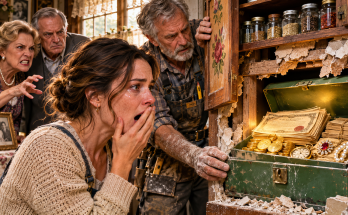
For a while, I kept Grandma's final letter near the wooden box.
I didn't read it every day.
I didn't need to.
I knew what she had asked of me.
Whenever I looked at the brass ruler, I thought about the little message she had left with Gil.
I thought about the difference between preserving something and putting it to good use.
Those were two separate responsibilities.
I had accomplished the first by repairing the house and protecting the trust.
I hadn't yet decided how to approach the second.
I continued working at the hospice.
My circumstances had changed considerably, but the people I cared for still needed the same things from me.
They needed patience.
They needed somebody to notice when they were uncomfortable.
Their relatives needed explanations they could understand.
Sometimes they needed somebody to sit quietly with them.
Money hadn't made those responsibilities seem less important.
If anything, I was more aware of the things that couldn't be purchased.
I thought about Grandma whenever I saw someone adjusting a pillow for a loved one or trying to make a difficult evening a little easier.
I remembered the way I used to watch the clock when I was caring for her.
Not because I wanted to leave.
Because I was trying to calculate how much sleep I might get before my next shift.
There had been periods when I felt as though I was working two completely different jobs.
One came with a salary.
The other came with a relationship I would never have traded for money.
I knew other families experienced similar pressures.
Some were fortunate enough to have several relatives available to help.
Others relied heavily on one person.
That person still had groceries to buy, bills to pay, and responsibilities that didn't disappear because somebody they loved was dying.
I understood how exhausting the ordinary practical difficulties could become.
Sometimes a relatively small expense made an already difficult week much worse.
It didn't need to be an enormous hospital bill.
It could be the cost of traveling repeatedly to appointments.
The price of meals when nobody had the energy to cook.
Basic things required to keep somebody comfortable.
Those were the kinds of expenses people sometimes overlooked when they talked about the burden of caring for a seriously ill family member.
I hadn't overlooked them.
I remembered how carefully I had managed my own money while Grandma was alive.
I remembered wondering whether I could afford a repair that shouldn't have been postponed.
And I remembered wanting to keep those worries away from her.
Those experiences stayed with me as I considered Grandma's letter.
There was another part of her life I wanted to honor.
Her teaching.
Thirty-one years.
That was a substantial portion of her life.
She had spent those years explaining things to children with different abilities and different circumstances.
Some learned quickly.
Others needed more time.
Grandma didn't believe needing extra help was something a child should be ashamed of.
I knew that from the hours she spent beside me at the kitchen table.
Whenever I became convinced I was incapable of understanding something, she treated my frustration as temporary.
She never allowed it to become a permanent description of who I was.
I was grateful for that.
Looking around the kitchen, I began thinking about how many children might benefit from the kind of patience Grandma had given me.
Some families couldn't easily afford additional educational resources.
Books cost money.
School supplies cost money.
Extra assistance with difficult subjects wasn't always available to children who needed it.
Grandma would have understood those problems.
She had dedicated her working life to helping children learn.
I didn't want that part of her contribution to end simply because she was no longer here.
About six months after the legal matters were resolved, I made a decision about the property.
I would keep it.
That had already been my preference, but now I understood more clearly what keeping it would mean.
I wasn't interested in selling it and purchasing something more impressive.
I didn't want to convert the house into an expensive rental and look at it primarily as a source of income.
I also didn't want to preserve the rooms so rigidly that everybody felt afraid to touch anything.
Grandma had given me permission to use the place.
I intended to do that.
The property would remain my home.
It would also become somewhere people could gather and receive practical support.
I wanted children to feel comfortable coming through the door.
I wanted people to sit at the kitchen table without worrying that it was too precious to use.
I wanted the garden to be somewhere neighbors and families could spend time together.
The house had enough history.
What it needed now was activity.
I decided to use a portion of what Grandma had left to establish a modest community education fund in her name.
The purpose was straightforward.
Children from families with limited financial resources would be able to receive assistance with school supplies, books, and tutoring.
I didn't intend to create something complicated merely because there was money available.
I wanted the assistance to address identifiable needs.
A child who needed books should be able to receive books.
A child struggling with schoolwork should have an opportunity to get additional help.
Families shouldn't need to be wealthy before those things became possible.
I thought Grandma would have appreciated the simplicity of that idea.
I also decided to establish a small fund supporting families whose loved ones were receiving hospice or palliative care.
I was careful about what I wanted that assistance to accomplish.
My professional experience had taught me the importance of properly provided medical services.
I wasn't trying to replace those services.
I wasn't attempting to create a separate medical organization out of Grandma's house.
The assistance would address practical difficulties that often surrounded serious illness.
Transportation.
Meals.
Essential everyday supplies.
Small expenses that could become substantial problems when a family's resources were already stretched.
I wanted the support to make life a little easier without promising things it couldn't deliver.
I thought about how much I would have appreciated certain kinds of practical assistance during Grandma's final months.
Sometimes simply knowing that one thing had been taken care of would have allowed me to concentrate more fully on her.
That was the feeling I hoped other families might experience.
Not dependence.
Not an obligation to repay somebody's kindness.
A little breathing room when they needed it.
I had no intention of giving away everything Grandma had protected.
That would have contradicted another important part of her advice.
She wanted me to have security.
She had taken considerable trouble to make sure I wouldn't spend the rest of my life struggling to meet expenses created by other people's decisions.
I needed to honor that intention, too.
I wasn't required to choose between helping people and protecting my own future.
There could be room for both.
I found that idea more difficult to accept than I expected.
For much of my life, I had believed the value of helping somebody was somehow connected to how much inconvenience I accepted.
If helping was easy, perhaps I wasn't doing enough.
If I still had money left afterward, perhaps I should have given more.
Grandma's letters had challenged that way of thinking.
She hadn't asked me to exhaust myself.
She hadn't asked me to demonstrate that I deserved the inheritance by immediately surrendering it.
She wanted me to use it carefully.
That meant deciding what I could reasonably contribute and making sure those contributions served the intended purpose.
The brass ruler seemed appropriate.
Measure before committing yourself.
Make sure what you build can withstand ordinary use.
Don't confuse something impressive with something durable.
I wanted the two funds to continue helping people rather than become short-lived gestures.
As the plans took shape, I spoke with Margaret.
We sat together and talked about the kind of gatherings the house could accommodate.
I told her that I wanted Grandma's teaching to remain part of what happened there.
I explained the education fund and the practical support I hoped to provide to hospice families.
Margaret listened without interrupting.
When I finished, she smiled.
"Helen would have understood exactly why you're doing this."
I looked at her.
"I hope I'm doing it the right way."
"You're thinking about the people who'll actually use it."
She paused.
"That's a good place to begin."
I appreciated that.
Margaret didn't tell me I needed to create something larger.
She didn't suggest that a substantial inheritance required a public display of generosity.
She understood why I wanted to begin with manageable assistance.
She also understood the house.
She had spent years visiting Grandma there.
She knew how the rooms connected and what the garden meant to Helen.
She could imagine people gathering around the old kitchen table.
She could picture children working on their school assignments.
I was glad to have somebody who understood the character of the place helping me think about its future.
We began arranging a small community gathering.
Nothing elaborate.
The idea was to bring together people who had known Grandma and families connected with the kinds of assistance I hoped to provide.
I didn't want the gathering to feel like a formal ceremony.
I wanted it to feel like people visiting a home.
Margaret helped organize it.
Her enthusiasm made me smile.
She had spent months helping me establish what Grandma wanted through documents and witness accounts.
Now we were discussing how people might spend an afternoon together in the garden.
The change was welcome.
I could tell that she was pleased to have something positive associated with the house again.
We had spent too much time talking about what had happened behind the kitchen wall.
There were other things worth talking about.
Gil agreed to help with the garden arrangements.
He built several long wooden tables.
When I looked at them, I thought about the difference between the work he had originally undertaken and the work he was doing now.
He had first come to repair something that was deteriorating.
Now he was building things that would allow the property to be used in a different way.
Both kinds of work mattered.
The tables were practical.
People could sit around them.
Food could be placed on them.
Children could use them without everybody worrying about damaging expensive furniture.
They belonged in the garden.
I thanked him for making them.
He seemed pleased to see that the house would have a purpose beyond being renovated.
Dad came over to help repair the old fence.
I watched him working outside.
There was something reassuring about seeing him occupied with a practical task.
He wasn't explaining himself.
He wasn't asking whether I had forgiven him.
He was repairing a fence that needed repairing.
I appreciated that.
Our relationship was still different from the one I remembered.
We had spoken more openly since the legal proceedings ended, but there were things between us that couldn't be resolved through a single apology.
I didn't expect a few repaired sections of fence to change that.
Still, I was glad he wanted to contribute.
There was a difference between a grand declaration and showing up to do something useful.
He was beginning to demonstrate that difference.
I hoped he would continue.
Aunt Carol volunteered to organize books for the children.
I hadn't expected her to become involved.
Considering our earlier disagreements, I wasn't sure whether she would feel comfortable participating.
But she offered.
I accepted.
Her willingness to provide a statement during the investigation had already shown me that she could reconsider something when new information became available.
Now she was offering to assist with something positive.
I didn't need to remind her about the telephone conversation in which she accused me of hurting the family.
She knew what she had said.
She had apologized.
I could allow her to take part without pretending the earlier conflict had never occurred.
Watching Margaret, Gil, Dad, and Carol contribute to the preparations made me think about trust.
It wasn't something I needed to distribute equally among everybody.
Different people could hold different places in my life.
I could appreciate a particular act without surrendering every boundary.
I could accept assistance without becoming obligated to agree with everything the person offering it might want in the future.
Those distinctions had become important to me.
As the day of the gathering approached, I walked through the house and garden.
The tables Gil had built were ready.
The fence Dad had helped repair looked better.
The books Carol was organizing represented opportunities for children who might otherwise have struggled to obtain them.
Margaret was helping bring the people together.
I thought about Grandma's final letter.
She wanted the house to contain new experiences.
There was nothing in her instructions that required me to reproduce her life exactly.
I wasn't a mathematics teacher.
My professional experience came from caring for people nearing the end of theirs.
The two funds reflected those different parts of our lives.
Her work.
Mine.
I liked that connection.
The money had made the arrangements possible, but it hadn't supplied the idea.
The idea came from knowing what she cared about and what I had learned through my own work.
I went into the kitchen.
The photograph Gil had given me was safe in its wooden box.
The brass ruler rested beside it.
I looked at the old table.
Soon there would be children coming into this room who had never known Grandma.
They wouldn't remember her correcting their arithmetic or telling them to try again.
But they might receive help because she had spent her life building something that could eventually benefit them.
That thought made me happier than I expected.
I had spent so long considering what other people might take from what Grandma had left.
Now I could consider what I wanted to give.
The difference was that the choice belonged to me.
And I was making it without fear, guilt, or pressure from anybody else.