The little girl placed her worksheet on the table.
Several of the problems involved dividing fractions.
She had tried some of them already.
I could see pencil marks where she had written answers, reconsidered them, and rubbed them out.
"I don't know what I'm supposed to do."
I looked at the paper.
"Which one is giving you trouble?"
She pointed to a problem.
Then she moved her finger toward the others.
"All of these."
I smiled.
"That's all right."
She looked doubtful.
I remembered feeling exactly that way when Grandma told me something wasn't difficult.
As far as I was concerned, it was difficult.
That was why I needed help.
I didn't want to hear that the problem should have been easy.
I wanted somebody to explain it in a way I could understand.
I moved the worksheet a little closer.
The girl watched me.
I picked up a pencil.
Then I noticed the little wooden box nearby.
I reached for it and opened the lid.
The brass ruler lay inside beside the photograph Gil had brought me.
I took out the ruler and placed it near the worksheet.
The girl glanced at it.
I looked at the worn metal.
For a moment, I remembered Gil telling me how Grandma had made him check the measurements of the hidden compartment three times.
I smiled.
There were probably few things Helen Marsh considered more important than getting the numbers right.
But she had also understood that people needed patience while learning how.
I turned my attention back to the worksheet.
"We'll do one together."
The girl nodded.
I explained what the fractions represented.
Then I showed her what needed to happen when one was divided by another.
She watched the pencil move across the paper.
When I finished explaining the first problem, she looked at the numbers for a moment.
Then she shook her head.
"I still don't get it."
"That's fine. We'll try again."
She glanced at me.
I could tell she expected me to become impatient.
Perhaps she was simply worried that she was taking too long.
I remembered Grandma never making me feel embarrassed about needing another explanation.
I wanted to offer the same kind of patience.
I went back to the beginning.
This time, I explained the steps more slowly.
I pointed to the part of the expression she needed to pay particular attention to.
Then I let her work through it herself.
She hesitated before writing.
I waited.
She made another attempt.
I watched without interrupting immediately.
When she reached the difficult part, I asked her to look at what she had already written.
She studied the page.
Then she changed something.
Her face brightened.
"Is that right?"
I checked the answer.
"Yes."
She smiled.
"Really?"
"Really."
She looked at the worksheet again.
The next problem didn't seem quite as intimidating to her.
I watched her begin working on it.
She still needed some assistance, but she was more willing to try.
That was progress.
I had learned through my own experiences that confidence didn't necessarily arrive before understanding.
Sometimes understanding came first.
Then confidence followed.
Grandma had known that.
She had spent her working life watching children gradually discover that something they considered beyond their abilities was actually within their reach.
I was beginning to understand why she remembered those moments so fondly.
The girl finished another problem.
She looked up.
"I think I know how to do it now."
"Try the next one."
She did.
I sat quietly beside her.
It felt strange being on that side of the lesson.
For so many years, I had been the child waiting for Grandma to tell me whether an answer was correct.
Now another child was waiting for me.
I looked toward the photograph beside the kitchen doorway.
Grandma stood outside the house in the summer of 1978.
Her image was visible from where we were sitting.
The girl followed my gaze.
"Who's that lady?"
I smiled.
"My grandmother."
She looked at the photograph more closely.
"Did she live here?"
"Yes."
"Was she the one who owned the house?"
"She was."
The girl considered that.
Then she asked whether Grandma had been a teacher.
I nodded.
"She taught mathematics for thirty-one years."
The girl's eyes widened a little.
"That's a long time."
"It certainly is."
She looked at the worksheet.
Then she looked back toward the photograph.
"Was she good at teaching?"
I didn't need to think about the answer.
"Very good."
I remembered her guiding my hand toward the relevant part of a problem.
I remembered her correcting me without making me feel incapable.
I remembered how pleased she seemed when I finally understood something.
She had been an excellent teacher.
Not because she could produce answers quickly.
Because she could help somebody else reach them.
The girl returned to the worksheet.
A few minutes later, she completed another problem correctly.
I congratulated her.
She smiled and moved on.
As I watched her, an old memory of Grandma's dry humor came back to me.
I could almost hear her making one of her little remarks about somebody who ought to have spent more time studying.
I laughed quietly.
The girl looked up.
"What happened?"
"Nothing. I was thinking about Grandma."
She looked toward the photograph again.
Then she continued writing.
I didn't tell her the whole story.
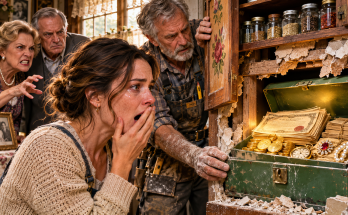
She didn't need to know about the green steel box.
She didn't need to know about the trust, the disputed will, or safe deposit box 417.
She didn't need to understand the financial decisions that had eventually made the education program possible.
She needed help with fractions.
And that was something I could give her.
When she finished the worksheet, she looked pleased with herself.
I was pleased for her.
She gathered the paper and thanked me.
Then she hurried outside.
I remained at the table.
The pencil was still beside the brass ruler.
The empty chair next to mine reminded me of Grandma.
I sat there for a while, looking at the familiar room.
The afternoon light reached across the table.
The spice cabinet stood against the wall.
I could see the place where Gil had discovered the hidden compartment.
It no longer seemed remarkable.
There was no reason for an unfamiliar visitor to pay particular attention to it.
The green box had been removed long ago.
The legal documents had served their purpose.
The money had been identified and protected through the appropriate arrangements.
The little compartment was simply there.
A reminder.
I got up and walked toward it.
As a child, I had sometimes heard Grandma make an unusual remark about the way a house retained the things its owner put into it.
I had always interpreted her words financially.
A house required money.
Repairs.
Maintenance.
Ordinary expenses associated with keeping a building in good condition.
I assumed she was explaining why it was important to look after property properly.
That interpretation hadn't been entirely wrong.
But it hadn't been complete.
Standing beside the cabinet, I finally understood what else she had meant.
The house retained the effects of what happened within it.
Grandma's decisions had shaped the building itself.
Her repairs had kept it standing.
Her care had preserved the things that made it familiar.
But there were other things the house seemed to hold.
The meals she prepared.
The conversations she shared.
The birthdays celebrated there.
The lessons she taught at the kitchen table.
Those experiences had influenced the people who carried them away.
I was one of those people.
I had brought Grandma's lessons into my adult life without always recognizing where they came from.
Some had influenced the way I approached my work.
Some had influenced my willingness to help people.
Others had eventually helped me understand why I needed to establish clearer boundaries.
The house had been part of all those things.
Now the little girl who had just left the kitchen would carry away something of her own.
She understood fractions a little better.
Perhaps the next time she encountered a difficult problem, she would remember that needing another explanation didn't mean she was incapable of understanding it.
That was a modest thing.
But Grandma had built a career out of modest things repeated over many years.
I could understand why she valued them.
I returned to the table and picked up the brass ruler.
It wasn't worth anything close to the amount of money hidden behind the kitchen wall.
I doubted anybody would have considered it a particularly significant asset when evaluating the contents of the estate.
But I couldn't imagine parting with it.
Grandma had handled it.
She had chosen to leave it for me.
It connected the practical work of restoring the house with the kind of life she wanted me to build inside it.
I placed it back in the wooden box.
The photograph lay underneath.
I read the little handwritten instruction again.
Grandma had encouraged me to measure thoughtfully and create something durable.
I had interpreted those words in several different ways since receiving them.
At first, I connected them with the renovation.
Then I thought about the careful administration of the inheritance.
Now I thought about the education program.
Something built to last didn't necessarily need to be made of wood.
It could be an arrangement that allowed children to receive assistance over time.
It could be a relationship slowly rebuilt through consistent honesty.
It could be a decision about my own future that I remained willing to respect even when other people disagreed.
I closed the box.
I had learned a considerable amount about financial matters since Grandma died.
I hadn't become an expert.
I still relied on professional guidance when I needed it.
But I participated in the decisions.
I asked questions.
I made sure I understood the responsibilities attached to the arrangements Grandma had established.
I didn't want another person controlling important matters simply because I felt uncomfortable discussing them.
That was one lesson I intended to keep.
I had paid the renovation expenses.
The house was properly repaired, and I no longer needed to carry the anxiety associated with those unfinished projects.
I had also set aside resources for the future.
With professional advice, I approached the investments carefully.
I wasn't looking for an opportunity to turn the inheritance into something dramatically larger as quickly as possible.
Grandma had accumulated what she possessed over many years.
She had understood patience.
She had understood the importance of protecting what she built.
I wanted to approach my own circumstances with similar care.
I didn't buy a mansion.
I didn't need one.
I already owned a house I loved.
I didn't purchase an expensive car simply to demonstrate that I could afford it.
I wasn't interested in making my financial circumstances visible to everyone around me.
There was no need to transform every part of my life.
The things that had mattered to me before the inheritance still mattered afterward.
My work.
My home.
My friendships.
The ability to spend an ordinary afternoon in the garden.
The inheritance had made it easier to enjoy those things without constantly worrying about money.
That was enough.
There were moments when I wondered what my parents had expected me to do if the green box had never been discovered.
Would I eventually have sold the house because the repairs became too expensive?
Would I have continued taking extra shifts to manage the costs?
Would I have spent years accepting their explanation that Grandma had decided I wasn't capable of managing anything more substantial?
I couldn't know.
Those were possibilities rather than events that actually happened.
I didn't want to spend my life imagining versions of the past I couldn't change.
The box had been discovered.
The original records had been recovered.
The trust had been upheld.
Grandma's decisions had been respected.
I had the opportunity to choose what I did next.
That was the reality I wanted to concentrate on.
I hadn't sold the property.
I had never seriously regretted keeping it.
Every time I saw somebody using the garden tables or sitting comfortably in the kitchen, I felt reassured about that decision.
There were less complicated ways I could have used my financial resources.
But none would have given me quite the same feeling as walking through Grandma's front door and knowing that the house still had a purpose.
It wasn't simply a reminder of what I had lost.
It was part of what I was building.
My family remained part of my life, although the relationships had changed.
Dad and I continued getting closer in ways that felt more honest than before.
Mom and I remained careful with each other.
There were things we could discuss comfortably and things that still brought pain.
I didn't regard that as a failure.
I had stopped believing that a relationship needed to return to its previous form before it could be considered worthwhile.
Sometimes the previous form contained problems nobody had been willing to acknowledge.
Perhaps something different could eventually become healthier.
Perhaps some relationships could only be maintained at a certain distance.
I was willing to let time and conduct help me determine the difference.
I no longer considered it cruel to protect myself.
I no longer believed that being somebody's daughter required me to overlook every decision they made.
I could love my mother while recognizing that trusting her completely would take more than an apology.
I could appreciate my father's efforts while remembering the consequences of his earlier silence.
Those positions weren't contradictions.
They were ways of remaining honest about complicated relationships.
I thought about the little girl who had been sitting beside me.
She had needed help with a difficult problem.
I had been able to provide it.
She had thanked me and gone outside.
Neither of us expected anything more from the other.
It had been a simple, pleasant exchange.
I liked the simplicity of it.
I took the empty cup from the table and carried it to the sink.
Then I looked once more at Grandma's photograph.
I was glad she had given me the opportunity to experience afternoons like this.
Not because there had been a fortune hidden in her house.
Because the fortune had allowed me to protect the things I genuinely cared about.
I could maintain the property.
I could continue working at something meaningful.
I could help people without placing my own financial security at risk.
I could make decisions according to my values instead of someone else's demands.
That freedom was something I hadn't fully understood when I first opened Grandma's envelope.
Now I experienced it in small ways almost every day.
I returned to the kitchen table and straightened the wooden box.
Outside, I could still hear the children.
I smiled.
For the first time, I understood that Grandma's work as a teacher hadn't completely ended when she died.
Some of it had simply found another place to continue.
Right there at her old kitchen table.