Mom arrived the following Sunday.
I heard her car outside and went to open the door.
She stood on the porch for a moment before coming inside.
"Thank you for letting me visit."
I stepped aside.
"Come in."
She looked around the living room.
Her eyes moved from one familiar piece of furniture to another.
She reached toward the back of a chair and touched the wood.
"I remember this."
"Gil managed to preserve quite a bit."
She nodded.
She walked slowly, taking in the things that had changed and the things that hadn't.
I stayed nearby without trying to guide her through every room.
This had been her mother's house long before it became mine.
She knew where everything was.
Or where everything had once been.
When she reached the kitchen, she stopped.
For a few seconds, she simply looked around.
Her attention settled on the spice cabinet.
I watched her approach it.
The wood had been carefully restored, and the surrounding wall showed little evidence of the extensive repairs.
Mom ran her fingers along the cabinet door.
"She was always standing here in the mornings."
I nodded.
"I remember."
Mom looked at the handle.
"She kept the cinnamon on the second shelf, didn't she?"
"The second jar."
She smiled faintly.
"That's right."
I opened the cabinet.
The old glass jar was still there.
I hadn't replaced it with something newer.
There was no reason to.
Mom looked at it.
Then her face changed.
She pressed her lips together and turned slightly away from me.
I waited.
Tears began running down her cheeks.
"I wish I'd handled everything differently."
I looked at the jar.
"So do I."
There wasn't much else I could say.
She wiped her face.
"I think about it all the time."
I closed the cabinet gently.
Mom had spent months dealing with the consequences of her decisions.
She was fulfilling her repayment arrangement.
She had begun receiving counseling.
She was making an effort to understand behavior that had caused considerable damage.
I recognized those things.
But I wasn't going to tell her that thinking about the past was enough to repair it.
She knew what she had done.
She couldn't undo the unauthorized withdrawals.
She couldn't return to the months before Grandma died and make different choices about the will.
Those opportunities were gone.
"I know I can't change any of it," she said.
"No."
She looked at me.
I could see that my answer hurt her.
I hadn't intended it to.
I simply didn't want to offer comfort through something that wasn't true.
She pulled out a chair and sat at the kitchen table.
I remembered the previous time we had sat there together.
She had admitted that she arranged the newer will because she wanted to prevent Grandma's earlier decisions from taking effect.
I remembered moving my hand away when she reached for it.
The memory remained clear.
But this visit felt different.
She hadn't arrived unexpectedly.
She hadn't accused anybody of lying.
She hadn't asked me to stop an investigation.
She had asked whether she could visit.
And I had agreed.
I sat opposite her.
For a while, she looked around the room.
Her gaze settled on the area beside the cabinet where Gil had installed the discreet access panel.
"Was that really where she kept everything?"
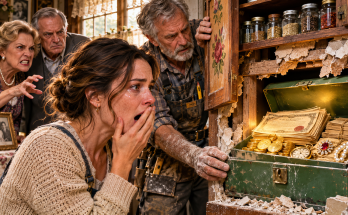
"The green box was behind there."
Mom leaned forward slightly.
She didn't get up to examine the panel.
She just looked at it.
"I still have trouble believing she did all that."
I understood.
I had experienced the same difficulty when the box was discovered.
Even now, the cabinet looked like an ordinary place to keep spices.
It was difficult to connect it with coins, bonds, trust documents, and approximately $1.9 million in valuables.
Mom turned toward me.
"Did she really intend for you to receive those things?"
I took a breath.
"The agreement explained exactly how the trust was supposed to work."
I reminded her that the arrangement concerned Grandma's grandchildren, with me named as its primary beneficiary.
The court had already confirmed the trust's validity.
I wasn't going to reopen that discussion at my kitchen table.
Mom nodded.
"I understand."
I waited.
She looked down at her hands.
"For a long time, I thought she was doing something against me."
I didn't answer immediately.
She continued.
"I thought choosing you meant she was rejecting me."
I looked at her.
That was probably one of the most revealing things she had ever said about the inheritance.
She had interpreted Grandma's decisions through what she believed they meant about her.
If Grandma protected money for somebody else, Mom saw herself losing something.
If Grandma wanted me to have the house, Mom thought she had been treated unfairly.
She hadn't been able to accept that another person could receive something without it necessarily being an insult to her.
"She was allowed to decide what happened to her property," I said.
Mom nodded.
"I know that now."
She rubbed one hand against the other.
"I don't think she was trying to punish me."
I waited for her to continue.
She looked toward the kitchen window.
"She knew what you were like."
"What do you mean?"
"She knew you'd keep helping people even when you couldn't really afford it."
I looked down.
Mom's voice became quieter.
"She wanted you to have something nobody could persuade you to give away."
I thought about Grandma's letters.
That was certainly part of what she had been trying to accomplish.
She had noticed that I struggled to refuse requests.
She knew I sometimes took on responsibilities that weren't mine.
She wanted me to become more careful about the people I allowed to influence my decisions.
Mom looked back at me.
"She understood that better than I did."
"Yes."
I didn't soften the answer.
She accepted it.
For a little while, the kitchen remained quiet.
I got up to make tea.
There were several cups on Grandma's little shelf.
I took down two and placed them beside the kettle.
Mom watched me.
"I can't believe you still have those."
"Gil saved the shelf."
She smiled.
"I used to worry I'd break one when I was younger."
I looked at the cups.
I understood that feeling.
Grandma had owned things I considered particularly precious simply because they belonged to her.
But she had never wanted anybody to be afraid of using them.
I brought the tea to the table.
Mom wrapped her hands around her cup.
We began talking about Grandma.
Not the trust.
Not the bank records.
Not the newer will.
Grandma herself.
Mom remembered how particular she could be about the ingredients she used when cooking.
She remembered her habit of correcting people's grammar in the middle of otherwise ordinary conversations.
I laughed.
"She used to do that to me, too."
"She did it to everybody."
Mom smiled.
"Even when nobody asked."
I could picture Grandma interrupting somebody at a family dinner because they had used a word incorrectly.
She never seemed embarrassed about it.
Teaching had become part of the way she interacted with the world.
Thirty-one years in a classroom had probably made the habit difficult to abandon.
Mom took a sip of tea.
Then she asked whether I remembered the money Grandma used to put inside birthday cards.
"Of course."
Usually, it was a small bill.
Enough to make a child feel wealthy for an afternoon.
Grandma liked slipping money into a card and watching the recipient discover it.
Mom laughed quietly.
"She gave me twenty dollars once."
"That was generous."
"She told me I wasn't supposed to spend more than ten."
I smiled.
"Did you listen?"
"No."
The answer came so quickly that I laughed.
Mom laughed, too.
It wasn't a careful little laugh intended to fill an uncomfortable silence.
It was genuine.
For a moment, I saw the mother I remembered from before the discovery.
The woman who could tell a funny family story without needing to defend herself.
The daughter who had once received birthday money from Helen Marsh.
I was glad that part of her still existed.
I had missed it.
But I also understood that remembering the good parts of somebody didn't eliminate the need to acknowledge the harm they had caused.
I could enjoy that moment without treating it as a complete reconciliation.
We continued talking.
Sometimes Mom remembered details I had forgotten.
Sometimes I remembered things she hadn't thought about in years.
It felt good to speak about Grandma without needing to explain why a particular memory might be relevant to a legal proceeding.
She had been more than the woman whose financial affairs we had spent months examining.
She had been funny.
Occasionally stubborn.
Very particular about numbers.
Sometimes unnecessarily concerned about the way other people expressed themselves.
She had been a teacher even when nobody was sitting in a classroom.
She had also been my grandmother.
I didn't need to defend that relationship anymore.
Nobody could take it away from me.
As the afternoon continued, Mom glanced toward the framed photograph beside the kitchen doorway.
She stood and walked over to it.
"Where did this come from?"
"Dad brought it when we had the community gathering."
She studied Grandma's face.
"That was taken a long time ago."
"The summer of 1978."
Mom nodded.
"I remember her looking like that."
I stood nearby.
She looked at the photograph for several seconds.
Then she returned to the table.
There were things I could have asked her.
About her childhood.
About her relationship with Grandma before the financial difficulties began.
About when she first started believing that her mother's savings were available to her without permission.
But I didn't want to turn the visit into another interview.
Those questions weren't necessary that afternoon.
The financial matters had been examined.
The court had reached its decisions.
Mom had acknowledged what she had done.
What happened next would depend largely on whether she continued accepting responsibility.
I didn't need another confession to understand the situation.
We finished our tea.
Eventually, Mom reached for her handbag.
"I should probably get going."
I nodded.
I walked with her toward the front door.
She stopped just before stepping outside.
"Paige?"
"Yes?"
She looked at me.
"I know things aren't the same between us."
I didn't interrupt.
"I know you still haven't forgiven me for everything."
"That's true."
She nodded slowly.
"I hope you'll be able to someday."
I took a moment before answering.
There had been a time when I would have immediately said yes.
I would have wanted to relieve the uncertainty.
I would have wanted my mother to leave believing everything would eventually be repaired.
But I didn't know that.
And I wasn't going to promise something I couldn't honestly guarantee.
"Perhaps," I said.
She looked at me.
"But I need to see that things are different over time. I can't just decide to trust you the way I used to."
"I understand."
I hoped she did.
She stepped outside.
I watched her walk toward her car.
There was no argument.
No request for money.
No accusation that I was being unreasonable.
She had come to see the house and talk about Grandma.
We had done those things.
When she drove away, I closed the door and returned to the kitchen.
The two cups were still on the table.
I carried them to the sink.
For a moment, I wondered whether I should feel more emotional about the visit.
Perhaps I should have been overwhelmed by the possibility that our relationship was improving.
Perhaps I should have been angry that we had spent an enjoyable afternoon together after everything that happened.
Instead, I felt quiet.
I washed the cups and returned them to the shelf.
Then I opened the spice cabinet.
The cinnamon jar remained exactly where it had been.
I touched the little glass container.
There had been a time when I believed preserving a family meant preserving everybody's place in my life, regardless of how they behaved.
I no longer believed that.
Mom could visit again if our relationship continued moving in a healthier direction.
Dad could continue rebuilding his relationship with me through the choices he made.
Carol could be part of the community work.
None of them needed to be permanently defined by the worst thing they had done.
But none of them were entitled to ignore those things, either.
I closed the cabinet.
I had spent years assigning people responsibilities and privileges according to their relationship with me.
Mother.
Father.
Aunt.
Family.
Those words mattered.
They just weren't enough by themselves anymore.
From that afternoon onward, I decided that the people closest to me would need to show through their conduct that they deserved the confidence I placed in them.
I was willing to recognize genuine change.
I was willing to leave room for ordinary kindness.
I was even willing to consider forgiveness.
But I was no longer willing to confuse any of those things with surrendering my judgment.