I was sitting in the garden with a cup of tea when I realized how peaceful the house had become.
There was no construction work that morning.
No one was expected to arrive with documents requiring my attention.
I didn't have a list of urgent repairs sitting beside me.
The flowers were growing, and the old fence stood straight.
I could sit outside without looking at the roof and worrying about what might happen the next time it rained.
That was still a relatively new feeling.
A year had passed since the discovery.
When I thought about the amount of change that had occurred during that time, it almost seemed longer.
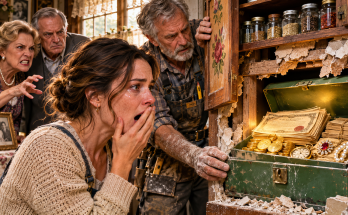
Yet there were days when I could remember the dust on my jacket as clearly as if Gil had opened the wall the previous afternoon.
I remembered the green steel box.
I remembered the discomfort of sitting across from an attorney with Grandma's envelope between us.
I remembered being afraid that whatever I learned might change how I felt about the people closest to me.
And it had.
But that morning, sitting in the garden, I wasn't thinking primarily about those things.
I was noticing the flowers.
Grandma had planted some of them years earlier.
She used to explain the differences between them when I helped her outside.
I still couldn't remember every name.
I smiled at that.
She would have considered it an indication that I needed another lesson.
I took another sip of tea.
The garden tables were empty.
They had become such familiar features of the property that it was difficult to remember the garden before Gil built them.
They were useful whenever people gathered.
They didn't need special treatment.
They could hold books, refreshments, or whatever else somebody wanted to put on them.
I liked having furniture that was intended to be used.
Grandma's final letter had changed my thinking about the whole house in that respect.
The restored rooms weren't valuable simply because they looked pleasant.
They were valuable because I could live in them.
Because other people could visit.
Because things could happen there that hadn't happened before.
The community education program had now assisted its first forty children.
Forty.
I was pleased whenever I thought about that number.
It wasn't a particularly large number compared with the number of children who needed educational assistance.
But it represented forty individual lives.
Forty children who had received some form of help with books, school materials, or learning.
Each had different circumstances.
Each had different needs.
Grandma would have understood that better than anybody.
She had spent decades working with classrooms full of children who didn't all learn the same way.
I sometimes wondered what she would have said if I could tell her about the first forty.
Knowing her, she probably would have been pleased.
Then she would have wanted to know whether we were doing everything carefully enough to continue.
That was the kind of question I tried asking myself.
I didn't want the number to become something I used to congratulate myself.
I wanted the assistance to remain useful.
The hospice support fund had also helped several families.
I was particularly grateful for that.
I knew what happened to people when the demands of caring for somebody began accumulating.
They could become so focused on getting through each day that they rarely had an opportunity to consider their own welfare.
Sometimes they felt uncomfortable accepting assistance.
Sometimes they apologized for having needs at all.
I recognized that behavior.
I had done versions of it myself.
When Grandma was alive, I rarely admitted how tired I was.
I didn't want her to feel responsible for my exhaustion.
I didn't want other people to think I was struggling with something I should have been capable of managing.
I simply continued working and helping wherever I could.
There were times when I should have asked for more support.
I understood that now.
The fund couldn't remove every responsibility from a family's life.
It couldn't make a loved one's illness less serious.
It couldn't eliminate grief.
But it could help with some practical expenses.
A journey that needed to be made.
A meal somebody didn't have the energy to prepare.
Basic supplies that cost more than a family could comfortably manage at the time.
I knew those things weren't insignificant.
When someone was exhausted, having one fewer thing to worry about could make a difference.
I wanted the assistance to be available without making people feel that they owed me something afterward.
That mattered enormously to me.
I had watched my mother confuse financial assistance with entitlement.
I had heard her explain that Grandma's previous generosity somehow justified taking additional money.
I didn't want to create relationships governed by similar expectations.
Help needed to have clear limits.
People needed to understand what it was intended to provide.
And nobody needed to pretend that accepting assistance made them permanently indebted to the person offering it.
I thought Grandma would have appreciated that distinction.
She had helped people voluntarily throughout her life.
She had also experienced the consequences when somebody stopped respecting the difference between what she offered and what they decided to take.
I wanted to learn from both parts of her experience.
As I sat in the garden, I thought about the next shift I was scheduled to work.
I hadn't left my nursing job.
That decision seemed natural to me.
I had spent nine years working in hospice care before everything changed.
It wasn't something I had chosen solely because I needed a salary.
It mattered to me.
I had learned a great deal about people through that work.
About fear.
About dignity.
About how much an ordinary gesture could mean when someone was going through an extraordinary difficulty.
I didn't want to abandon that simply because my financial circumstances had improved.
There were still days when I came home exhausted.
There were difficult conversations at work.
There were patients whose situations stayed with me long after a shift ended.
Having money available didn't change the nature of illness.
It didn't prevent families from grieving.
It didn't make every professional responsibility less demanding.
But my life outside work had changed.
I could return home without immediately calculating whether another household expense might overwhelm my savings.
I no longer felt that every additional shift needed to serve some urgent financial purpose.
I had more freedom to consider what I could reasonably manage.
That made the work feel different.
Not less important.
Less desperate.
For years, financial pressure had occupied a small part of my attention even when I was concentrating on something else.
It was there when I considered buying something for the house.
It was there when Grandma needed assistance.
It was there when an unexpected expense appeared.
Sometimes the amount involved wasn't particularly large.
But when several problems arrived together, the cumulative cost could become frightening.
Now there was room to breathe.
I was grateful for that every time I walked through the front door after work.
The house no longer greeted me with a collection of unfinished problems.
The roof was sound.
The wiring had been addressed.
The floors were repaired.
Gil had completed the final work.
I still needed to maintain the property.
An old house would always require attention.
But maintenance was different from living with the constant fear that something important might fail before I could afford to fix it.
I finally understood why Grandma had been concerned about my future.
She hadn't simply wanted me to receive something valuable.
She wanted me to possess enough security to make decisions without being cornered by circumstances.
I had never fully appreciated how much financial anxiety affected the choices I made.
I had accepted additional responsibilities because I worried about disappointing people.
I had accepted additional work because I worried about expenses.
Sometimes those worries overlapped until I couldn't tell whether I was doing something because I genuinely wanted to or because I felt I had no alternative.
Now I had opportunities to make clearer decisions.
That didn't mean I stopped helping people.
The education fund and the hospice support fund were evidence of that.
I simply wanted the help I offered to come from a decision I had made willingly.
I didn't want anybody else's expectations determining how much I was supposed to contribute.
I thought about Mom.
Our conversations had continued.
We weren't constantly discussing the past.
Sometimes we spoke about ordinary things.
Sometimes there was an awkward pause when a familiar family subject came up.
We were still learning how to talk to each other without relying on the assumptions that once governed our relationship.
I didn't know where that process would eventually lead.
I didn't need to know yet.
Her repayment obligations remained her responsibility.
Her counseling was something she needed to continue for herself.
I could recognize the progress she appeared to be making without making myself responsible for its outcome.
Dad and I had also continued rebuilding our relationship.
Slowly.
I appreciated that he seemed increasingly willing to contribute without attaching an emotional expectation to what he did.
He had helped with the fence.
He had brought the framed photograph.
He had apologized without insisting that I immediately tell him everything was forgiven.
Those things mattered.
But I still remembered the restaurant.
I remembered the figure he had mentioned while looking down at his coffee.
I remembered learning that he had known about the money long before Grandma died.
I didn't want to erase those memories.
They reminded me of why honesty mattered.
What I wanted was for the good things that happened afterward to become part of our relationship as well.
People were capable of making terrible decisions.
They were also capable of making better ones.
I had learned not to assume that the second possibility automatically followed from the first.
It needed to be demonstrated.
I could wait and observe without spending every day worrying about it.
That realization had made my life considerably calmer.
I finished my tea and carried the cup inside.
Grandma's photograph hung beside the kitchen doorway.
I paused beside it.
The woman looking out from the summer of 1978 seemed remarkably familiar despite the difference in her appearance.
I imagined her seeing the restored garden.
I imagined her examining the long tables.
She probably would have had something to say about their measurements.
I smiled.
The brass ruler was still in its wooden box.
I kept it somewhere accessible rather than locking it away with the legal papers.
It wasn't the kind of object I wanted to preserve by never touching.
It was a tool.
Grandma had wanted me to remember that tools were meant to be used.
I occasionally took it out simply because holding it reminded me of her.
The little markings brought back memories of mathematics lessons.
I used to think she made simple problems more complicated by insisting that I understand the steps involved.
As an adult, I appreciated what she was trying to accomplish.
She didn't want me to depend on somebody else telling me an answer.
She wanted me to be capable of arriving at an answer myself.
That lesson had served me far beyond school.
It had helped me recognize the importance of the original documents.
It had helped me understand why Laura insisted on establishing facts rather than accepting convenient explanations.
Now it was influencing something more ordinary.
Children participating in the tutoring program sometimes used the house and garden.
I enjoyed having them around.
Their presence made the rooms feel less connected to everything that had happened during the investigation.
They didn't look at the spice cabinet and see evidence.
They saw a kitchen.
They didn't see the table as the place where my mother admitted taking Grandma's money.
They saw somewhere they could put a worksheet.
That was exactly what I wanted.
The furniture could acquire new associations without losing the old ones.
I didn't need to choose between remembering Grandma and enjoying the house in the present.
Both were possible.
Whenever children gathered there, I thought about the final section of Grandma's letter.
She had asked me to create experiences rather than spend the rest of my life guarding hers.
I had taken that request seriously.
The educational assistance didn't need to recreate her classroom.
The house didn't need to become a formal memorial.
It could simply be a place where somebody received the help they needed.
That seemed appropriate for a woman who had spent thirty-one years teaching mathematics.
She had understood the satisfaction of seeing somebody finally comprehend something that had previously confused them.
I remembered experiencing that feeling at her kitchen table.
There would be a moment when a problem that had seemed impossible suddenly became understandable.
Grandma never made a great performance of it.
She usually just smiled and encouraged me to try another one.
She believed understanding needed practice.
I had appreciated that patience more as I grew older.
One afternoon, while I was in the kitchen, I heard a child approaching from outside.
I turned toward the doorway.
A little girl stood there holding a mathematics worksheet.
She was participating in the tutoring program.
She looked down at the paper, then back at me.
Her expression was uncertain.
I recognized it immediately.
It was probably the same expression I had worn at seven years old, sitting beside Grandma with a pencil in my hand.
The girl held up the worksheet.
"Do you know how to do fractions?"
I smiled.
"I think I can help you."
She stepped into the kitchen.
I pulled out a chair beside the old wooden table.
Then I sat down with her.