I used to believe my mother would never lie to me about money.
Especially not Grandma's money.
That belief lasted until I sat across from an attorney with an unopened envelope between us.
My grandmother's handwriting was on the front.
I recognized the way she formed the P in Paige. She always made the top loop a little bigger than necessary.
She had written my name that way on birthday cards, Christmas presents, and little notes she used to leave beside my breakfast.
Seeing it again made my throat tighten.
The attorney pushed the envelope a little closer.
"Would you like a minute before we begin?"
I nodded.
There was still plaster dust on the cuff of my jacket.
I hadn't noticed it until then.
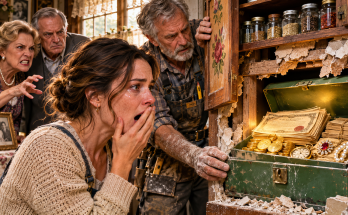
It had come from Grandma's kitchen, where Gil, the carpenter repairing the house, had uncovered something behind the old spice cabinet.
A green steel box.
Something that had been sitting inside a wall while generations of our family drank tea, ate breakfast, and celebrated birthdays a few feet away.
Inside that box were coins, bonds, other valuables, and documents that nobody had mentioned when Grandma's estate was divided.
Their preliminary estimated value was approximately $1.9 million.
I still couldn't make that number feel real.
My parents had inherited $240,000.
I had inherited a house with an unreliable roof, damaged floors, and electrical wiring that needed professional attention.
Until Gil opened that wall, I had been worried about how I would afford everything.
Now I was sitting in an attorney's office, afraid to open a letter.
"Whenever you're comfortable," he said.
"I don't think I'm going to be comfortable."
He gave me a moment.
I slid my finger beneath the flap.
There were three items inside.
I took them out carefully and arranged them on the desk.
One was a letter written by hand.
Another was a certified copy of a legal agreement.
The third carried the name Whitfield and Row.
I knew that name.
Grandma had mentioned the firm fourteen months before she died, around the same time she told me the house would eventually belong to me.
I hadn't understood why remembering the firm's name seemed so important to her.
She had been a retired mathematics teacher.
She liked precision.
If she told you something happened on a Tuesday, she usually knew which Tuesday.
If she lent someone twenty dollars, she remembered whether it had been a single bill or two tens.
I had assumed her insistence on details was simply an old professional habit.
I unfolded her handwritten letter.
It began with the words she had used on countless birthday cards.
My darling Paige,
I pressed my lips together.
Grandma had written that she expected me to discover the letter while the kitchen was being repaired.
She imagined me standing among the broken plaster, looking concerned because something had happened that I hadn't budgeted for.
That sounded exactly like her.
Even in a letter she knew I would read after her death, she had managed to tease me about worrying too much.
I smiled.
Then I cried.
The attorney quietly moved a box of tissues within my reach.
I took one and returned to the letter.
Grandma explained that the valuables had been concealed deliberately.
She hadn't been frightened of getting older.
She hadn't believed that death would somehow take away everything she had saved.
Her concern was about what might happen among the people she loved once she was no longer there to explain her decisions.
She believed money could expose qualities that families preferred not to acknowledge.
She also wrote about me.
She said she admired the way I looked after people, but she worried that I sometimes treated other people's needs as more important than my own.
That was difficult to read.
For nine years, I had worked in hospice care.
Looking after people was what I did.
At work, I helped patients through some of the hardest days of their lives.
Outside work, I had helped Grandma manage the ordinary difficulties that came with getting older.
I hadn't considered either of those things a sacrifice.
They were responsibilities I had accepted willingly.
Grandma understood that.
But she also wanted me to recognize when someone was using my willingness to help against me.
I read that section twice.
Then I reached the paragraph about my mother.
Renee.
Grandma explained that she had allowed Mom to assist with her financial affairs for several years.
She had trusted her daughter to help keep everything organized.
There was nothing surprising about that.
My mother had always been the person in our family who understood statements, insurance forms, bank accounts, and filing systems.
She knew which documents needed signatures.
She remembered renewal dates.
She could find a receipt from three years earlier without searching for more than a minute.
Whenever Grandma needed help with something financial, I felt reassured knowing Mom was involved.
It had seemed like a sensible division of responsibilities.
I looked after Grandma's physical needs.
Mom looked after the paperwork.
Grandma's next few sentences changed the meaning of that arrangement.
She had discovered transactions she couldn't account for.
There were papers concerning her finances that she didn't remember approving.
Some of the discussions about her property involved decisions she said she had never made.
I lowered the letter.
The attorney noticed immediately.
"Something troubling?"
I looked at him.
"She's talking about money being moved without her permission."
He stopped writing.
"Does she identify any particular accounts?"
"Not here."
"Keep reading, if you're able."
I looked down again.
Grandma explained that she had wanted more than suspicion before confronting anyone.
She had contacted Whitfield and Row and arranged for an independent financial investigator to examine her accounts.
The investigator had identified account activity that Grandma said she hadn't authorized.
I felt embarrassed by how surprised I was.
I should have been capable of considering the possibility that someone close to her had behaved improperly.
I had seen similar situations through my work.
Yet when it came to my own mother, I had never allowed myself to think that way.
I remembered watching Mom collect folders from Grandma's house.
Some contained bank statements.
Others held insurance records or property documents.
I had been grateful when she carried them away.
One less thing Grandma needed to worry about.
One less task for me.
That was how I had understood it.
Now I wondered what Grandma had felt when she watched those folders leave.
Had she been relieved?
Had she been suspicious?
Had she already known something was wrong?
The letter didn't answer every question.
It did make clear that Grandma wasn't asking me to hate my mother.
She wanted me to understand the circumstances that had influenced her estate planning.
She had separated her feelings about her daughter from her concerns about her finances.
I found that distinction painful.
Then I reached a sentence concerning the $240,000 my parents had received.
Grandma explained that the distribution represented only part of what she needed me to understand.
My eyes moved toward the other documents.
The attorney followed my gaze.
"Perhaps we should look at the agreement now."
I handed it to him.
He adjusted the pages and began examining them.
I watched his face instead of the document.
He didn't look shocked.
He looked concentrated.
Somehow, that made me more nervous.
The agreement had been prepared by Whitfield and Row fourteen months before Grandma's death.
He pointed out the date.
I remembered the conversation we had shared at her kitchen table around that time.
She had told me she intended for me to have the house.
I hadn't asked how much it was worth.
I hadn't asked what anyone else would receive.
I had simply imagined the familiar kitchen, the garden, and the little shelf where she kept her cups.
I loved that house.
Even before I understood what loving it would cost.
The attorney explained that the agreement established a separate trust for Grandma's grandchildren.
I was designated its principal beneficiary.
I stared at him.
"Are the things Gil found included?"
"They appear to be identified as trust property."
He showed me the relevant section.
The assets described there included the kinds of valuables that had been removed from behind the kitchen wall.
According to the documents, Grandma had transferred ownership into the trust before she died.
I tried to understand the difference.
"Wouldn't everything she owned be divided according to her will?"
"Not necessarily. Property that was properly transferred into a trust can be governed by different arrangements."
He explained that a will generally dealt with property belonging to the estate.
If the valuables had already been legally transferred elsewhere, the later will might not control them.
I needed him to explain that more than once.
Not because I couldn't understand the words.
Because the implications were so different from everything my mother had told me.
"Could my parents demand part of the money?"
"They can make a claim. That doesn't mean their claim would succeed."
He turned another page.
"We'll have to confirm the agreement, the transfer records, and the ownership of the individual assets."
There was no promise.
No congratulations.
Just a careful explanation of what needed to happen next.
I appreciated that.
I had already been given too many confident explanations about Grandma's wishes by people who apparently knew less than they claimed.
The attorney found the witness information toward the back of the agreement.
Two people had signed.
One was a retired accountant.
The other was Margaret Lewis.
I knew Margaret almost as well as I knew some members of my own family.
She and Grandma had been friends for nearly forty years.
She was someone Grandma spoke about with genuine affection.
I could easily imagine the two of them sitting together, discussing something serious over tea.
"Margaret would remember this," I said.
"Then her account may be useful when we verify the execution of the agreement."
He continued examining the signatures.
I picked up the third document.
It was correspondence from Whitfield and Row dated six weeks before Grandma died.
Six weeks.
By then, I had been painfully aware of how little time I might have left with her.
I had tried to make her comfortable.
I had paid attention to her medications, her energy levels, and whether she needed anything around the house.
Apparently, while I was concentrating on those things, Grandma was still making certain her legal arrangements were secure.
The letter confirmed that she had personally attended the firm's office.
The original trust documents remained in its possession.
There was a short handwritten instruction beneath the formal correspondence.
Grandma wanted me to remember that the importance of a home couldn't be calculated from the selling price of the building.
I touched the bottom of the page.
It was such a small note.
She had been thinking about the house.
About what I might do with it.
About whether I would look at the repairs and decide it had become too much trouble.
She understood what that place meant to me.
I wondered whether she knew how close I had come to feeling overwhelmed by it.
The attorney allowed me to finish crying before he spoke.
"We should obtain the originals directly from this firm."
I nodded.
Then I looked at the three documents together.
Something still didn't make sense.
My parents had received their inheritance through a newer will.
The attorney responsible for that will had never explained anything about Grandma's earlier trust.
I hadn't heard him mention Whitfield and Row.
I had accepted that the newer arrangements represented her final wishes.
Now I wanted to know how those arrangements had come into existence.
"Can we find out more about the attorney my parents used?"
"Certainly. Do you remember his name?"
I told him.
He made a note of it.
Then he examined some information concerning the firms and the previous professional relationships involved.
His expression changed.
"What is it?"
He chose his words carefully.
"There appears to be a connection between the firm responsible for the later will and an attorney who previously represented your mother in a financial matter."
I waited for him to explain further.
He didn't.
"Does that mean she arranged something?"
"We don't have enough evidence to say that."
I looked down at Grandma's letter.
I wanted an ordinary explanation.
I wanted somebody to tell me that the connection was harmless, that the trust had simply been overlooked, and that everything could be corrected without hurting anyone.
But I couldn't make myself ignore the dates.
Fourteen months before her death.
Six weeks before her death.
Two independent witnesses.
An investigator.
Original documents retained by a firm my parents had never mentioned.
Grandma hadn't trusted her wishes to a single piece of paper.
She had made arrangements to preserve them.
I collected the tissues beside my elbow and folded them into a small square.
I didn't know yet whether I would inherit the money.
I didn't know whether my mother had done anything wrong.
But I knew I could no longer accept her explanation without examining it myself.
I asked the attorney to help me obtain Grandma's original records.