I thought the worst part of losing my father would be the funeral.
I was wrong.
The funeral hurt because I knew I would never hear his voice again.
The reading of his will hurt for a different reason.
It made me wonder whether I had ever understood him.
My name was Daniel Carter.
Most people called me Danny.
My father, Robert Carter, had called me that since I was a little boy who couldn't tie his own fishing hooks.
He was the kind of man who kept things long after everyone else thought they should be thrown away.
Old tools.
Fishing equipment.
A coffee mug with a chipped handle.
And one particular aluminum fishing boat.
I never thought that boat would become the most important thing he left behind.
Not when I first walked into the attorney's office.
Not when I sat across from my stepmother.
And certainly not when I heard the amount of money she was getting.
Sheila sat with her handbag resting neatly on her lap.
She looked comfortable.
That bothered me more than I wanted to admit.
Dad had been gone only a short time, and I still caught myself reaching for my phone whenever something happened that I wanted to tell him.
Sheila seemed to have already accepted that life was moving forward.
Maybe that was unfair.
People grieved differently.
I kept telling myself that.
But when the attorney began reading the distribution of Dad's property, I noticed Sheila straighten in her chair.
She was listening closely.
The house went to her.
So did both cars.
She received the lake property as well.
Then came the financial inheritance.
Two million one hundred thousand dollars.
I looked down at my hands.
I had known Dad was financially comfortable, but hearing those details made the room feel strangely unfamiliar.
The attorney continued reading.
Then he reached my name.
I lifted my head.
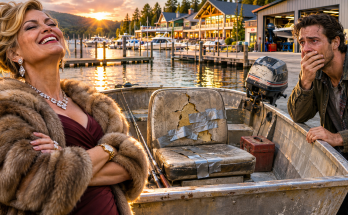
Dad had left me his 1987 aluminum fishing boat, including the motor and trailer.
That was it.
At least, that was how it sounded.
I waited for another sentence.
Another account.
Maybe some personal belongings.
But the attorney moved on.
I stared at the document in front of him.
The boat.
My entire inheritance appeared to be a boat Dad had owned for decades.
A boat with a cracked seat and a motor that complained every time someone tried to start it.
Beside me, Sheila laughed.
It wasn't a loud laugh.
That almost made it worse.
She pressed her lips together as though she were trying to hide her amusement.
Then she gave a little shake of her head.
I looked at her.
She didn't apologize.
Instead, she glanced at the attorney and then back at me.
I could tell she thought the situation was funny.
My father had given her millions.
He had given me an old fishing boat.
I wanted to ask whether Dad had really meant it.
I wanted to know whether something had been left out.
But mostly, I wanted to leave.
I had spent enough time in that office listening to a stranger describe my father's life in terms of property.
The attorney continued explaining the documents.
There was a specific hull identification number recorded beside the boat.
I noticed that because it seemed unusually detailed.
Dad could have simply written down the boat.
Instead, he had identified it precisely.
The motor.
The trailer.
The hull number.
All of it.
At the time, I assumed he was being careful.
Dad had always been careful with paperwork.
Even when he gave me a broken fishing reel as a teenager, he remembered exactly when and where he had bought it.
I didn't ask any questions.
Looking back, I wish I had.
Sheila was still smiling when we stood to leave.
I didn't want to speak to her.
But she approached me anyway.
She made a remark about Dad's old boat.
She treated it like something that would be more trouble than it was worth.
I didn't argue.
I wasn't interested in explaining why it mattered.
The truth was, I was struggling to explain that to myself.
I walked outside and sat in my truck.
For several minutes, I didn't start the engine.
I thought about all the Saturdays Dad and I had spent together.
We used to leave before sunrise.
He would bring coffee for himself and something to eat for both of us.
Sometimes the sandwiches were still cold from the refrigerator.
Sometimes he forgot the napkins.
He almost always remembered the fishing rods.
I remembered sitting on the aluminum bench while he checked the fuel line.
The boat would rock gently beside the dock.
Dad would lean over the motor and mutter something under his breath.
Then he would pull the starter again.
Sometimes it worked.
Sometimes it didn't.
He never seemed especially surprised either way.
He had owned that boat since I was young.
Over the years, he had repaired almost every part that could be repaired.
He replaced little fittings.
Tightened loose bolts.
Patched things that another man might have thrown away.
In 2003, the bench seat split badly enough that I thought we would finally need a new one.
Dad brought out a roll of silver duct tape.
He cleaned the damaged area.
Then he covered the crack.
I remember watching him smooth the tape down with his thumb.
It didn't look especially good.
But it held.
And Dad decided that was enough.
That patch was still there years later.
The edges had begun curling.
The tape had faded.
But the seat was still usable.
That was my father.
He didn't need something to look expensive before he considered it useful.
I knew that.
I had grown up knowing it.
So why had I been so hurt by the will?
Because I thought he had chosen Sheila over me.
That was the part I didn't want to admit.
I could tell myself that I didn't care about money.
I could tell myself that the boat meant more than a bank account.
But when I heard Sheila receive everything else, I felt forgotten.
And I hated that feeling.
Dad had been married to Sheila during the later years of his life.
After my mother died, I understood that he was lonely.
He had lost the woman with whom he had built his family.
He was trying to find some happiness again.
I didn't want him to spend the rest of his life alone.
But Sheila and I had never been close.
She could be polite when she wanted something.
She could be friendly when other people were watching.
But there was always something in her voice that made me feel like a visitor in my father's house.
I tried not to make things difficult.
Dad was happy, or at least he told me he was.
I accepted that.
I visited.
I called.
I kept the relationship going.
And I avoided arguing with Sheila whenever I could.
Now Dad was gone.
She had the house, the cars, the lake property, and the money.
I had the fishing boat.
I started the truck.
For a moment, I considered driving straight home.
But I couldn't stop thinking about the hull number.
The attorney had spent more time reading that number than I expected.
I remembered another thing.
Dad had left instructions concerning the boat and the marina.
There was a man there named Hank.
Hank had known Dad for years.
He knew the boat nearly as well as Dad did.
I had seen him working around the docks when I was younger.
He was the kind of person who seemed to know every engine by the sound it made.
If anyone understood why Dad had cared enough to preserve that old boat in his will, it was Hank.
I decided I would speak to him.
I didn't expect anything important to come from it.
I thought he might tell me where the trailer was stored.
Maybe explain whether the motor needed work.
Perhaps he would know why Dad had made such a strange decision.
I wanted an explanation.
Even a small one.
I didn't need the boat to be valuable.
I just needed to know that Dad hadn't forgotten me.
When the marina contacted me and asked that I bring identification, I assumed there was some paperwork to complete.
That made sense.
The boat was now legally mine.
There would probably be a transfer record.
Maybe a registration form.
I remembered being told to bring the original hull number as well.
That detail stayed in my mind.
I checked the paperwork again.
There it was.
A long identification number that seemed far too important for a boat everyone considered worthless.
I put the document inside a folder.
Then I gathered my driver's license and the other identification I might need.
The next time I drove toward the marina, I felt almost embarrassed by how much I hoped Hank might have something meaningful to tell me.
I wasn't hoping for money.
I really wasn't.
I wanted to hear that Dad had spoken about me.
That he had remembered our fishing trips.
That he had chosen the boat because he knew I would keep it.
Those were the things I kept thinking about.
The marina looked familiar when I arrived.
The docks stretched across the water.
Several boats rested in their slips.
The repair building stood where it always had.
Nothing seemed unusual.
I parked my truck and stepped outside.
The air smelled like lake water and machinery.
That smell brought back more memories than I expected.
I remembered Dad walking ahead of me with a tackle box in one hand.
I remembered trying to keep up.
I remembered the sound of his shoes on the dock.
For a moment, I almost expected to see him near the boat.
Then I remembered why I was there.
I found Hank and explained that I had come about Dad's fishing boat.
He recognized me.
His expression changed when I mentioned the will.
He asked for my identification.
I gave it to him.
Then he asked for the hull number.
I opened my folder.
He studied the number carefully.
Not casually.
Carefully.
He checked it against information he already had.
Then he looked up at me.
I noticed that he was no longer treating this like an ordinary registration transfer.
I asked whether there was a problem.
He told me there were documents I needed to see.
I followed him into the marina office.
The room was familiar enough.
A desk.
Several cabinets.
Folders and records.
A window overlooking the water.
But Hank's manner was different.
He seemed to be choosing his words.
He brought out paperwork and placed it on the desk.
I saw Dad's name.
Then I saw the hull number again.
That same long number.
I leaned forward.
Hank explained that my father had arranged for certain records to be held until I appeared with identification.
I didn't understand.
I asked why Dad would need to arrange something like that.
Hank looked at me for a moment.
He asked what I knew about my father's financial arrangements.
I told him what I knew.
The will.
Sheila's inheritance.
The boat.
Hank listened without interrupting.
When I finished, he opened another folder.
There were documents inside that didn't look like anything related to fishing.
I saw company names.
Property descriptions.
Legal references.
Dates.
I recognized a few of the locations.
They were properties around the lake.
I looked from the papers to Hank.
I asked what any of it had to do with Dad's boat.
Hank explained that my father had put special protections in place.
That word caught my attention.
Protections.
I looked at the documents again.
Dad had never been careless with his money.
He had never discussed every financial decision with me either.
But this was something I hadn't even known existed.
I asked Hank what my father had been trying to protect.
He looked toward the window.
The boat was somewhere beyond the glass.
Then he turned back to me.
He said Dad had been concerned that certain things might be taken from me before I ever understood they belonged to me.
I sat still.
I had arrived expecting a few forms.
Now I was sitting in front of documents that suggested my father had been preparing for something much more serious.
I looked down at the hull number once again.
For the first time, it didn't seem like an ordinary registration detail.
It seemed deliberate.
And I was beginning to understand that Dad had left me more questions than I knew how to ask.