The marina needed work.
That was something I understood better after spending time with Hank.
When Dad first left me the boat, I thought about its condition.
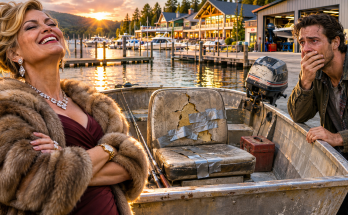
The cracked seat.
The peeling tape.
The old motor.
I knew it needed attention.
But I hadn't considered that a much larger property could have similar problems.
The marina was valuable.
The land alone represented a considerable part of the trust.
The storage buildings were worth a great deal.
The repair business had operated in town for decades.
But valuable didn't mean perfect.
Some docks had been damaged.
The repair shop was old.
There were safety improvements that needed attention.
I didn't want to ignore those things simply because the business continued operating.
Dad had left clear instructions about what he wanted.
He wanted the marina preserved.
He wanted the employees to keep working.
He wanted the repair shop to remain open.
And he wanted local families to continue using the fishing dock.
Those wishes became the center of my decisions.
I didn't want to treat the property as a collection of assets waiting to be sold.
I wanted it to remain a place people could use.
Hank understood that.
He had known Dad for years.
He had watched people come through the marina.
Some arrived in expensive boats.
Others came with old equipment that needed repairs.
Some families came simply because they wanted to spend time near the water.
Hank treated them all with the same practical kindness.
That reminded me of Dad.
I asked Hank to help me understand what improvements mattered most.
He didn't begin with anything impressive.
He talked about the docks.
He explained which areas needed attention.
He discussed the repair shop.
He pointed out equipment that had become worn.
He talked about safety measures that could be improved.
I listened.
I asked questions.
Sometimes I asked him to explain the same thing twice.
He never seemed bothered.
I appreciated that.
I had spent enough time in legal offices feeling as though I was learning a new language.
At the marina, the explanations were different.
A damaged dock was a damaged dock.
A worn piece of equipment needed replacing.
An old building needed careful maintenance.
I could understand those things.
Together with the people responsible for managing the trust, I helped move the improvements forward.
The repair shop was renovated.
We didn't close it permanently.
That was important to me.
Dad had specifically wanted it to remain operating.
The goal was to make it more useful.
Not to replace it with something that would look impressive but serve fewer people.
I thought about him often while those improvements were made.
He would have wanted to know what was being repaired.
He would have asked whether the work was necessary.
He would have wanted to understand the cost.
And he probably would have suggested fixing something himself.
I smiled whenever I imagined that.
Dad had never been impressed by spending money simply because money was available.
He liked practical decisions.
If something worked, he kept it.
If something could be repaired, he tried.
If it truly needed replacing, he wanted the replacement to last.
I tried to remember that approach.
The marina didn't need to become luxurious.
It needed to remain dependable.
Some damaged docks were replaced.
The safety equipment was improved.
The repair shop received the attention it needed.
I watched the changes carefully.
I wanted to make sure the work supported the people who used the facilities.
It was satisfying to see the improvements completed.
Not because I could point to them and say I had paid for something.
Because the marina was better prepared to continue operating.
Hank seemed pleased.
One afternoon, we stood near the repair shop.
I looked at the building.
It had served people in town for decades.
I remembered Dad talking about it.
He liked knowing there was a place where someone could bring an old motor and get help.
Now the shop could continue doing that work.
I asked Hank what he thought.
He looked around.
"Your father would have liked this."
That meant more to me than any compliment about the property value.
I nodded.
"I hope so."
Hank looked at me.
"He wanted the place to keep going."
I knew that.
It was one of the clearest instructions Dad had left.
And I was beginning to understand how much work it took to honor it.
Preserving something didn't mean leaving every part unchanged.
Sometimes preservation required repair.
Sometimes it required replacement.
Sometimes it required spending money on things no one would notice until something went wrong.
Dad had taught me that with the boat.
Now I was learning it with the marina.
I thought about the silver tape on the old seat.
He had patched it in 2003.
The repair wasn't beautiful.
But it had kept the boat usable.
That was the lesson.
Take care of what matters.
Don't wait until it falls apart.
As the improvements continued, I spent more time watching families around the fishing dock.
That was the part of the marina that mattered to me most personally.
It wasn't the most valuable property.
It wasn't the largest building.
It wasn't the part that appeared most impressive in the trust records.
It was simply a place where people could stand beside the water.
Children could learn to fish.
Parents could spend time with them.
And families could enjoy the lake without owning expensive equipment.
I remembered being one of those children.
Dad had taught me how to hold a rod.
How to prepare the line.
How to wait without constantly pulling it out of the water.
He taught me to pay attention.
He taught me that catching something wasn't the only reason to go fishing.
I hadn't appreciated those lessons when I was young.
I did now.
One afternoon, I watched a family near the dock.
The children seemed excited.
They were looking at the water.
I remembered how I used to behave.
I couldn't stand still.
I always wanted to know whether the fish were biting.
Dad would tell me to settle down.
Then he would hand me the rod.
I thought about families who might not have the money to take their children boating or fishing.
There were programs that could introduce children to those activities.
But not every family could afford them.
That bothered me.
Not because fishing was the most important thing in the world.
Because I knew what those mornings had meant to me.
I hadn't simply learned how to catch fish.
I had spent time with my father.
I had learned patience.
I had learned to pay attention.
And I had been given memories that stayed with me long after he died.
I wanted other children to have that opportunity.
I talked to Hank about the idea.
I told him I wanted to establish a small scholarship fund.
Something that could help children from families who couldn't afford boating and fishing programs.
Hank listened.
Then he smiled.
"I think your dad would have loved that."
I hoped he was right.
I didn't want the fund to be complicated.
I wanted it to be useful.
I wanted children to have access to activities they might otherwise miss.
And I wanted the marina to remain connected to local families.
Dad had asked for that.
This felt like one way to honor his wishes.
Hank helped me organize the effort.
We discussed what the fund should support.
We considered how it could be handled responsibly.
We wanted the money to serve the purpose it was intended for.
I had learned enough from the trust and the financial investigation to know that good intentions needed proper records.
I wasn't going to be careless.
Dad had spent years protecting the assets.
I wanted anything established in his memory to be handled with the same attention.
The fund took shape.
It was small compared with the value of the trust.
But that didn't make it unimportant.
I thought about the amount of money Dad had spent on our first fishing trips.
A little fuel.
Some tackle.
Coffee for himself.
Sandwiches for both of us.
The equipment wasn't expensive.
The memories were priceless.
I didn't need to build something enormous to honor that.
I needed to give children a chance to experience the water safely.
A chance to learn.
A chance to spend time with people who cared about them.
When it came time to choose a name, I didn't have to think very long.
Robert Carter.
My father.
The man who had taught me almost everything I knew about fishing.
We called it the Robert Carter Memorial Fishing Fund.
I remember seeing the name written down.
For a moment, I couldn't speak.
Dad's name looked different when it was attached to something that would continue after him.
I had seen his name on legal documents.
Bank records.
Trust paperwork.
Property information.
Those records mattered.
They established what he owned and what he intended.
But this was different.
The fund wasn't about proving he had been wealthy.
It wasn't about the millions protected by the trust.
It was about the mornings he spent with his son.
The patience he showed.
The way he made ordinary experiences feel important.
I wanted people to remember him for that.
Hank stood beside me when we discussed the name.
He looked at the words.
Then he nodded.
"That's right."
I smiled.
"I think he'd be happy."
Hank looked toward the lake.
"He would."
I thought about Dad's second letter.
He had asked me to take a child fishing someday if I had one of my own.
He wanted me to pass along the mornings we had shared.
I couldn't know what my future family would look like.
But I could help make those kinds of memories possible for other children.
That felt like a good beginning.
The fund became part of the work I cared about at the marina.
I didn't want it to be something people praised me for.
I wanted it to help families.
I wanted children to learn.
And I wanted the fishing dock to remain a place where ordinary people felt welcome.
I remembered the day I first learned about the trust.
Hank had opened a folder.
He showed me the property records.
Then he showed me my name beside the beneficiary designation.
I had stared at the figures.
Nearly nine million dollars when the arrangement began.
Approximately $10.6 million by the time I discovered it.
Those numbers had overwhelmed me.
I thought inheriting that much money would change everything.
In some ways, it had.
I had responsibilities I never expected.
I had a role in preserving businesses and property.
I could help support work that mattered to local families.
But the greatest change wasn't financial.
It was the way I thought about what Dad had left.
He hadn't wanted me to become someone who used money to measure every person.
He wanted me to remember what mattered.
I looked around the marina.
The repair shop was operating.
The docks had been improved.
The safety equipment was better.
Families continued using the fishing area.
And the old boat was still there.
I walked toward it.
The aluminum hull was familiar.
The bench still had the silver tape.
The motor was old and stubborn.
I placed my hand on the bow.
For a moment, I imagined Dad standing beside me.
He would have looked around.
He would have asked about the repairs.
He would have wanted to know whether the shop was busy.
Then he probably would have asked whether I was going fishing.
I smiled.
That was my father.
Even with all the responsibilities he had carried, he always made time for the lake.
I wanted to keep doing the same.
I stepped back from the boat.
I looked at the marina one more time.
Dad had trusted me to protect it.
I couldn't promise I would make every decision perfectly.
But I could promise to care.
And I could make sure his name remained connected to something more meaningful than a dollar amount.
The Robert Carter Memorial Fishing Fund was a beginning.
A way of giving other children a small part of what he had given me.
Time near the water.
A chance to learn.
And perhaps a memory they would carry for the rest of their lives.