One afternoon, Hank brought an old newspaper clipping into the marina office.
I was looking over the accounts when he came in.
He had a piece of paper in his hand.
It looked fragile.
The edges were worn.
The print had faded with age.
I looked up.
"What's that?"
Hank smiled.
"Something I thought you'd want to see."
He placed the clipping on the desk.
I leaned forward.
There was a photograph.
A younger man stood beside an aluminum fishing boat.
He was smiling.
I recognized him immediately.
Dad.
I picked up the clipping carefully.
He looked so young.
His face was fuller.
His expression was confident.
And the boat beside him looked almost new.
I stared at the picture.
I had seen countless photographs of Dad over the years.
Family pictures.
Holiday pictures.
Photographs from our fishing trips.
But I had never seen this one.
The newspaper clipping came from the year he purchased the boat.
The headline announced that a local man had opened a new waterfront business.
I read it slowly.
Then I looked at the photograph again.
Dad had been proud.
I could see it in his face.
He wasn't standing in front of an expensive office.
He wasn't posing beside a luxury car.
He was beside an aluminum boat.
The same boat that Sheila later called worthless.
I laughed softly.
"Look at him."
Hank smiled.
"He was excited about that boat."
I nodded.
"He always said buying it was one of the best decisions he ever made."
Hank looked at the clipping.
"He meant it."
I ran my finger near the edge of the photograph.
I didn't want to touch the printed image too much.
The paper was old.
But I wanted to hold it closer.
Dad had been young when the picture was taken.
He had plans.
He had energy.
He had a future he couldn't yet see.
He probably never imagined that the boat would one day become the center of a complicated inheritance.
He couldn't have known about Sheila.
He couldn't have known about the trust he would establish in 2019.
He couldn't have known that his son would someday sit in the marina office trying to understand why an old hull number mattered.
But he knew he liked the boat.
And he knew he wanted to be on the water.
I looked at Hank.
"Did he talk about those early days much?"
Hank thought for a moment.
"He talked about the boat."
I smiled.
"That sounds right."
Hank nodded.
"He liked what it gave him."
I looked at the photograph again.
The boat had been new once.
The aluminum hull was cleaner.
The seat wasn't cracked.
The motor probably started more easily.
I wondered whether Dad had imagined replacing it someday.
Maybe he had looked at larger boats.
Maybe he had admired newer engines.
But he never gave up the old one.
I used to think he was simply stubborn.
He didn't like throwing things away.
He repaired everything.
He kept tools long after they looked useful.
He used the same chipped coffee mug until it finally broke.
The boat fit that pattern.
But now I saw another reason.
It had been part of his life for decades.
He had built memories around it.
He had taken my mother onto the lake.
He had taken me fishing when I was young.
He had watched me learn.
Make mistakes.
Fall into the water.
Catch my first fish.
Ask questions about my future.
The boat had been there through all of it.
And when Dad became worried about his financial affairs, he found a way to connect that familiar object to the records he wanted me to discover.
I looked at the newspaper clipping.
The man in the photograph couldn't have known how important that boat would become.
But he had been right to value it.
I thanked Hank.
He shrugged.
"I figured it belonged with you."
I nodded.
"It does."
I looked toward the window.
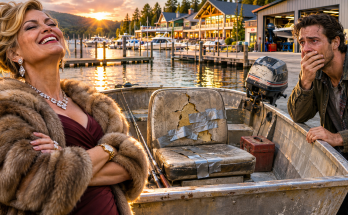
The old boat was tied to the dock.
Its aluminum sides looked worn.
The motor was still the same stubborn machine.
The cracked bench remained covered with silver duct tape.
I thought about the difference between the two pictures.
The newspaper photograph showed the beginning.
The photograph Hank had given me after Dad's death showed him much later in life.
He wore his fishing jacket.
He held a coffee mug.
The boat stood behind him.
Both pictures showed the same man.
Both showed the same boat.
But so many years separated them.
I felt the weight of that time.
I had been part of it.
I had spent Saturdays beside him.
I had watched him grow older.
I had complained about the boat.
I had asked why he wouldn't replace it.
Now I wished I could take back those complaints.
Not because they had hurt him.
He usually laughed.
But because I hadn't understood how much the boat meant.
I looked at Hank.
"I want to keep this."
He smiled.
"That's why I brought it."
I decided to frame the clipping.
I didn't want it folded in a drawer.
I didn't want the paper damaged.
I wanted people who visited the marina office to see Dad as he had been when he started building his waterfront business.
Not simply as a wealthy man.
Not as the person whose trust had been valued at millions.
But as someone who loved the lake.
Someone who believed a small boat could be worth the money he spent on it.
Someone who built a life around things other people might overlook.
When the clipping was framed, I placed it in the marina office.
I stood back and looked at it.
The photograph was small.
The newspaper print was old.
But it felt right.
I could picture Dad standing there when he was younger.
Proud of his boat.
Proud of the business he was building.
I wanted the display to honor him without making him seem like someone he wasn't.
He had never liked being treated as important because of money.
He didn't need a grand monument.
He would probably have been embarrassed by anything too elaborate.
I decided a small plaque was enough.
It would carry his name.
Robert Carter.
And it would remember him as a father, a fisherman, and a man who understood that valuable things weren't always obvious.
I looked at those words.
They were simple.
That was how I wanted them.
Hank stood beside me when the display was finished.
He studied the clipping.
Then he looked at the plaque.
I waited.
He smiled.
"Your dad would have liked that."
I laughed softly.
"He probably would have told me it was too much."
Hank nodded.
"Probably."
We both laughed.
For a moment, I could almost hear Dad joining us.
I looked at the young man in the photograph.
He had no idea what was coming.
Marriage.
Fatherhood.
Loss.
Another marriage.
Financial worries.
The trust.
The final letters.
A life could contain so much.
And one photograph could capture only a tiny part.
I was glad Hank had found it.
I had spent years remembering Dad as an older man.
A man who wore the same fishing jacket.
A man who complained about his motor.
A man who was sometimes tired.
Sometimes worried.
Sometimes quiet.
The clipping reminded me that he had once been young.
He had made plans.
He had taken chances.
He had built things.
And he had been proud of a little aluminum boat.
I stood there for a long time.
Then I returned to the accounts.
There was work to do.
The marina needed attention.
The repair shop continued serving customers.
The storage buildings and waterfront property remained part of the trust.
The Robert Carter Memorial Fishing Fund had been established.
There were responsibilities that didn't disappear because I felt sentimental.
I understood that.
Dad had always known how to move between work and ordinary life.
He could spend hours dealing with business.
Then he would put everything aside and go fishing.
I wanted to learn that balance.
I didn't want to let managing the trust consume every part of my life.
And I didn't want to treat the marina simply as a financial investment.
It was a place where people worked.
Where families spent time.
Where children learned to fish.
Where I had made some of my favorite memories.
That mattered.
A few days later, I was in the marina office when someone noticed the old clipping.
The person looked at the photograph.
Then at the plaque.
I explained that it showed my father.
He had purchased the boat years earlier.
The photograph came from the time he opened his waterfront business.
The person looked toward the window.
The old aluminum boat was visible near the dock.
I could see the question forming.
Why would someone keep such an old boat when there were newer ones available?
I smiled.
I had heard versions of that question before.
Sometimes people asked politely.
Sometimes they laughed.
Sometimes they assumed I simply didn't want to spend money.
I had learned not to take offense.
Not everyone knew the story.
And not everyone needed to.
When people asked why I still used the boat, I gave them a simple answer.
"It was my father's."
Usually, that was enough.
Most people understood immediately.
They had something similar in their own lives.
An old watch.
A photograph.
A piece of furniture.
A tool.
Something that might not be worth much to a stranger but carried years of memory.
Other people didn't understand.
That was fine.
I no longer felt responsible for changing their minds.
I remembered Sheila.
She had laughed at the boat because she looked at its age and condition.
She thought Dad had given me something worthless.
For a while, I had felt the same way.
Now I understood how little the opinions of strangers mattered.
The boat didn't need to impress anyone.
It didn't need a new paint job to become valuable.
It didn't need an expensive motor.
It didn't need to look like the boats tied nearby.
It had belonged to Dad.
That was enough.
One afternoon, I went down to the dock.
I stood beside it.
The bench seat was still patched.
I thought about replacing it.
The tape was peeling more than before.
It wouldn't last forever.
I knew that.
But I wasn't ready.
I touched the edge of the silver patch.
Dad had put it there in 2003.
I remembered watching him smooth it down.
I remembered telling him we should buy a new seat.
He had ignored my complaint.
The boat still worked.
That was what mattered to him.
I smiled.
Maybe someday I would replace the seat.
Maybe the motor would eventually need work that couldn't be avoided.
I would take care of the boat properly.
But I didn't need to change it simply because it looked old.
I looked across the lake.
The water was calm.
I imagined Dad steering toward the northern shore.
I imagined the sound of his voice.
The way he would complain if I forgot the sandwiches.
The way he would laugh when the motor finally started.
I missed him.
I always would.
But the sadness had changed.
It no longer made every memory painful.
Sometimes it made me grateful.
I had been lucky.
I had a father who spent time with me.
He taught me things I didn't appreciate until I was older.
He made mistakes.
He kept secrets.
He hurt me without meaning to.
But he also loved me.
And he made sure I knew it before I had to spend the rest of my life wondering.
I returned to the office.
The newspaper clipping hung on the wall.
I looked at it again.
The younger Dad smiled beside his boat.
I wondered what he would think of the marina now.
The repaired docks.
The improved safety equipment.
The renovated repair shop.
The fishing fund carrying his name.
I hoped he would be proud.
Not because I had inherited millions.
Because I had tried to preserve what mattered to him.
I sat down at the desk.
The framed photograph was visible from my chair.
So was the lake.
I thought about how strange life could be.
A woman had laughed because my inheritance appeared to be an old boat.
A marina manager had asked me to bring identification.
An attorney had opened folders explaining a trust worth more than ten million dollars.
And in the end, the thing I most wanted to preserve was still the boat.
The same old boat.
The same patched seat.
The same stubborn motor.
I smiled.
Dad had known something I needed years to learn.
The best things weren't always the things that looked impressive.
Sometimes they were the things you kept because you couldn't imagine letting them go.