The last time someone laughed at Dad's boat, I didn't feel embarrassed.
That was how I knew something had changed.
It was a Saturday morning.
The air was cold.
A thin layer of mist rested over the lake.
I arrived at the marina early.
The docks were quiet.
The repair shop hadn't yet become busy.
I parked my truck and looked toward the water.
Dad's boat was still tied where I kept it.
The aluminum hull looked pale in the morning light.
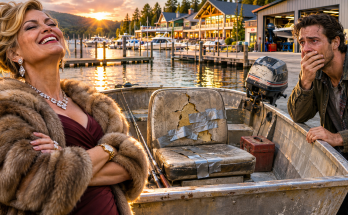
The seat was still patched with silver duct tape.
The motor was old.
And the boat was exactly where I wanted it.
I carried my equipment toward the dock.
I had brought two coffees.
Two sandwiches.
And an extra fishing rod.
That had become a habit.
I knew I wouldn't need everything.
There was no one waiting to join me.
But I still packed the way Dad and I used to.
Some habits were difficult to change.
Others I didn't want to change.
I placed the equipment inside the boat.
Then I checked the motor.
I looked over the fuel line.
I made sure everything was ready.
Dad would have done the same.
I smiled at the thought.
He had always insisted that we prepare carefully before leaving the dock.
I used to complain.
I wanted to get onto the water.
He would tell me we could start fishing once the boat was ready.
I understood that better now.
I climbed aboard.
The bench felt familiar beneath me.
I looked at the silver tape.
Its edges were curling again.
I ran my fingers across it.
Dad had repaired the seat in 2003.
I could still remember watching him.
He had smoothed the tape with his thumb.
I had wanted a new seat.
He had decided the old one was good enough.
Years later, I was still sitting on it.
I placed the extra fishing rod across the empty space beside me.
For a moment, I looked at it.
I knew Dad wasn't coming.
I knew no one would sit there.
But I liked having the rod beside me.
It reminded me of the mornings when we prepared the boat together.
I picked up one of the coffee cups.
The other stood nearby.
I thought about the first Saturday in April after his death.
Hank had been waiting with two coffees.
I had been nervous.
I didn't know whether I could take the boat out without Dad.
But I had done it.
The motor started after several attempts.
I reached our usual fishing spot.
I caught one small bass.
And I returned to the marina feeling closer to my father than I had felt in months.
I remembered that morning now.
I smiled.
Then I started the motor.
It sputtered.
I waited.
I tried again.
The engine caught.
That familiar rattling sound filled the air.
I laughed.
"Still stubborn."
I guided the boat away from the dock.
The lake opened in front of me.
The mist moved slowly across the water.
The morning was quiet.
I headed toward our favorite spot near the northern shore.
I didn't hurry.
Dad never hurried when he was on the lake.
He liked looking at the water.
He liked the early light.
He liked listening to the motor.
And he liked knowing we had the morning to ourselves.
I followed the same route.
Past the marina.
Across the familiar stretch of water.
Toward the place where he taught me to cast a line.
I reached the spot and stopped.
The lake was calm.
I picked up my fishing rod.
Then I looked at the empty seat.
The extra rod was still resting there.
For a moment, I imagined Dad sitting beside me.
He would have asked whether I remembered the sandwiches.
He would have checked his line.
Then he would have told me not to keep moving around.
I smiled.
I cast my line into the water.
Then I waited.
The morning passed slowly.
I didn't mind.
I had learned that a quiet fishing trip didn't need a large catch to be worthwhile.
Dad had spent years trying to teach me that.
I was finally old enough to understand.
I drank my coffee.
I looked across the lake.
I thought about my mother.
Her Sunday pancakes.
Dad burning the toast.
The laughter that used to fill our kitchen.
I thought about Aunt Margaret.
The way she had helped Dad verify information from my mother's past.
I remembered Mr. Pruitt explaining why the March 14, 2022 documents mattered.
I thought about the trust.
The commercial marina.
The three waterfront storage buildings.
The land near the northern entrance.
The repair business.
The investments.
All the property Dad had protected.
I remembered the valuation.
Approximately $10.6 million.
That number had once seemed impossible.
Now it was part of the life I was responsible for managing.
The trust continued operating.
The marina remained open.
The repair shop had been renovated.
Damaged docks had been replaced.
Safety equipment had been improved.
The employees still had their jobs.
Families still came to fish.
And the Robert Carter Memorial Fishing Fund was helping make boating and fishing programs accessible to children whose families couldn't easily afford them.
Those were the things I was proud of.
Not simply the amount of money.
The way it was being used.
I thought about Sheila.
It had been a long time since I felt the need to argue with her.
She had received what Dad left her.
The house.
Both cars.
The lake property.
And $2.1 million.
She later sold the lake property.
The house was eventually sold too.
She moved to another town.
I never asked why.
I didn't need to.
The settlement concerning the disputed funds had been reached.
Sheila had agreed to repay a portion of the money established as improperly transferred.
Richard had been required to cooperate with the investigation.
The remaining matters had been left to the proper authorities.
I hadn't used the trust to threaten anyone.
I hadn't tried to take Sheila's inheritance away.
And I hadn't spent years trying to make her admit she had been wrong.
That mattered to me.
Dad had asked me not to let anger shape the rest of my life.
I wanted to honor that.
I looked down at my fishing rod.
The line was still.
I smiled.
Dad would have told me to be patient.
I waited a little longer.
Then I checked the time.
The sun was higher now.
I had been on the lake for several hours.
It was time to head back.
I secured the equipment.
Then I started the motor.
It rattled.
I laughed.
The boat turned toward the marina.
I looked at the empty seat one more time.
The extra rod lay across it.
The second coffee had gone cold.
The sandwiches were still there.
I knew nobody had used them.
But I didn't regret bringing them.
Some things were worth doing because of what they helped me remember.
I guided the boat across the lake.
The mist had disappeared.
The water reflected the morning light.
I felt peaceful.
Not because everything in my life was perfect.
It wasn't.
I still missed Dad.
I still wished he had told me about the trust while he was alive.
I still wished we could have talked about Sheila.
I still wished I could ask him whether he was proud of what I had done with the marina.
But I had learned to live without those answers.
I had his letters.
I had his photographs.
I had the boat.
And I had the memories.
When I reached the marina, I slowed down.
I guided the boat toward the dock.
I secured it carefully.
Then I shut off the motor.
The familiar rattling stopped.
For a moment, I stood in the quiet.
Then I began unloading my equipment.
That's when I noticed a little boy standing nearby with his father.
The boy was looking at my boat.
He couldn't have been very old.
He pointed toward the aluminum hull.
"Why is that boat so old?"
I smiled.
Before I could answer, his father laughed.
He suggested that maybe I couldn't afford a newer one.
I looked at the boat.
The cracked seat.
The peeling tape.
The rust stain near the motor.
I understood why someone might think that.
Years earlier, the comment would have embarrassed me.
I would have felt the need to explain myself.
I might have mentioned the marina.
The trust.
The money.
I might have wanted to prove I could afford a new boat.
But standing there that morning, I didn't feel any of those things.
I simply smiled.
Then I walked closer.
I told the boy that the boat was one of the most important things I owned.
He looked surprised.
"That one?"
I nodded.
"That one."
He studied the boat again.
I could see he didn't understand.
"Why?"
I crouched beside him.
I told him it had belonged to someone I loved very much.
He looked toward the aluminum hull.
"Was he a fisherman?"
I smiled.
"The best one I ever knew."
The boy's eyes widened slightly.
"Did he catch big fish?"
I laughed.
"Sometimes."
Then I looked toward the empty seat.
"But he was even better at teaching."
The boy smiled.
I could tell he was trying to imagine the man I was describing.
I thought about Dad.
His old jacket.
His coffee mug.
His patience.
The way he helped me untangle fishing line.
The way he pulled me out of the water when I was twelve.
The way he laughed when I caught a fish too small to impress anyone.
I wished the boy could have met him.
I think Dad would have liked him.
The boy looked back at the boat.
He didn't ask about the motor.
He didn't ask how much it cost.
He seemed satisfied with my explanation.
His father stepped closer.
He apologized for what he had said.
I shook my head.
"It's all right."
And I meant it.
I wasn't offended.
Not everyone could know the story behind an old boat.
I had spent years learning it myself.
The father and son walked away.
I watched them for a moment.
The boy stayed close to his father.
I thought about the Saturdays Dad and I had shared.
Then I looked at the boat.
I placed my hand on the aluminum bow.
The metal was warm.
I smiled.
I no longer needed strangers to understand why I kept it.
I knew.
That was enough.
I finished unloading the equipment.
Then I went to the marina office.
The old newspaper clipping was hanging on the wall.
It showed Dad standing beside the boat when it was new.
The headline announced the opening of his waterfront business.
Beneath it was the small plaque honoring Robert Carter.
A father.
A fisherman.
A man who understood that valuable things weren't always obvious.
I stood in front of it.
I remembered Hank bringing me the clipping.
He had found it while we were reviewing the marina accounts.
I had laughed when I saw how young Dad looked.
Then we framed it.
I wanted people to remember him for more than the property he owned.
That was why the display mattered.
I looked toward the window.
The boat was visible at the dock.
The same boat from the photograph.
Older now.
Worn.
Still useful.
I sat at the desk.
Inside one drawer, I kept a copy of Dad's will.
I took it out.
The document looked ordinary.
I had read it many times.
But I hadn't looked at the inheritance section for a while.
I opened it carefully.
Sheila's inheritance was listed.
The house.
Both cars.
The lake property.
And $2.1 million.
Then came my name.
Daniel Carter.
The 1987 aluminum fishing boat.
Motor and trailer included.
The hull identification number was recorded.
I stared at that number.
It had seemed like an unnecessary detail when I first heard the will read.
I remembered sitting in the attorney's office.
Waiting for another sentence.
Waiting for something that would show Dad hadn't forgotten me.
Then Sheila laughed.
I remembered how small I felt.
I had been grieving.
I was already struggling with the fact that Dad was gone.
And in that moment, I believed he had given everything important to someone else.
I closed my eyes.
I wished I could tell that version of myself what I knew now.
Dad hadn't forgotten me.
He had arranged something more complicated than I could have imagined.
He had established a private holding trust in 2019.
He had transferred the waterfront assets into it before his death.
He had connected the original records to the boat's hull identification number.
He had named me as the beneficiary.
He had left instructions for Hank.
And he had arranged for Mr. Pruitt to explain the legal documents.
The boat had led me to the trust.
But it had also led me back to Dad.
That was the part I valued most.
I looked at the will again.
Sheila had received an enormous inheritance.
I didn't deny that.
She had walked out of the attorney's office believing she had received everything important.
She had looked at the boat and laughed.
But she hadn't asked why Dad had recorded the hull number so carefully.
She hadn't asked why he wanted me to speak with Hank.
She hadn't understood that Dad had been preparing for the future long before his death.
And she hadn't understood what the boat represented.
Neither had I.
Not at first.
I thought about that.
I had judged Dad too quickly.
I had looked at the will and assumed the worst.
I had believed the size of my inheritance reflected how much he loved me.
That was my mistake.
Dad had made mistakes too.
He had trusted Sheila when he should have questioned things sooner.
He had kept secrets.
He had allowed me to feel hurt without knowing why.
But he had also tried to make things right.
He had protected the assets.
He had written the letters.
And he had made sure I would eventually learn the truth.
I put the will back in the drawer.
I didn't need to read it again.
It had once felt like evidence that Dad had chosen someone else over me.
Now I understood it as one part of a much larger story.
I had the marina.
I had the businesses.
I had the land and investments held through the trust.
I had the responsibility of preserving the place Dad loved.
But I also had something money couldn't replace.
I had the Saturdays.
The quiet mornings.
The lessons.
The laughter.
I looked around the office.
The repair shop was operating.
The docks had been improved.
The employees were working.
The fishing fund carried Dad's name.
And families still came to the water.
I felt proud of that.
Not because I had become wealthy.
Because I had tried to use what Dad left me in a way he would have respected.
I opened the drawer again.
This time, I took out his photograph.
The one Hank had given me.
Dad stood beside the boat wearing his old fishing jacket.
He held a coffee mug.
He was smiling.
I placed it beside the window overlooking the lake.
The afternoon light was beginning to soften.
The water looked gold.
I stood there for a moment.
I remembered all the things I wished I could say to him.
I wished I could tell him about the first Saturday in April.
About the little bass.
About Hank laughing at the size of it.
About the repair shop.
The improved docks.
The fishing fund.
The children who would have opportunities because of the money he protected.
I wished I could tell him I had finally stopped worrying about Sheila.
That I no longer needed her approval.
That I understood why he had wanted me to protect the marina.
And that I was trying to become the kind of man he hoped I would be.
I looked at his face.
Then I spoke quietly.
"Thank you, Dad."
Those were the only words I needed.
I stood beside the window a little longer.
Then I turned off the office lights.
Outside, the old boat was still tied to the dock.
Its seat was cracked.
The silver tape was peeling.
The motor would probably complain the next time I started it.
I smiled at the thought.
I knew I would take it out again.
When the weather was good.
When I had a free Saturday.
When I wanted to spend a morning remembering the man who taught me how to fish.
I didn't need a reason more complicated than that.
As I walked toward the door, I looked back at the photograph.
Dad was still smiling.
I thought about the day Sheila laughed at my inheritance.
She had seen an old boat and assumed it was worthless.
I had almost believed her.
Now I knew better.
She had inherited $2.1 million and the property Dad intended for her.
I had inherited a fishing boat connected to a trust worth far more.
But the final value of my inheritance wasn't the number Mr. Pruitt had shown me.
It wasn't the marina's appraisal.
It wasn't the storage buildings or the waterfront land.
Those things mattered.
I would protect them.
I would continue honoring Dad's wishes.
But the most valuable part had been there all along.
In the cracked seat.
In the stubborn motor.
In the mornings when Dad and I sat together watching the water.
I had spent months learning what the boat was worth.
It took me much longer to understand why Dad wanted me to keep it.
I closed the office door.
Then I walked toward my truck.
The lake was quiet behind me.
The boat remained at the dock.
And for the first time, I didn't feel that my father's death had left me with an unfinished argument.
He had made his choice.
I understood it.
And I was at peace.
The End
Read more original stories on lastestdrama.