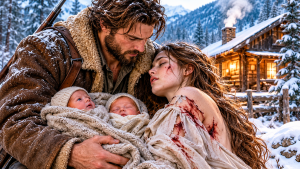
I knew there was blood in the snow before I saw the woman.
The wind carried the smell to me.
Sharp.
Metallic.
Wrong.
I stopped beneath the last line of aspens, one gloved hand resting on the strap of my rifle, and stared across the frozen plain.
A storm was coming down from the mountains.
The sky had turned the color of old iron.
Snow moved sideways across the open ground, racing in thin white sheets.
Another hour and every track on that plain would be gone.
So would anything lying in it.
At first, I thought the shape near the trees was a dead deer.
Then I saw the dress.
I started running.
She was half buried in a drift, lying on her side with her knees drawn up.
Her hair was frozen against her cheek.
One hand was tucked beneath her body.
Her back—
God.
I had seen what whips could do.
I had seen men beaten in mining camps and soldiers opened by bullets.
This was different.
Someone had taken time with her.
The back of her dress had been torn apart.
Beneath it, her skin was striped with wounds, some already crusted dark and others still bleeding where the cold had cracked them open.
It had not been a beating delivered in rage.
It had been punishment.
That was what made my stomach turn.
Somebody had wanted her to remember every stroke.
Maybe they had wanted other people to remember too.
I knelt.
“Ma’am?”
Nothing.
I touched two fingers beneath her jaw.
There.
A pulse.
So faint I almost imagined it.
Then something moved beneath her arm.
I froze.
A tiny sound came from inside the rags gathered against her chest.
Not a cry.
Barely a breath.
I pulled the cloth aside.
A baby stared up at me.
A little girl.
Her lips were turning blue.
And underneath her—
another baby.
For a second I simply stared.
Twins.
Two newborn girls wrapped together in torn cloth while their mother had curled herself around them like a human wall against the storm.
“Lord Almighty.”
I did not pray much in those days.
The mountains had cured me of expecting answers.
But I remember saying those words.
I remember them because the woman moved.
Her fingers tightened weakly around the babies.
Even unconscious, she would not let me take them.
“I’m helping,” I told her.
Maybe I was talking to myself.
Maybe to her.
Maybe to whatever part of her was still fighting.
“I’m not taking them from you.”
Her grip loosened.
I stripped off my shearling coat and opened my shirt beneath it.
I tucked one baby against my chest, then the other, skin to skin, and buttoned the coat over all three of us.
One of them moved.
The other did not.
“Come on, little one.”
I rubbed her through the cloth.
“Don’t you quit.”
A breath touched my chest.
Weak.
But there.
Then I lifted their mother.
She weighed almost nothing.
That frightened me more than the blood.
A grown woman should not have felt that light in my arms.
Behind me, somewhere among the trees, a wolf howled.
I turned toward the mountains.
My cabin stood less than two miles away.
On a summer morning, it was an easy walk.
That day it felt like crossing the whole territory.
The wind hit me broadside.
Snow filled my beard.
My boots sank nearly to the knee.
Every dozen steps I looked down to make sure the woman’s face was not disappearing beneath the white.
Inside my coat, the babies barely moved.
“Stay with me,” I muttered.
I did not know their names.
I did not know hers.
I only knew three people had been thrown into the snow to die.
And I had buried enough people.
I was done burying.
By the time I saw smoke from my chimney, I could no longer feel my hands.
I kicked open the cabin door.
Heat from the banked hearth struck my face.
I laid the woman on blankets beside the fire and opened my coat.
One baby whimpered.
The sound nearly brought me to my knees.
The second followed.
“That’s right.”
My voice broke.
I cleared my throat.
“Make all the noise you want.”
I had no cradle.
No milk.
No experience with newborns.
What I had was a warm cabin, goat’s milk, clean cloth, firewood, and the stubbornness to keep trying until something worked.
For the next hours, that was enough.
I warmed the babies slowly.
I fed them drops of diluted milk from the corner of a clean rag, terrified I would choke them.
Then I turned to their mother.
Cleaning her wounds took most of the night.
She never woke.
Once, when warm water touched the deepest lash across her shoulders, she cried out.
I pulled my hand away.
“Sorry.”
Her eyes stayed closed.
I waited.
Then continued.
By midnight she was burning with fever.
By dawn I was certain she would die.
But morning passed.
Then another night.
She stayed.
So did the girls.
For three days, my cabin became a place measured in breaths.
The woman’s.
The first baby’s.
The second baby’s.
I slept in a chair beside the hearth with my rifle across my knees.
On the fourth morning, I heard a voice.
“Girls?”
I woke so fast the rifle nearly hit the floor.
Her eyes were open.
Dark eyes.
Terrified eyes.
She tried to rise.
“Easy.”
“My babies.”
“They’re here.”
“Girls?”
“Both.”
Her eyes found the wool-lined crate beside the hearth.
I had divided it with a folded blanket so the babies would not roll against each other.
The moment she saw them, her whole face collapsed.
She covered her mouth.
A sob escaped anyway.
“Both?”
“Both.”
She started crying.
Not loudly.
That would have been easier to hear.
She cried like someone who had learned that even grief had to be quiet.
I poured water into a cup.
“You need this.”
She looked at me then.
Really looked.
Her fear returned.
“Who are you?”
“Elias Vance.”
Her gaze moved to the rifle.
Then the door.
Then back to the babies.
“I won’t hurt you.”
Her lips trembled.
“Where am I?”
“My cabin.”
“How long?”
“Four days.”
She went pale.
“They’ll come.”
“Who?”
She did not answer.
She tried to stand.
Pain stopped her before I did.
I caught her shoulders as her knees folded.
“No.”
“I have to leave.”
“You’ll die.”
“If they find me here—”
“Who?”
She looked toward the cradle.
That was when I understood.
She was not afraid for herself.
She was afraid that whoever had nearly killed her would finish the job with those babies.
I crouched so we were eye to eye.
“Listen to me.”
She stared at me.
“You’re not going anywhere today.”
Her fear sharpened.
I heard how the words sounded and changed them.
“You can leave when you’re strong enough.
I won’t stop you.
But until you can walk through that door without falling, you’ll live with me.”
She swallowed.
“And my daughters?”
I looked at the cradle.
“They stay with you.”
Something changed in her face.
Only slightly.
But I saw it.
No one had said that to her before.
No one had treated those children as though they naturally belonged at their mother’s side.
“What are their names?”
I asked.
Her eyes filled again.
“Rose.”
She pointed weakly.
“And Lily.”
I nodded.
“Rose and Lily.”
She closed her eyes.
“And you?”
“Ara.”
“Ara what?”
Her eyes opened.
“Ara Whitmore.”
The name meant nothing to me then.
Later, I would learn there were men willing to cross a mountain in winter because of that name.
But that morning, Ara Whitmore was only a wounded woman in my bed.
And when I asked who had whipped her, she whispered the answer.
“My husband.”
Outside, snow struck the windows.
Inside, something cold settled into my bones.
“What did you do?”
Her expression told me I had asked the wrong question.
Then she looked at the twins.
“I gave him daughters.”
Chapter 2: THE WOMAN THEY CALLED CURSED
Ara did not tell me everything at once.
Truth rarely comes out clean when fear has lived with it too long.
It came in pieces.
A sentence while I changed her bandages.
A name when she woke from a nightmare.
A memory while feeding Rose.
A confession spoken to the fire because looking at me made it too difficult.
Her husband was Silas Whitmore.
He owned a cattle spread east of the ridge and enough grazing land that men in the nearest settlement called him important.
He wanted a son.
Not merely wanted.
Expected.
Ara had been reminded of that expectation from the day she married him.
“A Whitmore boy,” Silas used to tell her, “will inherit everything I built.”
When her belly grew large enough that neighbors started guessing the child would be strong, Silas bought a small silver-handled knife.
For his son, he said.
His first gift.
Ara told me this while Rose slept against her breast.
She touched one finger to her daughter’s cheek.
“When the midwife said there were two babies, he laughed.”
I sat across the room repairing a harness.
“He thought it meant two boys?”
She nodded.
“Then Rose came.”
Her voice changed.
“And the midwife said, ‘A beautiful girl.’”
Ara looked down.
“He stopped smiling.”
Then Lily was born.
Another girl.
Silas stared at the two newborns and said one word.
“Curse.”
There had been people in the room.
His sister.
Two ranch hands’ wives.
The midwife.
Neighbors waiting downstairs.
Not one challenged him.
That part seemed to hurt Ara almost as badly as what came afterward.
Silas would not hold the twins.
He would not allow the knife he had purchased for his imaginary son to remain in the nursery.
By evening he was drinking.
By morning he was telling people Ara had shamed him.
I put the harness aside.
“A woman doesn’t choose whether a child is a boy or girl.”
“I know.”
“Then why did they believe him?”
Ara gave me a tired look.
“Because he owned their wages.
Their houses.
Their debts.”
That I understood.
Cruel men rarely rule through strength alone.
They rule through all the decent people who decide survival requires silence.
“What happened after?”
She hesitated.
Then told me.
Silas demanded that the girls be sent away.
Ara refused.
He told her he could find a family farther east.
She refused again.
He threatened to do it without her permission.
So Ara locked herself inside the nursery.
That night, Silas broke down the door.
The next morning, he dragged her outside.
Several people watched.
“He said I had defied my husband and humiliated his name.”
Her hands began trembling.
I stood.
“That’s enough.”
“No.”
She looked at me.
“If you know part of it, you should know all.”
So I sat again.
Silas had her tied to a hitching rail.
Then he whipped her.
He told everyone watching that disobedience spread if it was not corrected.
Ara stopped counting after the eighth stroke.
When she woke, she was in the back of a wagon.
The twins were beside her.
Silas was driving.
“Where did he say he was taking you?”
“He didn’t.”
She closed her eyes.
“But I knew.”
He drove toward the mountain.
Far from settlements.
Far from witnesses.
He stopped near the aspens.
He pulled Ara from the wagon.
Then he placed the babies beside her.
“He said nobody would look for us.”
My hands tightened.
Ara continued.
“He told me people would believe I ran away because I was ashamed.”
“Then he left?”
“Yes.”
“With newborn babies?”
“Yes.”
“In a storm?”
“Yes.”
Each answer made my anger quieter.
That is the dangerous kind of anger.
The loud kind passes.
The quiet kind starts making decisions.
Ara must have seen something in my face.
“Elias.”
I looked at her.
“Don’t.”
“Don’t what?”
“Go after him.”
“I didn’t say I would.”
“You didn’t have to.”
I stood and added wood to the stove.
“He tried to kill three people.”
“And he has men.”
“So?”
“He has money.”
“So?”
“He has the whole town afraid of him.”
I turned.
“So?”
Ara stared at me.
Then, unexpectedly, she smiled.
It was barely there.
The first smile I had seen from her.
“You really don’t care who he is.”
“No.”
The smile disappeared.
“You should.”
Maybe she was right.
But fear had never been the reason I stayed away from towns.
Disgust was closer.
Years earlier, I had learned what happened when a community chose the easiest lie over an inconvenient truth.
My younger brother had been accused of stealing payroll from a logging company.
He swore he had not done it.
I believed him.
The town did not.
The company owner needed someone blamed quickly, and my brother was poor enough to be convenient.
By the time evidence surfaced showing another man had taken the money, my brother was dead.
A jailhouse beating, they called it.
No one was responsible.
Everyone was sorry.
I left civilization not long afterward.
I told myself I preferred mountains.
The truth was simpler.
Mountains could kill you.
But they never pretended it was justice.
I did not tell Ara all of that.
Not then.
I simply said, “I’ve met men like Silas.”
“And?”
“I stopped being impressed by them.”
The babies grew stronger.
So did Ara.
Days became weeks.
Her wounds closed.
She began walking around the cabin.
Then outside.
The first time she stood beneath the winter sun with Rose against her chest, I watched from the doorway.
She turned slowly toward the mountains.
“I thought I’d never see anything beautiful again.”
I almost told her she was wrong.
Then I realized what words were forming in my mouth and went back inside.
That was how it began between us.
Not with declarations.
Not with desire.
With ordinary things.
I cut firewood.
Ara made bread.
I repaired the roof.
She laughed when Lily grabbed my beard.
Rose discovered that falling asleep against my chest was easier than falling asleep anywhere else.
I pretended this inconvenienced me.
Ara knew better.
One night, Lily would not stop crying.
I walked the floor with her until midnight.
Ara sat wrapped in a blanket near the fire.
“You’re holding her like a sack of flour.”
“She isn’t complaining.”
“She has been screaming for twenty minutes.”
“That’s how babies express gratitude.”
Ara laughed.
I stopped walking.
Not because Lily had quieted.
Because I had never heard Ara laugh.
Not truly.
The sound filled that little cabin.
For one impossible moment, it felt like spring had arrived in January.
She caught me staring.
“What?”
“Nothing.”
“You’re smiling.”
“I don’t smile.”
“You are.”
“Must be the firelight.”
She laughed again.
And that was when I became afraid.
Because I knew what was happening.
The cabin did not feel empty anymore.
I no longer came through the door expecting silence.
There were blankets hanging near the stove.
Baby clothes drying over chairs.
Ara humming while she cooked.
Two little voices announcing their existence at all hours.
Life had entered my home.
And I wanted it to stay.
Then, one morning, I found tracks outside.
Three horses.
They had stopped among the trees above the cabin.
Whoever had ridden them had stayed long enough to watch.
Then they had turned east.
Toward Whitmore country.
Ara saw my face.
“What is it?”
I looked toward the ridge.
“They found you.”
Chapter 3: THE MEN WHO CAME TO TAKE THEM BACK
I had three days to prepare.
That was my guess.
Men who rode in winter did not waste horses without purpose.
If they had been Silas’s riders, they would return.
If they were not, preparation cost me nothing.
I moved firewood inside.
Checked every cartridge.
Repaired the back shutter.
Put food, blankets, and a pistol in the storage cellar beneath the floor.
Ara watched without asking questions.
Finally she said, “You believe he’ll come.”
“Yes.”
Her face tightened.
“I should leave.”
“No.”
“If I go before he gets here—”
“He’ll follow you.”
“Then you won’t be involved.”
I stared at her.
“Ara, I carried you home half dead.
I’m involved.”
“This isn’t your fight.”
“You were dumped on my mountain.”
Despite everything, she almost smiled.
“Your mountain?”
“The bears and I have an arrangement.”
“Elias.”
Her voice softened.
“I don’t want you killed because of me.”
I looked toward Rose and Lily sleeping near the stove.
“Good.”
She frowned.
“Because I don’t plan on getting killed.”
They came the following afternoon.
Four riders.
Silas rode in front.
I knew which man he was before anyone spoke.
Some men carry authority naturally.
Silas carried the expectation of obedience.
He was handsome in the polished way wealthy men often are—good coat, clean gloves, expensive saddle, trimmed beard.
He looked less like a murderer than I expected.
That made him worse.
I stepped onto the porch with my rifle.
Ara stayed inside.
Silas stopped twenty yards from the cabin.
“You Elias Vance?”
“Depends who’s asking.”
“Silas Whitmore.”
“I’ve heard the name.”
His eyes moved toward the window.
“My wife is inside.”
It was not a question.
I said nothing.
“You found her?”
“Yes.”
“And my daughters?”
“Alive.”
His expression barely changed.
“I’ve come to take my family home.”
“No.”
One of his riders shifted in the saddle.
Silas stared at me.
“Perhaps you misunderstood.”
“I didn’t.”
“That woman is my wife.”
“I know.”
“Those children are mine.”
“They’re hers too.”
His jaw tightened.
“You have no legal right to interfere.”
“Maybe.”
“Then step aside.”
“No.”
Silas smiled.
That smile told me more about him than anger would have.
“You mountain men spend too much time alone.
Makes you forget how the world works.”
“I remember.”
“Do you?”
He leaned slightly forward.
“I own six thousand acres east of this ridge.
I employ half the men in Fairhaven.
The sheriff is a personal friend.”
“And yet here you are asking me.”
The smile vanished.
Behind me, the door opened.
“Ara.”
I did not turn.
She stepped beside me.
She was pale.
But standing.
Silas looked at her scars.
Then at her face.
No guilt.
No surprise.
Only irritation.
“You’ve caused enough trouble.”
Ara flinched.
I heard it in her breath.
Silas saw it too.
That pleased him.
“Get your things.”
“No.”
The word was so quiet the wind almost took it.
Silas blinked.
“What did you say?”
Ara’s hands shook.
She curled them into fists.
“I said no.”
Silas dismounted.
My rifle lifted.
He stopped.
“You would point a gun at me over another man’s wife?”
“I’d point it over any woman you left to freeze.”
One of the riders looked away.
Silas’s face darkened.
“She was hysterical.
She fled after childbirth.”
Ara stared at him.
For a moment I thought she would retreat.
Instead she stepped off the porch.
“Then how did I get the whip marks?”
Silas went still.
The riders looked at him.
There it was.
The first crack.
Tiny.
But real.
Silas recovered quickly.
“She became violent.”
“Against whom?”
Silence.
Ara took another step.
“You tied me to the rail.”
Silas’s eyes sharpened.
“Enough.”
“You whipped me in front of your workers.”
“Ara.”
“You put me in your wagon.”
“I said enough.”
“And you left me and your daughters in the snow.”
One rider muttered, “Jesus.”
Silas spun toward him.
“Quiet.”
I watched Ara.
Her whole body was trembling.
But she was not stopping.
That mattered.
For weeks I had protected her body.
This was the first time I watched her reclaim her own voice.
Silas pointed at her.
“You will come home.”
“No.”
“You are my wife.”
“I was.”
His expression changed.
“Was?”
Ara looked at me only once.
Then back at him.
“You told me I was dead to you.”
Silas said nothing.
“So stay true to your word.”
He took a step.
I worked the rifle lever.
The sound stopped everyone.
Silas looked at me.
“This isn’t finished.”
“I know.”
“I’ll return with the sheriff.”
“Bring him.”
“And a warrant.”
“Bring that too.”
His eyes narrowed.
“You think a cabin and a rifle make you powerful?”
“No.”
I looked at Ara.
Then at the window where two newborn girls slept.
“But they make me difficult.”
Silas mounted.
Before turning away, he looked at Ara.
“You’ll regret embarrassing me.”
She answered before I could.
“The only thing I regret is being afraid of you for so long.”
They rode away.
Ara remained standing until the horses disappeared.
Then her knees buckled.
I caught her.
“I thought I was stronger.”
“You stood in front of him.”
“I was shaking.”
“You stood anyway.”
She looked up.
“Is that what courage is?”
“Mostly.”
That night neither of us slept much.
We both knew Silas would return.
But something had changed.
Ara was no longer merely hiding from him.
She wanted to fight.
The question was how.
The answer arrived two days later in the form of an old woman riding a mule.
Her name was Martha Bell.
She had been the midwife who delivered the twins.
When I opened the door, she looked past me at Ara.
Then burst into tears.
“I thought you were dead.”
Ara crossed the room.
Martha held her as carefully as if she might break.
“I am so sorry.”
Ara stiffened.
“You watched.”
“I know.”
“You watched him do it.”
Martha cried harder.
“I was afraid.”
Ara stepped away.
“So was I.”
Those three words nearly broke the old woman.
Martha reached into her coat.
“I came because Silas is telling everyone you attacked him and ran away with the children.”
I felt anger rise.
But Ara only said, “Of course he is.”
“He’s bringing Sheriff Cole.”
“When?”
“Tomorrow.”
Martha looked at me.
“And he has statements from men who work for him.”
“Lies,” I said.
“Yes.”
“Will you tell the truth?”
Martha’s face went pale.
She looked toward the babies.
Then at Ara’s back.
“Yes.”
Ara studied her.
“Even if Silas ruins you?”
Martha swallowed.
“Yes.”
“Why now?”
The midwife walked to the cradle.
Rose opened one tiny hand.
Martha touched her finger.
“Because I already helped him once by doing nothing.”
She looked at Ara.
“I won’t do it twice.”
And for the first time, we had something Silas Whitmore had never expected.
A witness willing to speak.
Chapter 4: THE DAY THE TOWN HAD TO LOOK
Sheriff Cole arrived with Silas and six men.
I expected a fight.
Ara wanted something harder.
Truth.
“Put the rifle down,” she told me.
“No.”
“Elias.”
“No.”
She almost smiled.
“Then at least don’t shoot anyone unless they start it.”
“I’ll consider your proposal.”
Sheriff Cole was older than Silas, broad through the shoulders and tired around the eyes.
He carried a folded paper.
“Elias Vance?”
“Yes.”
“I have an order requiring Mrs.
Whitmore and the children to return with her husband pending review.”
Ara stepped outside.
“I won’t go.”
Cole looked uncomfortable.
“Ma’am—”
“Did Silas tell you why I left?”
“He said there was a domestic disagreement.”
“A disagreement?”
She turned her back to him.
Then lowered the shawl.
The scars were healing.
They were still unmistakable.
Nobody spoke.
Sheriff Cole looked at Silas.
“What is this?”
Silas’s voice hardened.
“She became violent after the birth.”
Martha came from inside.
“No, she did not.”
Silas went white.
“You.”
“Yes.”
“You’d better be careful.”
Martha trembled.
But she kept walking.
“I delivered those girls.
I saw what you did afterward.”
Sheriff Cole looked between them.
Silas laughed.
“An old woman’s word?”
“No.”
Ara spoke.
“Mine.”
Silas sneered.
“You’re my wife.”
“Which means I cannot tell the truth?”
“It means you’re confused.”
That word changed her.
I saw it.
For months, perhaps years, he had survived by telling Ara what she saw was not real.
What she felt was unreasonable.
What he did was deserved.
But she was not alone now.
Ara walked straight toward him.
“You wanted a son.”
Silas said nothing.
“You bought a silver-handled knife for him.”
His eyes flickered.
There.
A clue I had heard weeks earlier.
Ara saw it too.
“Where is it?”
Silas frowned.
“What?”
“The knife.”
“What does that matter?”
“You had it with you when you drove me into the mountains.”
My eyes moved to Ara.
She had never told me that.
Neither had she understood its importance until that moment.
“I remember seeing it when you pulled me from the wagon,” she said.
“You used it to cut the rope from my wrists.”
Sheriff Cole’s expression sharpened.
Ara continued.
“You threw the rope down beside me.”
Silas said, “She’s delirious.”
“No.”
Her voice grew stronger.
“You used that knife.”
Then I remembered something.
The day I found Ara, I had gathered everything around her before the storm covered it.
Blankets.
Rags.
A broken bottle.
And a length of rope.
I still had it.
I went inside.
Silas shouted, “Where are you going?”
I ignored him.
The rope lay in a storage box beneath the bed.
When I carried it outside, Sheriff Cole took it.
One end had been cleanly cut.
But more important was what remained knotted around it.
A narrow strip of dark leather.
Stamped into it was a small W.
Ara stared.
“His tack.”
Silas’s face changed.
The rope had been tied to something bearing Whitmore’s mark.
It did not prove every word.
But it destroyed his story that Ara had simply fled.
Sheriff Cole looked at him.
“You told me she left on foot.”
“She did.”
“Then how did rope from your ranch end up where Vance found her?”
Silas stepped toward Ara.
“This is your doing.”
I moved between them.
“No.”
Ara stepped around me.
“No, Elias.”
She wanted him to see her.
“This is my doing.”
Silas stared at her.
“You ungrateful—”
“Ungrateful?”
Years of fear seemed to leave her all at once.
“I gave you loyalty.
I kept your house.
I defended you when people called you cruel.
I carried your children.
I nearly died bringing them into this world.”
Her voice broke.
She steadied it.
“And when they weren’t sons, you looked at two innocent babies and saw an insult to yourself.”
Silas’s face reddened.
“You humiliated me.”
“No.”
Ara stepped closer.
“You did that yourself.”
Behind Silas, one of his own men dismounted.
I recognized him from the first visit.
The one who had muttered when Ara described being abandoned.
His name, I later learned, was Thomas Reed.
He removed his hat.
Sheriff Cole looked at him.
“You have something to say?”
Thomas glanced at Silas.
Fear was plain on his face.
Then he looked at Ara.
“I saw the wagon.”
Silas turned.
“Thomas.”
Thomas kept speaking.
“The night Mrs.
Whitmore disappeared.
Mr.
Whitmore took the north wagon.”
“Shut your mouth.”
“He came back alone.”
“Thomas!”
“And there was blood on the bed.”
Silence fell.
Silas lunged.
I caught him before he reached Thomas.
Sheriff Cole grabbed his arm.
Suddenly every man had a weapon half drawn.
“Enough!”
Cole shouted.
Silas struggled.
“You work for me!”
Thomas looked miserable.
“Not anymore.”
Something extraordinary happened then.
Another ranch hand stepped forward.
Then another.
Not heroes.
Not brave men suddenly transformed.
Just frightened men realizing they were no longer frightened alone.
One admitted he had seen Ara tied to the rail.
Another had heard Silas order the wagon prepared.
Martha described the birth.
Ara described the beating.
I described finding her.
Piece by piece, the lie collapsed.
Not because of one miraculous piece of evidence.
Because silence stopped protecting it.
Sheriff Cole folded the order he had brought.
Then tore it in half.
Silas stared at him.
“What are you doing?”
“Taking you back to Fairhaven.”
“For what?”
“Attempted murder is a good place to start.”
“You can’t believe these people.”
Cole’s eyes moved to Ara’s scars.
“I believe enough to investigate.”
Silas looked at Ara.
Pure hatred filled his face.
“This isn’t over.”
Ara’s answer was quiet.
“Yes.”
She looked toward Rose and Lily.
“It is.”
They took him away.
I expected Ara to cry.
She didn’t.
Not until the riders disappeared.
Then she sat on the porch.
I sat beside her.
For a while we watched snow fall.
Finally she said, “I thought I’d feel different.”
“How?”
“Triumphant.”
“You survived him.”
“That doesn’t feel like winning.”
“No.”
I looked toward the mountains.
“Survival usually doesn’t.”
She turned toward me.
“What does winning feel like?”
I thought about the cabin.
The babies.
Her laughter.
The fact that tomorrow morning would arrive without Silas coming through the door.
“Maybe you find out later.”
Ara slipped her hand into mine.
I did not let go.
Chapter 5: WHAT WE CHOSE TO KEEP
Silas Whitmore did not escape what he had done.
Once Sheriff Cole began asking questions without Silas standing beside him, the town found its memory.
People remembered.
People always do.
They remembered Ara being tied outside.
They remembered Silas raging after the twins were born.
They remembered the wagon.
They remembered the blood.
Some had excuses.
Some apologized.
Some never did.
Ara discovered she did not need every apology.
That surprised her.
Silas was held for trial, and the authority he had worn like armor began falling away.
Men stopped calling him sir.
Workers left.
Debts were examined.
People who had once lowered their eyes began meeting his.
His greatest punishment started before any judge spoke.
The world stopped obeying him.
Spring came slowly to the mountains.
Snow retreated from the southern slopes.
Streams broke free.
The aspens put out pale green leaves.
Rose and Lily grew round-cheeked and loud.
Very loud.
I discovered there were few forces in nature more powerful than two hungry infants.
Ara discovered I could be made to do nearly anything by handing me a crying baby.
“You spoil them,” she told me one morning.
Lily was asleep against my shoulder.
“I saved them from freezing.
I earned privileges.”
“That isn’t how parenting works.”
I looked at her.
“Parenting?”
Ara froze.
So did I.
The word remained between us.
I handed Lily back too quickly.
“I need firewood.”
“We have enough for three days.”
“We might have a cold summer.”
“Elias.”
I escaped outside.
Cowardly.
I admit it.
I could face wolves.
Storms.
Armed men.
But Ara looking at me as if I belonged to her daughters frightened me in a way Silas never could.
Because there was something I could lose.
That evening she found me repairing the fence.
“Are you planning to avoid me forever?”
“Depends.”
“On?”
“How long forever is.”
She folded her arms.
“Elias Vance.”
I sighed.
“I’m working.”
“You’ve repaired that section twice.”
“It requires craftsmanship.”
“It requires six nails.”
I looked at the fence.
She was right.
I hated that.
Ara stepped closer.
“The trial will be next month.”
“I know.”
“Afterward, I’ll be free.”
I drove a nail unnecessarily deep.
“Yes.”
“I’ve been thinking about where the girls and I should go.”
The hammer stopped.
There it was.
The moment I had known would come.
I had told her from the beginning she could leave.
I had meant it.
That did not mean I wanted it.
“There are towns west,” I said.
“Yes.”
“Good land.”
“So I’ve heard.”
“Safer than here.”
“Perhaps.”
I stared at the fence because looking at her was impossible.
“I can give you money.”
“No.”
“You’ll need—”
“I don’t want your money.”
“All right.”
Silence.
Then she said, “Is that all?”
I finally looked at her.
“What do you want me to say?”
“The truth would be refreshing.”
“You want truth?”
“Yes.”
“I don’t want you to go.”
Her expression softened.
I continued before courage failed me.
“I wake up expecting to hear Rose crying.”
Ara’s mouth twitched.
“I know which floorboard to avoid because Lily wakes when it creaks.”
Now she was smiling.
“I know you put too much salt in stew when you’re worried.”
“I do not.”
“You do.”
“Elias.”
I stepped toward her.
“I spent years making that cabin a place where nothing could hurt me.”
Her smile faded.
“It worked.”
I looked toward the house.
“It was also a place where nothing could love me.”
Ara’s eyes filled.
“I didn’t know the difference until you three came.”
She whispered my name.
“I don’t know what happens next,” I said.
“I don’t know what you want.
And after what you’ve lived through, I’ll never tell you what you owe me.”
I swallowed.
“But if you’re asking whether I want you to stay—”
I looked into her eyes.
“Stay.”
A tear rolled down her cheek.
“With you?”
“With me.”
“And the girls?”
I almost laughed.
“Especially the girls.”
She laughed through her tears.
I touched her face.
Slowly.
Giving her every chance to step away.
She didn’t.
When I kissed her, it was not the kind of kiss men write songs about.
There was no thunder.
No great declaration.
It was gentle.
Careful.
A question.
Ara answered by putting her hand against my chest.
For a man who had spent years believing loneliness was safety, that was enough to undo me.
She stayed.
Not because she had nowhere else to go.
That mattered to both of us.
She stayed because she chose to.
The trial ended before summer.
Silas was convicted.
Ara attended every day.
On the last morning, he looked at her across the room and tried one final time to make her small.
“You ruined my name.”
Ara held Rose while I held Lily.
She looked at him without fear.
“No.
I stopped carrying it for you.”
Then she walked away.
We married the following spring.
Quietly.
Martha stood with Ara.
Thomas Reed came too, along with several families who had left Whitmore’s ranch.
Sheriff Cole drank more whiskey than a sheriff ought to drink in public and claimed afterward that the altitude had affected him.
Rose and Lily were old enough to throw flowers but young enough to throw most of them at me.
Ara laughed until she cried.
I didn’t mind.
Years passed.
We added rooms to the cabin.
Then a barn.
Then another chimney.
Travelers began stopping on their way through the pass.
Some stayed for supper.
A few stayed through storms.
I never became fond of crowds.
Ara said I merely became better at pretending not to like people.
Rose grew fearless.
Lily grew thoughtful.
Both learned to ride before Ara believed they were old enough.
That was my fault.
I accepted responsibility.
Sometimes strangers heard the story.
They usually got it wrong.
They said I saved Ara Whitmore and her twin daughters.
People like simple stories.
A mountain man finds a dying woman.
He carries her home.
He fights the villain.
He saves the family.
But that isn’t what happened.
Not really.
I saved three lives from the snow.
That’s true.
But Ara saved herself from Silas.
She was the one who stood on my porch and told him no.
She was the one who faced the sheriff.
She remembered the knife.
She forced people to look at the scars they had helped create through their silence.
She faced Silas in court.
She walked away from his name.
I only gave her somewhere safe enough to remember she still had choices.
And as for Rose and Lily—
they saved me.
Before them, I thought surviving was enough.
Wake.
Work.
Eat.
Sleep.
Repeat until the mountain eventually took me.
I had mistaken the absence of pain for peace.
Those girls taught me differently.
So did their mother.
One winter, many years after I found them, snow fell hard for three straight days.
I stood at the window watching it bury the yard.
Ara came beside me.
Her hair had silver in it by then.
Mine had more.
“What are you thinking about?” she asked.
“The day I found you.”
She became quiet.
“I still dream about it sometimes.”
“So do I.”
“You were frightening.”
I looked at her.
“I was frightening?”
“Very.”
“I carried you two miles.”
“You had a beard full of ice and a rifle.”
“You were unconscious.”
“I woke briefly.”
“You never told me that.”
“I remember your voice.”
I waited.
“What did I say?”
Ara smiled.
“Stay with me.”
I frowned.
“I don’t remember saying that.”
“You kept saying it to the girls.”
Maybe I had.
She slipped her hand into mine.
“Do you ever wonder what would have happened if you hadn’t gone hunting that morning?”
“No.”
“Why not?”
“Because I did.”
She leaned her head against my shoulder.
Outside, the snow kept falling.
Inside, Rose and Lily—grown women now—were arguing in the kitchen over a pie while their children ran through my house as if it belonged to them.
Which it did.
The noise was tremendous.
I loved every bit of it.
Ara looked around.
“You know what Silas never understood?”
“What?”
“He thought daughters meant his name would disappear.”
I glanced toward the kitchen.
Our daughters were laughing.
Their children were laughing.
The house I once built for one man was overflowing with voices.
Ara squeezed my hand.
“He was so afraid of being forgotten that he destroyed everything worth remembering about himself.”
I thought about that.
Then I thought about two tiny gray faces beneath a woman’s arm in a snowdrift.
“They weren’t a curse,” I said.
Ara smiled.
“No.”
“They were never a curse.”
“No.”
I kissed the top of her head.
Outside, winter covered the mountains in white.
For years, I had remembered snow as something that buried things.
Tracks.
Blood.
Bodies.
Evidence that anyone had ever been there.
But standing in that house, surrounded by children and grandchildren, I finally understood something.
Snow did not only bury.
Sometimes it preserved a trail just long enough for the right person to find it.
People would keep saying I saved Ara that winter.
Maybe I did.
But when I think of the man I was before I walked out of those aspens, I know the fuller truth.
I found a woman dying because she had refused to surrender her daughters.
I carried her into my home.
And without meaning to, I carried in everything I had spent years hiding from.
Love.
Fear.
Responsibility.
Hope.
A family.
A future.
A reason to care what tomorrow brought.
I once thought the strongest thing a man could do was survive alone.
I was wrong.
The strongest thing I ever did was open my door.
And the bravest thing Ara ever did was believe that walking through it did not mean exchanging one prison for another.
She stayed because she was free to leave.
She loved me because I never demanded it.
And I loved Rose and Lily long before either of them was old enough to understand that I had not given them life.
They had given mine back to me.
All because, on the edge of a frozen plain, I smelled blood in the snow—
and decided I was done burying.