The first thing I learned after my husband died was that a dead man could still make his family suffer.
I had thought death would be the end of it.
I had been wrong.
My knees gave way in the snow behind our barn.
I caught myself with both hands, but the ground was so hard that the impact sent pain up through my wrists.
The shovel slipped out of my fingers.
It struck the frozen earth with a sharp noise.
I stayed where I had fallen.
For a moment, I could not make myself move.
My hands were bleeding.
The skin across my knuckles had opened in several places, and I watched small spots of blood appear on the snow.
I remember thinking how easily the snow accepted those drops.
Yet the ground would not accept Thomas.
My husband had been dead for six days.
Six days.
I had counted every one of them.
His body lay behind the barn beneath an old canvas covering.
I had pulled that covering over him myself.
I had made sure his face was hidden.
I could not bear the thought of the children looking at him.
Not because I wanted to protect his memory.
Because I knew what they had already seen while he was alive.
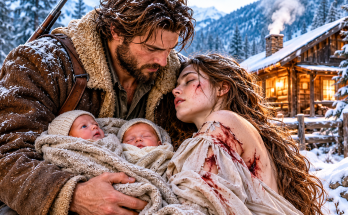
There were five children standing a short distance behind me.
None of them said anything.
That frightened me more than their crying would have.
Will was eleven.
He had baby Danny tucked against his chest, using his own coat to shelter the little one from the wind.
Jake was seven.
His cheeks were red, and his hands stayed hidden beneath his arms.
Maggie stood close to Sarah.
The two girls held each other as though they could keep the cold away by refusing to separate.
I looked at them and felt something inside me give.
They were waiting for me.
They had been waiting for six days.
Waiting for me to bury their father.
Waiting for me to find a way to make the house warm.
Waiting for me to tell them what would happen next.
I had no answers.
I had a shovel.
I had a grave that was barely deep enough to matter.
And I had five children whose feet were becoming numb while they watched their mother fail.
I pushed myself upright.
My right boot bent awkwardly beneath me.
The leather had split near the toe.
Every time I put my weight on that foot, cold air reached my stocking.
I had stopped noticing the pain hours earlier.
Now I noticed everything.
The rough wooden handle against my palms.
The stiffness in my shoulders.
The way the wind slipped beneath my clothes.
The dry ache in my throat.
I picked up the shovel.
The blade had a thin white edge where frost had collected.
I set it against the bottom of the hole.
Then I pushed.
Nothing happened.
I moved my foot higher and put my full weight against the metal.
It barely scratched the surface.
I tried again.
The blade slid sideways.
I nearly fell.
Behind me, someone shifted.
I did not look back.
I knew they were cold.
I knew they needed to go inside.
But I could not leave Thomas lying there another night.
Not another night.
The first day after his death, I had managed to loosen some earth.
It had been difficult, but I could still work the blade beneath the surface.
The second day was harder.
By the third, the weather had changed.
A bitter wind came down across the prairie, bringing a cold that seemed to settle inside the ground itself.
After that, every attempt became a fight.
I had dug perhaps twelve inches.
I needed much more.
The hole looked almost insulting.
Six days of work, and I had made something barely deeper than a shallow ditch.
I stared at it.
Then I raised the shovel again.
A small voice came from behind me.
“Mama?”
It was Jake.
I turned my head.
He was looking toward the barn.
His face had gone pale beneath the redness from the cold.
“What is it, sweetheart?”
He swallowed.
“There’s a bad smell.”
I knew what he meant.
I had noticed it myself.
The cold had not completely hidden what six days could do.
I tightened my fingers around the shovel.
“Jacob.”
That was all I said.
His eyes dropped immediately.
“I’m sorry, Mama.”
There was something terrible about how quickly he apologized.
He had told the truth.
Nothing more.
Yet he looked as though he expected to be punished for it.
I knew why.
Thomas had made our children afraid of ordinary things.
A question asked at the wrong moment.
A dish placed too loudly on a table.
A truthful answer he did not want to hear.
I had watched them learn to measure every word.
And now I had spoken to Jake in a voice that reminded him of his father.
I wanted to take it back.
I wanted to reach across the snow and pull him into my arms.
Instead, I stood with that useless shovel and said his name again.
This time, gently.
“Jake, come closer.”
He took a small step.
Then he looked at the shovel.
I saw the hesitation in his face.
It hurt worse than my hands.
“You didn’t do anything wrong,” I told him.
He nodded.
But he did not seem to believe me.
I could not blame him.
Too many times in our house, words had meant one thing and actions another.
I wanted him to know that would change.
I did not yet know how to make it change.
Will spoke next.
“Mama, we ought to go inside.”
His voice was steady.
Too steady for an eleven-year-old boy.
I looked toward him.
Danny was pressed so tightly against his chest that I could barely see the baby beneath the coat.
“Soon,” I said.
Will glanced at the hole.
“You've been trying all morning.”
“I know.”
“The ground’s too hard.”
“I can see that.”
He lowered his eyes.
Then he looked up again.
“I don't think you can dig any more.”
I should have listened.
I should have put the shovel down.
I should have taken my children inside while there was still a little warmth left in their bodies.
But I heard something in his words that he had never intended.
I heard failure.
And I was already carrying more of that than I could bear.
“I'll get through it,” I said.
Will did not argue.
He simply shifted Danny higher against his shoulder.
That silence made me angry.
Not at him.
At myself.
At Thomas.
At the weather.
At everything that had brought us to that miserable patch of ground.
I drove the shovel down again.
The metal scraped.
My palms burned.
I pushed harder.
The frozen dirt held.
“Mama,” Will said again.
“I heard you.”
He waited.
“Please.”
I turned so quickly that my boot slipped.
“I said I'm going to finish it!”
The words came out louder than I intended.
They cut through the cold air.
Nobody moved.
Jake stared at his feet.
Maggie pulled Sarah closer.
Will went very still.
Even Danny seemed quiet beneath the coat.
I could hear my own breathing.
I knew that silence.
I had lived inside it for years.
It was the silence that followed Thomas when he raised his voice.
The silence of children deciding whether it was safe to speak.
I looked at Will.
Then at the shovel in my hands.
For one awful moment, I understood that my husband did not have to be alive for his anger to remain in our home.
I had just carried it into the yard myself.
I lowered the shovel.
“Will.”
He watched me without answering.
“I shouldn't have shouted.”
He looked down at Danny.
I waited.
“I’m sorry,” I said.
He gave a small nod.
That was all.
I had wanted forgiveness.
But I had not earned the right to ask for it.
Will was eleven years old.
That fact would not leave me.
Eleven.
He should have been thinking about ordinary things.
Food.
Games.
Animals along the creek.
The little troubles that belong to boys who know they are safe.
Instead, he had learned how to keep his baby brother warm.
He had learned to recognize his father's footsteps.
He knew the loose floorboard near the bedroom.
He knew how to take Sarah's attention away from the doorway when Thomas came home drunk.
And he had learned to stand between danger and the people he loved.
I had watched that happen.
I had told myself there would be time to make things better.
When the harvest improved.
When the debt was smaller.
When Thomas stopped drinking.
When the weather changed.
Always later.
Now Thomas was dead.
And my eldest child still stood like a small guard beside his mother.
I wanted to tell him he could stop.
I wanted to tell him the danger had passed.
But how could I?
The man who had frightened us lay beneath a canvas sheet, and we were still suffering because of him.
The house was cold.
Our food was uncertain.
My hands were bleeding.
And five children stood behind a barn, waiting for me to find enough strength to do one final thing for their father.
I looked down into the unfinished grave.
I hated that hole.
I hated how little I had managed after six days.
Most of all, I hated that I was beginning to fear the ground would defeat me.
I could not leave Thomas where he was.
Whatever kind of husband he had been, his body had to be buried.
I knew that.
But knowing what needed to be done was not the same as being able to do it.
I pressed the shovel against the earth once more.
It would not move.
The wind caught the edge of the canvas near the barn.
I turned toward it.
For a moment, I imagined Thomas standing there instead of lying beneath it.
His face tight.
His voice impatient.
Telling me I was doing everything wrong.
I waited for the familiar shame.
Instead, something else came.
Relief.
It was so sudden that I almost lost my balance.
Thomas could no longer get up.
He could no longer come through the door with whiskey on his breath.
He could no longer make Will listen for his footsteps.
And yet I was still standing in the cold, trying desperately to do what I believed a wife was supposed to do.
I looked toward my children.
They were watching me.
All five of them.
And I understood that the grave was not the only thing I had failed to finish.
I still had to learn how to live without being afraid.