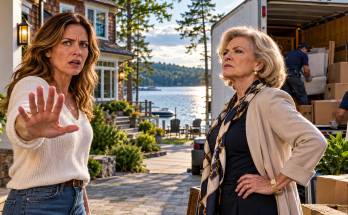
The closing-day photograph stayed leaning against the hallway wall for nearly four years.
Every few months, someone asked why I had not hung it.
Dad once.
Derek twice.
Mom never.
Eventually I stopped noticing it.
That was probably why I was ready.
One Saturday morning, I was dusting the hallway when I picked up the frame.
The photograph showed the house exactly as it looked before I moved in.
Bare windows.
Empty porch.
Morning light on cedar siding.
Lake visible between trees.
No furniture.
No addition.
No Japanese maple.
No history yet, at least none I knew.
I had taken the picture because the house looked full of possibility.
Then Mom used it for her Facebook announcement.
After that, I saw false ownership every time I looked at it.
Now I saw something else.
A beginning I survived.
I found a nail.
Measured the wall.
Then laughed at myself and did not measure.
Hung it slightly too high.
Adjusted once.
Done.
The image belonged to me again.
Not because the past disappeared.
Because the past no longer monopolized its meaning.
Mom noticed during her next visit.
She stood in the foyer.
Looked at the photograph.
Then at me.
“You hung it.”
“Yes.”
She smiled.
No tears.
No speech.
“Looks good.”
“That’s all?”
She laughed.
“What else am I supposed to say?”
“Nothing.”
“Then I am learning.”
We went to the kitchen.
She brought bread from a bakery I liked.
Asked before visiting.
Asked before bringing food.
Apparently boundaries could coexist with carbohydrates.
Dad arrived an hour later.
Also invited.
Mom and Dad had not been inside my house together since before the divorce.
I had hesitated to invite both.
Then decided I was tired of arranging reality around old fear.
They entered separately.
Sat at opposite sides of the table.
Talked about weather.
Derek.
A mutual friend.
No old marriage argument.
No strange nostalgia.
When Dad needed sugar, Mom started to reach for it.
Then stopped.
He reached himself.
I saw the movement.
So did she.
Neither said anything.
Four years earlier, that tiny correction would have been invisible.
Now I understood how relationships change.
Not mainly through speeches.
Through interrupted habits.
Mom no longer automatically managed.
Dad no longer automatically yielded.
I no longer automatically mediated.
We were three adults at a kitchen table.
It should never have been revolutionary.
It was.
After lunch, Dad went outside to inspect the Japanese maple.
He asked.
I said yes.
Mom stayed in the kitchen.
She looked toward the hallway.
“I used that picture because I wanted people to see a story.”
I knew which picture she meant.
“The retirement story.”
“Yes.”
“Why tell me now?”
“I don’t know.”
She thought.
“Maybe because I can finally look at it without wanting to edit what happened.”
I nodded.
She continued.
“I wanted people to see that I had raised a daughter who loved me enough to give me something enormous.”
The honesty still surprised me sometimes.
“You wanted the house to prove something about me?”
“About you. About me. About us.”
“What?”
“That I had done motherhood right.”
I leaned against the counter.
“That’s a lot for one property.”
“I know.”
She smiled sadly.
“I wanted retirement to be proof too.”
“Proof of what?”
“That our life had gone well.”
I understood.
The lake house.
The money.
The family gatherings.
The master bedroom.
All symbols.
Not just conveniences.
Mom had tried to build a visible conclusion to her life.
Successful mother.
Successful marriage.
Secure retirement.
Close family.
Beautiful house.
The problem was that people had to be positioned inside the picture whether they chose it or not.
“I think I spent half my life staging outcomes,” she said.
“Probably.”
“I hate when you agree so fast.”
I smiled.
She laughed.
Then Dad returned.
“The maple needs mulch.”
I raised an eyebrow.
He immediately said, “Observation. Not assignment.”
Mom burst out laughing.
I did too.
Dad looked pleased with himself.
Later, when both had left, I sat beneath the photograph.
I thought about proof.
Mom once needed the house to prove family closeness.
Now closeness appeared differently.
Dad asking.
Mom stopping.
Derek repaying by choice.
Linda setting limits.
Me not fixing everything.
Nothing impressive enough for Facebook.
Much more real.
That evening, Derek called.
“Mom told me she and Dad had lunch together at your place.”
“Yes.”
“That’s wild.”
“Not really.”
“It would have been impossible three years ago.”
“True.”
“How was it?”
“Normal.”
He laughed.
“That might be wilder.”
We talked about his kids.
He and Melissa had finally decided to have children after years of uncertainty.
Their first baby was due in spring.
Mom knew.
Naturally, she was excited.
Derek said, “She asked whether we wanted help setting up the nursery.”
“What did you say?”
“No.”
“And?”
“She said okay.”
I laughed.
Then Derek added, “Two days later she asked whether buying one book counts as help.”
“That is very Mom.”
“We said yes.”
“Good.”
“She bought one book.”
“Only one?”
“Only one.”
That may have been the greatest evidence of transformation yet.
Mom limiting baby purchases voluntarily.
Months later, my niece was born.
Her name was Eleanor.
Everyone called her Ellie except Mom, who insisted on Eleanor for three weeks before surrendering.
Some control tendencies survive harmlessly.
At the hospital, Mom waited until invited.
Derek later told me she stood in the hallway crying when he texted that she could come in.
No barging.
No “I’m the grandmother.”
No assumption.
Invitation.
The same lesson repeated into the next generation.
That mattered to me more than anything she ever said to my face.
Patterns only truly change when they stop traveling downward.
When Ellie was six months old, the family gathered at my lake house.
Not because Mom planned it.
Because I did.
Dad.
Mom.
Derek.
Melissa.
Linda.
Frank.
Ellie.
I sent invitations.
Real ones.
Specific date.
Specific time.
No overnight assumption.
No automatic holiday claim.
People responded.
Some yes.
Some no.
No guilt.
The day was warm.
Derek grilled near the deck.
Linda brought salad.
Dad sat with Ellie under an umbrella.
Mom stood near the garden holding a bowl.
At one point, I noticed her looking toward the west lawn.
The original retirement addition would have stood there.
I walked over.
“What?”
She shook her head.
“Nothing.”
“Tell me.”
She hesitated.
Then said, “I’m thinking how close I came to ruining this place for you.”
I looked around.
Family laughing.
Lake quiet.
Japanese maple moving in the breeze.
“You didn’t.”
“I tried.”
“Yes.”
She accepted that.
Then looked toward everyone.
“And somehow I’m still here.”
“You’re here because I invited you.”
Mom smiled.
“Yes.”
No offense.
Just gratitude.
At lunch, we sat around my actual dining table.
Six adults.
One baby.
Not the eight-seat lake-house table Mom bought years earlier.
No staged family future.
Just a day.
Halfway through the meal, Ellie started crying.
Everyone offered advice simultaneously.
Melissa laughed.
“Absolutely not. One person at a time.”
The table went silent.
Then we all laughed.
Mom raised both hands.
“I have been legally advised.”
Even Evelyn would have appreciated that.
After lunch, some people walked to the dock.
Mom stayed behind to help clean.
She stopped herself.
“Do you want help?”
“Yes.”
We worked side by side.
Then she asked, “Where do these go?”
Instead of deciding.
I showed her.
Plates here.
Glasses there.
Normal.
The entire story had begun with her deciding where her bed would go in my house.
The master bedroom is ours.
Years later, she stood in the same home asking where I wanted a plate.
The scale of the correction almost made me cry.
Mom noticed.
“What?”
“Nothing.”
“You’re doing my thing.”
“What thing?”
“Saying nothing when there’s obviously something.”
I laughed.
“Fine.”
I told her.
She became quiet.
Then looked down at the plate in her hands.
“I remember saying that.”
“I know.”
“I thought if I said it confidently enough, reality would catch up.”
“That sounds accurate.”
She placed the plate exactly where I indicated.
Then said, “I like this reality better.”
I did too.
Later, after everyone left, I walked through the house.
Cups on the counter.
Crumbs.
A baby blanket on the sofa.
Evidence of family.
Chosen evidence.
No one had claimed a room.
No one had left boxes.
No one had announced the property belonged to everyone now.
Family had filled the house without taking it.
That was what Mom once believed impossible.
She thought closeness required shared ownership.
It did not.
It required mutual permission.
I carried Ellie’s forgotten blanket to the porch.
Derek had already texted.
Can I grab it tomorrow?
Not:
I’m coming over.
Can I?
I smiled.
Yes. Text first.
He replied:
Obviously.
The word made me laugh.
Nothing was obvious before.
That was why we asked now.
I went back inside and turned off the lights.
At the hallway, I stopped beneath the closing-day photograph.
The house in the image was empty.
The house around me was not.
Memory lived here now.
Good and bad.
The moving truck.
Dad’s overnight bag.
The contractor documents.
Mom’s first invited coffee.
The ugly pottery bowl.
Family dinner.
Ellie crying at the table.
The place had become layered.
Owned.
Not because no one else entered.
Because entry happened by choice.
I touched the frame.
Then went upstairs to the master bedroom.
Mine.
Still mine.
That fact no longer needed defending every morning.
I stepped onto the balcony.
The lake was dark.
Lights from distant houses reflected across the water.
I thought about the version of myself who stood there years earlier, holding a bank statement with forty-eight thousand missing and no idea how deep the story went.
She thought the problem was a moving truck.
She had no idea she was about to uncover years of hidden decisions.
No idea she would learn how often love and control had been mixed together.
No idea her father would leave.
Her brother would change.
Her mother would admit forgery.
A developer would disappear.
Money would return.
Trust would rebuild in small pieces.
No idea she would someday invite Mom back.
I wished I could tell that version of myself one thing.
Not that everything would be fine.
That would have been too vague.
Not that family would heal.
Some parts never returned.
I would tell her:
Your no is enough before anyone understands it.
You do not need proof of harm before you set a boundary.
You do not need a courtroom to own what is yours.
You do not need everyone to agree that pressure is pressure.
And love that survives a boundary may become better love.
Below me, the Japanese maple moved in the night breeze.
Small once.
Now taller.
Still growing.
I stood there until the air cooled.
Then went inside.
The house did not feel like a victory.
Victories usually have losers.
It felt like a life.
Mine.
And because it was mine, I could choose who shared parts of it.
That was the difference Mom had finally learned.
And the difference I had finally learned to protect.