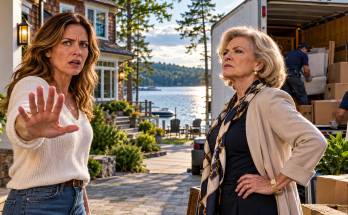
Mom’s will contained no surprises.
That may sound like a small mercy.
It was enormous.
No secret account.
No hidden loan.
No mysterious promise.
No note saying she had “always intended” something different from the documents.
Everything matched what she had told us.
The professional fiduciary handled administration.
Derek and I received equal shares after expenses and a few specific gifts.
Linda received Grandma’s original recipe book.
Ellie received Mom’s pottery tools.
Jack got her collection of old cameras.
I received the blue armchair.
I laughed when I saw it listed.
Of course.
The last surviving piece of furniture she once bought for my house.
Derek asked, “You keeping it?”
“Yes.”
“Seriously?”
“Yes.”
“Why?”
I touched the worn fabric.
“Because now it’s just a chair.”
That was true.
Objects lose some of their power when the story around them changes.
The armchair came to the lake house.
Invited.
I placed it in the guest room.
Not the master bedroom.
No grand symbolism intended.
It fit there.
That was enough.
Mom’s estate also included a letter for me.
One envelope.
My name.
Her real handwriting, shakier than before.
I waited several days to open it.
Not from fear.
Because I wanted to choose the moment.
Andrew sat nearby reading while I opened it at the kitchen table.
The letter was short.
Claire,
If this reaches you, then I do not get to revise it after hearing your reaction, which is probably good for both of us.
I smiled immediately.
She continued.
I spent too much of my life believing love gave me authority. I thought knowing people well meant I knew what they should choose. I confused being needed with being close, and I confused being included with being entitled.
I read slowly.
You taught me the difference, though I wish the lesson had not cost you so much.
My eyes blurred.
The next paragraph was about the house.
I am glad the lake house stayed yours long enough for you to decide what to do with every part of it. I am even glad you later sold some of the land, because it proved something I resisted for years: the problem was never whether selling was smart. The problem was that the choice was yours.
I stopped.
That sentence resolved something I had not known remained unresolved.
For years, a tiny part of me worried that selling the western parcel had validated Mom’s old plan.
She saw value.
Eventually I sold.
Was she right?
No.
She had been right about value.
Wrong about authority.
Those were separate.
Mom understood that too.
I continued.
I hope when you think of me, you remember more than my worst season. But if you remember the truck, remember that you were right to keep the door closed.
I cried.
Not quietly.
Andrew came over.
“Want me here?”
“Yes.”
He sat beside me.
The final lines:
A mother can love her child deeply and still do something deeply wrong. Both truths can exist. I am grateful you made me live with both instead of allowing me to erase one with the other.
Love,
Mom
No request for forgiveness.
No instruction.
No final management.
Just truth.
I folded the letter.
Andrew said nothing.
Eventually I said, “That’s probably the best thing she ever wrote.”
He nodded.
“Sounds like her.”
“Which version?”
“The final one.”
I liked that.
Not because final means truest.
But because people deserve to be remembered as capable of change without pretending the change cancels what came before.
Mom’s ashes were divided according to her instructions.
Some with Grandma.
Some in a memorial garden.
A small portion she asked me to scatter near water “only if Claire wants to.”
Even in death, she had written the permission correctly.
I wanted to.
Not on my property.
That surprised everyone.
I chose a public overlook several miles away.
The family gathered.
Derek.
Melissa.
Ellie.
Jack.
Linda.
Frank.
Andrew.
We scattered the ashes into wind above the lake.
No ownership.
No permanent marker.
No claim.
Just release.
Afterward, we came back to my house.
Invited.
We ate sandwiches.
People told stories.
Not only flattering ones.
Mom would have hated some.
That made them more honest.
Linda told the story of Mom reorganizing her pantry while she was at work.
Derek told the story of Mom trying to negotiate his salary for him at twenty-six.
I told the moving truck story.
Not the entire saga.
Just the beginning.
“She got out and said, ‘The master bedroom is ours.’”
Ellie stared.
“She really said that?”
“Yes.”
“What did you say?”
“I said no.”
Jack laughed.
“That’s it?”
“Eventually.”
Derek nearly choked.
“Eventually involved lawyers.”
Everyone laughed.
Even grief could hold humor.
The story no longer felt like a wound every time I told it.
It had become family history.
Cautionary.
Absurd.
Painful.
Transformative.
Months later, I reorganized the safe in my office.
The legal folder still existed.
Settlement.
Account records.
Forgery reports.
Vale documents.
County notices.
Mom’s signed acknowledgment.
Henry’s statement.
Martin’s recording transcript.
All of it.
I considered shredding everything.
Then decided not to.
Some records should remain.
Not because I expected another battle.
Because truth matters even after trust returns.
I placed Mom’s personal letters in a different box.
Not legal.
Not evidence.
Memory.
That distinction pleased me.
One folder documented what happened.
The other documented what changed.
Both true.
The house itself changed too.
Years after Andrew moved in, we renovated the kitchen.
Mom would have had opinions.
I almost heard them.
We opened one wall.
Replaced counters.
Kept the old cabinets after refinishing.
No dramatic expansion.
No west-side addition.
The downstairs office remained an office.
The guest room kept the blue chair.
The master bedroom remained ours in one sense now—Andrew’s and mine—but that word no longer frightened me.
Ours because I chose partnership.
Not because someone announced entitlement.
Ownership and sharing could coexist.
That was another lesson Mom’s mistake had almost obscured.
Protection is not the same as isolation.
I could own something and still share it generously.
The difference was choice.
Over the years, Ellie and Jack began spending weekends at the lake.
Asked.
Invited.
Sometimes they brought friends.
They knew the rules.
Text first.
No surprise arrivals.
No borrowing boats without permission.
No assuming a room.
The rules were ordinary to them.
They had no idea those habits were revolutionary in our family.
Good.
Healthy patterns should feel boring to the next generation.
One summer, Ellie—twenty by then—asked whether she could stay for a month while doing an internship nearby.
I said yes.
She moved into the guest room.
The blue armchair became covered in clothes.
Mom would have complained.
I did too.
Different issue.
Halfway through the month, Ellie said, “Aunt Claire, do you ever worry that people staying here too long will think they own the place?”
I stared at her.
Then laughed so hard she looked offended.
“What?”
“Nothing.”
“No, seriously.”
“Sometimes history makes us weird.”
She knew pieces of the story.
Not all.
I told her more.
About consent.
Not the forensic details.
Not every family betrayal.
Enough.
She listened.
Then said, “Grandma was intense.”
“Yes.”
“But she got better.”
“Yes.”
“Do you think people really change?”
I looked toward the Japanese maple.
Huge now.
Branches spreading.
“I think people can change behavior.”
“That’s not what I asked.”
She had my family’s talent for irritating precision.
I smiled.
“I think behavior repeated long enough changes who someone is in relationship to you.”
She thought.
“That sounds complicated.”
“It is.”
“Could you just say yes?”
I laughed.
“Yes.”
She smiled.
“Better.”
The following morning, Ellie asked before borrowing my car.
I said no because I needed it.
She said okay.
Then got a ride.
No guilt.
No negotiation.
I watched her leave.
Patterns ending often look like nothing happening.
That is the best kind.
Andrew and I grew older at the lake.
Not gracefully every day.
He developed knee problems.
I became less patient with technology despite working around it for decades.
We argued about thermostat settings.
Ordinary marriage.
The property remained in my name until we updated our estate plans.
This time, every conversation was explicit.
If I died first, Andrew could live there for life if he wanted, with clear maintenance terms.
Afterward, ownership would pass according to my instructions.
No implied arrangement.
No family assumption.
Everyone affected knew.
Signed.
Understood.
When I showed Derek the plan, he laughed.
“You turned estate planning into a military operation.”
“Yes.”
“Mom would be proud.”
I looked at him.
He corrected.
“Final-version Mom would be proud.”
That was fair.
I kept the closing-day photograph in the hallway until the frame wore out.
When I replaced it, I found Mom’s old note taped behind the backing.
This belongs to you without my story on it.
I had forgotten it was there.
I stood holding the paper.
Then added another line beneath it.
In my handwriting.
It can hold both stories now.
I put the note back.
The first story was the one I thought I bought into.
Independent woman buys lake house.
Simple success.
Then came Mom’s story.
Family retirement property.
Development opportunity.
Shared future.
Neither fully held what the place became.
The real story was more complicated.
A house became the boundary line where an entire family learned that love without permission can become control.
That generosity without transparency can become debt.
That financial skill does not create ownership over someone else’s choices.
That peace purchased by surrender is not peace.
That saying no does not destroy every relationship worth keeping.
And that someone who does deep harm can sometimes change without being excused.
Those lessons were larger than the deed.
But the deed mattered too.
Because abstract values become real at doors.
Accounts.
Signatures.
Bedrooms.
Driveways.
Places where someone has to decide who gets to choose.
I was sixty-two when a realtor knocked on my door.
She represented someone interested in purchasing the remaining property.
Not a developer.
A family.
They loved the cove.
Loved the cedar house.
Wanted privacy.
The offer was absurdly high.
I invited her inside.
Listened.
Then said no.
She smiled.
“Of course. If you change your mind, call.”
That was it.
No pressure.
No emotional story.
No urgency.
After she left, I stood on the porch.
Same place.
Different decade.
I thought about twenty years earlier, when Mom arrived with the truck believing my love guaranteed access.
I thought about the first no.
How hard it felt.
How much followed.
Then I thought about this no.
Easy.
Almost boring.
Practice changes the nervous system too.
Andrew came outside.
“Who was that?”
“Realtor.”
“Offer?”
“Yes.”
“Good?”
“Very.”
“You selling?”
“No.”
“Okay.”
I looked at him.
We both laughed.
That word again.
Okay.
Maybe every healthy relationship eventually learns how much love can fit inside it.
Years later, when I finally did decide to leave the lake house, it was because I wanted something smaller.
Closer to town.
Easier stairs.
Less maintenance.
No dramatic financial reason.
No developer.
No family pressure.
Just age.
I listed it.
The western parcel remained smaller than when I bought, but the property was still worth far more than I had ever imagined.
The first offer was strong.
I rejected it.
Second better.
Rejected.
Third right.
I accepted.
Every step mine.
At closing, I sat across from the buyers.
A couple in their forties.
Excited.
Nervous.
They had saved for years.
I recognized the look.
The woman touched the folder containing the deed as though it might disappear.
I wanted to warn her about everything.
Developers.
Family.
Hidden value.
Life.
Instead I said what Henry Wallace had once said to me.
“I hope you love the house.”
But then I added what he should have.
“There’s nothing affecting title beyond what’s in the documents, and I’ve disclosed everything I know that could matter to your decision.”
The woman looked surprised.
Then grateful.
“Thank you.”
That was the difference.
No protecting excitement through omission.
No deciding what someone else could handle.
Truth before choice.
I handed over the keys.
Then left.
No grief explosion.
Just sadness.
Good sadness.
A life ending where it should.
Andrew and I moved into a smaller house twenty minutes away.
No lake.
No strategic shoreline.
Tiny garden.
One guest room.
When Derek visited, he looked around.
“So this is it?”
“This is it.”
“No developer premium?”
“None.”
“Disappointing.”
“Get out.”
We laughed.
I kept one thing from the lake property besides photographs.
The Japanese maple.
Not the whole tree.
Impossible.
A young sapling grown from one of its seeds.
A nursery helped transplant it.
I planted it in the new yard.
Mom’s gift.
My placement.
Years of growth.
Another beginning.
On the first evening after planting, I sat beside it.
The light was fading.
Andrew inside making dinner.
My phone full of ordinary messages.
Ellie asking about work.
Jack sending a ridiculous video.
Derek complaining about his back.
Life.
I thought about the moving truck one last time.
Mom smiling in the driveway.
“The master bedroom is ours.”
At the time, I believed the most important answer I would ever give her was no.
I had been partly right.
No protected the house.
But the deeper answer took years.
Mine does not mean I do not love you.
Yours does not mean I am excluded.
Family does not erase ownership.
Love does not eliminate permission.
And permission freely given is worth more than access taken.
The lake house was gone now.
Sold.
The money invested.
The deed belonged to someone else.
Yet nothing essential had been lost.
Because the thing I fought hardest to protect was never the cedar walls or shoreline.
It was my right to choose.
That stayed with me.
Mom had finally understood it.
Dad learned to use it.
Derek learned to ask for it.
I learned not to apologize for it.
And the family that survived was smaller in assumption, larger in honesty.
That was the true outcome.
Not a house won.
Not a mother defeated.
Not a dramatic punishment.
A boundary held long enough to become a new way of loving each other.
I touched one leaf on the young maple.
Then went inside.
The door closed behind me.
Not as a barrier.
Just a door.
Mine to open.
Mine to close.
Mine to share.
The End
Read more original stories on Feel Every Story.