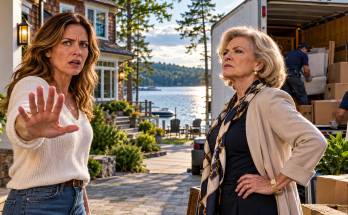
The letter arrived almost eight years after the moving truck.
Not from Vale.
Vale Development had reorganized twice since then and sold several assets.
Martin was long gone.
Paul Mercer’s name had disappeared from every business search that mattered.
The new company was called Shoreline Meridian Partners.
Professional letterhead.
No mystery.
No family intermediary.
No fake property alert.
The envelope came directly to me.
Dear Ms. Bennett.
That alone almost made me laugh.
The proposal was simple.
They wanted to purchase a portion of my western shoreline for access to a future low-density residential project.
I stared at the map.
Different project.
Same basic geography.
Apparently strategic land remains strategic even after human drama fades.
Andrew read over my shoulder.
“How much?”
I turned the page.
The number made both of us quiet.
One million one hundred thousand dollars.
For less land than Vale once wanted.
Years of appreciation.
Scarcity.
Changed development economics.
Maybe the old strategy had eventually been correct about value.
That was almost funny.
Andrew said, “Well.”
I laughed.
“That was Evelyn’s word.”
“You’re calling her?”
“She retired.”
“Right.”
Her former associate, Nina Patel, handled my occasional legal matters now.
I sent the letter.
Then did something important.
Nothing else.
No family calls.
No Mom.
No Dad.
No Derek.
I wanted to know what I thought first.
That had once been impossible.
Our family moved information so quickly that decisions became communal before the decision-maker understood the question.
Now I waited.
For three days, Andrew and I discussed it.
Privacy.
Money.
Traffic.
Future value.
Taxes.
What the development might become.
Whether an access easement would bother us.
Whether we wanted to stay forever.
The offer was large enough to change retirement.
Not enough to make consequences irrelevant.
I walked the west boundary repeatedly.
The Japanese maple was mature now.
The garden had moved twice.
Ellie and Jack loved catching fireflies near the trees.
Money pressed against memory.
But neither automatically won.
I told Andrew, “I’m afraid if I sell, it means Mom was right.”
He looked at me.
“About what?”
“That the smart thing was always to monetize the land.”
Andrew shook his head.
“That would only be true if the choice were the same.”
“It is the same land.”
“Different choice.”
I knew he was right.
Mom’s wrong was never wanting a sale.
It was deciding before asking.
The land itself had no moral position.
Selling now by choice would not validate pressure then.
It would prove the opposite.
I could decide differently when circumstances changed.
Freedom includes changing your mind.
That realization loosened something.
I told Mom about the offer a week later.
Not because I needed advice.
Because our relationship had reached the point where I wanted to share.
We sat at her townhouse.
She was eighty by then.
Hair completely silver.
Still sharp.
Still capable of turning a simple sentence into a plan if she forgot herself.
I placed the offer on the table.
She read the first page.
Then the price.
Her eyebrows lifted.
“That’s… a lot.”
“Yes.”
She read the map.
I watched old intelligence activate.
Road access.
Shoreline length.
Parcel shape.
The same mind that once built a scheme around those details.
She put the papers down.
“What do you think?”
The question was perfect.
Not:
You should sell.
Not:
This proves I was right.
Not:
Imagine what the family could do.
What do you think?
“I don’t know.”
Mom nodded.
“Do you want my opinion?”
I nearly laughed.
“Yes.”
She took a long breath.
“I think you should decide based on whether you want the development near you, not the money first.”
That surprised me.
“Why?”
“Because I made the opposite mistake.”
I waited.
“I treated money as capable of making later consequences acceptable.”
She tapped the map.
“If this changes the place you love, the number has to be worth that to you. Not to me. Not to Andrew. Not to your retirement spreadsheet.”
I stared at her.
“That is annoyingly good advice.”
“Therapy.”
Still.
After all these years.
She continued.
“And you should get an independent valuation.”
“Already scheduled.”
“Good.”
She smiled.
Then said, “I would also—”
Stopped.
“What?”
“You asked for my opinion.”
“I did.”
“Then I’m allowed one more.”
“Fine.”
“Don’t negotiate emotionally with the first offer.”
I laughed.
“Also annoyingly good.”
“I have experience.”
“Yes.”
The appraisal showed the proposed parcel could be worth between $1.3 and $1.6 million strategically.
I felt vindicated on behalf of my younger self.
Vale’s old offer had indeed been cheap.
Mom once planned to sell something worth far more than she knew.
Not because she was foolish.
Because urgency made her easy to price.
Shoreline Meridian increased to $1.45 million.
Then added protections.
Limited residential density.
No marina.
No service road behind the house.
Landscaping buffers.
No shared dock.
The proposal was less destructive than Vale’s old project.
I began considering yes.
Andrew remained neutral.
“I can live with either.”
“That’s not helpful.”
“It’s honest.”
I called Derek.
Not for permission.
For perspective.
He listened.
Then said, “Do you want me to say what old Mom would say?”
“No.”
He laughed.
“Okay.”
“What do you think?”
“I think you should sell if you want the money more than the land.”
Simple.
“And if not?”
“Keep the land.”
Also simple.
“Any claim to family benefit?”
“Absolutely not.”
“Good.”
He laughed.
“Can I still ask for twenty bucks?”
“No.”
“Worth a try.”
Dad was older now.
Seventy-seven.
Still living independently.
Sports car long gone.
He came to walk the boundary with me.
We moved slowly.
His back had worsened.
At the western point, he leaned on a walking stick.
“This was the part she wanted.”
“Yes.”
He looked toward the lake.
“What do you want?”
“I think I want to sell part.”
He nodded.
“Then sell.”
“Just like that?”
“Not my land.”
I smiled.
Dad had come far.
Then he added, “Get a good lawyer.”
Still Dad.
Practical.
I negotiated for three months.
Directly through counsel.
No side conversations.
No hidden facilitators.
Every document in my name.
Every survey reviewed.
Every easement exact.
Every restriction written.
At one point the developer requested a minor access adjustment.
I said no.
They returned with another route.
No pressure.
No moving truck.
No family leverage.
Business negotiation.
Clean.
The final price was $1.52 million.
I signed.
My hand did not shake.
After closing, the funds appeared in my account.
Mine.
The land transferred.
By choice.
I drove home and stood at the new western boundary.
Smaller property.
Still beautiful.
The Japanese maple remained on my side.
That had been nonnegotiable.
Andrew joined me.
“How do you feel?”
“Strange.”
“Regret?”
“No.”
“Relief?”
“Some.”
“Vindicated?”
“Maybe.”
Then I laughed.
“I think mostly hungry.”
We ordered pizza.
That evening, I called Mom.
“It closed.”
She was quiet.
“How do you feel?”
“Okay.”
“Good.”
I waited.
Then she said, “I have a confession.”
My body tensed reflexively even after all these years.
She laughed.
“Nothing bad.”
“Proceed cautiously.”
She said, “A tiny part of me wants to say I knew that land would be worth something.”
I smiled.
“I knew it.”
“But I am not saying it.”
“You just did.”
“Technically I confessed the desire.”
We both laughed.
Then she became serious.
“I’m glad you got to choose.”
That was the only sentence that mattered.
“Me too.”
I used some of the money to pay off the remaining mortgage.
Andrew and I kept our existing financial agreement.
I invested most.
Donated some to a local housing legal-aid organization.
Not because of poetic justice.
Because ownership disputes and financial coercion had become less abstract to me.
I also created separate education accounts for Ellie and Jack.
In their names.
With clean custodial structure.
Transparent statements.
Their parents had access to every record.
No family reserve.
No hidden pooling.
Derek joked when I showed him.
“Subtle.”
“I’m not trying to be.”
He became serious.
“Thank you.”
“They’re gifts.”
“I know.”
“Once legally theirs, they’re theirs.”
“I know.”
I looked at him.
He laughed.
“Okay, okay.”
That was the point.
The next generation would not need to discover ownership after the fact.
Mom heard about the education accounts.
She asked if she could contribute.
I said yes.
Direct deposits.
Documented.
No management authority.
She contributed every birthday.
Never once asked how the money was invested.
That may have been harder for her than therapy.
Years passed.
The Shoreline Meridian development went forward slowly.
Five homes.
No marina.
Landscaped road on the far side.
From my porch, I could barely see rooftops through trees.
The cove changed.
Less than feared.
More than before.
I did not regret selling.
That mattered.
Mom visited one autumn afternoon.
We stood near the new boundary.
She looked toward the distant houses.
“Does it bother you?”
“Sometimes.”
“You regret it?”
“No.”
She nodded.
Then said, “That is what I never understood.”
“What?”
“That someone can choose a consequence and still dislike parts of it.”
I looked at her.
She continued.
“I thought if a decision had drawbacks, the person needed help making a better one.”
There it was.
Another root of control.
Protect people from imperfect choices.
By taking choice.
I said, “Most decisions have drawbacks.”
“I know.”
She smiled.
“Another annoying thing therapy taught me.”
We stood beneath the Japanese maple.
Leaves deep red.
Mom touched one branch, then pulled her hand back.
“Can I?”
I smiled.
“It’s a tree.”
“That’s not an answer.”
“Yes.”
She touched the leaf.
Even then.
Even with something so small.
Ask.
The habit had finally become hers.