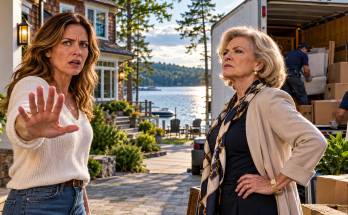
After Mom’s first indoor visit, I expected some emotional aftershock.
There was almost none.
That surprised me.
For two years, the front door had symbolized the entire conflict.
Who could enter.
Who belonged.
Who decided.
The morning after Mom sat at my kitchen table, I made coffee in the same chair she had used and felt mostly normal.
That was the point.
A boundary respected stops feeling dramatic.
It becomes architecture.
The door still locked.
I still owned the house.
Mom had come inside.
Those facts coexisted easily.
I realized then how much power we give to feared events before they happen.
I had imagined that inviting her inside might reopen old claims.
Instead, she drank coffee and complained mildly about my brand of tea.
Then went home.
Ordinary.
Healing often arrived looking disappointingly ordinary.
Mom did not ask for another visit.
Two months later, I invited her to dinner.
Just us.
I chose the date.
She asked whether she could bring dessert.
I said yes.
She brought lemon cake.
Not furniture.
We laughed about that.
The joke came from me.
Important distinction.
During dinner, she looked toward the dining area.
“This table is better than the one I bought.”
I raised an eyebrow.
She immediately added, “For your house.”
We both laughed.
The correction was quick enough to be funny.
She said, “I hear it now.”
“What?”
“When I start making something mine.”
“That’s useful.”
“Annoying.”
“Also useful.”
After dinner, she helped carry plates to the sink.
Then stopped.
“Do you want help?”
“Yes.”
She loaded the dishwasher.
Badly.
I rearranged it after she left.
Some traditions survived.
Dad and Mom settled into a strange post-divorce relationship.
Not friendship exactly.
Civil familiarity.
They met occasionally for coffee.
Attended one mutual friend’s funeral together.
Shared photographs from old albums.
No remarriage.
No reconciliation.
They stopped trying to force forty-two years into either success or failure.
It had been a life.
Then it became a past.
Dad dated once.
Three dinners.
Then decided he preferred living alone.
Mom reacted badly for one afternoon.
She admitted this later.
“What did you do?”
“Nothing.”
“That must have hurt.”
“It did.”
“You didn’t call him?”
“No.”
“You didn’t ask Linda who the woman was?”
Mom looked guilty.
“I considered it.”
“Consideration is free.”
“That is what my therapist says.”
Mom’s therapist deserved a medal.
Derek and Melissa became more financially stable.
He repaid the remaining amount he personally felt he owed me even though Marisol’s final accounting did not require it.
I initially refused.
He insisted.
Evelyn told us it was now a family choice, not a legal obligation.
Derek said, “Then my choice is to finish my part.”
I accepted.
Not because I needed the money.
Because refusing his agency would repeat the same pattern in reverse.
He paid slowly.
No crisis.
No guilt.
When the final transfer arrived, he texted:
Done.
I replied:
Done.
Nothing else.
Clean endings were possible.
Aunt Linda and Frank became serious.
Mom did not run their relationship.
That may have been her greatest achievement.
Linda told me one afternoon, laughing, “Your mother asked whether I wanted advice before giving it.”
“What did you say?”
“No.”
“And?”
“She said okay.”
We both laughed.
The word still carried family history.
Mom’s pottery improved.
She made me a bowl.
Before giving it, she sent a photo.
Do you want this? It is not a surprise gift if you don’t.
I said yes.
The bowl was uneven.
One side higher.
I loved it.
Not because it was beautiful.
Because it contained no agenda.
I kept it on the kitchen counter.
Sometimes small objects are safer symbols than houses.
Three years after the moving truck, I refinanced the lake house.
Rates had improved.
The process required new appraisal documents.
Property map.
Title search.
Insurance review.
I felt my body react to the paperwork.
Old tension.
Would some hidden claim appear?
Some forgotten filing?
Some residue?
Nothing.
Title:
Claire Bennett, sole owner.
No easement.
No lien.
No option.
No unauthorized filing.
Clean.
The appraiser noted the western shoreline as a major value component.
I almost laughed.
Of course.
He asked whether I had considered subdividing.
“No.”
He nodded.
No sales pitch.
No family plan.
Question asked.
Answer accepted.
The refinance closed.
I signed every page.
Read every line.
Some lessons remain practical.
After closing, I took the new deed copy to Dad.
Not because he needed it.
Because he had once treasured property documents.
He looked at it.
“Keeping this yourself?”
“Yes.”
He smiled.
“Good.”
Then I surprised myself.
I gave him a photocopy.
“For sentimental reasons only.”
Dad laughed.
“I’ll frame it.”
“Don’t let Mom borrow it.”
The joke would once have been cruel.
Now he smiled.
“She has her own hobbies.”
The past had become available for humor without denial.
That evening, I realized the original closing folder was still in my office safe.
The copy Mom once used.
I opened it.
Survey.
Inspection.
Old deed photocopies.
County records.
Some pages had become famous in the worst way.
I considered shredding the entire folder.
Then decided against it.
Documents are not guilty.
I removed only one thing.
The old proposed subdivision map.
Red line cutting the west side.
I carried it outside.
Not to burn.
Too theatrical.
I tore it into four pieces and put it in the recycling bin.
Paper becoming pulp.
Nothing sacred.
The next morning, the bin was collected.
That was all.
A month later, Mom called.
“Do you remember the dining table?”
I laughed.
“The cursed one?”
“The cursed one.”
“I thought you donated it.”
“I did.”
“Then why?”
“The charity sold it.”
“Good.”
“To a community center.”
“Okay.”
“They sent me a picture.”
I waited.
“Families eating at it.”
The sentence touched something in both of us.
Mom continued.
“I thought you might find that funny.”
“I do.”
The table she had bought to stage family life in my house now served actual families somewhere else.
Better ending.
She did not send the picture until I asked.
Another sign.
That winter, Mom had minor surgery.
Nothing serious.
Linda drove her.
Dad visited once.
Derek brought groceries.
I called.
I did not take over.
That may sound small.
It was not.
Old Claire would have coordinated.
Schedules.
Meals.
Follow-ups.
Because I was dependable.
Because everyone expected it.
Because competence was resource.
Instead I asked Mom:
What do you need from me?
She said:
A phone call is enough.
So I called.
Enough remained enough.
No guilt.
No secret resentment.
Mom recovered.
Then sent me a message:
Thank you for doing exactly what I asked instead of more.
I stared.
That was another family revolution.
Doing more had once meant love.
Now enough could also mean love.
The fourth anniversary of the moving truck arrived quietly.
I no longer woke thinking about it.
At 8:17, I happened to be outside watering the garden.
I checked the time.
Smiled.
Then kept watering.
Later, Mom texted.
I remembered after nine this year.
I wrote:
Progress.
She replied:
Absolutely.
We did not revisit the story.
No ritual.
No apology.
The event had stopped requiring annual management.
That was how I knew it was moving into history.
One evening, sitting on the dock with Mom during another invited visit, she asked me a question.
Not about ownership.
Not about forgiveness.
“What are you going to do with this place when you’re old?”
I laughed.
“Very dangerous question.”
She laughed too.
“I know.”
Then raised both hands.
“I am not planning anything.”
“Good.”
“I’m genuinely asking.”
I looked at the house.
The dock.
The maples.
The small garden.
“I don’t know.”
Mom nodded.
“That’s allowed.”
I smiled.
“Yes.”
Maybe I would live there forever.
Maybe sell.
Maybe marry.
Maybe not.
Maybe leave it to someone.
Maybe donate it.
Maybe one day develop it myself.
The important thing was no longer which future occurred.
It was who chose.
Me.
Mom looked toward the water.
“I wish I had understood that before.”
“So do I.”
She nodded.
No defense.
We sat until sunset.
When it was time to leave, Mom stood.
Then looked at me.
“Can I ask one strange thing?”
“Yes.”
“Do you ever think about what would have happened if you let the truck unload?”
I had.
Many times.
At first, obsessively.
Less now.
“I think everything would have become harder.”
She nodded.
“Me too.”
“Would you have gone through with the land transfer plan?”
Mom thought carefully.
“Yes.”
The honesty still mattered.
“Even if I was unhappy?”
She looked down.
“For a while.”
That answer hurt.
But not like before.
Because it belonged to a past version of her.
Not denied.
Not excused.
Known.
She continued.
“I would have kept telling myself you’d thank me later.”
“I know.”
“I’m glad you stopped me before I got proof for that story.”
“What proof?”
“If you had given in, I would have used your agreement afterward to tell myself I was right all along.”
That was profound.
Consent obtained under pressure could become retroactive moral permission in her mind.
My no had protected more than land.
It forced the pattern to become visible.
“I’m glad I said no too.”
Mom smiled sadly.
“Best thing you ever did for both of us.”
I did not agree.
But I understood what she meant.
She hugged me.
Asked first.
Then left.
I stood at the driveway until her taillights disappeared.
No fear she would return with furniture.
No checking locks twice.
No photographing the gravel.
Just goodbye.
I walked back inside.
The house was quiet.
Mine.
But mine no longer meant alone.
It meant chosen.
That difference had taken years to learn.