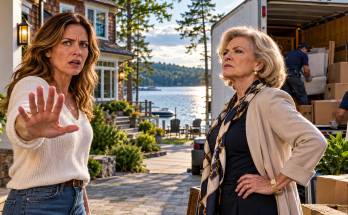
Mom turned eighty-four in early winter.
We celebrated at Derek’s house.
Not the lake.
Not her townhouse.
Neutral because it was easiest for Ellie and Jack.
She wore a purple sweater, complained about the cake being too sweet, and cried when Ellie gave her a pottery mug she had made at school.
The mug leaned badly to one side.
Mom said, “Perfect.”
I laughed.
“Your standards have changed.”
“Age.”
“Therapy.”
“Both.”
By then, her health had begun slowing her.
Nothing dramatic at first.
Arthritis.
Blood pressure.
More fatigue.
She stopped driving at night.
Then stopped highway driving.
The question our family had avoided for decades returned in a new form.
What happens when Mom needs help?
This time, we did not assume.
We held a family meeting.
At her request.
Mom.
Me.
Derek.
Melissa.
Linda.
Dad attended by video even though they had been divorced for years.
Andrew sat beside me.
Mom began.
“I do not want anyone deciding where I live without me.”
The irony was so enormous that Derek coughed to hide a laugh.
Mom glared.
Then laughed too.
“Fine. I hear it.”
We all relaxed.
She continued.
“I also do not want Claire becoming project manager because she is competent.”
I stared.
“Who are you?”
Mom smiled.
“I have notes.”
She actually did.
One page.
Her preferences.
Stay in townhouse as long as safe.
Home-care support if needed.
No moving in with either child.
Assisted living later if necessary.
Medical proxy: Derek first, me second.
Financial agent: professional fiduciary.
Not family.
That surprised me.
“Why professional?” I asked.
Mom looked at me.
“Because I spent a lifetime confusing love with authority.”
The room went quiet.
She continued.
“I don’t want either of you carrying that.”
That may have been one of the best gifts she ever gave us.
Not money.
Not heirlooms.
Clear responsibility placed elsewhere.
Derek asked, “You sure?”
“Yes.”
“What if the professional charges fees?”
“They should.”
Mom smiled.
“Apparently labor has value even when family could do it for free.”
Another old pattern named.
We reviewed everything.
She had an updated will.
Beneficiary designations.
Healthcare directive.
Funeral wishes.
Password list.
No secret accounts.
No informal understandings.
No “you know what I mean.”
Everything written.
Copies where appropriate.
Originals secure.
I joked, “Evelyn would be proud.”
Mom said, “Evelyn terrified me into administrative competence.”
Fair.
Dad watched from the screen.
Then said, “Susan, this is good.”
Mom looked at him.
“Thank you.”
They held each other’s gaze for a moment.
Forty-two years of marriage.
Years apart.
History transformed into something calmer.
Dad died the following spring.
Peacefully.
Heart failure in his sleep.
Seventy-nine.
I had spoken to him the night before.
We discussed weather.
He complained about baseball.
Nothing profound.
At first, that bothered me.
I wished I had said something meaningful.
Then I realized ordinary conversation after years of restored relationship was meaningful enough.
Mom took his death hard.
Harder than I expected.
Divorce had ended the marriage.
Not the bond.
At the memorial, she sat beside me.
Not because she assumed.
She asked.
“Can I sit here?”
“Yes.”
We held hands during the service.
No complicated meaning.
Just grief.
Afterward, Mom said, “I’m glad he left me.”
I looked at her sharply.
She continued.
“Not glad it hurt. Glad he finally chose himself.”
That was a generous truth.
“I think he was too.”
She nodded.
“He became very opinionated.”
I laughed through tears.
“He did.”
“I hated it.”
“I know.”
“I also liked him better.”
That made me cry harder.
Dad’s death changed Mom.
Not back toward control.
Toward softness.
She stopped planning years ahead.
Maybe age made long plans less convincing.
She took days more seriously.
Coffee.
Pottery.
Calls with Ellie.
Lunch with Linda.
Visits to my house.
Always invited.
Sometimes I invited her overnight.
That took years.
The first time, I prepared the guest room.
Not the master.
Of course.
Mom arrived carrying one small suitcase.
She stood in the hallway.
“Which room?”
I almost cried.
“Guest room.”
She nodded.
“Perfect.”
No joke.
No reference to the old claim.
She slept there one night.
Left after breakfast.
Stripped the bed.
Asked where linens went.
The contrast with the moving truck was almost too large to hold.
Years earlier, she announced the master bedroom was hers.
Now she was grateful for one night in a room I offered.
Not diminished.
Healthier.
That was what old Mom never understood.
Permission did not reduce dignity.
It created it.
Her health declined more quickly after eighty-six.
Walking became difficult.
Home care expanded.
The professional fiduciary handled payments.
Derek coordinated medical appointments because Mom had chosen him.
I helped when asked.
Sometimes I said no.
The first time I declined taking her to an appointment because of work, guilt surged.
Mom said, “Okay. I’ll ask Derek.”
No sigh.
No reminder of childhood sacrifice.
No subtle disappointment.
The guilt faded faster.
That was healing too.
Then came the day assisted living became necessary.
Mom made the decision herself.
The facility was fifteen minutes from Derek.
Thirty-five from me.
She toured three places.
Rejected two.
Chose the third.
When we moved her, the irony was impossible to ignore.
A moving truck.
Smaller this time.
White.
I stood in the parking lot watching it arrive.
Mom stood beside me with a walker.
She glanced at the truck.
Then at me.
We both started laughing.
Hard.
People stared.
Mom wiped tears.
“I swear this one is invited.”
I laughed harder.
“Yes.”
“And I know which bedroom is mine.”
“Excellent.”
She leaned toward me.
“Too soon?”
“Perfect.”
The truck unloaded.
Her actual room.
Her actual furniture.
Her actual consent.
We arranged the blue armchair near the window.
The one surviving piece from the lake-house set.
Mom sat in it.
“Full circle.”
“Careful.”
She smiled.
“Sorry.”
We placed Grandma’s recipe book on the shelf.
Some pottery.
Photographs.
One framed image of the lake house.
I had given it to her years earlier.
Not the closing-day one.
A later picture showing the Japanese maple mature.
She asked before hanging it.
Always.
Mom lived there almost two years.
She made friends.
Complained about the food.
Ran a pottery group until her hands became too stiff.
Ellie visited from college.
Jack brought ridiculous socks.
Derek came often.
I came less often but consistently.
Mom never compared.
That mattered until the end.
One winter afternoon, she asked me to bring her to the lake.
Her mobility was poor.
The trip required planning.
I almost said no because it was difficult.
Then asked why.
“I want to see the maple.”
That was all.
So we arranged it.
Andrew drove.
We brought a wheelchair.
Mom sat on the deck wrapped in blankets.
The lake was steel gray.
The Japanese maple bare.
She looked around.
“I’m glad you kept the tree.”
“You gave it to me.”
“You chose where it went.”
“Yes.”
She smiled.
Important distinction still.
Then she asked, “Do you ever wish I hadn’t given it?”
“No.”
“Good.”
We sat.
After a while, Mom said, “I used to think this house was the thing that broke us.”
“It exposed us.”
“Yes.”
She looked toward the west boundary.
“The money from the sale changed your life?”
“Some.”
“But not the way I imagined.”
“No.”
“What changed it more?”
I thought.
“Learning that I could say no and survive everyone being disappointed.”
Mom nodded.
“That changed mine too.”
The answer surprised me.
“How?”
“Learning that people could say no and still love me.”
There it was.
Maybe the root beneath everything.
Control had been Mom’s defense against abandonment.
If everyone did what she planned, no one disappointed her.
If no one disappointed her, perhaps no one could leave.
Except control had pushed people away.
Boundaries brought some of us back.
We sat for another hour.
Before leaving, Mom asked Andrew to wheel her toward the front entrance.
At the porch, she stopped.
“Can I go inside?”
I smiled.
“Yes.”
She looked around the foyer.
At the framed closing-day photograph.
At the stairs.
At the kitchen.
Then she said, “I think this is the last time I’ll be here.”
My throat tightened.
“Maybe.”
“Don’t lie.”
“Probably.”
She nodded.
Then pointed toward the hallway.
“Can I see the master bedroom?”
I froze.
The old sentence flashed.
The master bedroom is ours.
Mom saw my face.
Immediately she said, “Never mind.”
I took a breath.
“No.”
Her eyes dropped.
Then I continued.
“No, I mean yes.”
She looked up.
“You can see it.”
“Are you sure?”
“Yes.”
Andrew helped her upstairs slowly.
One step at a time.
At the doorway, she stopped.
The room was ordinary.
Bed.
Chair.
Balcony doors.
Nothing worth years of conflict.
Mom laughed softly.
“This is what I caused all that trouble over?”
“Partly.”
“It’s not even the nicest room.”
I laughed.
“Get out.”
She smiled.
Then stepped onto the balcony with help.
She looked at the lake.
“I never needed this room.”
“I know.”
“I needed to believe there was somewhere I could arrive and finally be safe.”
My eyes filled.
“And?”
She looked at me.
“I should have learned safety is not something you take from somebody else.”
I cried then.
So did she.
We hugged.
No asking this time.
I initiated it.
That was okay too.
Rules become natural when trust exists.
Mom whispered, “Thank you for letting me see it.”
“You’re welcome.”
We went downstairs.
She left.
The house stayed mine.
The memory became ours.
Different things.
Mom died eight months later.
Peacefully.
No final confession.
No dramatic last words.
I was there the day before.
She slept most of the time.
When she woke, she asked if the maple had leaves yet.
“Not yet.”
“Send me a picture when it does.”
I smiled.
“Okay.”
She fell asleep.
She did not wake again.
In spring, when the leaves opened red, I took a photograph.
For a second, I reached for my phone to send it.
Then remembered.
I stood beneath the tree.
And cried.
Not for the woman who arrived with the moving truck.
Not only.
For all the versions of her.
Mother.
Controller.
Liar.
Caretaker.
Planner.
Forger.
Student of boundaries.
Potter.
Grandmother.
Woman in the blue chair.
Person who changed late but genuinely.
Grief held all of them.
That was fair.