I had kept that wooden box for years.
It wasn't valuable.
It wasn't beautiful.
It was simply something I used to protect the memories I didn't want to lose.
Olivia had found it while we were sorting through old photographs.
Now it sat between us.
She looked inside with the curiosity of someone discovering a part of her family history she hadn't known existed.
I watched her lift a photograph.
The corners had begun to show their age.
In it, I stood beside a group of soldiers in a dusty overseas location.
I looked younger.
My expression was serious.
The people standing beside me wore the same tired look I remembered from that assignment.
Olivia studied the picture.
"Was this taken when you were deployed?"
I nodded.
"Yes."
She looked at me.
"You look so young."
I smiled.
"I was younger."
She laughed softly.
Then she looked at the photograph again.
I could see her trying to imagine me in that place.
For most of her life, she had known me at home.
She knew the sound of my voice in the kitchen.
She knew how I worried about her when she was upset.
She knew the way I sometimes became quiet after a demanding day.
But she hadn't seen much of the world where I spent so many working years.
Now she was looking at evidence of it.
The photograph showed soldiers standing together far from home.
Their faces held memories Olivia couldn't fully understand from a picture.
Neither could I explain everything.
Some experiences belonged to the people who had lived through them.
But I could tell her what the photographs meant to me.
And I was willing to try.
She set the picture down.
Then she picked up another.
There were more soldiers.
More uniforms.
More moments preserved because someone had thought to take a photograph.
Olivia moved carefully.
She didn't treat the box like a collection of trophies.
She handled each item as though she understood it mattered.
I appreciated that.
Some of the medals inside represented years of work.
Some of the commendations marked particular responsibilities.
And some of the letters meant more to me than the official recognition.
It had taken me a long time to understand why.
When I was younger, I thought success would be measured by the positions I reached.
I worked hard.
I accepted difficult assignments.
I tried to learn from the people who had more experience.
I wanted to serve well.
And I wanted to become the kind of officer others could trust.
Promotions mattered.
Of course they did.
Each one brought new responsibilities.
Each one required different decisions.
I had been proud when my work was recognized.
But over time, I began to see the limits of rank.
A promotion could tell people that an institution had entrusted me with more authority.
It couldn't guarantee that I would use that authority wisely.
A medal could recognize service.
It couldn't tell the full story of the people who had been affected by the decisions behind it.
And a uniform could identify my position.
It couldn't replace character.
Those lessons hadn't arrived all at once.
I learned them through people.
Through difficult assignments.
Through mistakes.
Through moments when someone trusted me with a problem they were afraid to bring to anyone else.
Olivia was still looking through the box when she found a folded letter.
She held it carefully.
"Mom, can I read this?"
I looked at the paper.
I recognized it immediately.
It had been written by a young soldier I once commanded.
He had sent it after returning home from a difficult deployment.
I hadn't opened it in some time.
But I remembered the message.
I nodded.
"Yes, sweetheart."
She unfolded the paper.
I watched her eyes move across the lines.
She read quietly.
The soldier hadn't written a long account of his experiences.
He hadn't tried to flatter me.
He had simply wanted to express gratitude for something that mattered to him.
He remembered being treated as an individual.
Someone with a life.
Someone with feelings.
Someone whose concerns deserved attention.
He had felt that he was more than a number in a personnel system.
That sentence had stayed with me for years.
I remembered reading it for the first time.
I had been surprised by how much it affected me.
I was accustomed to formal recognition.
I understood performance evaluations.
I knew the language of official commendations.
But the soldier's letter was different.
It was personal.
He wasn't thanking me for a promotion.
He wasn't talking about an award.
He was remembering the way he had been treated.
And that made me think about all the ordinary interactions a leader might forget.
A conversation.
A question asked at the right time.
A moment when someone needed to feel heard.
Those things could remain with people long after an assignment ended.
Olivia reached the part of the letter I remembered.
She read it again.
Then she looked at me.
"Mom, he really remembered that?"
I nodded.
"Apparently."
She looked down.
"He was grateful because you treated him like a person."
I smiled faintly.
"That's what he wrote."
She was quiet for a while.
Then she placed the letter on her lap.
I could tell she was thinking about something.
I didn't interrupt.
Finally, she asked the question that brought the past week back into the room.
"Is that why you don't tell everyone you're a general?"
I looked at her.
"Part of the reason."
She waited.
I considered how to explain something I had spent years learning.
"When I was younger, I thought reaching a senior rank would be the most important thing I ever accomplished."
She listened.
"I worked toward responsibilities I cared about."
I glanced at the medals.
"And I was proud when I earned them."
Olivia nodded.
"But the longer I served, the more I realized that rank wasn't the whole story."
I touched the edge of the wooden box.
"A position can change."
She looked at me.
"An assignment can end."
I paused.
"And eventually, everyone reaches the day when they stop wearing the uniform."
Olivia became very still.
I hadn't spoken much about that part of military life.
She was accustomed to thinking of me as someone who would always have important work waiting.
But I knew no career lasted forever.
One day, the responsibility would pass to someone else.
The stars would remain part of my history.
They wouldn't define every day that followed.
"What people remember about you is different," I told her.
She looked at the letter.
I continued.
"They remember whether you listened."
I paused.
"They remember whether you treated them fairly."
I glanced at her.
"And they remember how you behaved when you had the power to make their lives difficult."
She nodded slowly.
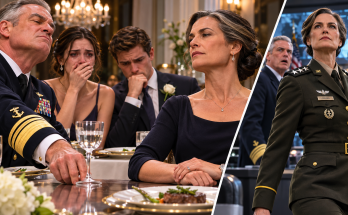
I thought about Richard Whitmore.
His dinner table.
His confidence.
The wineglass he had pushed toward me.
At the time, he hadn't known what rank I held.
He had judged me by what he could see.
A woman in a simple dress.
A mother who had raised her daughter alone.
Someone he assumed had no professional importance.
And he had treated me accordingly.
Then he learned I was a lieutenant general.
His attitude changed.
He became careful.
Apologetic.
Concerned.
I believed he was beginning to understand his mistake.
But the contrast still revealed something important.
If respect depended on someone's position, it could disappear the moment that position was removed.
That wasn't the kind of respect I wanted.
Olivia seemed to be thinking along the same lines.
She looked at the photograph of me standing before the soldiers.
Then she looked at the letter.
"Richard only changed when he found out who you were."
I considered her words.
"At first, yes."
She nodded.
"But the soldier in this letter already knew you were his commander."
"That's true."
"And what he remembered wasn't your rank."
I smiled.
"No."
She looked down at the paper again.
"He remembered how you treated him."
I felt something tighten in my throat.
My daughter understood.
Not because I had given her a lecture.
Not because she was impressed by my military career.
Because she had seen two different examples of authority.
One man had used his position to make a guest feel small.
Another person had remembered being treated with dignity by someone who held authority over him.
The difference was simple.
But it mattered.
Olivia carefully folded the letter.
She didn't return it to the box immediately.
Instead, she held it in both hands.
"Mom, I think I understand why you wanted me to have a normal life."
I looked at her.
"Do you?"
She nodded.
"You didn't want people deciding who I was because of your job."
"That's right."
She thought for a moment.
"And you didn't want me deciding who I was because of it either."
I smiled.
"Exactly."
She looked toward the photograph from Sunday morning.
The one where my three stars had surprised her.
It wasn't in the box.
But she remembered it.
She had spent years knowing me as her mother.
Then she discovered I held one of the senior ranks in the Army.
The revelation had changed what she knew about my career.
It hadn't changed the childhood we shared.
It hadn't changed the calls I made from overseas.
It hadn't changed the holidays I missed.
And it hadn't changed the love between us.
That meant more to me than I could say.
Olivia looked back at the letter.
"Do you think Ethan would have understood this?"
I hesitated.
I didn't want to answer unfairly.
I didn't know what Ethan understood now.
I knew what he had done.
I knew what he had said.
And I knew Olivia had made her decision.
But I couldn't claim to know everything that might happen inside another person's mind.
"I wish he had understood it before the dinner," I said.
She nodded.
"So do I."
We sat quietly.
There was sadness in her voice.
I recognized it.
She wasn't trying to return to the relationship.
She was mourning the fact that the man she loved hadn't been able to see something she believed was obvious.
People deserved respect.
Even when they disagreed.
Even when their backgrounds were different.
Even when they had no impressive title.
I wished Ethan had understood that.
I wished Richard had understood it before Friday.
And I wished Olivia hadn't needed to lose her engagement to see how deeply those beliefs mattered to her.
But wishing couldn't change what had happened.
We had to live with the truth in front of us.
After a while, Olivia placed the letter back in the box.
She handled it gently.
Then she picked up one of the photographs again.
I watched her study the younger version of me.
She seemed curious about the woman I had been before she understood my career.
I told her a little about the deployment.
Nothing dramatic.
Nothing I couldn't properly explain.
Just enough for her to understand when the photograph had been taken and why I had kept it.
She listened.
Then she returned the photograph to its place.
We continued through the memories.
There were medals.
Letters.
Commendations.
Pieces of a career that had shaped much of my adult life.
For years, I had kept them stored away.
Now I was sharing them with the person whose opinion mattered most to me.
I hadn't expected that.
A week earlier, Olivia had known very little about my rank.
Now she was learning about my responsibilities.
But what moved me was the way she listened.
She wasn't asking how much authority I held.
She wasn't asking whether Richard could be punished.
She wasn't asking whether my position could help her recover the money lost on the wedding.
She wanted to understand what my service had meant.
And what I had learned from it.
That mattered.
Eventually, she closed the wooden box.
She rested her hands on the lid.
Then she looked at me.
"I wish Ethan could have seen what I see."
I didn't answer immediately.
I thought about how much she had wanted him to be part of our family.
I thought about her excitement before dinner.
The flowers.
The careful dress.
The small gift for Patricia.
The way she had hoped everyone would get along.
Then I thought about the daughter sitting beside me now.
She looked sad.
But she also looked stronger.
Not because she had stopped caring about Ethan.
Because she was no longer willing to ignore what she needed from a marriage.
"I wish things had been different too," I told her.
She nodded.
Then she moved closer and hugged me.
I held her.
For a while, neither of us spoke.
The wooden box sat beside us.
Its contents were ordinary things to anyone who didn't know their history.
Paper.
Photographs.
Metal.
A few objects saved across many years.
But to me, they held memories of people and responsibilities that had shaped my understanding of leadership.
Olivia rested her head against my shoulder.
I thought about the soldier's letter.
He had written because he wanted me to know that being treated with dignity had mattered to him.
He probably didn't realize how long I would keep those words.
Or how many times I would think about them.
Now my daughter had read them.
And perhaps they had helped her understand something that Friday's dinner had forced us both to confront.
Respect wasn't a reward reserved for people who could impress others.
It was part of how we were supposed to treat one another.
I had believed that for years.
I had tried to practice it.
I had not always succeeded perfectly.
But I had never stopped trying.
Olivia lifted her head.
She smiled sadly.
"Mom, I'm glad you showed me these."
"So am I."
She looked at the box.
"Can we keep looking through them another time?"
"Of course."
She smiled again.
And for a moment, I saw the same curiosity she had shown as a child.
It made me happy.
Not because she admired my career.
Because she wanted to know more about me.
We put the photographs away.
I returned the letters to the box.
Then I closed the lid.
There would be time to look through the memories again.
There would be time to tell her more about the assignments and people who had shaped my life.
But for now, I was grateful for the quiet morning.
My daughter was moving forward.
She was beginning to feel proud of herself again.
And I was learning that protecting her didn't always mean keeping parts of my life hidden.
Sometimes it meant trusting her enough to share them.
When we finished, Olivia carried the wooden box back to its place.
Then she returned and sat beside me.
I looked at her.
I thought about the years I had spent in uniform.
The responsibilities.
The sacrifices.
The long absences.
The decisions that had sometimes kept me awake at night.
I was proud of that service.
I always would be.
But sitting beside my daughter, I knew that no promotion could replace what mattered most.
She trusted me.
She knew I loved her.
And she was beginning to understand that her own worth didn't depend on anyone else's approval.
That was enough for me.
For that morning, it was more than enough.