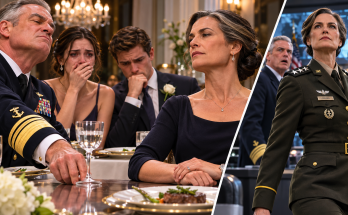
I had never believed that leadership was measured by how uncomfortable a senior officer could make everyone else feel.
I had seen people try.
I had watched them confuse loud instructions with clear direction.
I had watched them mistake obedience for loyalty.
And I had watched them assume a person's respect could be demanded simply because of the insignia on a uniform.
That kind of authority might produce silence.
It didn't always produce trust.
On Monday morning, I sat at the head of the conference table with twelve officers looking toward me.
The revised leadership guidance had been distributed.
Every representative had a copy.
Richard Whitmore sat among the Navy officers.
I didn't look at him when I began.
I looked at the room.
"I want to close with something about the responsibility that comes with leadership."
A few officers lifted their pens.
Others set down the papers they had been reviewing.
I continued.
"An officer's authority isn't demonstrated by the number of people who feel obligated to agree with him."
I paused.
"It's demonstrated by the decisions he makes and the standard of behavior he shows other people."
I had delivered many professional remarks over the years.
Sometimes they concerned readiness.
Sometimes they concerned discipline.
Sometimes they addressed the ordinary expectations that allowed people from different commands to work together.
But I had always believed conduct mattered.
Not only during an inspection.
Not only when senior officers were watching.
All the time.
"We represent our services whenever we wear these uniforms," I told them.
"That responsibility should make us more careful about the way we treat people, not less."
I glanced around the table.
Nobody spoke.
"Authority is not permission to make someone feel inferior."
I let the words settle.
"We cannot expect people to trust our leadership if we treat basic dignity as something that has to be earned through position or status."
I could see several officers listening closely.
The point was simple.
It was also easy to forget.
Most people in positions of responsibility spent years learning how to advance.
They learned procedures.
They learned expectations.
They learned how to present information and make decisions.
But the way they treated people could reveal more than any evaluation report.
I thought briefly of a junior soldier I had once known.
A young man who had later written to thank me for treating him like an individual instead of another entry in a roster.
I still kept that letter.
It reminded me why the ordinary parts of leadership mattered.
I looked down at my folder.
Then I returned my attention to the room.
"Remember that our uniforms stand for service. They shouldn't become an excuse for looking down on anyone."
There was no mention of Friday.
No mention of dinner.
No mention of my daughter.
I had no intention of making a private dispute part of a command briefing.
The message applied to every person in that room.
It applied to Richard.
It also applied to me.
I believed that was important.
No one was too senior to need a reminder about character.
I closed the folder.
"That completes today's business."
The officers began gathering their papers.
Chairs shifted.
I thanked them for their participation.
Several returned the acknowledgment.
The meeting had gone as planned.
The unresolved personnel report was due Wednesday.
The other responsibilities had been reviewed.
The required guidance had been distributed.
Professionally, there was nothing unusual left to do.
I expected the officers to leave and continue their assignments.
Most of them did.
But Richard remained.
I noticed him while I was organizing my documents.
The other Navy representatives were moving toward the door.
An Army colonel stopped briefly to speak with another officer.
Colonel Brooks stood nearby.
Richard stayed at his place.
He wasn't reading.
He wasn't writing.
He seemed to be waiting for an opportunity.
I knew why.
At least, I suspected.
I continued putting my papers in order.
There was no reason to hurry him.
If he wanted to speak, he could ask.
Eventually, he stood.
He approached the head of the table.
"General Hayes?"
I looked up.
"Yes, Captain?"
His expression was different from what I remembered at dinner.
He wasn't smiling.
He wasn't trying to control the conversation.
He looked uncertain.
"Could I have a moment with you?"
I glanced toward Colonel Brooks.
Then I looked back at Richard.
"Of course."
Daniel moved away to give us privacy.
Richard waited until the remaining officers were far enough away that our conversation wouldn't become a public exchange.
I respected that.
Whatever had happened between our families, I did not want it discussed in front of his colleagues.
He took a breath.
"I think we've met outside of work."
I looked at him.
"We may have."
He swallowed.
It was clear he wanted me to make the conversation easier.
I didn't.
I wasn't trying to frighten him.
But he had asked for the conversation.
He needed to find the words.
He glanced at my uniform again.
"Your name is Victoria Hayes."
"It is."
He paused.
"Did you have dinner with my family Friday evening?"
I held his gaze.
"Yes."
He looked down.
For a few seconds, he seemed unable to continue.
I waited.
He had been so sure of himself at his dining table.
He had decided what kind of woman I was before asking anything meaningful about my life.
Now he was looking at someone whose professional position was completely different from the one he had imagined.
But the woman hadn't changed.
That was what I wanted him to understand.
I was the same person.
The same mother.
The same guest who had sat across from him while he made insulting remarks.
The stars on my shoulders had not appeared overnight.
I had worn that rank before Friday.
I had carried the responsibilities of my office before Friday.
He simply hadn't known.
Richard exhaled.
"I had no idea."
I said nothing.
He looked genuinely shaken.
Then he spoke again.
"General, I'm sorry."
I studied him.
An apology was a beginning.
It wasn't an explanation.
And it didn't erase what Olivia had experienced.
Richard continued.
"I didn't realize who you were."
I felt my expression become more serious.
There it was.
The sentence I had been expecting.
He hadn't known my position.
He hadn't known my background.
He hadn't known how much authority I held.
And now he was sorry.
I wondered whether he understood why that answer troubled me.
"Captain, that's the problem."
He looked up.
I kept my voice even.
"You didn't know anything about my work, so you decided you could speak to me however you pleased."
His face tightened.
I continued.
"You made judgments about my life. You made remarks about my family. And you expected me to accept them because we were sitting in your home."
He opened his mouth.
I lifted one hand slightly.
"Please hear me out."
He stopped.
I wasn't angry in the way I had been Friday night.
I didn't feel the urge to argue.
I wanted him to understand what he had done without the conversation becoming another contest over authority.
"Suppose I hadn't served in the Army," I said.
He listened.
"Suppose I had spent my career teaching school."
I paused.
"Or waiting tables. Or working in an office. Suppose I had retired years ago and had no position at all."
Richard looked at me.
"Would anything you said at dinner have been more acceptable?"
He was quiet.
I waited for an answer.
"No, General."
"And if I'd been the mother of an officer you knew personally, would you have spoken to me in that manner?"
He lowered his eyes.
"No."
I nodded.
"Then you need to examine why you thought it was acceptable when you believed I was simply a single mother."
He didn't respond immediately.
I could see the discomfort on his face.
For a moment, I remembered Olivia sitting beside me in the car.
Her hands folded.
Her voice shaking.
She hadn't been crying because Richard failed to recognize a general.
She had been crying because the man she planned to marry hadn't defended her mother.
That was the damage Richard had caused.
His embarrassment at discovering my rank was a smaller matter.
I wanted him to see that.
"Captain, I came to your house as Olivia's mother."
He looked at me.
"I wasn't there to discuss my career."
I held his gaze.
"I wasn't there to establish my position in relation to yours."
I thought of the flowers waiting in my kitchen.
Olivia had been so hopeful.
All she wanted was one pleasant evening.
"I was there because our children were planning a life together."
Richard stood quietly.
"And you treated that occasion as an opportunity to decide whether my family was good enough for yours."
His shoulders lowered.
I could see that he wanted to explain himself.
Perhaps he wanted to tell me about his service.
Perhaps he wanted to say he had been trying to protect Ethan.
Perhaps he wanted to repeat that he hadn't intended to offend anyone.
But none of those explanations would change what happened.
I wasn't interested in debating his intentions.
I was interested in whether he understood his actions.
Richard nodded slowly.
"You're right, General."
I let the silence remain.
Then I turned to the professional issue.
There was something else he needed to hear.
And I wanted to be very clear.
"Your responsibilities connected to this exercise will be handled through the normal process."
He looked up.
I continued.
"The personnel report is still due Wednesday."
"Yes, General."
"Your office will be evaluated on the quality and accuracy of its work."
He nodded.
I kept speaking.
"What happened Friday evening will not alter operational requirements."
I wanted no misunderstanding.
I wasn't threatening his career.
I wasn't offering him protection from ordinary scrutiny.
And I wasn't going to use a command position to settle something that belonged to our private lives.
"Every officer involved in this exercise will be held to the same professional standard," I said.
"That includes you."
"Understood, General."
I watched him for a moment.
He appeared relieved.
But there was still something he needed to hear.
I picked up my folder.
The conversation had already lasted longer than I expected.
I had no desire to prolong it.
Still, I couldn't leave without saying the one thing that mattered most to me.
"Captain."
"Yes, General?"
"My daughter was hurt Friday evening."
His eyes moved toward mine.
"She came to your house hoping to feel welcome."
I paused.
"Instead, she watched you judge the woman who raised her."
Richard looked down again.
"And she watched Ethan remain quiet."
I could hear the restraint in my own voice.
It took effort.
I didn't want to speak for Olivia.
Her relationship belonged to her.
But I had witnessed her pain.
I wasn't going to pretend otherwise.
"Whatever happens between our children is their decision," I told him.
He nodded.
"But Olivia deserves to be part of a family that treats her mother with respect whether I'm wearing this uniform or not."
He said nothing.
I didn't ask him to.
Some things needed to be considered before they could be answered.
I gathered the last of my papers.
"That's all, Captain."
He straightened.
"Yes, General."
I turned toward the door.
Colonel Brooks was waiting outside.
I could see the morning's remaining work in the folder he carried.
There were still meetings to attend.
Reports to read.
Decisions that had nothing to do with the Whitmore family.
I was ready to return to them.
Before leaving, I glanced back once.
Richard was standing beside the conference table.
He looked nothing like the man who had pushed a wineglass toward me three nights earlier.
But I reminded myself not to mistake discomfort for change.
He had learned that I was a three-star general.
That was obvious.
Whether he had learned to respect people without impressive titles was another question.
And it wasn't one I could answer for him.
I walked into the hallway.
Colonel Brooks fell into step beside me.
We began discussing the next items on my schedule.
I listened.
I answered his questions.
I returned to the duties waiting for me.
That was what I had come to Fort Meade to do.
I didn't contact Olivia.
I didn't call Ethan.
I didn't send Richard's family a message about what had happened.
There was no reason to turn the meeting into a family announcement.
The professional matter was finished.
Richard had asked to speak privately.
I had answered him.
Now his behavior was his own responsibility.
I thought again of my daughter's face on Sunday morning when she saw the photograph.
The three stars had surprised her.
But I hoped she would remember what I told her afterward.
A person's dignity wasn't granted by a uniform.
It wasn't granted by a promotion.
It wasn't granted because someone important finally recognized them.
It belonged to them already.
I had spent thirty years trying to live by that principle.
Friday's dinner had tested it.
Monday's meeting had given me another opportunity to practice it.
I had not embarrassed Richard in front of his colleagues.
I had not punished him.
I had not asked anyone to treat him differently.
I had simply done my job.
Then I had told him, privately, why his behavior toward my family was wrong.
That was enough for me.
I hoped it would be enough for him to begin thinking differently.
But the question that mattered most was still waiting at home.
Could Ethan recognize the same truth?
Could he understand why Olivia was hurt?
Could he stand beside her without needing his father's approval?
I didn't know.
And as I continued down the hallway toward my next responsibility, I accepted something I had been resisting since Friday evening.
I could speak to a room full of officers and expect them to listen.
I could make difficult decisions in my command.
I could carry authority earned through decades of service.
But I could not make my daughter's fiancé become the man she needed.
That decision belonged to Ethan.
And Olivia would have to decide what his answer meant for their future.