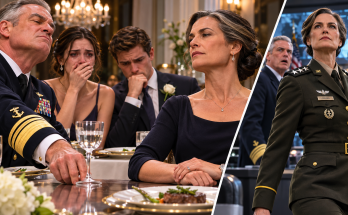
I had attended more military briefings than I could count.
Most followed a familiar pattern.
People arrived with folders.
Someone reviewed the agenda.
Officers presented information that had been checked, corrected, and sometimes checked again.
Questions were asked.
Decisions were recorded.
Then everyone returned to the work waiting outside the conference room.
That Monday should have been no different.
But I knew one person at the table would be surprised to see me.
Captain Richard Whitmore.
The man whose dining room I had left on Friday evening.
The man who had treated my daughter like an embarrassment for having a single mother.
And the man who would soon discover that the woman he had judged so casually was responsible for chairing the meeting.
I arrived at Fort Meade at six-fifteen in the morning.
The air was cold.
The flag outside headquarters moved in the light wind.
My driver opened the vehicle door.
I stepped out wearing my Army dress uniform.
Three stars sat on my shoulders.
They were familiar to me.
They were part of a position I had spent many years preparing to hold.
I didn't look at them with the sense of wonder Olivia had shown the previous morning.
I looked at them as a reminder.
People depended on the decisions I made.
That responsibility did not become smaller because I had experienced an unpleasant weekend.
"Good morning, General Hayes."
The security officer greeted me as I approached.
"Good morning."
I returned the greeting and entered the building.
The hallways were familiar.
So were the people moving through them.
Some carried documents.
Others were already discussing the day's work.
I liked arriving early.
It gave me time to settle my thoughts before the demands of a full schedule began.
And that morning, I needed the quiet.
I had not forgotten Friday evening.
I could still picture Richard sitting at the head of his table.
I could still see Olivia looking from her fiancé to his father, hoping someone would put an end to the humiliation.
And I could still remember the sound of that wineglass being pushed toward me.
It would have been easy to carry all of that into Monday's meeting.
Easy.
And wrong.
My duty was to evaluate the readiness information before me.
Nothing more.
Nothing less.
Richard's conduct at a private dinner did not give me permission to bend professional standards.
I had repeated that principle to myself over the weekend.
Not because I doubted it.
Because I understood how important it was to follow it when emotions were involved.
At home, I was a mother protecting her daughter's dignity.
At Fort Meade, I had a command responsibility.
I could not allow one role to misuse the authority of the other.
Colonel Daniel Brooks was waiting outside the conference area.
He served as my chief of staff.
He was dependable, organized, and direct.
Those qualities mattered on mornings when several commands needed to agree on the same facts.
"Morning, General."
"Good morning, Daniel."
He handed me a folder.
The briefing materials were arranged in order.
I looked through the agenda.
Personnel coordination.
Operational planning.
Logistical requirements.
Unresolved discrepancies.
The matters were important.
A joint exercise depended on different organizations providing information that could be trusted.
If the numbers were wrong, planning would be affected.
If assignments weren't clear, responsibilities could become confused.
And if officers avoided difficult questions, those problems would reach people who had done nothing to create them.
I turned a page.
Colonel Brooks mentioned that the Navy representatives had arrived.
I looked up.
"All of them?"
"Yes, ma'am."
He confirmed that Captain Whitmore was included.
I kept my face neutral.
"Very well."
There was no reason for Daniel to know what had happened at Richard's house.
The incident was personal.
The meeting was professional.
I intended to keep it that way.
"Are they ready?" I asked.
"They're waiting for you, General."
I nodded.
"Then we'll begin."
We approached the conference room.
I could hear voices through the doors.
Ordinary conversation.
People speaking before a meeting.
I wondered whether Richard had noticed my name on the agenda.
He may have seen it.
He had probably worked with documents carrying my name before.
But knowing a name wasn't the same as recognizing a face.
And on Friday evening, I had given him no reason to suspect who I was.
I had worn a simple dress.
I had spoken as Olivia's mother.
I had not described my command.
I had not listed my assignments.
I had not corrected his assumptions about my profession.
I wasn't obligated to do any of those things.
At dinner, I had come as a parent.
That should have been enough.
Colonel Brooks opened the doors.
Twelve officers were seated around the table.
They represented different branches of the military.
There were Army colonels.
Two Air Force officers.
A Marine Corps representative.
And three officers from the Navy.
I recognized some of the faces immediately.
Then I saw Richard.
He was sitting toward the far end of the table.
His Navy uniform was neat.
He appeared comfortable.
He was speaking to another captain.
From where I stood, he looked very much like the man I remembered from dinner.
Confident.
Accustomed to his surroundings.
Certain of his place.
Then Colonel Brooks announced my arrival.
"Attention. General Victoria Hayes will preside."
Chairs moved.
Every officer stood.
Richard stood too.
But his movements changed the moment he saw me.
He looked directly at my face.
Then at my shoulders.
Then back at my face.
I saw him recognize me.
There was no need for anyone to explain it.
His expression did that.
The easy confidence disappeared.
His posture became rigid.
His mouth opened slightly, though he didn't speak.
I continued walking.
I didn't slow down.
I didn't look at him longer than I looked at anyone else.
The officers were standing.
The meeting was ready.
I reached the head of the table.
"Good morning. Please sit."
Everyone took their seats.
Papers shifted.
Folders opened.
The room settled.
Richard remained almost motionless.
I placed my briefing folder in front of me.
For a moment, I could feel his attention fixed on my uniform.
I understood his surprise.
He had spent Friday evening speaking to me as though my experience counted for very little.
Now he was sitting in a room where my professional authority was not in question.
But I hadn't come to enjoy his discomfort.
I had come to conduct a meeting.
I welcomed the representatives.
Then I acknowledged the Navy delegation.
When I addressed Richard by rank and name, he looked up immediately.
"Captain Whitmore."
"General."
His answer was quiet.
Much quieter than his voice had been in his dining room.
I gave him a brief nod.
Then I opened the agenda.
"We'll begin with the readiness requirements."
There was no reason to linger on him.
The first items concerned planning.
I asked officers to clarify the status of their responsibilities.
I reviewed what had been completed.
I asked about matters still unresolved.
Some answers were straightforward.
Others required more explanation.
I listened.
I made notes.
I turned pages.
The meeting continued exactly as it should have.
I could sense that Richard was uncomfortable.
He wasn't the only officer in the room, but he seemed to be making a particular effort not to attract attention.
He spoke only when necessary.
When another representative answered a question, Richard looked down at the documents in front of him.
I understood the temptation to watch him.
I resisted it.
The room had twelve officers.
All twelve deserved the same professional attention.
I had spent thirty years learning to distinguish what I felt from what I needed to do.
That discipline mattered.
I wasn't going to abandon it because a man who had insulted me was now embarrassed.
The discussion moved to staffing.
Different branches were responsible for providing personnel needed for the exercise.
The figures had to be reliable.
A discrepancy had appeared in the personnel allocation information.
It wasn't something that could simply be ignored.
I turned to the section in my folder.
The responsibility for reviewing it belonged to Richard's office.
I looked toward him.
"Captain Whitmore, can you explain the status of this discrepancy?"
He straightened.
"Yes, General. Our office is looking into it."
I waited.
That answer told me the work was underway.
It didn't tell me who was accountable for completing it.
"Who has responsibility for the review?"
"My office, General."
I made a note.
"And when should we expect the findings?"
"Wednesday."
I looked at the schedule.
That timing was important.
The exercise planning could not rely on uncertain figures indefinitely.
"Make sure the report is complete when it comes back."
"Yes, General."
"We need accurate personnel information before the next planning decisions."
"Understood."
I moved to the next item.
There was nothing personal in the exchange.
I would have asked the same questions of any officer responsible for the report.
That distinction mattered to me.
If Richard had been expecting punishment, he wasn't going to receive it from me.
If he had been hoping for special consideration because of our personal connection, he wasn't going to receive that either.
He was a captain attending a command-level meeting.
His office had work to complete.
That was the beginning and end of my professional interest in him.
We continued through the other requirements.
Operational timing.
Personnel assignments.
Support coordination.
Documentation.
I asked questions whenever something needed clarification.
I expected officers to speak plainly.
I also expected them to say when an answer was not yet available.
A confident guess was not a substitute for reliable information.
I had seen the consequences of poor communication before.
That was one reason I took these meetings seriously.
People sometimes imagined that senior leaders spent their days giving impressive speeches.
The truth was less dramatic.
Much of the job involved listening carefully, asking inconvenient questions, and making sure responsibility didn't disappear between offices.
There was nothing glamorous about correcting a personnel figure.
But accuracy could matter far more than appearances.
I glanced at Richard once while another officer was speaking.
He was looking at his notes.
His expression was tight.
For a moment, I remembered his certainty at dinner.
He had seemed to believe that people should respect him because he was a Navy captain.
Now he was surrounded by officers who understood that rank involved accountability.
Nobody in that conference room was being asked to admire him.
They were being asked to trust his work.
I hoped he understood the difference.
Not because I wanted him humiliated.
Because it was a lesson every officer needed.
Including me.
I had seen senior people grow too comfortable with their authority.
I had seen how easily someone could begin believing that the position made every judgment correct.
It didn't.
A person could wear a distinguished uniform and still make a terrible decision.
A person could hold considerable responsibility and still fail to recognize another human being's dignity.
I wasn't exempt from that danger.
None of us were.
The briefing moved toward its final items.
Colonel Brooks prepared the updated guidance for distribution.
It concerned leadership and conduct within the joint command environment.
The guidance applied to personnel involved in the exercise.
It was part of the meeting's professional business.
As the copies were passed around, Richard looked at the document in front of him.
I watched the officers settle again.
There was one point I wanted everyone to remember.
Not because Richard was present.
Because leadership depended on more than reports and schedules.
It depended on character.
And character was often most visible when nobody expected to be held accountable.
I rested my hands near the folder.
The room quieted.
I looked around the table.
The officers were waiting.
Richard was among them.
Three days earlier, he had believed the woman sitting at his dinner table was beneath him.
Now he knew her rank.
But I still wanted the same thing I had wanted on Friday.
Not fear.
Not admiration.
Not an apology offered only because someone powerful had been offended.
I wanted people to understand that authority meant nothing if it couldn't exist alongside ordinary decency.
I looked at the guidance before me.
Then I began speaking.